
Red, White, and Red Tape: Inside the Battle for St. George’s Cross on Britain’s Streets
In three decades of covering cultural fractures and neighborhood skirmishes from the rust belts of the American Midwest to working-class enclaves across Western Europe, I have learned that flags are rarely just pieces of dyed cloth. They are emotional lightning rods. When hung from a bedroom window, draped across a public street, or tied to a civic lamppost, a national emblem acts as an unfiltered mirror of a society’s anxieties about belonging, authority, and identity.
In the south of Bristol, along a quiet, residential stretch known as Torrington Avenue in Knowle West, that mirror has once again cracked open one of the United Kingdom’s most sensitive culture wars. What began as a working-class football tradition during the 2026 World Cup rapidly escalated into a heated national controversy over local government authority, civic ownership, and what it truly means to be patriotic in modern Britain.
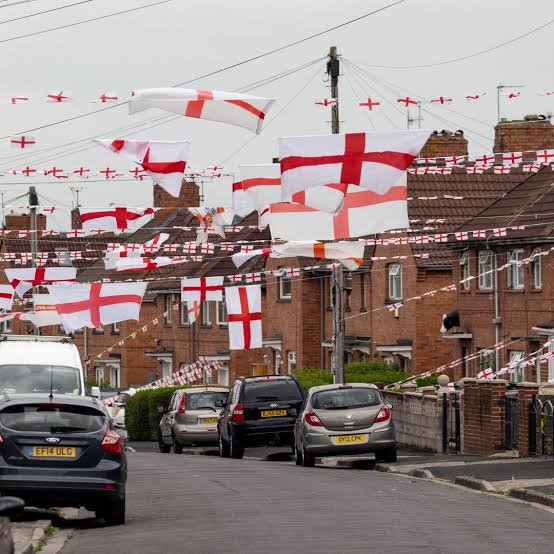
Torrington Avenue in Knowle West is no ordinary suburban road during major international soccer tournaments. For years, the neighborhood has earned widespread attention for creating some of the most elaborate, wall-to-wall expressions of sporting fandom in the country. During the Euro 2020 tournament (staged in 2021), ITV News West Country documented that every single one of the 88 homes on the street had erected St. George’s Cross flags, banners, and bunting, transforming the neighborhood into a spectacle celebrated nationally as “England’s most patriotic street”.
TORRINGTON AVENUE: A TRADITION OF CELEBRATION
Euro 2020 (2021):  [========================================] 88 / 88 Homes Decorated
World Cup (2026):  [====================================>   ] Cross-street canopy returns amid council dispute
For the residents of Knowle West—a proud, predominantly working-class district of South Bristol—the tradition has always been about community pride, international soccer, and honoring family heritage. But when the 2026 World Cup kicked off, the ritual collided head-on with municipal governance and a rapidly polarizing online media ecosystem.
Main Events: The Clash Over Public Infrastructure
As tournament bunting went up across Bristol, Bristol City Council issued clear guidance reminding the public of existing regulations regarding street furniture. The council warned residents not to affix flags or banners without authorization to publicly owned assets, specifically utility poles, streetlights, and highway railings.
+-----------------------------------------------------------------------------+
|                     BRISTOL FLAG GUIDANCE: THE BOUNDARY                     |
+-----------------------------------------------------------------------------+
|  ALLOWED ON PRIVATE PROPERTY:          RESTRICTED ON PUBLIC ASSETS:         |
|  - House facades & windows             - Streetlight columns (Electrical)   |
|  - Private front gardens               - Highway railings & guardrails      |
|  - Porches, balconies & roofs          - Traffic signal poles & road signs  |
+-----------------------------------------------------------------------------+
The warning produced an immediate, angry backlash. Community members on Torrington Avenue argued that their decorations were a harmless expression of national pride and sports solidarity. Within days, sensational claims began spreading on social media asserting that Bristol authorities had “banned the England flag” outright.
Independent fact-checking and official council statements quickly demonstrated that this viral claim was false. The council had placed no ban on flying the St. George’s Cross or the Three Lions emblem from private homes, personal vehicles, or private gardens. Instead, the municipal policy was anchored in statutory safety management and the regulation of highway infrastructure.
According to official reporting guidance published on the Bristol City Council Report Flyposting Portal, streetlight columns are classified as electrical assets. Attaching heavy fabric or reaching high columns without certified personnel creates legal liabilities, wind hazards, and potential obstructions for maintenance crews and motorists.
Important Figures and Statements
The political stakes quickly drew commentary from across the civic spectrum:
-
Cllr. Tony Dyer (Leader of Bristol City Council): Dyer clarified the administration’s stance, stating that the city welcomed residents displaying flags on their own homes to support their teams, but firmly reiterated that attaching items to electrical lampposts or public railings poses distinct safety hazards. He noted that the council would prioritize taking down unauthorized fixtures in “sensitive locations” or where highway safety was compromised.
-
George Ferguson (Former Mayor of Bristol): Taking a far more critical tone, the city’s former independent mayor ignited widespread debate online by describing excessive, unvetted public flag takeovers as “chilling,” arguing that national symbols had in certain instances been co-opted to create an atmosphere of intimidation.
-
Local Organizers & Residents: Longtime community members in Knowle West defended the display as an organic neighborhood gathering point. Residents pointed out that the flags honored England’s soccer team, marked collective street parties, and commemorated local veterans and loved ones who had passed away.
-
National Political Commentators: Figures aligned with Conservative and Reform UK parties seized on the story, accusing local authorities of showing institutional shame toward England’s national heritage, turning the neighborhood’s bunting into a talking point on national television.
When you spend decades examining civic controversies, you quickly realize that almost no dispute is ever purely about what is printed on the citation notice. The standoff on Torrington Avenue is not simply an argument over a technician’s ladder or the load-bearing tolerances of an aluminum streetlight. It is an illuminating case study in how modern administrative legalism, working-class alienation, and symbolic politics collide.
1. What Details Have Been Overlooked?
The mainstream coverage has treated this as a binary conflict: either bureaucratic overreach vs. patriotic pride, or civic safety vs. aggressive nationalism. Both framings ignore the crucial physical reality of the neighborhood itself.
Torrington Avenue’s tradition pre-dates the current fever pitch of the UK culture wars by more than a decade. This is an area that has experienced significant post-industrial shifts, under-investment, and a feeling of being overlooked by Westminster and regional power centers alike. In communities that feel economically and politically neglected, decorating an entire street becomes an act of self-assertion. It is one of the few occasions where neighbors come together, pool money, borrow ladders, and build a collective visual identity.
When a city council arrives with statutory notices citing safety codes, the residents do not hear an electrical engineer talking about streetlights—they hear an administrative elite telling them that their community expression is improper.
THE REAL CONFLICT BEHIND THE HEADLINES
[Civic Authority / Safety Codes]        [Working-Class Community / Identity]
- Infrastructure liability & risks     - Organic, grassroots tradition
- Maintenance access to lampposts      - Collective pride & neighborhood unity
- Neutrality of public assets          - Assertion of voice & cultural visibility
               \                                /
                \                              /
                 ▼                            ▼
            [ THE SYMBOLIC CLASH AT THE STREET LEVEL ]
2. The Deeper Meaning: The Fractured Symbol of St. George
Unlike the Scottish Saltire or the Welsh Dragon, which have largely functioned as uncontroversial symbols of regional culture and civic pride, the English St. George’s Cross has carried a deeply complicated political burden for forty years.
Because England lacks its own devolved parliament, English national identity has often been left politically unchanneled. Over the decades, far-right and anti-immigration movements frequently utilized the St. George’s Cross at street protests, while the cosmopolitan middle class often retreated from displaying it outside of stadium settings.
This creates an intense perceptual disconnect:
-
To the resident on Torrington Avenue, hanging the flag during the World Cup is pure sporting enthusiasm and an innocent celebration of home.
-
To minority communities or outside observers who have seen the same symbol brandished at exclusionary rallies, vast, unannounced swathes of flags across public infrastructure can evoke a very different emotional response.
The tragedy of the modern public square is that the symbol itself has been politicized to the point where neutral intent is rarely assumed.
3. The Unanswered Questions and the Path Forward
Why have local councils and communities struggled so profoundly to find a sensible middle ground?
In many American and European municipalities, simple permit frameworks exist for block parties, festive holiday lighting, and sporting events. If a community wishes to hang tournament bunting, a streamlined, zero-cost community registry could allow neighborhood associations to install temporary displays safely—with agreed-upon take-down dates following the final whistle.
Instead, the absence of proactive civic mediation leaves a vacuum. That vacuum is immediately filled by hyper-partisan social media accounts that misrepresent standard safety regulations as outright bans on patriotism, deepening societal cynicism and eroding trust in basic local governance.
The battle of Torrington Avenue is not an anomaly; it is a snapshot of modern Britain’s unresolved relationship with its own national emblems. At its core, the dispute highlights a widening chasm between the orderly, risk-averse world of municipal bureaucracy and the raw, expressive traditions of working-class neighborhoods.
When local authorities appear to police symbols of national celebration while struggling to solve more pressing everyday civic challenges, they inadvertently feed a narrative of cultural disconnect. Conversely, when political commentators turn an organic street party into a partisan wedge, they strip a local tradition of its joy, weaponizing neighborly camaraderie for algorithmic engagement.
Torrington Avenue simply wanted to cheer on eleven players running across a soccer pitch. That such a simple act can instantly combust into a national crisis over sovereignty, safety, and identity proves that the flags hanging above our streets are never just about sport—they are about our desperate, competing searches for belonging in an increasingly divided world.
A Question for the Public Square
How can modern democratic societies balance the legitimate need to keep public spaces safe and welcoming for all citizens without sanitizing the vibrant, messy traditions that bind local working-class communities together?