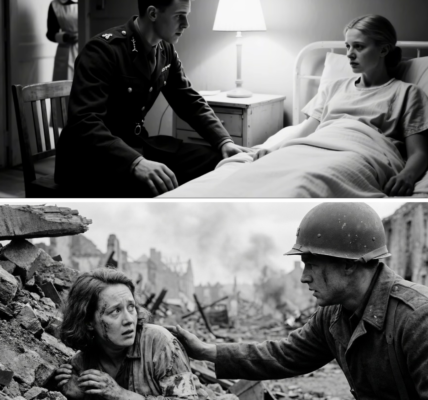
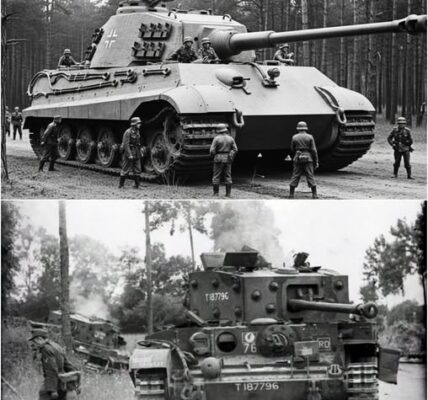
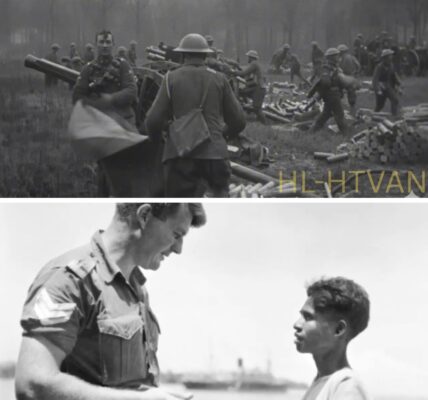
A photograph can survive a war, outlive the people who appear in it, and remain unseen long after the world has moved on. Somewhere inside an archive, an old image may preserve a moment that official reports barely described: a military installation before an attack, civilians waiting amid uncertainty, soldiers preparing to leave, or the ruins left behind when the fighting finally passed. The image may have been withheld, misplaced, forgotten, or simply never selected for publication. Decades later, when it emerges again, it raises a question that reaches beyond the photograph itself: what happens when the surviving evidence of history is larger than the story the world remembers?
The title “These Photos Were HIDDEN from US!” captures the fascination surrounding rare historical photographs. It promises a glimpse behind the familiar images of the Second World War, into a visual record that was supposedly kept from public view. The idea is compelling because the war was documented on an enormous scale, yet most people recognize only a small number of its photographs. The raising of a flag, a devastated city, a column of prisoners, a soldier looking into a camera—certain images have become so familiar that they seem to represent the entire conflict. But the war was experienced by millions of people whose lives never entered those famous frames.

The reality behind these forgotten photographs is more complicated than a single headline suggests. Some images were deliberately restricted because they revealed military information. Some were withheld out of concern for privacy, dignity, or public morale. Others remained in government files, private albums, or archival collections that were difficult to search. A photograph could also disappear from public attention simply because editors chose another image, an archive lacked the resources to catalogue it, or later generations no longer knew where to look.
These differences matter. Not every rare photograph was suppressed, and not every newly discovered image overturns an established account of the past. Yet the history of wartime photography shows that the pictures people see are never the whole record. What was photographed, what was selected, what was withheld, and what survived all shaped the visual memory of the Second World War.

When war spread across continents in the 1930s and 1940s, cameras became part of the machinery through which the conflict was recorded and understood. Military photographers documented training, equipment, transport, operations, and the lives of service members. Government agencies produced images of industrial production, rationing, civilian relocation, and other aspects of the home front. Newspapers and magazines depended on photographs to bring distant events into homes far removed from the front lines. Private individuals also recorded their own experiences, leaving behind family albums that would eventually become historical sources.
The scale of this work was extraordinary. The United States National Archives preserves extensive photographic collections created by the Army Signal Corps, the Navy, the Marine Corps, the Coast Guard, the Office of War Information, and other agencies. Its records include images of combat, military preparation, political leaders, industrial activity, and civilian life. The collection is not a single, perfectly complete visual account of the war. It is a vast body of material produced for different purposes, by different people, under different conditions.

That distinction becomes important when we encounter an unfamiliar photograph. A military photographer might have taken an image to document equipment rather than tell a story for the public. An intelligence photograph might have been created to answer a specific operational question. A picture of workers in a factory could have served a government campaign intended to encourage production. A family photograph might never have been intended for anyone beyond a small circle of relatives.
The same image could later acquire a different meaning. A photograph originally made for administrative purposes might become valuable evidence of how a military unit operated. A picture taken to promote wartime confidence could reveal details that its creators never intended future historians to examine. An ordinary image of a street or railway station might become a record of a landscape that no longer exists.
But the path from camera to public memory was rarely straightforward. During wartime, photographs could reveal information that authorities considered dangerous. A clear view of a military installation might expose its layout. An image of an unfamiliar piece of equipment could reveal technological developments. Photographs showing the location or strength of a unit could help an enemy understand where forces were concentrated. Images of intelligence activities or preparations for an invasion could compromise operations before they began.
For these reasons, military censorship became part of the photographic record of the Second World War. The United States National Archives describes categories of photographs whose release was restricted for security reasons, including images showing sensitive installations, intelligence work, invasion preparations, advanced technology, and identifiable military positions. The restrictions were not merely about whether a photograph was disturbing. They could concern what an adversary might learn from a seemingly ordinary detail in the background.
A camera did not need to capture a battle to produce information of military importance. A row of vehicles, a distinctive building, a visible insignia, or a recognizable stretch of coastline could reveal something about the forces operating in an area. Even a caption could create a security problem if it identified a location too precisely. In some cases, authorities could meet security requirements by obscuring insignia or removing revealing details rather than withholding an entire photograph.

The result was a visual record shaped by decisions made before the public ever saw it. Some images were approved. Others were altered, delayed, or restricted. Still others were published with captions that deliberately concealed precise locations. The public record therefore reflected not only what photographers witnessed, but also what institutions considered safe or appropriate to release.
There was another reason certain images did not reach newspapers and magazines: the human consequences of war could be difficult to reconcile with the messages governments wanted to communicate. Photographs of dead service members, severe injuries, and medical treatment raised questions about privacy, dignity, and the responsibilities of editors. Authorities in the United States restricted the release of some images showing identifiable dead Americans or graphic depictions of death and injury. Medical photography was also generally not released. The policies were not applied equally to every subject, and the treatment of images showing enemy dead could differ significantly from the treatment of images showing American casualties.

These choices reveal a difficult contradiction. The public needed to understand the cost of war, but the institutions controlling the photographs also had reasons to limit how that cost was displayed. Families deserved consideration. Military security mattered. Editors had to decide whether an image informed the public or merely exposed someone’s suffering. At the same time, restricting photographs could leave the public with an incomplete understanding of the consequences of military action.
No single rule resolved every case. An image might be withheld because it revealed a sensitive location, because it exposed a private medical situation, or because it showed suffering that officials did not want widely circulated. In other circumstances, an institution might have had a reputational interest in limiting the release of an embarrassing photograph. Those possibilities should not be treated as interchangeable, but they demonstrate why the history of censorship must be examined case by case.

The absence of a photograph from a wartime newspaper does not, by itself, prove that officials were hiding a scandal. The image might have arrived too late, lacked a usable caption, duplicated another picture, or been rejected by an editor who needed limited space for more urgent news. The photographer might have worked for an agency whose records were never intended for mass publication. A photograph could also have been retained in an archive long after its immediate purpose had passed.
Yet censorship was real, and the distinction between justified secrecy and the management of public perception remains important. A government could have legitimate reasons to protect an operation while also having an interest in presenting the war in a favorable light. These motives could overlap. Historians examining the resulting photographs must therefore look at the documented circumstances surrounding their creation and release rather than assume that every decision had a single explanation.

The photographs that survive can reveal the difference between the public image of war and the complicated reality behind it. An official picture might show soldiers lined up for inspection, conveying discipline and readiness. A different photograph from the same collection might document the practical work required to maintain vehicles, move supplies, or prepare equipment. Neither image necessarily contradicts the other. Together, they provide a fuller view of the system that sustained military operations.
Other photographs can show the consequences of war without explaining how those consequences came about. A damaged building records destruction, but not necessarily the decision that caused it. A group of displaced civilians reveals movement and uncertainty, but the photograph alone may not identify the route they took or the circumstances that forced them to leave. An image of soldiers beside a road may preserve a moment, but without a reliable date and location, its place in a larger campaign can remain unclear.

This is where the work of archives becomes essential. The photograph is only one part of the record. Original captions, photographers’ notes, operational reports, maps, correspondence, and related images can help establish what the camera actually recorded. When several independent sources agree, researchers can make stronger claims. When evidence is incomplete, the limits of what is known must remain visible.
Some of the most revealing changes in historical photography did not involve censorship at all. They involved manipulation. Long before digital editing software existed, photographs could be altered through retouching, photomontage, combination printing, overpainting, and other darkroom techniques. People could be added to or removed from an image. Separate scenes could be combined. A photograph could be modified to create a version of reality that had never existed before the camera.
The Metropolitan Museum of Art examined this history in its exhibition Faking It: Manipulated Photography Before Photoshop. The exhibition included examples of images changed for political, artistic, commercial, and other purposes. Among them were photographs associated with Soviet political culture in which officials who had fallen out of favor were removed from later versions of images.
Such manipulation illustrates a particularly troubling use of photography. An image can preserve evidence of a person’s presence, but it can also be altered to deny that presence. When a political authority controls the version that circulates publicly, the photograph becomes more than a record of an event. It becomes a means of shaping what later generations are permitted to remember.
The practice was not confined to one country or one political ideology. Photographic manipulation has a long history, and its purposes have varied widely. Some alterations were made for artistic or technical reasons. Others were designed to persuade, deceive, or reinforce a particular account of events. The significance of any altered photograph depends on who changed it, why it was changed, and how the resulting image was used.
During the years surrounding the Second World War, photographs were especially powerful because they appeared to offer direct access to reality. A written report could be challenged as partisan or incomplete, but a photograph seemed to show what had been in front of the camera. That impression gave images extraordinary influence in journalism and propaganda alike.
The danger was not only that a photograph could be physically altered. Its meaning could also be changed through selection, cropping, or captioning. A real photograph presented with a false date could appear to document a different event. An authentic image cropped to exclude crucial details could lead viewers toward a misleading interpretation. A picture of one location could be circulated as evidence of another. In each case, the photograph itself might be genuine while the story attached to it was not.
This is one reason the rediscovery of photographs from Soviet archives and other formerly restricted collections must be approached carefully. The political changes that followed the end of the Cold War created new opportunities for researchers to examine records that had previously been difficult to access. Photographs of daily life, workplaces, public events, and official ceremonies helped researchers investigate societies that had often been represented through a limited set of familiar images.
But it would be inaccurate to claim that all such photographs had been deliberately hidden from the world. Some were made for internal government use. Others were published within their countries but remained unfamiliar to international audiences. Many were simply stored in collections that were difficult to access. Political restrictions were part of the story, but so were institutional practices, language barriers, preservation problems, and the sheer volume of surviving material.
The same caution applies to photographs found in declassified intelligence records. Such material can illuminate reconnaissance, surveillance, military planning, and the assessment of strategic sites. Yet declassification does not automatically mean that a photograph has just been discovered, or that its contents reveal a major secret. It means that restrictions on access have been removed or changed under the relevant rules. The image’s historical importance must still be established through evidence.
For the people who lived through the war, the photographs were not abstract historical objects. They were part of the world around them. A soldier might appear in a picture taken during training, unaware that the image would one day be catalogued by an archive. A civilian might be photographed at work, in a queue, or outside a damaged building. A family might preserve a picture of someone who never returned. The photograph could survive long after the names and circumstances of those depicted had faded from collective memory.
These quieter images are often among the most valuable. They remind us that the Second World War was not experienced only through the decisions of leaders or the movement of armies. It was also experienced through ordinary routines interrupted by extraordinary events. People worked, travelled, waited, searched for relatives, adapted to shortages, and attempted to preserve some sense of continuity amid uncertainty. A single photograph rarely tells the whole story, but it can offer a starting point for recovering the lives that broad historical narratives tend to compress.
There is a particular responsibility when the photographs show suffering. Images of the dead, the injured, displaced families, and devastated communities may be essential to understanding the human consequences of war. They can challenge sanitized accounts and preserve evidence of events that might otherwise be forgotten. But the people in those images deserve more than to become objects of online fascination.
A photograph should not be shared merely because it is shocking. Its context matters. So does the dignity of those depicted. An image may help document a historical event, but circulating it with an inaccurate caption or using it to provoke outrage can obscure rather than clarify the past. The strongest historical account does not need to exaggerate suffering. It allows the documented facts to carry their own weight.
The digital age has made this responsibility more urgent. Online platforms allow images to travel across borders in seconds. A photograph preserved for decades in a private collection can suddenly be seen by millions. Digital restoration can reveal details that were difficult to examine in a damaged print, while searchable catalogues make it easier to compare photographs from different collections. These changes have opened new paths into the historical record.
They have also made mistakes easier to spread. An image can be separated from its original caption and reposted with a more dramatic description. A speculation can be repeated until it begins to look like established fact. A digitally altered picture can be presented as an untouched wartime photograph. A genuine image may be described as newly discovered even when it has been available in a public archive for years.
The answer is not to distrust every photograph. It is to ask better questions. Who took the image? When and where was it made? Does the original archive identify the photographer or provide a catalogue number? Is there a contemporary caption? Can the photograph be compared with other records from the same event? Has the image been cropped, retouched, colorized, or otherwise altered? Does the source explain what is known and what remains uncertain?
These questions may seem less exciting than the promise of a forbidden secret, but they are what allow a discovery to become history rather than rumor. A reliable archive record can establish that a photograph belongs to a particular collection. A contemporary newspaper can show when it first circulated publicly. A military report may clarify the location or purpose of an image. Comparing different versions may reveal whether an alteration occurred after the photograph was taken.
The National Archives also makes clear that large parts of the photographic record have not been fully digitized. Some World War II collections can be searched online, while others remain only partly available in digital form. This means that a photograph may be difficult to find even though it has been preserved for decades. The obstacle may be the time and resources required to catalogue, conserve, scan, and describe the material—not an attempt to conceal it.
That fact changes how we should interpret the phrase “hidden from us.” Sometimes it describes a real restriction. Sometimes it describes an image that has been overlooked by the public. Sometimes it is simply a headline designed to make an unfamiliar photograph appear more mysterious than the evidence supports. Each possibility requires a different explanation.
The original source text is right about one essential point: the visual record of the past is far richer than the collection of iconic images most people recognize. The photographs that remain unfamiliar can broaden our understanding of the Second World War, reveal the limitations of official narratives, and bring attention to experiences that received little public recognition at the time. But a photograph does not automatically rewrite history merely because it has not been widely seen.
Its significance emerges from the relationship between the image and the evidence surrounding it. A newly accessible photograph might confirm an established account, correct a mistaken caption, reveal a previously overlooked detail, or raise a question that further research must answer. Sometimes its greatest contribution is modest: it helps identify a person, document a place, or restore an ordinary moment to a history dominated by extraordinary events.
That is still important. History is not made only from dramatic revelations. It is also built from small corrections, recovered names, preserved records, and the patient work of comparing evidence. An archive may contain millions of photographs, but each image began as a limited view of a particular moment. To understand it, we must learn what lay inside the frame—and what lay beyond it.
As digitization continues, more photographs from the Second World War will become easier to find. Some may reveal details that have escaped researchers. Others will simply make familiar events more accessible to a new generation. The process will continue to challenge the assumption that the historical record is complete, while also reminding us that new access does not eliminate the need for careful verification.
The most meaningful discoveries may not be the ones that expose a grand conspiracy. They may be the images that restore complexity to a familiar story: a civilian who appears only briefly in a military archive, a workplace that reveals how the war affected daily life, or a photograph whose original caption corrects a claim repeated for decades. Such discoveries can change how we understand the past without requiring us to invent anything about it.
A photograph can preserve a moment, but it cannot explain every cause, motive, or consequence. It cannot speak for every person outside the frame. It cannot tell us whether the photographer understood the full significance of what was being recorded. Those answers require research, comparison, and an honest acknowledgement of uncertainty.
Perhaps that is the deeper lesson behind the photographs described as hidden from public view. The history of the Second World War was recorded by many different people, for many different reasons, under conditions that shaped what they could capture and what others were allowed to see. Some images were restricted for military security. Some were withheld because of privacy or institutional concerns. Some were altered to serve political purposes. Others simply waited in archives for someone to find them.
The task now is not merely to uncover more images, but to understand them responsibly. The past deserves curiosity, but it also deserves accuracy. Photographs can restore forgotten experiences and challenge incomplete accounts, yet their power is greatest when they are connected to reliable evidence rather than dramatic claims.
When we look at a rare photograph from the Second World War, we are seeing more than a frozen instant. We are seeing a fragment of a much larger human story—one shaped by what was recorded, what was withheld, what survived, and what later generations chose to remember. The image may open the door, but careful historical inquiry is what allows us to understand what lies beyond it.
If a newly discovered wartime photograph challenged a story you had always believed, what would matter most to you: the shock of seeing it for the first time, or the evidence that explains what it truly shows?
Some content was generated using AI tools (including ChatGPT) and edited by the author for creativity, storytelling, and historical illustration purposes. Historical facts and key details should be verified against reliable historical sources. Any AI-generated or reconstructed visuals are intended for illustrative purposes and should not be interpreted as original historical photographs or archival evidence.