
The Sovereign Gate vs. The Public Square: Inside Britain’s Escalating War Over Speech and Borders
In thirty years of reporting from diplomatic summits, volatile border frontiers, and tense urban streets, I have witnessed a recurring, uncomfortable reality of liberal democracies: free speech is easiest to defend when it is polite, domestic, and inconsequential. The moment political speech becomes raw, border-crossing, and capable of mobilizing tens of thousands onto capital boulevards, the philosophical ideals of the Enlightenment collide head-on with the raw machinery of state security.
Britain has now entered that exact friction point. Across the spring and summer, the UK has witnessed a sharp escalation over protest, immigration rhetoric, and civic platforms. Centered around the populist figurehead Tommy Robinson, the exclusion of foreign speakers, and a contentious debating chamber in Oxford, the debate is no longer just about who gets to hold a microphone. It is about where a sovereign nation draws the boundary between legitimate political dissent and state-monitored national threat.
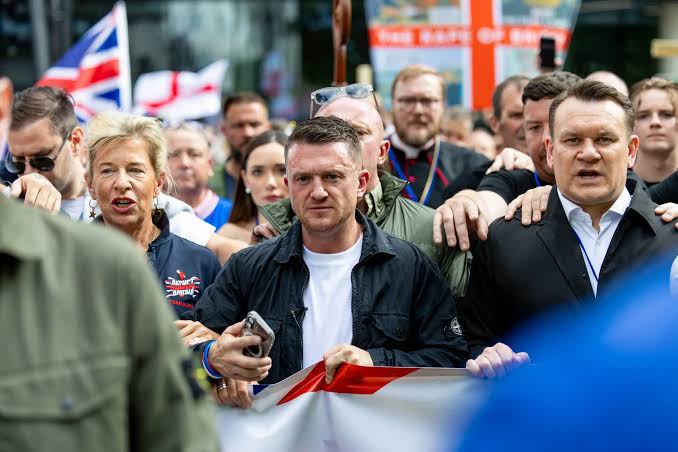
The political turbulence that reached a boiling point in central London had its origins in a massive street mobilization in September 2025. That first “Unite the Kingdom” rally—convened by activist Tommy Robinson (real name Stephen Yaxley-Lennon), the co-founder of the English Defence League—drew an estimated 110,000 to 150,000 demonstrators. It represented the largest right-wing street gathering in modern British history.
========================================================================
UNITE THE KINGDOM: ESTIMATED CROWD DYNAMICS
========================================================================
September 2025 Rally: [========================================] 110,000 - 150,000
May 16, 2026 Rally:    [=================>                      ] ~60,000 (Police Est.)
========================================================================
Supporters framed these gatherings as patriotic rallies defending national borders, free speech, and traditional British identity. Critics, civil liberties groups, and government officials characterized them as a conduit for far-right anti-Muslim agitation and xenophobia.
Main Events: The May 16 Rally and the Border Exclusion
When a second major rally was scheduled for May 16, 2026, in central London, the political and security apparatus responded aggressively.
-
The Exclusion Orders: In the days leading up to the march, Home Secretary Shabana Mahmood moved to deny entry to a cohort of scheduled international speakers. While initial accounts pointed to seven individuals, the government confirmed to Parliament that 11 foreign nationals had been barred from entering the UK to address the crowd. Those excluded included notable international right-wing influencers and politicians, such as Dutch commentator Eva Vlaardingerbroek, Polish MEP Dominik Tarczyński, and US-based commentator Valentina Gomez. Authorities also sought to restrict remote broadcasting into the rally site.
-
The Turnout: On May 16, approximately 60,000 people took to London’s streets under strict Public Order Act conditions, accompanied by a major counter-demonstration commemorating the Nakba.
-
The Policing Mandate: Scotland Yard deployed an unprecedented operation involving roughly 4,000 officers, the deployment of live facial recognition technology, and physical cordons. The day concluded with 43 recorded arrests across all linked demonstrations.
-
The Electoral Pivot: On stage, Robinson urged the crowd to convert street momentum into ballot-box pressure, signaling an ambition to integrate the movement’s energy into mainstream electoral politics.
+-----------------------------------------------------------------------------+
|               KEY FIGURES IN THE MAY–JUNE 2026 CONTROVERSY                  |
+-----------------------------------------------------------------------------+
|  Stephen Yaxley-Lennon   | Lead organizer & agitator; pivoted rally toward  |
|  ("Tommy Robinson")      | formal electoral participation.                  |
|--------------------------+--------------------------------------------------|
|  Shabana Mahmood         | Home Secretary; exercised discretionary "public  |
|                          | good" exclusion powers to bar 11 foreign speakers.|
|--------------------------+--------------------------------------------------|
|  Sir Keir Starmer        | Prime Minister; framed the confrontation as a     |
|                          | "fight for the soul of the country."             |
|--------------------------+--------------------------------------------------|
|  Arwa Elrayess           | Oxford Union President; defended hosting the     |
|                          | June 17 debate to test controversial speech.     |
+-----------------------------------------------------------------------------+
The Oxford Union Debate (June 17, 2026)
The free speech controversy moved from London’s streets into academia a month later.
On June 17, 2026, the historic Oxford Union hosted Robinson to debate the motion: “This House believes the West is right to be suspicious of Islam.” Speaking alongside him was Reclaim Party leader Laurence Fox, while opponents included former Conservative minister Sir Jacob Rees-Mogg.
The invitation sparked outrage. Local faith leaders, Islamic societies, and Oxford East MP Anneliese Dodds demanded the invitation be rescinded, warning that it amplified far-right extremism. A member motion to force Union President Arwa Elrayess to cancel the event was defeated. On the night of the debate, hundreds of anti-fascist protesters formed human blockades outside, prompting a £100,000 police security deployment. Robinson entered under heavy security, and the motion was ultimately defeated in the student chamber.
When analyzing stories of this magnitude, the press often falls into the trap of covering the friction rather than the tectonic plates moving beneath it. What happened in London and Oxford this summer was not merely a logistical policing headache or a routine debate over offensive rhetoric. It exposed three structural fault lines that modern Britain has largely avoided confronting.
1. The Weaponization of the “Non-Conducive to the Public Good” Clause
The cornerstone of the state’s intervention was the Home Secretary’s statutory power under the Immigration Act to bar foreign nationals whose presence is judged “not conducive to the public good.”
THE LEGAL PARADOX OF BORDER SPEECH
┌────────────────────────────────────────────────────────┐
│ DOMESTIC CITIZENS (UK Jurisdiction)                    │
│ - Robust Article 10 / Common Law Speech Protections    │
│ - Right to attend lawful assemblies                    │
└──────────────────────────┬─────────────────────────────┘
                           │ Disconnect
┌──────────────────────────▼─────────────────────────────┐
│ FOREIGN NATIONALS (Sovereign Border Control)           │
│ - No automatic right of entry                          │
│ - Subject to broad executive discretion ("Public Good")│
└────────────────────────────────────────────────────────┘
Historically, this power was reserved for suspected terrorists, war criminals, or those openly inciting physical violence. By applying it systematically to political commentators and European parliamentarians who were invited to speak at a lawful domestic gathering, the executive branch crossed an important threshold.
The legal distinction is clear: foreign nationals have no inherent right to enter Britain. But politically, when exclusion powers are utilized to prevent speech that would be lawful if uttered by a British citizen, the government effectively creates a nationalized ideological filter at the border. This leaves an unanswered question: where does administrative public-safety management end, and political speech-policing begin?
2. The Transnational Populist Network vs. The Isolated Nation
What many commentators overlook is that the modern British populist right is no longer an isolated, parochial street movement.
Robinson and his network have successfully integrated into a broader, well-funded transnational populist ecosystem spanning North America and mainland Europe. By inviting US media personalities and European lawmakers, organizers intentionally designed the May 16 rally as a multi-national summit.
When the Home Office issued its entry bans, it handed the movement the exact narrative it craved: an allegation of an insecure state apparatus working to silence an international populist coalition. The state’s tactical victory in keeping foreign agitators off a physical stage provided them with an even more potent digital story of political martyrdom.
3. The Street, the Ballot, and the Illusion of “Losing Steam”
Much was made in mainstream commentary of the drop in rally attendance from over 100,000 in late 2025 to 60,000 in May 2026. Many rushed to label the movement as waning.
That analysis is flawed. Mobilizing 60,000 paying, traveling demonstrators to central London under intense police scrutiny is an enormous organizational feat in contemporary British politics. More importantly, Robinson’s directive on stage—urging his followers to transition from street rallies to electoral mobilization—points to an evolving strategy. When disorganized street anger learns to channel itself into voter turnout, local council seats, and party primary pressure, it presents a far more durable challenge to the political establishment than an afternoon demonstration on Whitehall.
Britain’s late-spring political standoff did not begin or end at the police cordons in London or the stone archways of the Oxford Union. It has laid bare the unresolved tension at the heart of modern democratic governance: the battle between the sovereign right of the state to manage its borders and the core duty of a free society to tolerate dissenting ideas.
When governments bar foreign political voices under broad public-order mandates, they may purchase short-term calm on the streets. But they do so at the cost of deepening societal cynicism, reinforcing the belief among millions of alienated citizens that the democratic game is rigged against them.
True democratic resilience is not demonstrated by preemptively closing border gates or barricading university debate halls. It is proven when a society has the confidence to let contentious ideas into the open air, subject them to rigorous scrutiny, and defeat them in the public square with stronger arguments, deeper evidence, and superior principles.
A Question for the Public Square
When a government uses border controls to decide which political opinions are safe for its citizens to hear, does it protect public order, or does it quietly erode the very foundation of free intellectual inquiry?