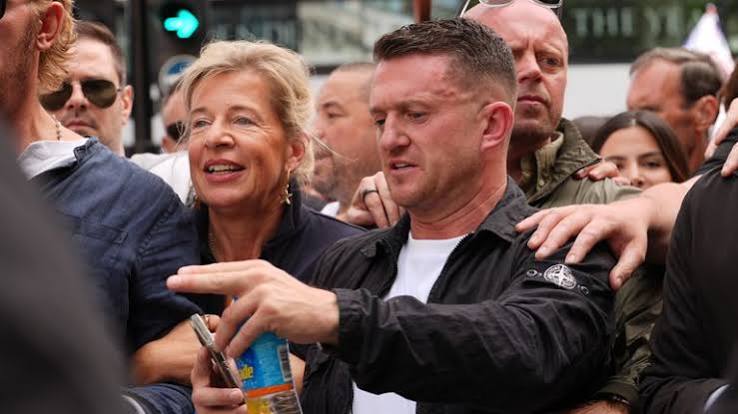
Faith, Fury and the Fight for Britain: Tommy Robinson’s Christian Message Electrifies a Huge London Crowd — and Deepens a National Divide. n1

The Cross, the Crown, and the Culture War: Inside Tommy Robinson’s Religious Rebrand
For over a decade, British street politics has been defined by polarized arguments over national borders, integration, and freedom of expression. At the center of many of these flashpoints has been Stephen Yaxley-Lennon, widely known by the pseudonym Tommy Robinson. Originally rising to prominence as the co-founder of the English Defence League (EDL), Robinson’s activism historically focused on opposition to Islam, immigration, and institutional multiculturalism.
In recent years, however, the visual, rhetorical, and ideological language of his movement has shifted toward overt Christian symbolism. Rather than solely relying on populist slogans, demonstrations have integrated worship music, public prayers, wooden crosses, and references to Britain’s Christian heritage.
                     EVOLUTION OF MOVEMENT MESSAGING
┌────────────────────────────────────────┐     ┌────────────────────────────────────────┐
│             Early Activism             │ ──► │           Current Framework            │
│  • Anti-Islam / Anti-Immigration Focus │     │  • Explicit Christian Imagery & Crosses│
│  • Secular Nationalist Grievance       │     │  • Defense of Global Christian Causes  │
│  • Counter-Jihad Framing               │     │  • Defense of British Christian Roots  │
└────────────────────────────────────────┘     └────────────────────────────────────────┘
Main Events: The “Unite the Kingdom” Demonstration
At the “Unite the Kingdom” rally in central London, an estimated 60,000 demonstrators assembled carrying Union Jacks, St. George’s Crosses, and signs displaying Christian iconography. Chants of “Christ is King” echoed across the thoroughfares.
       DEMONSTRATION TIMELINE & KEY DEVELOPMENTS (LONDON)

  [Morning]   ──► Crowd gathers with crosses, flags, and faith signage
         │
  [Mid-Day]   ──► Platform addresses on British national identity
         │
  [Afternoon] ──► Nigerian Anglican Bishop speaks on persecuted Christians
         │
  [Main Event]──► Robinson frames overseas violence as a warning for the West
         │
  [Resolution]──► Call for political mobilization ahead of future elections
A major focus of the rally occurred when Robinson directed the audience’s attention toward Africa, specifically the security crisis in Nigeria. He was joined on stage by a Nigerian Anglican bishop who described the ongoing attacks against Christian communities in West Africa. Robinson argued that Western institutions deliberately ignore atrocities against Christians abroad because of a reluctance to defend Christian heritage, asserting that Britain cannot protect vulnerable religious groups globally unless it first reclaims its own historical faith at home.
The event took place alongside a counter-mobilization and a major pro-Palestinian march on the same day, prompting the deployment of approximately 4,000 Metropolitan Police officers. By the end of the day, authorities recorded 43 arrests linked to the wider protests.
Key Facts & Regional Context
-
The Security Crisis in Nigeria: Independent monitoring by the U.S. Commission on International Religious Freedom (USCIRF) notes that armed non-state actors—including Boko Haram, Islamic State West Africa Province (ISWAP), and militant networks—continue to carry out deadly attacks against civilian communities. USCIRF documentation highlights severe violence against Christians in Nigeria’s Middle Belt and northern states, including mass abductions from churches and attacks on holiday services.
-
The Multi-Faceted Conflict: The violence in Nigeria is recognized by international analysts and the Nigerian government as deeply complex. While sectarian targeting occurs, large numbers of Muslim civilians are also killed by insurgent factions, such as a massacre that claimed 162 lives in predominantly Muslim villages in Kwara State. Experts note that resource competition over arable land, organized criminality, banditry, and state security deficits all contribute significantly to the bloodshed.
-
Institutional Reactions in the UK: Established religious figures, including senior representatives within the Church of England, have expressed concern over religious imagery being incorporated into exclusionary or anti-immigrant political platforms, reiterating that Christian values emphasize universal human dignity.
===================================================================
              INVESTIGATIVE MEMO: THE THEOLOGICAL PIVOT
===================================================================
Covering socio-political movements over several decades teaches an essential truth: when a political campaign changes its symbolic language, it is executing a deliberate strategic realign.
The emergence of crosses and theological rhetoric on the streets of London is not simply an organic spiritual awakening; it represents an attempt to construct a broader transatlantic cultural coalition.
1. The Power of “Moral Legitimacy”
For years, secular nationalist movements in Western Europe faced institutional marginalization and severe reputational challenges, frequently labeled by critics as xenophobic or reactionary.
By framing political goals through the lens of religious freedom and human rights advocacy, the movement shifts its posture:
┌──────────────────────────────────────────────────────────────────┐
│                   THE STRATEGIC FRAMEWORK PIVOT                  │
├──────────────────────────────┬───────────────────────────────────┤
│ FROM: "Anti-Other" Stance    │ TO: "Protector of Faith" Stance   │
├──────────────────────────────┼───────────────────────────────────┤
│ • Divisive street brawling   │ • Moral defense of human rights   │
│ • Easily dismissed by media  │ • Harder for critics to condemn   │
│ • Domestic grievances only   │ • Transatlantic network appeal    │
└──────────────────────────────┴───────────────────────────────────┘
When Robinson speaks about abducted schoolgirls or targeted congregations in Nigeria, he utilizes real, verified human tragedies documented by official bodies like USCIRF. This approach makes the core argument far more difficult for political opponents to dismiss, effectively functioning as an ideological shield.
2. The Transatlantic Playbook
This evolution mirrors political strategies developed in North America and parts of Central Europe, where traditional Christian identity has been merged with right-leaning populism.
By adopting the language of Christian persecution, British organizers can build alliances with well-funded international conservative networks, American think tanks, and European political parties that view Western civilization as being in active civilizational retreat.
                     TRANSNATIONAL NETWORKS

        [US Conservative Coalitions]
                    │
                    ▼
     [UK Street Mobilization Movements] ◄──► [European Far-Right Alliances]
                    ▲
                    │
   [Persecuted Diaspora Advocacy Groups]
3. What Audiences Overlook
Beyond the immediate footage of demonstrations, critical structural questions remain:
-
The Secular Dilemma: Modern Britain is among the most secularized nations in Western Europe, with census data reflecting an increasingly diverse and non-religious population. Can an explicitly Christian identity resonate with voters outside a dedicated activist base?
-
The Theological Conflict: Established British churches generally embrace progressive social principles, interfaith dialogue, and migrant support. This creates an unusual dynamic where street activists and official church hierarchies present opposing visions of what Christianity represents in public life.
-
Complex International Realities: Reducing multi-dimensional crises—such as the land and security conflicts in West Africa—into purely binary religious wars simplifies complex socioeconomic factors, risking further polarization both abroad and domestically.
The presence of tens of thousands of demonstrators beneath crosses in the heart of London indicates a profound shift in modern public discourse. It highlights a segment of the population that feels traditional national identity is eroding and perceives mainstream institutions as indifferent to Christian communities facing persecution globally.
At the same time, this fusion of faith and political activism raises fundamental questions for a diverse democracy. When sacred religious symbols are placed at the center of partisan political platforms, they risk deepening cultural divisions rather than bridging them.
As national identities across the Western world continue to transform, can inherited religious traditions be recovered to unite diverse societies, or will faith inevitably be used as another battleground in modern politics?
Civic and Electoral Engagement
For citizens interested in learning more about participating in the democratic process, official voting guidelines, registration requirements, and local electoral information:
-
Verify registration status and guidelines via the UK Electoral Commission Voter Portal.
-
Check official electoral roll details through the GOV.UK Register to Vote Service.