
How the U.S. Moved 133,000 Men to Bastogne Overnight and Shocked Germany
In the bitter freezing darkness of December 16th, 1944, the serene silence of the Arden’s forest was violently shattered. Adolf Hitler had secretly amassed a staggering force of over 400,000 men, thousands of artillery pieces, and his heaviest panzer divisions for one final apocalyptic roll of the dice.
He launched a massive surprise offensive aimed at splitting the Allied armies in half and capturing the vital port of Antwerp. It was the beginning of the Battle of the Bulge. The American front line, thinly held by exhausted veterans and raw, untested recruits, buckled under the sheer unexpected weight of the German steel.
Within days, the situation transformed from a tactical setback into an absolute existential crisis for the Allied command. Right in the heart of the German advance lay the small, unassuming Belgian town of Baston. Geographically, Baston was the absolute center of gravity for the entire region. Seven major paved roads converged on the town like the spokes of a wheel.
The German heavy armor desperately needed those roads to maintain the speed of their offensive. To deny them that prize, the American High Command rushed the Elite 101st Airborne Division into the town with orders to hold the crossroads at all costs. By December 20th, the trap slammed shut. The 101st, completely lacking heavy armor, winter clothing, and adequate ammunition, was entirely surrounded by the ferocious German fifth Panzer Army.
The freezing mist and heavy snow grounded the Allied air forces, meaning no supplies could be dropped and no bombers could strike the encroaching German armor. The German high command, led by Field Marshal Gar von Runstead, was highly confident. They looked at the operational map and calculated exactly how long it would take the Americans to mount a rescue operation.
They knew that General George S. Patton’s massive third army was the only force large enough to break the siege. But Patton was currently heavily engaged in a brutal fight over a 100 miles to the south in the Sar Basin. His entire army was facing east, pushing toward the German border. According to traditional textbook German military doctrine, safely disengaging an entire field army from active combat, rotating them 90°, planning a new logistical route, and marching them over a 100 m north through
a historic blizzard would take a minimum of 2 to 3 weeks. The Germans believed Baston would be starved, frozen, and crushed long before Patton could even finish his paperwork. They were about to be thoroughly catastrophically blindsided. As the crisis in the Ardens spiraled out of control, Supreme Allied Commander General Dwight D.
Eisenhower called an emergency meeting of his top generals in a cold, damp, heavily guarded bunker in Verdon, France. The mood in the room was incredibly grim. Eisenhower looked at the enormous map, seeing the massive red bulge protruding into the American lines. Eisenhower turned to George S.
Patton and asked the critical question. How quickly could Patton disengage his third army from their current eastward offensive, pivot north, and launch a massive counterattack to relieve the trapped men in Boston? The other generals in the room, understanding the sheer, mind-bending logistical nightmare of such a maneuver, braced themselves for a timeline of at least a week or more.
Moving an army is not like turning a car. It is like trying to turn a massive heavy freight train on a dime while simultaneously being shot at. Patton stood up, cigar in hand, and delivered a statement that shocked the entire room. I can attack with three divisions in 48 hours. The room fell dead silent.
General Eisenhower, visibly irritated by what he thought was Patton’s usual bravado and theatrical boasting, snapped back. Don’t be fatuous, George. If you try to go that early, you won’t have all three divisions ready and you’ll go peacemeal. But Patton was not boasting. He was not making a reckless, emotional gamble.
He was stating a cold, calculated, mathematical fact. Patton knew exactly what his staff had already accomplished, and he knew the sheer terrifying industrial capability of the American military machine. What the German high command and even some of Patton’s own peers failed to understand was that the United States Army in 1944 possessed the most highly educated, ruthlessly efficient logistical staff in the history of human warfare.
Before Patton had even left his headquarters to attend the Verdun meeting, his brilliant chief of staff, Major General Hobart Gay, and his chief of operations, Colonel Hal Maddox, had already anticipated the crisis. While Patton was driving to the meeting, the men of the Third Army staff were furiously running the mathematics of a massive pivot.
They had no computers. They had no digital spreadsheets. They had only pencils, slide rules, protractors, highly detailed topological maps, and an intricate secure telephone network strung across the frozen French countryside. To pivot an army of 133,000 men, you cannot simply tell everyone to turn left.
If you do that, thousands of supply trucks, heavy tanks, and artillery tractors will instantly collide at the crossroads, creating a massive, immovable traffic jam that would paralyze the entire force. The logistics officers had to instantly calculate the exact weight and speed of every single vehicle.
They had to map out dozens of parallel, winding, narrow country roads. They had to determine the loadbearing capacity of tiny stone bridges built in the 18th century to ensure 45 ton Sherman tanks wouldn’t collapse them. They had to calculate exactly how many thousands of gallons of gasoline would be burned per hour in sub-zero temperatures and perfectly sequence the fuel trucks to merge into the tank columns at the exact moment the tanks ran empty.
Within hours, typing furiously on mechanical typewriters, Patton’s staff generated over 1 million entirely new operational orders, maps, and route assignments. They fundamentally rewired the nervous system of an entire field army in a single afternoon. But brilliant paperwork means absolutely nothing if the physical movement fails.
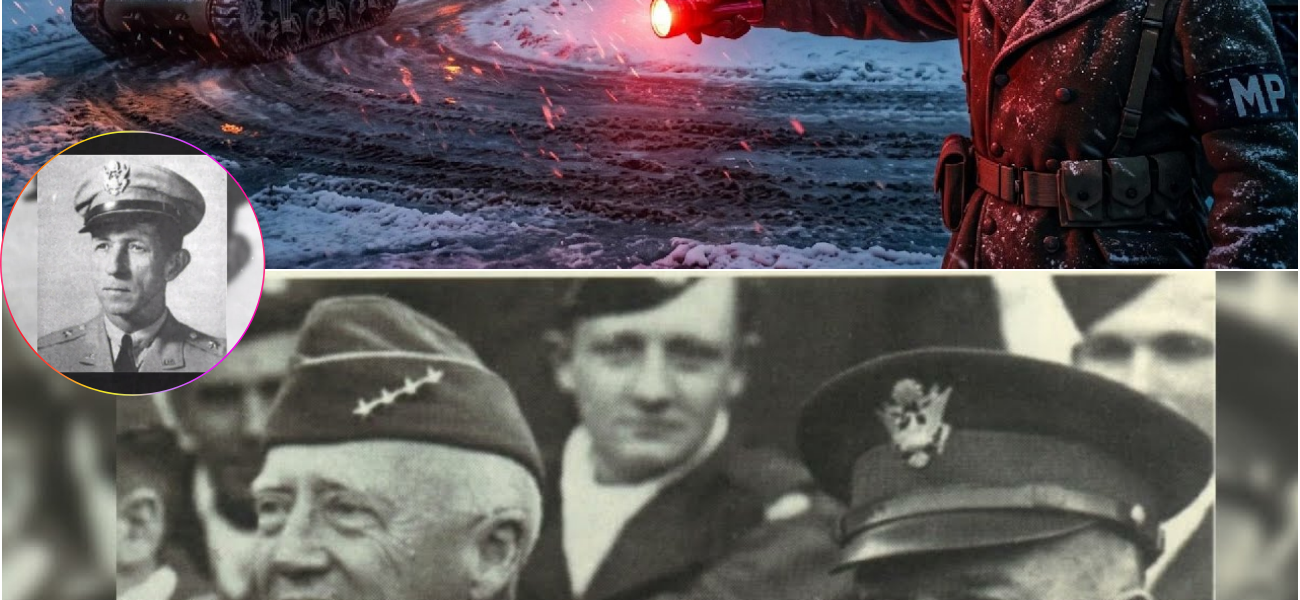
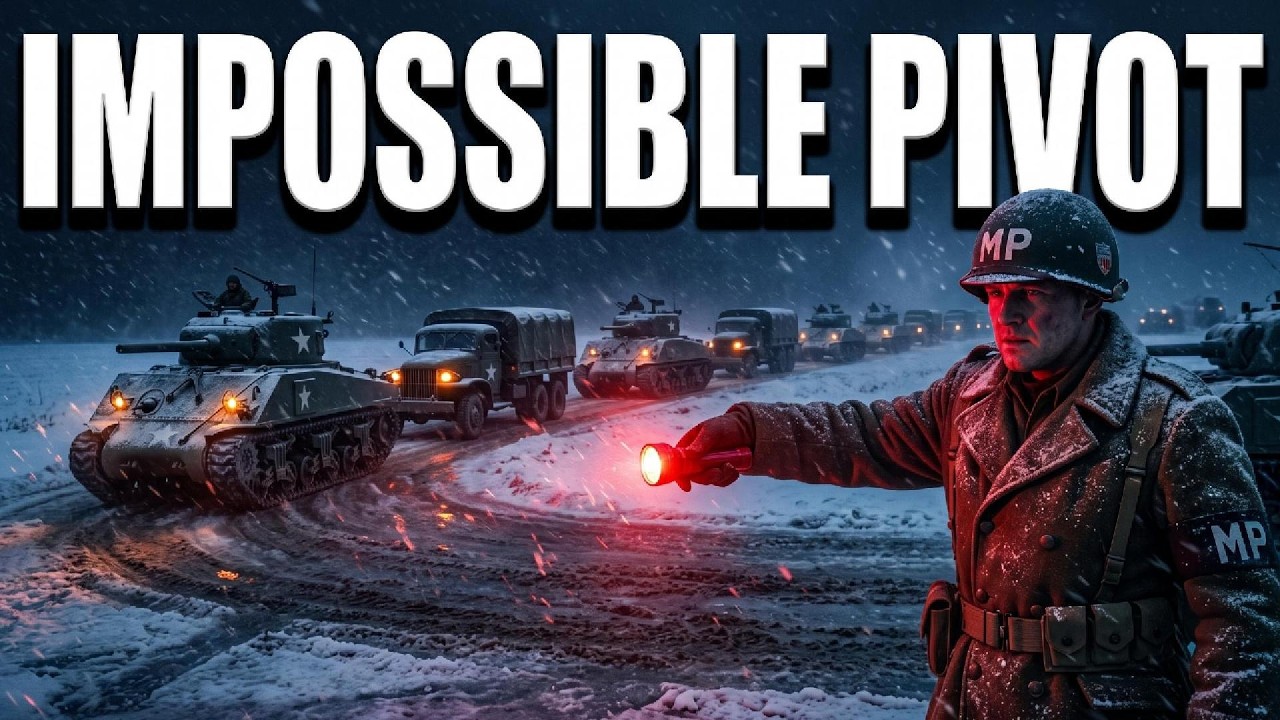
The true unsung heroes of this impossible operational miracle were the thousands of American military police. the MPs. As the sun set and the temperatures plummeted well below zero, a historic blinding blizzard slammed into the region. The roads instantly transformed into lethal ribbons of solid black ice.
Under the strict rules of warfare, the entire American movement had to be conducted in absolute total blackout conditions to avoid detection by German reconnaissance planes and artillery spotters. Tens of thousands of American drivers had to navigate their massive, sliding, freezing vehicles over unfamiliar, narrow, icy roads in pitch black darkness.
They were not allowed to use their main headlights. They drove using cat eyes, tiny shielded slits over the lights that emitted only a faint, dull glow, barely visible from a few feet away. To prevent the entire army from getting lost or crashing in the dark, the MPs were deployed to every single crossroads, bridge, and intersection along the 100-m route.
These men stood perfectly still in the howling, freezing wind for 10, 12, sometimes 18 hours straight. Many suffered horrific frostbite. They acted as living traffic signals, using incredibly precise hand gestures and carefully shield flashlights to direct the endless roaring avalanche of American steel.
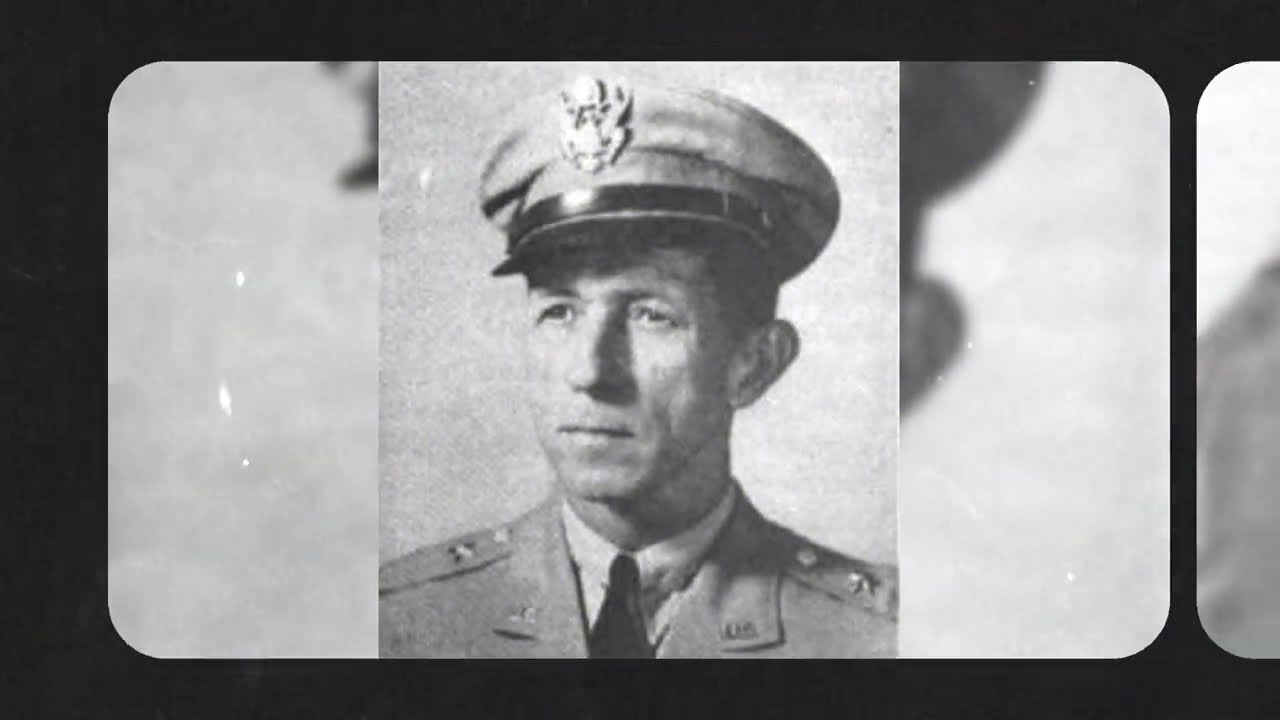
If a truck broke down or a tank threw a heavy steel track on the ice, they were not allowed to stop and fix it. Doing so would delay the entire army. The MPs had strict, ruthless orders. Any broken down vehicle was to be instantly violently shoved completely off the road and into the ditches by the tanks behind it.
The flow of the column was the only thing that mattered. The physical toll on the American soldiers executing this pivot was unimaginable. The men of the Third Army had to physically disengage from brutal close quarters combat with the Germans in the SAR, pack up their gear under artillery fire, and immediately climb into the freezing open topped beds of uninsulated transport trucks.
Because of the extreme urgency, there was no time to issue specialized winter gear. Thousands of men rode through the freezing blizzard in standard canvas field jackets, huddling together for warmth. As the temperatures dropped to 10° below zero fah, the heavy grease and oil inside the artillery pieces and tank engines began to physically freeze solid, requiring mechanics to light small.
Dangerous fires directly underneath the engine blocks just to get the heavy steel machines to start. Yet against all odds, defying the weather, the ice and the limits of human endurance, the massive synchronized machine worked flawlessly. Within exactly 48 hours, an astounding 133,000 troops, over 10,000 heavy transport vehicles, and thousands of tons of ammunition and fuel were completely picked up, turned 90°, and thrust violently toward the besieged town of Baston.
When the first American artillery shells from the Third Army suddenly began raining down on the southern flanks of the German forces surrounding Baston, the German commanders were thrown into a state of absolute paralyzing shock. It completely broke their operational reality. The German intelligence officers frantically checked their maps and their calculations.
It was physically impossible for Patton’s army to be there. The German doctrine dictated that a maneuver of this scale in this weather required weeks of preparation, massive rail networks, and days of clear weather. They failed to comprehend the sheer overwhelming superiority of American motorized logistics. Unlike the German army, which still relied heavily on thousands of horsedrawn wagons to move their supplies, the United States Army was entirely completely mechanized.
Every single American infantryman, artillery shell, and ration was carried on a standardized, highly reliable combustion engine. The United States didn’t just bring an army to Europe. They brought the entire industrial capability of Detroit. The massive, unexpected hammer blow of the Third Army shattered the German offensive rhythm, while the heavy snow and ice made the fighting incredibly brutal and slow.
The logistical miracle had already dictated the outcome of the battle. On the day after Christmas, December 26th, the legendary Fourth Armored Division, spearheaded by Lieutenant Colonel Kraton Abrams, violently punched a hole through the final ring of German defenses at the village of Aseninoa. Leading the charge was a heavily armored, mudcaked M4 Sherman tank, nicknamed Cobra King.
Firing its heavy gun and crushing German defensive positions beneath its freezing steel tracks, Cobra King smashed through the German lines and finally linked up with the exhausted, freezing but unbroken paratroopers of the 101st Airborne inside Baston. The siege was broken. The trap had failed. The relief of Baston is frequently remembered for the incredible heroic resilience of the paratroopers who held the line and the aggressive fighting spirit of the tankers who broke through. But the true
underlying miracle of that December was a masterpiece of mathematics, administration, and supply. Hitler’s grand >> >> illusion of winning the Battle of the Bulge was not just crushed by American guns. It was utterly dismantled by American staff officers, typewriters, slide rules, and truck drivers.
When George Patton turned an entire field army of 133,000 men 90° in the middle of a historic blizzard, he proved that courage and firepower are only half the equation of victory. The German engineers had built terrifying heavy tanks, but they had fundamentally ignored the mechanics of how to move them.
The Americans, by contrast, mastered the physics of war. They proved that the ultimate most devastating weapon on the modern battlefield is not the thickness of your armor. It is the flawless, terrifying efficiency of an unstoppable logistical machine.
How the U.S. Moved 133,000 Men to Bastogne Overnight and Shocked Germany
In the bitter freezing darkness of December 16th, 1944, the serene silence of the Arden’s forest was violently shattered. Adolf Hitler had secretly amassed a staggering force of over 400,000 men, thousands of artillery pieces, and his heaviest panzer divisions for one final apocalyptic roll of the dice.
He launched a massive surprise offensive aimed at splitting the Allied armies in half and capturing the vital port of Antwerp. It was the beginning of the Battle of the Bulge. The American front line, thinly held by exhausted veterans and raw, untested recruits, buckled under the sheer unexpected weight of the German steel.
Within days, the situation transformed from a tactical setback into an absolute existential crisis for the Allied command. Right in the heart of the German advance lay the small, unassuming Belgian town of Baston. Geographically, Baston was the absolute center of gravity for the entire region. Seven major paved roads converged on the town like the spokes of a wheel.
The German heavy armor desperately needed those roads to maintain the speed of their offensive. To deny them that prize, the American High Command rushed the Elite 101st Airborne Division into the town with orders to hold the crossroads at all costs. By December 20th, the trap slammed shut. The 101st, completely lacking heavy armor, winter clothing, and adequate ammunition, was entirely surrounded by the ferocious German fifth Panzer Army.
The freezing mist and heavy snow grounded the Allied air forces, meaning no supplies could be dropped and no bombers could strike the encroaching German armor. The German high command, led by Field Marshal Gar von Runstead, was highly confident. They looked at the operational map and calculated exactly how long it would take the Americans to mount a rescue operation.
They knew that General George S. Patton’s massive third army was the only force large enough to break the siege. But Patton was currently heavily engaged in a brutal fight over a 100 miles to the south in the Sar Basin. His entire army was facing east, pushing toward the German border. According to traditional textbook German military doctrine, safely disengaging an entire field army from active combat, rotating them 90°, planning a new logistical route, and marching them over a 100 m north through
a historic blizzard would take a minimum of 2 to 3 weeks. The Germans believed Baston would be starved, frozen, and crushed long before Patton could even finish his paperwork. They were about to be thoroughly catastrophically blindsided. As the crisis in the Ardens spiraled out of control, Supreme Allied Commander General Dwight D.
Eisenhower called an emergency meeting of his top generals in a cold, damp, heavily guarded bunker in Verdon, France. The mood in the room was incredibly grim. Eisenhower looked at the enormous map, seeing the massive red bulge protruding into the American lines. Eisenhower turned to George S.
Patton and asked the critical question. How quickly could Patton disengage his third army from their current eastward offensive, pivot north, and launch a massive counterattack to relieve the trapped men in Boston? The other generals in the room, understanding the sheer, mind-bending logistical nightmare of such a maneuver, braced themselves for a timeline of at least a week or more.
Moving an army is not like turning a car. It is like trying to turn a massive heavy freight train on a dime while simultaneously being shot at. Patton stood up, cigar in hand, and delivered a statement that shocked the entire room. I can attack with three divisions in 48 hours. The room fell dead silent.
General Eisenhower, visibly irritated by what he thought was Patton’s usual bravado and theatrical boasting, snapped back. Don’t be fatuous, George. If you try to go that early, you won’t have all three divisions ready and you’ll go peacemeal. But Patton was not boasting. He was not making a reckless, emotional gamble.
He was stating a cold, calculated, mathematical fact. Patton knew exactly what his staff had already accomplished, and he knew the sheer terrifying industrial capability of the American military machine. What the German high command and even some of Patton’s own peers failed to understand was that the United States Army in 1944 possessed the most highly educated, ruthlessly efficient logistical staff in the history of human warfare.
Before Patton had even left his headquarters to attend the Verdun meeting, his brilliant chief of staff, Major General Hobart Gay, and his chief of operations, Colonel Hal Maddox, had already anticipated the crisis. While Patton was driving to the meeting, the men of the Third Army staff were furiously running the mathematics of a massive pivot.
They had no computers. They had no digital spreadsheets. They had only pencils, slide rules, protractors, highly detailed topological maps, and an intricate secure telephone network strung across the frozen French countryside. To pivot an army of 133,000 men, you cannot simply tell everyone to turn left.
If you do that, thousands of supply trucks, heavy tanks, and artillery tractors will instantly collide at the crossroads, creating a massive, immovable traffic jam that would paralyze the entire force. The logistics officers had to instantly calculate the exact weight and speed of every single vehicle.
They had to map out dozens of parallel, winding, narrow country roads. They had to determine the loadbearing capacity of tiny stone bridges built in the 18th century to ensure 45 ton Sherman tanks wouldn’t collapse them. They had to calculate exactly how many thousands of gallons of gasoline would be burned per hour in sub-zero temperatures and perfectly sequence the fuel trucks to merge into the tank columns at the exact moment the tanks ran empty.
Within hours, typing furiously on mechanical typewriters, Patton’s staff generated over 1 million entirely new operational orders, maps, and route assignments. They fundamentally rewired the nervous system of an entire field army in a single afternoon. But brilliant paperwork means absolutely nothing if the physical movement fails.
The true unsung heroes of this impossible operational miracle were the thousands of American military police. the MPs. As the sun set and the temperatures plummeted well below zero, a historic blinding blizzard slammed into the region. The roads instantly transformed into lethal ribbons of solid black ice.
Under the strict rules of warfare, the entire American movement had to be conducted in absolute total blackout conditions to avoid detection by German reconnaissance planes and artillery spotters. Tens of thousands of American drivers had to navigate their massive, sliding, freezing vehicles over unfamiliar, narrow, icy roads in pitch black darkness.
They were not allowed to use their main headlights. They drove using cat eyes, tiny shielded slits over the lights that emitted only a faint, dull glow, barely visible from a few feet away. To prevent the entire army from getting lost or crashing in the dark, the MPs were deployed to every single crossroads, bridge, and intersection along the 100-m route.
These men stood perfectly still in the howling, freezing wind for 10, 12, sometimes 18 hours straight. Many suffered horrific frostbite. They acted as living traffic signals, using incredibly precise hand gestures and carefully shield flashlights to direct the endless roaring avalanche of American steel.
If a truck broke down or a tank threw a heavy steel track on the ice, they were not allowed to stop and fix it. Doing so would delay the entire army. The MPs had strict, ruthless orders. Any broken down vehicle was to be instantly violently shoved completely off the road and into the ditches by the tanks behind it.
The flow of the column was the only thing that mattered. The physical toll on the American soldiers executing this pivot was unimaginable. The men of the Third Army had to physically disengage from brutal close quarters combat with the Germans in the SAR, pack up their gear under artillery fire, and immediately climb into the freezing open topped beds of uninsulated transport trucks.
Because of the extreme urgency, there was no time to issue specialized winter gear. Thousands of men rode through the freezing blizzard in standard canvas field jackets, huddling together for warmth. As the temperatures dropped to 10° below zero fah, the heavy grease and oil inside the artillery pieces and tank engines began to physically freeze solid, requiring mechanics to light small.
Dangerous fires directly underneath the engine blocks just to get the heavy steel machines to start. Yet against all odds, defying the weather, the ice and the limits of human endurance, the massive synchronized machine worked flawlessly. Within exactly 48 hours, an astounding 133,000 troops, over 10,000 heavy transport vehicles, and thousands of tons of ammunition and fuel were completely picked up, turned 90°, and thrust violently toward the besieged town of Baston.
When the first American artillery shells from the Third Army suddenly began raining down on the southern flanks of the German forces surrounding Baston, the German commanders were thrown into a state of absolute paralyzing shock. It completely broke their operational reality. The German intelligence officers frantically checked their maps and their calculations.
It was physically impossible for Patton’s army to be there. The German doctrine dictated that a maneuver of this scale in this weather required weeks of preparation, massive rail networks, and days of clear weather. They failed to comprehend the sheer overwhelming superiority of American motorized logistics. Unlike the German army, which still relied heavily on thousands of horsedrawn wagons to move their supplies, the United States Army was entirely completely mechanized.
Every single American infantryman, artillery shell, and ration was carried on a standardized, highly reliable combustion engine. The United States didn’t just bring an army to Europe. They brought the entire industrial capability of Detroit. The massive, unexpected hammer blow of the Third Army shattered the German offensive rhythm, while the heavy snow and ice made the fighting incredibly brutal and slow.
The logistical miracle had already dictated the outcome of the battle. On the day after Christmas, December 26th, the legendary Fourth Armored Division, spearheaded by Lieutenant Colonel Kraton Abrams, violently punched a hole through the final ring of German defenses at the village of Aseninoa. Leading the charge was a heavily armored, mudcaked M4 Sherman tank, nicknamed Cobra King.
Firing its heavy gun and crushing German defensive positions beneath its freezing steel tracks, Cobra King smashed through the German lines and finally linked up with the exhausted, freezing but unbroken paratroopers of the 101st Airborne inside Baston. The siege was broken. The trap had failed. The relief of Baston is frequently remembered for the incredible heroic resilience of the paratroopers who held the line and the aggressive fighting spirit of the tankers who broke through. But the true
underlying miracle of that December was a masterpiece of mathematics, administration, and supply. Hitler’s grand >> >> illusion of winning the Battle of the Bulge was not just crushed by American guns. It was utterly dismantled by American staff officers, typewriters, slide rules, and truck drivers.
When George Patton turned an entire field army of 133,000 men 90° in the middle of a historic blizzard, he proved that courage and firepower are only half the equation of victory. The German engineers had built terrifying heavy tanks, but they had fundamentally ignored the mechanics of how to move them.
The Americans, by contrast, mastered the physics of war. They proved that the ultimate most devastating weapon on the modern battlefield is not the thickness of your armor. It is the flawless, terrifying efficiency of an unstoppable logistical machine.