
Why U.S. Marines Were Ordered NEVER to Pick Up a Japanese Sword
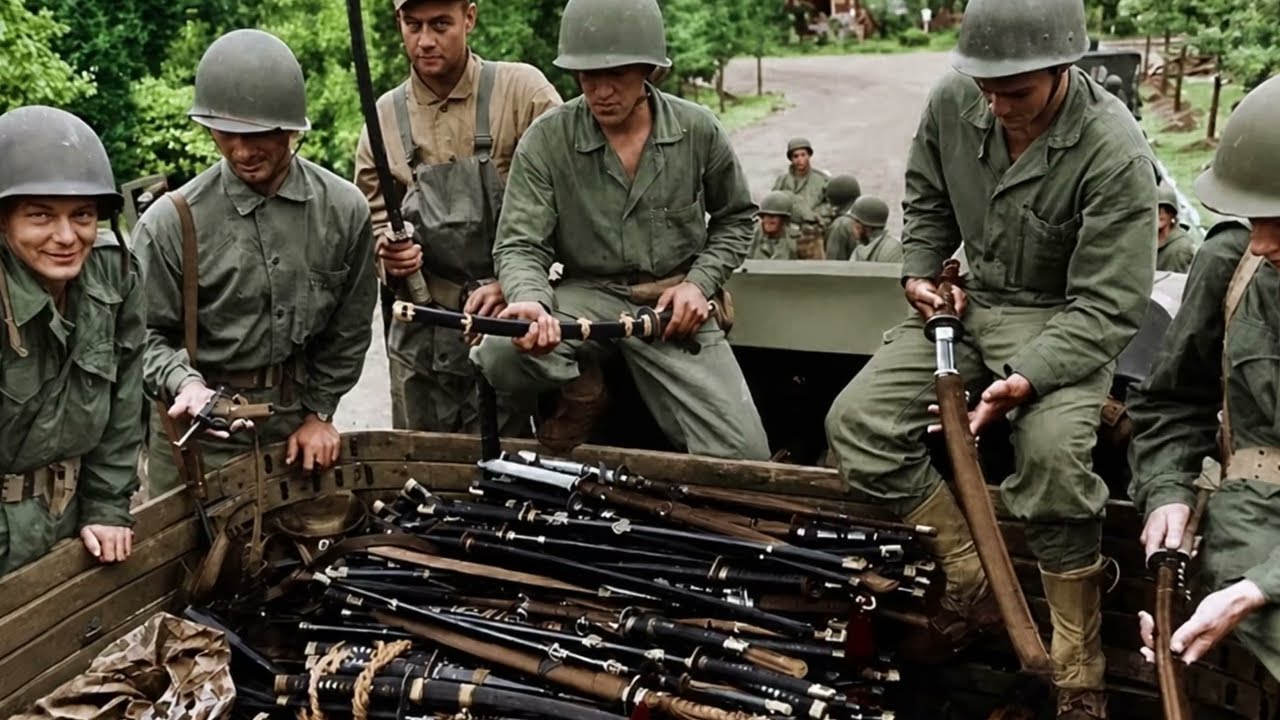
On a Pacific island, in the silence after a failed banzai charge, a Japanese officer lies dead in the dirt. And beside him, untouched, is the one thing every Marine in the theater wants more than a letter from home. A sword. The curved blade of an officer’s gunto, the closest thing to treasure a man can carry off a battlefield.
A young Marine sees it. He breaks from cover. He reaches down, and the ground beneath him comes apart. What nobody told him, what nobody standing there could even see, was that the dead man was never the trap. The sword was. This is the story of how the most prized trophy of the Pacific War became one of its quietest killers, and why American commanders started ordering their men to walk past it and leave it lying in the dirt.
Start in 1942 on Guadalcanal. The American war machine had landed in the jungle, and almost immediately it developed a strange second appetite. Not for ground, for trophies. There is a captured enemy pilot around the middle of October that year who supposedly told an American flyer that the Japanese fought for their emperor, and the Germans fought for Hitler, but the Marines seemed fighting for souvenirs.
The veteran William Manchester remembered the same joke in a cleaner form. The Japanese fought for the emperor, the British for glory, the Americans for souvenirs. It was funny. It was also true, and it was already getting men killed. On the 21st of August, 1942, Colonel Kiyono Ichiki threw roughly 900 men of the 28th Infantry Regiment against the Marines dug in along the Tenaru.
By morning, his force was annihilated. And a young Marine named Robert Leckie watched what happened next. In his memoir, he described the souvenir hunters moving among the enemy dead, picking their way delicately as though they were already afraid of what those bodies might be hiding. That is the danger surfacing on the first major battlefield of the Pacific ground war.
The hunters were nervous. They had reason to be. So, what was worth the risk? Understand the prize and you understand why men kept reaching for it. The sword first. And here is the detail almost everyone gets wrong, including the men who carried them home. These were not samurai swords. The correct word is gunto, which simply means military sword.
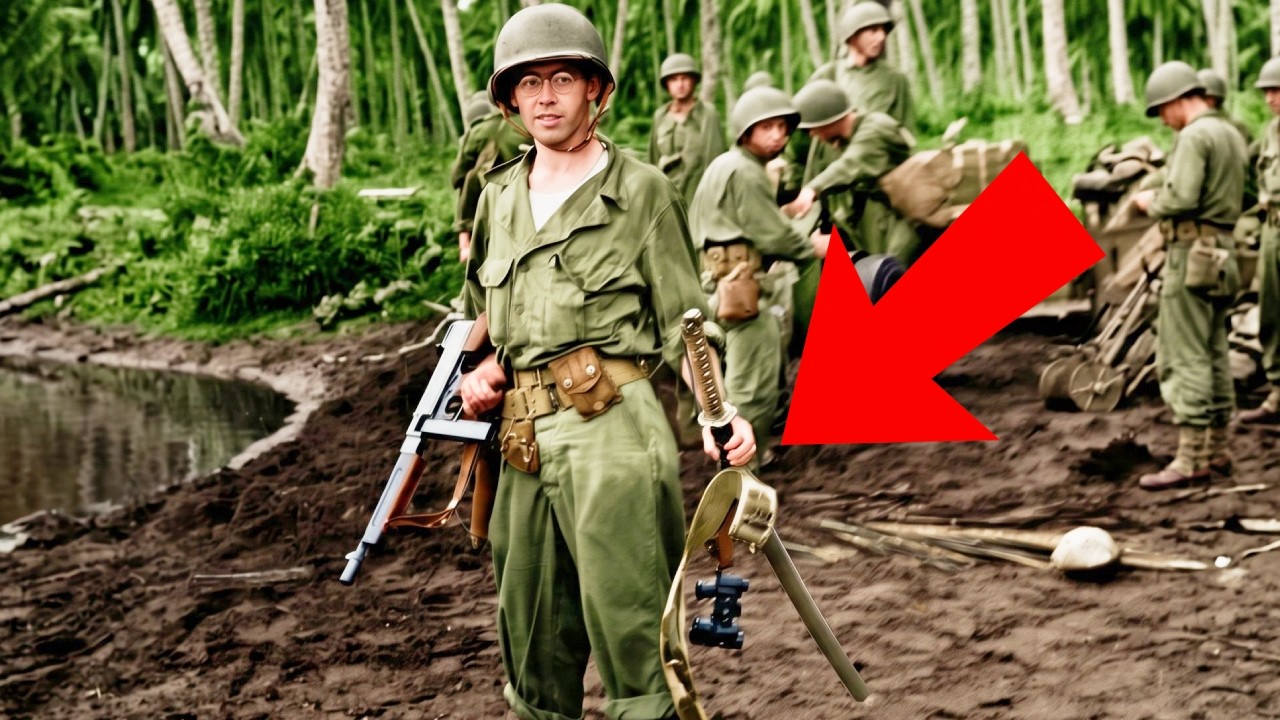
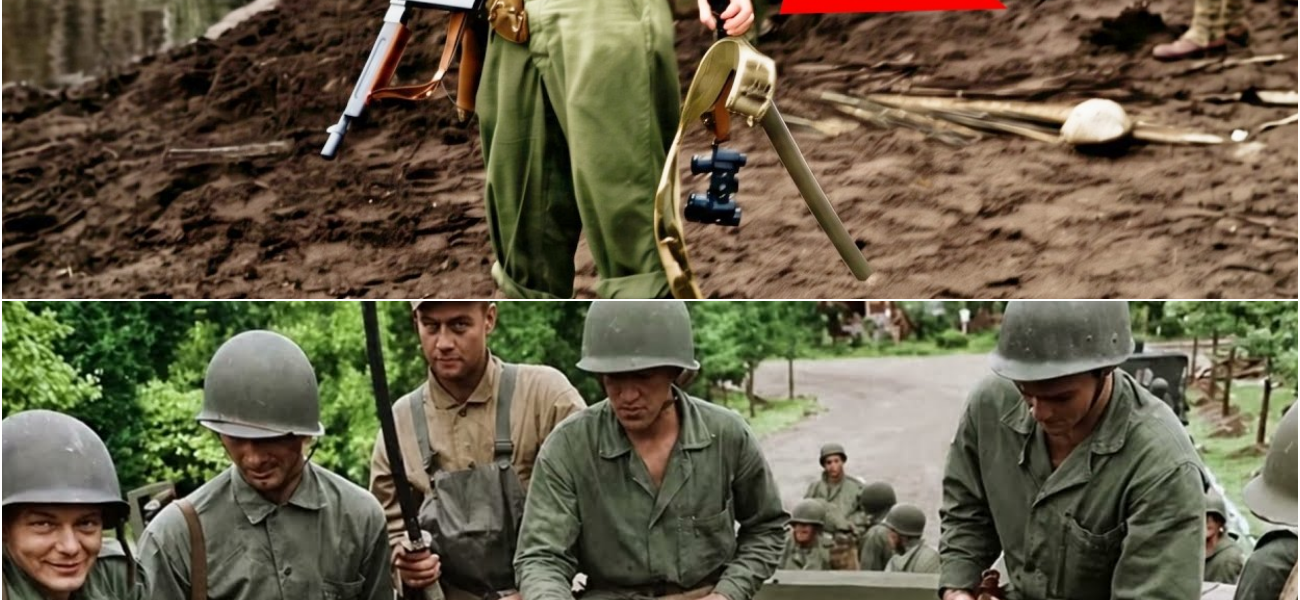
The most common one a Marine would find was the Type 98 Shin Gunto, the standard Army officer’s blade adopted in 1938. There was the older, fancier Type 94 it was based on, and the cheaper Type 95 carried by sergeants, machine stamped with a serial number. The Navy had its own version, the Kai Gunto, with a black ray skin scabbard.
Now, the part that made these objects so seductive. Most of those blades were factory steel, mass-produced weapons, nothing more. But a minority were the real thing, traditionally forged, and a few were genuine ancestral blades, hundreds of years old, handed down through a family, and then bolted into plain military fittings for the war.
By one widely cited estimate, only about 6% of the wartime blades from the Seki sword-making center were fully traditional. Which means most trophies were ordinary, and a rare few were priceless. The hunter grabbing one in the dark had no way of knowing which he had. Then, the pistol. The Type 14 Nambu, the officer’s sidearm, chambered in 8 by 22 mm.
To an American, it looked like a German Luger, so that is what they called it, the Japanese Luger. Around 400,000 were made, though nobody knows the real figure because Japanese soldiers treated their weapons as the emperor’s property, and many destroyed their own rather than let them be taken. There was also the smaller Type 94, a pistol with an exposed sear bar that could fire if you so much as knocked it against something.
The Americans had a name for that one, too, the suicide gun. And finally, the personal things. The good luck flag, a national flag covered in signatures from family and neighbors, carried folded against the chest. The thousand-stitch belt, a sash sewn by a thousand different women. Each stitch meant to turn a bullet.
Small, portable, intensely personal, easy to mail home. The single most common souvenir of the entire Pacific War. Demand got so high that Australian troops started manufacturing fake samurai swords to sell to the Americans. On Guadalcanal, Marines forged counterfeit Japanese flags using script they copied off the labels of canned food.
So, now you have the obsession and you have the prize. The Japanese had both figured out, too. Here is where we need to be honest with you because the popular version of this story and the documented version are not the same thing. The image you have in your head is cinematic. A pristine katana laid across a dead officer’s chest.
An almost invisible wire running from the sword’s hilt to a buried fragmentation grenade. The Marine lifts the blade, the wire goes taut, and the squad is gone. That exact mechanism is a dramatization. It is plausible. It fits everything the Japanese were known to do, but it is not what the official intelligence record actually describes. What the record describes is, in some ways, worse because it was simpler and harder to spot.
In December of 1944, the War Department’s intelligence bulletin printed an account from a cavalryman in the Admiralty Islands. His words were plain. The Japanese planted many booby traps using swords and flags. The usual method was to place a landmine close by. Positioned so that a man would step on it while trying to pick the trophy up.
No wire from the hilt. A pressure mine in the dirt waiting for the foot, not the hand. You were not killed for touching the sword. You were killed for walking up to it. That same intelligence circulated for a reason. The tactic worked. Why would a soldier turn his own sword into bait? To understand that, you have to understand what the sword meant to the man carrying it.
In the 1930s, militarist Japan deliberately revived the cult of the sword, reaching back to the samurai and the code called bushido, the way of the warrior. The blade became the visible badge of an officer’s rank and honor. In the romantic phrasing of the era, the sword was the soul of the warrior himself, an extension of his ancestors and his emperor.
Think about that for a second because it changes the whole picture. To a Japanese officer, an American casually looting his sword, then selling it or trading it for canned ham was not theft. It was desecration. And turning that same coveted blade into a kill mechanism carried a cold, brutal logic.
The enemy’s greed for the soul of your dead would be the thing that buried him. It also fit a much larger doctrine. After 1943, on the defensive everywhere, Japanese engineers became masters of the booby trap, rigging caves, tombs, abandoned positions, even the bodies of the dead to keep killing long after the position itself had fallen.
The trophy ruse was one small, vicious tool inside that system. The clearest case comes from Saipan in the summer of 1944. A senior American officer described the method in the same intelligence bulletin. [music] Japanese troops hiding in the island’s natural caves would set a sword or a rifle near the cave mouth, out in the open, exactly where a souvenir hunter could see it.
A man would go for it, and a sniper back in the dark of the cave would be waiting. The officer’s verdict was four words long, and it should sit with you. The trick worked. There were many unnecessary casualties. He recommended those areas be put off limits for as long as the sniper threat remained. That is the strongest period evidence that the bait killed men.
Not a movie, a high-ranking officer reporting losses, asking that the trophies simply be left where they lay. The explosives behind the mines were the same ones the Japanese used everywhere. [music] The Type 91, the Type 97, and the Type 99 grenades could all be rigged as traps. Pull the pin, wedge the grenade under a board, an object, or a body, and walk away.
When grenades ran short, they improvised. On Tarakan, Australians found a booby trap built out of a captured 5-in Dutch naval shell. The trophy did not have to be wired to anything fancy. The dirt around it just had to be patient. If this is the kind of history you actually want, the real tactics underneath the legend, [music] subscribe.
It genuinely helps the channel keep digging into the parts most documentaries skip. Now, back to the men who had to live inside this problem. By the time the fighting reached Peleliu and Okinawa, the booby trap had become part of the air the infantry breathed. Eugene Sledge, a mortarman in K Company, Third Battalion, Fifth Marines, became the great memoirist of all of it.
In With the Old Breed, he wrote about the trophy hunting with an unflinching eye. The men gloating over their prizes and swapping them. A savagery he said was particular to the war between the Marines and the Japanese. On Okinawa, the tombs and caves were routinely rigged. A corporal named Joseph Pizamenti remembered a booby trap set right in the center of a tomb entrance that scared the life out of him.
You would think, after Guadalcanal, after Attu, after the Admiralties, that someone in command would have said something. Someone did. Repeatedly. And mostly, the men did not listen. This is the part of the title we have to get exactly right. American commanders did not simply court-martial men for picking up a sword.
The truth is more diffuse and more interesting. They issued warning after warning. They put areas off limits the way that Saipan officer asked. They invoked the 80th Article of War, which governed dealing in captured and abandoned property, and they held it over men’s heads as a threat. The orders were about safety, about lost intelligence, and about discipline.
Not a tidy wave of sword-related trials. And there is a darker order in this record, one that points the camera back at the Americans themselves. Because the trophy hunting did not stop at swords and flags. It is well documented that some American troops mutilated the Japanese dead, taking gold teeth, ears, and skulls.
It was common enough that in September of 1942, the commander-in-chief of the Pacific Fleet, Admiral Chester Nimitz, ordered that no part of the enemy’s body could be used as a souvenir with violators facing stern disciplinary action. The next year, General Marshall radioed MacArthur about atrocity reports. In January of 1944, the Joint Chiefs issued their own directive against it.
Historians still argue about how widespread it was. Most men did not do it. A minority did. But the orders existed because the behavior was real and that belongs in the honest version of this story with the same weight as everything else. The Pacific War dehumanized the men who fought it on both sides and the commanders who saw it tried, often failing, to pull their own troops back from the edge.
There is one more reason they wanted men to leave the dead alone and it had nothing to do with honor or grenades. It was disease. Bodies in tropical heat rot fast. Sledge wrote again and again about how fear and filth went hand in hand. Picking through corpses for trophies was a good way to get sick on top of getting killed.
So that is the answer to the question in the title. Not one neat reason, a stack of them. The mines in the dirt, the snipers in the caves, the intelligence lost when a battle order got mailed home as a keepsake. The atrocities command was trying to stop and the simple rot of the dead. Officers and sergeants carried more than a million swords into that war.
Hundreds of thousands of them came home in American duffel bags and the overwhelming majority were taken without a scratch off surrenders and abandoned stores and bodies that held no trap at all. The booby trapped trophy was a real danger and a small one against the vast machinery of Japanese mines. But every man reaching for a blade in the dark had to gamble that the one in front of him was the safe kind.
Which brings us back to the sword in the dirt. Most of those blades never went home to Japan. They sat in American attics and closets for decades, in boxes behind the war the men who took them often did not want to talk about. And a good number of the flags went with them. One estimate puts more than 50,000 of those good luck flags still in the United States, and another 200,000 scattered across the world.
In recent years, a small organization in Astoria, Oregon, the Obon Society, started reading the signatures on those flags like fingerprints, tracing them back to the towns and families they came from. They say they have returned more than 750 items so far. Against the more than 1.1 million Japanese servicemen still listed as missing, it is almost nothing.
And it is everything to the family that opens the door. The sword was the soul of the man who carried it. That was the belief that made it the ultimate prize. It was also the belief that made it bait. And eight decades later, the most dangerous trophy of the Pacific is finally, quietly being carried back the other way.
Not as treasure, as someone’s father coming home.
Why U.S. Marines Were Ordered NEVER to Pick Up a Japanese Sword
On a Pacific island, in the silence after a failed banzai charge, a Japanese officer lies dead in the dirt. And beside him, untouched, is the one thing every Marine in the theater wants more than a letter from home. A sword. The curved blade of an officer’s gunto, the closest thing to treasure a man can carry off a battlefield.
A young Marine sees it. He breaks from cover. He reaches down, and the ground beneath him comes apart. What nobody told him, what nobody standing there could even see, was that the dead man was never the trap. The sword was. This is the story of how the most prized trophy of the Pacific War became one of its quietest killers, and why American commanders started ordering their men to walk past it and leave it lying in the dirt.
Start in 1942 on Guadalcanal. The American war machine had landed in the jungle, and almost immediately it developed a strange second appetite. Not for ground, for trophies. There is a captured enemy pilot around the middle of October that year who supposedly told an American flyer that the Japanese fought for their emperor, and the Germans fought for Hitler, but the Marines seemed fighting for souvenirs.
The veteran William Manchester remembered the same joke in a cleaner form. The Japanese fought for the emperor, the British for glory, the Americans for souvenirs. It was funny. It was also true, and it was already getting men killed. On the 21st of August, 1942, Colonel Kiyono Ichiki threw roughly 900 men of the 28th Infantry Regiment against the Marines dug in along the Tenaru.
By morning, his force was annihilated. And a young Marine named Robert Leckie watched what happened next. In his memoir, he described the souvenir hunters moving among the enemy dead, picking their way delicately as though they were already afraid of what those bodies might be hiding. That is the danger surfacing on the first major battlefield of the Pacific ground war.
The hunters were nervous. They had reason to be. So, what was worth the risk? Understand the prize and you understand why men kept reaching for it. The sword first. And here is the detail almost everyone gets wrong, including the men who carried them home. These were not samurai swords. The correct word is gunto, which simply means military sword.
The most common one a Marine would find was the Type 98 Shin Gunto, the standard Army officer’s blade adopted in 1938. There was the older, fancier Type 94 it was based on, and the cheaper Type 95 carried by sergeants, machine stamped with a serial number. The Navy had its own version, the Kai Gunto, with a black ray skin scabbard.
Now, the part that made these objects so seductive. Most of those blades were factory steel, mass-produced weapons, nothing more. But a minority were the real thing, traditionally forged, and a few were genuine ancestral blades, hundreds of years old, handed down through a family, and then bolted into plain military fittings for the war.
By one widely cited estimate, only about 6% of the wartime blades from the Seki sword-making center were fully traditional. Which means most trophies were ordinary, and a rare few were priceless. The hunter grabbing one in the dark had no way of knowing which he had. Then, the pistol. The Type 14 Nambu, the officer’s sidearm, chambered in 8 by 22 mm.
To an American, it looked like a German Luger, so that is what they called it, the Japanese Luger. Around 400,000 were made, though nobody knows the real figure because Japanese soldiers treated their weapons as the emperor’s property, and many destroyed their own rather than let them be taken. There was also the smaller Type 94, a pistol with an exposed sear bar that could fire if you so much as knocked it against something.
The Americans had a name for that one, too, the suicide gun. And finally, the personal things. The good luck flag, a national flag covered in signatures from family and neighbors, carried folded against the chest. The thousand-stitch belt, a sash sewn by a thousand different women. Each stitch meant to turn a bullet.
Small, portable, intensely personal, easy to mail home. The single most common souvenir of the entire Pacific War. Demand got so high that Australian troops started manufacturing fake samurai swords to sell to the Americans. On Guadalcanal, Marines forged counterfeit Japanese flags using script they copied off the labels of canned food.
So, now you have the obsession and you have the prize. The Japanese had both figured out, too. Here is where we need to be honest with you because the popular version of this story and the documented version are not the same thing. The image you have in your head is cinematic. A pristine katana laid across a dead officer’s chest.
An almost invisible wire running from the sword’s hilt to a buried fragmentation grenade. The Marine lifts the blade, the wire goes taut, and the squad is gone. That exact mechanism is a dramatization. It is plausible. It fits everything the Japanese were known to do, but it is not what the official intelligence record actually describes. What the record describes is, in some ways, worse because it was simpler and harder to spot.
In December of 1944, the War Department’s intelligence bulletin printed an account from a cavalryman in the Admiralty Islands. His words were plain. The Japanese planted many booby traps using swords and flags. The usual method was to place a landmine close by. Positioned so that a man would step on it while trying to pick the trophy up.
No wire from the hilt. A pressure mine in the dirt waiting for the foot, not the hand. You were not killed for touching the sword. You were killed for walking up to it. That same intelligence circulated for a reason. The tactic worked. Why would a soldier turn his own sword into bait? To understand that, you have to understand what the sword meant to the man carrying it.
In the 1930s, militarist Japan deliberately revived the cult of the sword, reaching back to the samurai and the code called bushido, the way of the warrior. The blade became the visible badge of an officer’s rank and honor. In the romantic phrasing of the era, the sword was the soul of the warrior himself, an extension of his ancestors and his emperor.
Think about that for a second because it changes the whole picture. To a Japanese officer, an American casually looting his sword, then selling it or trading it for canned ham was not theft. It was desecration. And turning that same coveted blade into a kill mechanism carried a cold, brutal logic.
The enemy’s greed for the soul of your dead would be the thing that buried him. It also fit a much larger doctrine. After 1943, on the defensive everywhere, Japanese engineers became masters of the booby trap, rigging caves, tombs, abandoned positions, even the bodies of the dead to keep killing long after the position itself had fallen.
The trophy ruse was one small, vicious tool inside that system. The clearest case comes from Saipan in the summer of 1944. A senior American officer described the method in the same intelligence bulletin. [music] Japanese troops hiding in the island’s natural caves would set a sword or a rifle near the cave mouth, out in the open, exactly where a souvenir hunter could see it.
A man would go for it, and a sniper back in the dark of the cave would be waiting. The officer’s verdict was four words long, and it should sit with you. The trick worked. There were many unnecessary casualties. He recommended those areas be put off limits for as long as the sniper threat remained. That is the strongest period evidence that the bait killed men.
Not a movie, a high-ranking officer reporting losses, asking that the trophies simply be left where they lay. The explosives behind the mines were the same ones the Japanese used everywhere. [music] The Type 91, the Type 97, and the Type 99 grenades could all be rigged as traps. Pull the pin, wedge the grenade under a board, an object, or a body, and walk away.
When grenades ran short, they improvised. On Tarakan, Australians found a booby trap built out of a captured 5-in Dutch naval shell. The trophy did not have to be wired to anything fancy. The dirt around it just had to be patient. If this is the kind of history you actually want, the real tactics underneath the legend, [music] subscribe.
It genuinely helps the channel keep digging into the parts most documentaries skip. Now, back to the men who had to live inside this problem. By the time the fighting reached Peleliu and Okinawa, the booby trap had become part of the air the infantry breathed. Eugene Sledge, a mortarman in K Company, Third Battalion, Fifth Marines, became the great memoirist of all of it.
In With the Old Breed, he wrote about the trophy hunting with an unflinching eye. The men gloating over their prizes and swapping them. A savagery he said was particular to the war between the Marines and the Japanese. On Okinawa, the tombs and caves were routinely rigged. A corporal named Joseph Pizamenti remembered a booby trap set right in the center of a tomb entrance that scared the life out of him.
You would think, after Guadalcanal, after Attu, after the Admiralties, that someone in command would have said something. Someone did. Repeatedly. And mostly, the men did not listen. This is the part of the title we have to get exactly right. American commanders did not simply court-martial men for picking up a sword.
The truth is more diffuse and more interesting. They issued warning after warning. They put areas off limits the way that Saipan officer asked. They invoked the 80th Article of War, which governed dealing in captured and abandoned property, and they held it over men’s heads as a threat. The orders were about safety, about lost intelligence, and about discipline.
Not a tidy wave of sword-related trials. And there is a darker order in this record, one that points the camera back at the Americans themselves. Because the trophy hunting did not stop at swords and flags. It is well documented that some American troops mutilated the Japanese dead, taking gold teeth, ears, and skulls.
It was common enough that in September of 1942, the commander-in-chief of the Pacific Fleet, Admiral Chester Nimitz, ordered that no part of the enemy’s body could be used as a souvenir with violators facing stern disciplinary action. The next year, General Marshall radioed MacArthur about atrocity reports. In January of 1944, the Joint Chiefs issued their own directive against it.
Historians still argue about how widespread it was. Most men did not do it. A minority did. But the orders existed because the behavior was real and that belongs in the honest version of this story with the same weight as everything else. The Pacific War dehumanized the men who fought it on both sides and the commanders who saw it tried, often failing, to pull their own troops back from the edge.
There is one more reason they wanted men to leave the dead alone and it had nothing to do with honor or grenades. It was disease. Bodies in tropical heat rot fast. Sledge wrote again and again about how fear and filth went hand in hand. Picking through corpses for trophies was a good way to get sick on top of getting killed.
So that is the answer to the question in the title. Not one neat reason, a stack of them. The mines in the dirt, the snipers in the caves, the intelligence lost when a battle order got mailed home as a keepsake. The atrocities command was trying to stop and the simple rot of the dead. Officers and sergeants carried more than a million swords into that war.
Hundreds of thousands of them came home in American duffel bags and the overwhelming majority were taken without a scratch off surrenders and abandoned stores and bodies that held no trap at all. The booby trapped trophy was a real danger and a small one against the vast machinery of Japanese mines. But every man reaching for a blade in the dark had to gamble that the one in front of him was the safe kind.
Which brings us back to the sword in the dirt. Most of those blades never went home to Japan. They sat in American attics and closets for decades, in boxes behind the war the men who took them often did not want to talk about. And a good number of the flags went with them. One estimate puts more than 50,000 of those good luck flags still in the United States, and another 200,000 scattered across the world.
In recent years, a small organization in Astoria, Oregon, the Obon Society, started reading the signatures on those flags like fingerprints, tracing them back to the towns and families they came from. They say they have returned more than 750 items so far. Against the more than 1.1 million Japanese servicemen still listed as missing, it is almost nothing.
And it is everything to the family that opens the door. The sword was the soul of the man who carried it. That was the belief that made it the ultimate prize. It was also the belief that made it bait. And eight decades later, the most dangerous trophy of the Pacific is finally, quietly being carried back the other way.
Not as treasure, as someone’s father coming home.
Note: Some content was generated using AI tools (ChatGPT) and edited by the author for creativity and suitability for historical illustration purposes.