
The Woman the Frontier Refused to Understand
Most towns are remembered for the people who fit in.
Dry Creek remembered the woman who never did.
Long before anyone spoke her name with respect, before children pointed toward her store with admiration instead of curiosity, before an entire frontier community was forced to confront its own assumptions, there was only a story people told in whispers.
A story about a woman who worked too hard.
A woman who spoke too little.
A woman who seemed determined to survive without needing anyone.
And in the unforgiving landscape of the American frontier, that alone was enough to make her an outsider.
The truth, however, was far more complicated.
Because hidden beneath years of gossip, judgment, and misunderstanding was a grief few people ever bothered to see.
And hidden beneath that grief was a quiet strength that would eventually change an entire town.
The first thing visitors noticed about Dry Creek was the wind.
It carried dust across the streets during summer and cut through heavy coats during winter. It rattled loose signs, whispered through fence posts, and reminded everyone that nature—not people—still ruled this corner of Texas.
The second thing visitors noticed was her.
Every town has a center.
In Dry Creek, it wasn’t the church.
It wasn’t the sheriff’s office.
It wasn’t even the saloon.
It was the supply store standing near the middle of town.
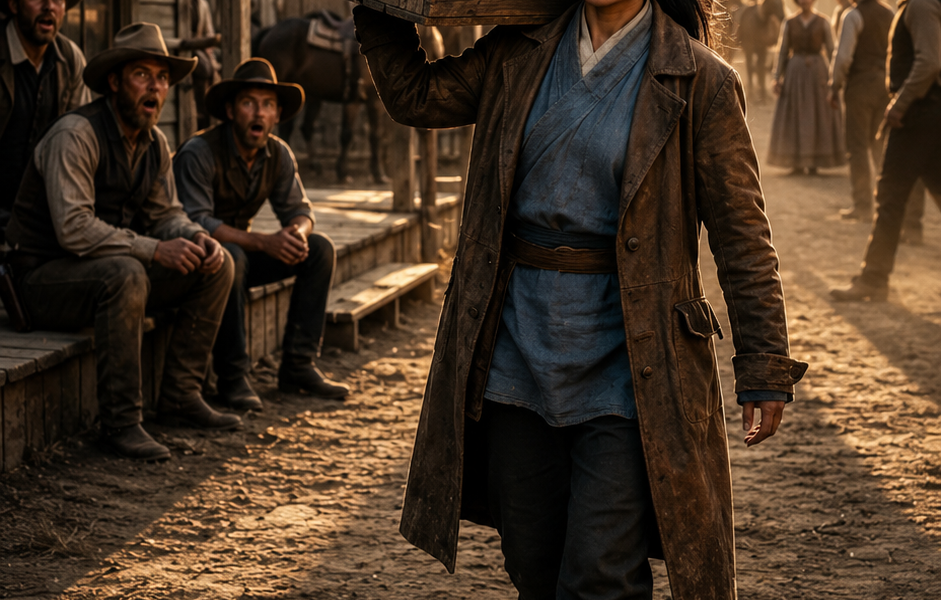
And behind the counter stood a woman named Mlin.
Most mornings she unlocked the door before sunrise.
Most evenings she locked it long after everyone else had gone home.
She kept inventory records more accurately than the bank.
She negotiated prices better than most ranch owners.
She unloaded shipments herself.
And she had done it alone for years.
The townspeople admired her competence.
What they didn’t understand was her refusal to depend on anyone.
In the eyes of many men, that made her difficult.
In the eyes of many women, it made her mysterious.
In reality, it made her lonely.
But loneliness rarely announces itself.
It hides behind routines.
It disguises itself as discipline.
It learns how to look like strength.
Few people knew that every morning before opening the store, Mlin spent several minutes standing silently in the storage room.
There, hanging from a nail near the back wall, was her father’s old work coat.
The fabric had faded.
The stitching had begun to loosen.
The smell of leather and cedar had long disappeared.
Yet she never moved it.
Never washed it.
Never stored it away.
It remained exactly where he had left it.
A small memorial invisible to everyone else.
Three years earlier, a fever had swept through the region.
Strong men had fallen.
Families had been shattered.
Doctors had arrived too late.
Among those buried was the only person Mlin had ever fully trusted.
Her father.
The man who had crossed hundreds of miles of wilderness with her.
The man who had built the store board by board.
The man who had believed she could accomplish anything.
His death created a silence inside her that never fully disappeared.
What most people saw as stubborn independence was actually something else.
Fear.
Not fear of hard work.
Not fear of failure.
Fear of loss.
Because depending on someone meant risking the pain of losing them.
And once had been enough.
So she worked.
And worked.
And worked.
If she stayed busy, she didn’t have to think about the empty chair at supper.
She didn’t have to think about unfinished conversations.
She didn’t have to remember the final promise she made beside his bed.
Keep the store alive.
No matter what.
For three years she honored that promise.
Every single day.
Then Ethan Carter rode into town.
At first glance, he seemed ordinary.
The frontier was full of men like him.
Weathered faces.
Dust-covered boots.
Strong hands.
Practical minds.
But first impressions often miss the most important details.
And Ethan carried scars no one could see.
Long before Dry Creek, he had spent years moving from ranch to ranch across Texas.
He had witnessed droughts destroy livelihoods.
He had buried friends.
He had watched ambitious men become bitter and hopeful men become defeated.
The frontier taught lessons quickly.
One of those lessons was simple.
Most people reveal themselves if you pay attention long enough.
So Ethan paid attention.
He noticed things others ignored.
The way Mlin checked inventory before customers arrived.
The way she memorized every family’s needs.
The way she quietly extended credit to struggling ranchers without announcing it.
The way widows always seemed to receive better prices than everyone else.
None of those things fit the image people described at the saloon.
According to local gossip, she was cold.
According to local gossip, she was unfriendly.
According to local gossip, she thought she was better than everyone.
Yet Ethan saw something entirely different.
He saw exhaustion.
He saw responsibility.
He saw someone carrying more weight than anyone realized.
And most importantly, he saw someone carrying it alone.
That intrigued him.
Not because he wanted to rescue her.
Ethan disliked that word.
Rescue implied weakness.
Nothing about Mlin was weak.
No.
What intrigued him was the question.
Why had someone so capable built such high walls around herself?
The answer wasn’t obvious.
And Ethan had always been curious about things that weren’t obvious.
So he kept returning.
At first, there was always a reason.
Feed orders.
Equipment requests.
Ranch paperwork.
But eventually the reasons became thinner.
A question about weather patterns.
A conversation about road conditions.
A cup of coffee before sunrise.
The townspeople noticed immediately.
Small towns survive on observation.
Information moves faster than horses.
Within weeks, nearly everyone had formed an opinion.
Most believed Ethan would eventually give up.
Every man before him had.
Some tried flirting.
Others tried impressing her.
Several attempted persuasion.
None succeeded.
The pattern seemed predictable.
Until Ethan refused to follow it.
He never pressured.
Never performed.
Never treated conversations like negotiations.
Instead, he listened.
And that confused Mlin more than she cared to admit.
Listening was rare.
Most people waited for their turn to speak.
Ethan actually listened.
He remembered details.
Asked thoughtful questions.
Noticed changes in her mood.
Sometimes entire conversations passed without him offering advice.
That was unusual.
Dangerously unusual.
Because understanding creates connections.
And connections create vulnerability.
The very thing she spent years avoiding.
One winter morning, while snow drifted outside the windows, Ethan asked a question no one else had ever asked.
Not because it was difficult.
Because nobody cared enough to wonder.
“What did your father dream about?”
The question caught her completely off guard.
For a moment she simply stared at him.
Most people asked about profits.
Or inventory.
Or business.
Nobody asked about dreams.
Especially not her father’s.
For several seconds she considered changing the subject.
Instead, something unexpected happened.
She answered.
“He wanted the store to become a gathering place.”
Ethan waited.
No interruption.
No impatience.
Just attention.
“He said people need more than supplies.”
Her voice softened.
“He thought every town needed a place where people felt welcome.”
Outside, wind pushed snow against the windows.
Inside, a memory long buried surfaced.
She remembered her father laughing with ranchers.
Helping travelers.
Offering coffee to strangers.
Creating community.
For the first time in years she realized something painful.
The store had survived.
But the dream behind it had faded.
She had protected the building.
She had protected the business.
She wasn’t sure she had protected its purpose.
The realization lingered long after Ethan left.
That night she sat alone beside the stove.
The fire crackled softly.
The ledger remained unopened.
For once, there was no work.
Only thought.
And a question.
Had survival become her entire identity?
The answer frightened her.
Because she wasn’t sure.
Weeks passed.
Winter slowly loosened its grip on Texas.
The snow melted.
The river swelled.
Grass began returning to the hills.
And something else began changing.
Not dramatically.
Not visibly.
But undeniably.
Mlin laughed more often.
Not much.
Just enough for people to notice.
Customers lingered longer.
Coffee remained available near the stove.
Travelers stayed to talk.
The store started feeling different.
Warmer.
Livelier.
More human.
Without realizing it, she was slowly rebuilding the dream her father once described.
The town noticed.
Though many didn’t understand why.
Some blamed Ethan.
Others credited spring weather.
Few recognized the deeper truth.
Healing rarely happens through grand moments.
It happens through countless small ones.
A conversation.
A kindness.
A question.
A shared silence.
A person who stays when leaving would be easier.
Ethan’s presence became one of those small moments.
Repeated often enough to matter.
Then came the ride into the hills.
Years later, people would remember it as a turning point.
Not because of anything dramatic.
Not because of romance.
Because it revealed something neither fully understood about the other.
The day began with resistance.
Mlin insisted she had work.
Ethan insisted the work would survive without her for a few hours.
Eventually she agreed.
Reluctantly.
The frontier unfolded before them as they rode north.
Miles of rolling prairie stretched beneath a pale winter sky.
Golden grass moved like waves across the landscape.
The air smelled clean.
Untouched.
Ancient.
For nearly an hour neither spoke much.
There was comfort in that.
Some people require conversation to feel connected.
Others require silence.
The strongest connections often understand both.
Eventually they reached a ridge overlooking a river valley.
The view seemed endless.
Sunlight shimmered across water.
Distant hawks drifted on invisible currents.
The world below appeared peaceful.
Timeless.
For several minutes neither said anything.
Then Ethan asked the question.
The question that had quietly followed him since the day he arrived.
“Why do you stay?”
Not why do you work.
Not why do you run the store.
Why do you stay?
The answer took longer than he expected.
Because it required honesty.
And honesty can be difficult when it involves pain.
Finally she spoke.
“My father built something here.”
Her eyes remained fixed on the horizon.
“He gave everything he had.”
The wind moved gently through the grass.
“When he died, people expected me to leave.”
A pause.
“They expected the store to disappear.”
Another pause.
“They expected me to fail.”
The words hung in the air.
Heavy.
Unfinished.
Then came the truth underneath them.
The truth she rarely admitted even to herself.
“If I left, it would feel like losing him twice.”
For the first time since arriving in Dry Creek, Ethan understood.
Not completely.
Nobody can fully understand another person’s grief.
But enough.
Enough to recognize what had driven her all these years.
Enough to realize that beneath her strength lived heartbreak.
Enough to see that every crate she lifted and every ledger she balanced had been part of a promise.
And promises made to the dead can become powerful things.
Especially when they are the only connection we believe we have left.
Neither knew it then.
But the conversation on that ridge would change everything.
Because once another person truly sees your pain, hiding from it becomes much harder.
And what happened after they started back toward town would force both of them to confront truths they could no longer avoid.
The frontier was about to test them in ways neither expected.
And Dry Creek would soon witness a moment that challenged everything it thought it knew about strength, respect, and the quiet power of standing beside someone when the rest of the world stands against them.
The three young ranch hands probably expected a reaction.
A sharp argument.
An angry exchange.
Maybe even a threat.
What they received instead was something far more unsettling.
Respect.
Not given to them.
Demanded from them.
As the afternoon sun lowered over the ridge and Ethan forced them to sit and listen, something shifted—not only in those young men, but in the invisible social order of Dry Creek itself.
For years, Mlin had defended herself alone.
She had endured comments, assumptions, whispers, and laughter.
Not because she lacked the strength to respond.
But because she understood something most people never learn.
You cannot force people to see your worth.
They must choose to see it.
The problem was that few had ever challenged the stories Dry Creek told about her.
Until now.
When Ethan spoke about her father’s death, about her years of sacrifice, about the store she refused to abandon, the young men looked uncomfortable for a reason.
For the first time, someone had transformed her from a rumor into a human being.
And once humanity enters a story, prejudice becomes much harder to maintain.
The ranch hands left quietly.
The dust from their horses lingered behind them long after they disappeared.
Mlin remained silent.
The winter wind moved gently through the prairie grass.
Ethan expected her to say something.
She didn’t.
Instead, she studied him.
Not as a friend.
Not as a customer.
Not even as a man she was beginning to care about.
She studied him as a mystery.
Because nobody had ever stood beside her that way.
People either criticized her.
Admired her.
Avoided her.
Or tried to change her.
Ethan had done none of those things.
He had simply stood there and said, in his own way, that she deserved respect.
The distinction mattered.
More than either of them realized.
The ride back to town passed quietly.
Yet the silence felt different than before.
Less guarded.
Less distant.
For the first time, neither seemed to be standing on opposite sides of an invisible wall.
The frontier stretched endlessly around them.
Golden hills fading into shadow.
A crimson sunset spilling across the horizon.
And somewhere beneath that enormous Texas sky, something neither wanted to name had already begun.
Not romance.
Not yet.
Trust.
The rarer thing.
The harder thing.
The thing both had spent years learning not to give away.
When they reached Dry Creek, evening lanterns already glowed along the main street.
A few townspeople watched them return.
Conversations paused.
Heads turned.
Speculation spread.
But something interesting happened over the following weeks.
The gossip began losing strength.
Not because people stopped talking.
Because the facts no longer supported the rumors.
People kept expecting conflict.
They found companionship.
People expected Ethan to grow frustrated.
He became more patient.
People expected Mlin to push him away.
Instead, she gradually allowed him closer.
The town’s favorite story was quietly falling apart.
And when a story dies, people must either invent a new one or accept reality.
Many struggled to do either.
One person, however, noticed the changes more clearly than anyone.
Sheriff Dawson.
At sixty-one years old, the sheriff had watched Dry Creek grow from a collection of rough buildings into a functioning community.
He understood people.
More importantly, he understood loneliness.
One evening, while Ethan sat outside the boarding house watching the sunset, the sheriff joined him.
For several minutes neither spoke.
Then Dawson broke the silence.
“You know what people used to say about her?”
Ethan smiled faintly.
“Which version?”
The sheriff laughed.
“Fair point.”
The old lawman removed his hat.
“They thought she was proud.”
Ethan looked toward the distant supply store.
A lamp glowed inside.
As usual.
“She’s not proud.”
“No.”
The sheriff nodded.
“She’s hurt.”
The answer surprised Ethan.
Not because it was wrong.
Because it was accurate.
The sheriff leaned back.
“Most folks can’t tell the difference.”
The words lingered long after the conversation ended.
Because they revealed something important about human nature.
Pain often disguises itself.
Sometimes as anger.
Sometimes as silence.
Sometimes as independence.
And if people misunderstand the disguise, they miss the person entirely.
That misunderstanding had defined Mlin’s life for years.
But not for much longer.
Spring arrived gradually.
The prairie transformed.
Wildflowers appeared across the hills.
The river ran high with snowmelt.
The town seemed lighter.
More hopeful.
Business improved.
Travelers returned.
And Dry Creek prepared for another busy season.
One afternoon, a widow named Clara Jensen entered the store carrying a small sack of flour.
She approached the counter carefully.
Mlin immediately noticed the concern in her eyes.
“What happened?”
Clara hesitated.
“My son.”
A pause.
“He got kicked by a horse.”
Mlin stepped around the counter.
“How bad?”
“He can’t work for several weeks.”
The older woman looked down.
“I don’t know how I’ll cover supplies.”
Mlin didn’t answer immediately.
Instead, she walked to a ledger.
Opened it.
Made a notation.
Then returned.
“You’ll pay when you can.”
Clara’s eyes widened.
“No, I couldn’t—”
“You can.”
The widow stared at her.
Emotion filled her face.
For several moments she seemed unable to speak.
Finally she whispered two words.
“Thank you.”
After Clara left, Ethan—who had been repairing shelves nearby—looked toward the door.
“How often do you do that?”
Mlin pretended not to understand.
“Do what?”
He smiled.
“Help people.”
She returned to organizing inventory.
“People help each other.”
Ethan laughed softly.
“Not that often.”
She didn’t answer.
But he noticed something.
She wasn’t embarrassed by generosity.
She simply didn’t see it as extraordinary.
To her, helping others wasn’t virtue.
It was responsibility.
The realization deepened his admiration.
And it revealed another truth hidden beneath years of gossip.
The woman many considered difficult had quietly become one of the most generous people in Dry Creek.
She simply never advertised it.
Months passed.
Their relationship continued evolving in ways neither could fully control.
There were no dramatic declarations.
No grand speeches.
No theatrical moments.
Instead, there were hundreds of small things.
Shared breakfasts.
Long conversations.
Comfortable silences.
Mutual respect.
Tiny acts of care repeated so often they became impossible to separate from daily life.
One evening, while closing the store, Mlin realized something startling.
She was happy.
Not constantly.
Not perfectly.
But genuinely.
The discovery almost frightened her.
Because happiness creates vulnerability.
When life improves, loss becomes possible again.
The fear returned.
Quietly.
The same fear she carried since her father’s death.
The fear of needing someone.
The fear of losing them.
The fear of surviving another goodbye.
For several weeks she wrestled with it alone.
Then came the ledger.
The gift that changed everything.
At first glance it seemed simple.
A wooden book.
Nothing more.
Yet great emotional moments are rarely about objects.
They are about what objects represent.
When Ethan placed the handcrafted ledger on the counter, she immediately noticed the details.
The careful joinery.
The smooth oak cover.
The quality of the paper.
The precision of the binding.
Hundreds of hours lived inside those details.
Hours he never mentioned.
Hours spent creating something specifically for her.
Not because she needed it.
Because he understood her.
The realization struck with unexpected force.
All her life, people noticed her strength.
Very few noticed her burdens.
Fewer still tried to lighten them.
When she opened the cover and read the inscription, emotion rose so suddenly she nearly closed the book again.
For the finest merchant in Texas.
Simple words.
Yet behind them stood something larger.
Recognition.
Not for what she could do.
For who she was.
The distinction mattered.
And in that moment, a truth she had spent years avoiding became impossible to deny.
She loved him.
Not because he completed her.
Not because he rescued her.
Not because he changed her.
She loved him because he saw her clearly and stayed anyway.
Perhaps that is the rarest kind of love.
The kind built on understanding rather than fantasy.
The kind rooted in truth.
When she told him he had stayed long enough, Ethan understood immediately.
The look on his face became one of the happiest memories either would ever carry.
Months later, the church overflowed.
Families arrived from neighboring ranches.
Travelers delayed journeys.
Even people who barely knew the couple wanted to attend.
Because everyone sensed they were witnessing something unusual.
Not merely a wedding.
A transformation.
The union of two people who had spent years carrying life alone.
The ceremony itself was simple.
The best ones usually are.
Sunlight streamed through church windows.
The minister spoke softly.
Friends smiled.
Children fidgeted.
Old ranchers pretended not to become emotional.
And when the vows ended, applause erupted.
The sound spilled into the streets.
Across storefronts.
Through the entire town.
For a brief moment, Dry Creek felt united.
As if everyone understood they had witnessed something worth celebrating.
Not perfection.
Not fairy tales.
Perseverance.
Healing.
Human connection.
The things that actually matter.
The celebration lasted until evening.
Music filled the air.
Lanterns glowed.
Laughter echoed between buildings.
Eventually the crowd dispersed.
One by one.
House by house.
Light by light.
Until only a few remained awake.
Among them stood Ethan and Mlin.
Together on the porch of the supply store.
Watching darkness settle over the prairie.
The sign above them remained unchanged.
Mlin Supply Company.
Exactly as her father had left it.
Neither suggested replacing it.
The name represented more than ownership.
It represented history.
Memory.
A promise fulfilled.
For a long time they simply stood together.
Comfortable in the silence.
Comfortable in the future.
Perhaps that is why neither noticed the rider immediately.
At first he appeared as a distant shape against the horizon.
A silhouette moving rapidly through gathering darkness.
Then the speed became apparent.
The urgency.
The desperation.
Dust exploded behind the horse.
The rider waved wildly.
Shouting.
The sound carried across the quiet town.
People emerged from doorways.
Windows opened.
Heads turned.
Something was wrong.
Very wrong.
The horse thundered closer.
Foam covered its neck.
Its rider looked exhausted.
Terrified.
The celebration atmosphere vanished instantly.
By the time he reached the center of town, dozens of people were watching.
The rider pointed toward the western hills.
His face pale.
Voice breaking.
And then he shouted words that would change Dry Creek forever.
“The Walker Ranch is burning!”
For one frozen second, nobody moved.
Then chaos erupted.
Men ran for horses.
Buckets appeared.
Families gathered children.
Questions flew through the crowd.
How bad?
How many trapped?
What happened?
No one knew.
Only one thing was certain.
A massive fire had started somewhere on the Walker property.
And with strong winds sweeping across the prairie, disaster was spreading fast.
Ethan was already moving before the rider finished speaking.
Years of ranch work had trained him to recognize danger immediately.
Every second mattered.
Mlin grabbed his arm.
For a brief moment their eyes met.
No words.
None were necessary.
Because both understood the risk.
Frontier fires were merciless.
Entire livelihoods could disappear overnight.
People could disappear with them.
Then he was gone.
Racing into darkness with dozens of others.
Toward smoke rising beyond the western horizon.
Toward a battle against fire, wind, and fate itself.
Mlin remained standing on the porch long after the horses disappeared.
The celebration lanterns still glowed.
Music still lingered faintly in the air.
Yet everything felt different now.
Because life has a habit of reminding us how fragile happiness can be.
One moment we are celebrating.
The next we are praying.
And as smoke darkened the stars above the Texas prairie, a question emerged that no one in Dry Creek could answer.
Would Ethan Carter return?
Or had the frontier found one final test for the two people who had finally learned how to trust again?
Note: Some content was generated using AI tools (ChatGPT) and edited by the author for creativity and suitability for historical illustration purposes.