
The Three Knocks That Changed a Forgotten Winter
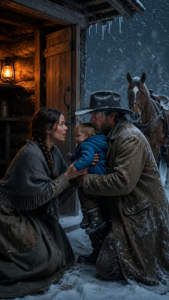
For years, people in the Wyoming Territory told a simple version of the story.
A lonely mountain woman helped a stranded cowboy during a snowstorm. The cowboy later turned out to be wealthy. They fell in love. They lived happily ever after.
It was a story repeated around campfires because it was comforting.
But the truth was far more complicated.
Behind that winter night stood a grieving father trying to escape a life he no longer wanted, a young woman carrying wounds nobody could see, and a child whose future depended on a single act of kindness from a stranger.
What happened on that mountain was not really a love story.
It was a story about loneliness.
About loss.
About the strange ways broken people sometimes save one another.
And it all began with three desperate knocks on a cabin door.
The wind arrived before the storm.
Old settlers often said that mountains spoke before they attacked. First came the silence. Then came the wind. Then came the snow.
That evening, the mountain had fallen unnaturally quiet.
The kind of quiet that made a person look over their shoulder.
Clara Whitfield noticed it while feeding the last pieces of firewood into her stove.
The cabin creaked softly around her.
Every sound mattered when a person lived alone.
Every loose board.
Every gust of wind.
Every distant howl from wolves roaming the ridge.
Especially during winter.
At twenty-three years old, Clara had already learned lessons that many people spent an entire lifetime avoiding.
She had learned what it meant to bury someone she loved.
She had learned what hunger felt like when there was no money left.
She had learned how loneliness could become so familiar that it almost felt like another person living in the room.
Two winters earlier, her father had died suddenly while repairing fencing after a heavy storm.
One moment he was there.
The next, he was gone.
No warning.
No final conversation.
No chance to say goodbye.
Just an empty chair beside the fire.
An unfinished cup of coffee.
And silence.
The land had been left to her.
Most people expected her to sell it.
A young woman alone in the mountains had little chance of surviving, according to nearly everyone in town.
The banker expected failure.
The merchants expected failure.
The neighboring ranchers expected failure.
Even some of her father’s friends quietly expected failure.
But Clara remained.
Not because it was easy.
Because leaving felt like losing him twice.
Every fence post held his fingerprints.
Every trail carried memories.
Every sunrise reminded her that this place had once been his dream.
So she stayed.
And winter after winter, she fought to keep that dream alive.
Outside, darkness swallowed the ridge.
The first snowflakes began falling.
Then the wind arrived.
A low howl at first.
Then stronger.
Then stronger still.
Within an hour, the world beyond her windows disappeared entirely.
Snow slammed against the cabin walls.
Branches snapped somewhere beyond sight.
The mountain had become a white wilderness.
No traveler would be foolish enough to be out there tonight.
Or so Clara believed.
Until she heard the knocking.
Three sharp blows.
Sudden.
Violent.
Impossible.
Her body froze instantly.
The wooden spoon slipped from her fingers and clattered against the floor.
The knocking came again.
This time weaker.
Not demanding entry.
Begging for it.
A pulse of fear moved through her chest.
People disappeared in these mountains.
Outlaws traveled through the territory.
Desperate men did desperate things.
Slowly, she reached for the rifle hanging above the fireplace.
The metal felt cold in her hands.
Another knock.
Then silence.
Clara moved toward the window.
Ice coated the glass.
She wiped it away with her sleeve.
At first she saw nothing except swirling white.
Then a shape emerged.
A man.
Tall.
Broad-shouldered.
Barely standing.
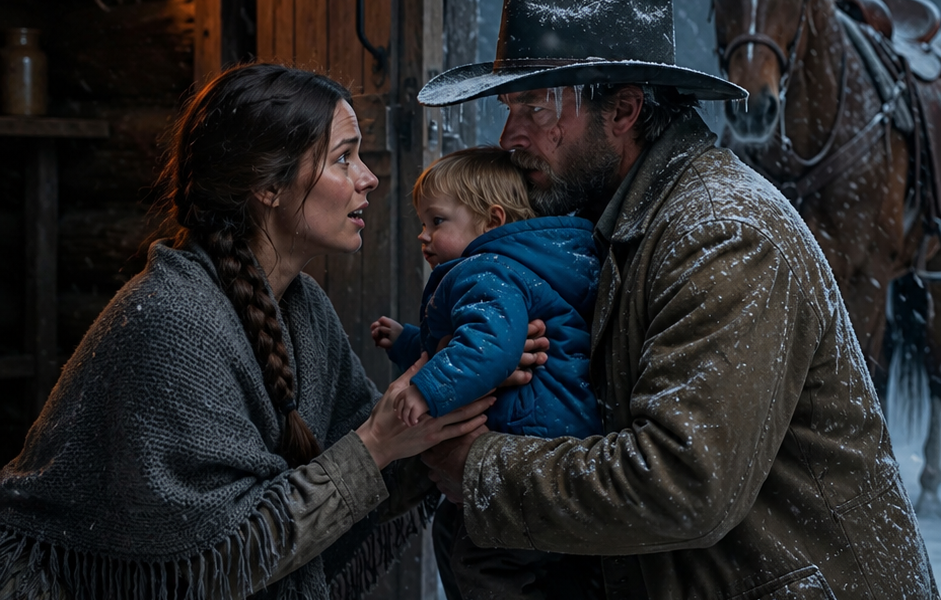
And pressed against his chest was a child.
For a moment Clara simply stared.
The boy looked unconscious.
The man’s face was buried beneath snow and ice.
Behind them stood two exhausted horses trembling against the storm.
The sight instantly changed everything.
Fear remained.
But something else rose stronger.
Compassion.
Her father’s voice echoed from memory.
The same words he had spoken countless times.
“A storm doesn’t care who you are. Rich or poor. Friend or stranger. Out here, we help each other.”
Clara lowered the rifle.
Crossed the room.
And opened the door.
The mountain exploded into the cabin.
Wind screamed inside.
Snow scattered across the floorboards.
Cold air sliced through the room like a knife.
The stranger stepped forward.
His boots dragged heavily across the threshold.
Up close, he looked older than she first thought.
Perhaps thirty-five.
Maybe forty.
Hard years had left their marks.
But what struck Clara most wasn’t exhaustion.
It was grief.
She recognized it instantly.
Because she had seen the same expression every morning when she looked into her own mirror.
The man adjusted the child in his arms.
His voice came out rough.
Almost broken.
“Please.”
Only one word.
Yet it carried more desperation than a thousand speeches.
Clara stepped aside.
The man entered.
The child followed.
And the storm remained outside.
For now.
The boy’s lips had turned blue.
His small hands shook uncontrollably.
Clara immediately wrapped him in the warmest blanket she owned.
A quilt her mother had sewn years before her death.
The child looked no older than eight.
Maybe nine.
He tried to smile despite his condition.
“Thank you, ma’am.”
His manners surprised her.
Most frontier children were loud, restless, and rough around the edges.
This boy spoke carefully.
Politely.
Almost formally.
The stranger crouched beside him.
Every movement revealed concern.
Not the concern of a guardian.
The concern of a father terrified of losing the last person he loved.
Clara recognized that look too.
Because she had once seen it in her own father’s eyes.
She heated water.
Prepared soup.
Added extra potatoes despite knowing food was running low.
The stranger barely touched his meal.
Instead, he watched the boy eat.
Watched him breathe.
Watched him warm beside the fire.
As though he feared looking away might somehow make him disappear.
Hours passed.
Outside, the storm grew even worse.
Inside, another mystery slowly emerged.
The stranger called himself Nathan.
Nothing more.
No last name.
No explanation.
No destination.
No reason for being on the mountain.
Only silence.
And yet silence often reveals more than words.
Clara noticed details.
His hands were rough from labor.
But not permanently worn like a ranch hand’s.
His coat had once been expensive.
The stitching was precise.
The leather boots, though damaged, had been crafted by skilled hands.
The child carried himself differently too.
Even exhausted, he sat upright.
Spoke clearly.
Used words uncommon among frontier families.
These were not ordinary travelers.
Not drifters.
Not settlers.
Certainly not poor.
The realization arrived quietly.
Someone was hiding.
The question was why.
That night Clara lay awake listening to the storm.
The cabin had only one main room.
Nathan and the boy slept near the fire.
Moonlight occasionally slipped through cracks in the walls.
She watched their shadows rise and fall with the flames.
At some point the boy began dreaming.
Softly at first.
Then louder.
“No… please don’t go…”
The words were barely audible.
Nathan woke instantly.
Not startled.
Prepared.
As though this happened often.
He knelt beside the child.
Placed a hand gently on his shoulder.
“It’s alright, Tommy.”
Tommy.
The first real name Clara had heard.
The boy slowly calmed.
Moments later he fell asleep again.
Nathan remained awake.
Staring into the fire.
His face illuminated by flickering orange light.
And for the first time, Clara noticed tears.
Not many.
Just enough.
A man crying when he believed nobody could see.
She looked away immediately.
But the image stayed with her.
Whoever Nathan was…
whatever he was running from…
it had already cost him dearly.
And Clara had the unsettling feeling that the answers would arrive much sooner than either of them expected.
Because beyond the mountain, beyond the storm, beyond the fragile safety of her cabin, forces were already moving.
Men were searching.
Secrets were spreading.
And somewhere in the darkness, a decision made long ago was quietly making its way toward all three of them.
What none of them yet understood was that the storm outside was not the greatest danger approaching that winter.
The real storm had not arrived.
Not yet.
The next morning arrived wrapped in silver light.
The storm had not ended, but it had weakened enough for the mountains to reveal themselves again.
Outside the cabin window, the world looked untouched.
Snow covered every ridge, every pine tree, every fence post.
It was beautiful.
And dangerous.
Clara rose before sunrise, as she always did.
Years of living alone had taught her that winter rewarded discipline and punished hesitation.
She expected to find her guests sleeping.
Instead, Nathan was already outside.
Working.
Through the frosted glass she watched him split wood beside the shed.
The rhythmic crack of the axe echoed through the morning air.
There was something strangely comforting about the sound.
It reminded her of another winter.
Another man.
Her father.
For a moment, grief and memory became impossible to separate.
She looked away.
When she stepped outside carrying a bucket of water, Nathan immediately took it from her.
Not because she couldn’t carry it.
Because he noticed.
Small acts often reveal more about a person than grand gestures.
Clara had learned that long ago.
Most men who came through the territory wanted to impress people.
Nathan seemed interested only in helping.
That difference mattered.
By noon, half a dozen repairs around the property had already been completed.
A loose gate now stood straight.
Broken fencing had been reinforced.
Firewood was stacked neatly against the cabin wall.
Tommy spent the afternoon chasing chickens and laughing whenever one escaped his reach.
The sound surprised Clara.
Not because children laughed.
Because she had forgotten what laughter sounded like around her home.
Loneliness changes people in ways they rarely notice.
It doesn’t simply make life quieter.
It changes the rhythm of existence itself.
Meals become shorter.
Conversations disappear.
Days blur together.
And eventually a person forgets what it feels like to share space with others.
Tommy changed that within hours.
By evening, the cabin felt different.
Warmer somehow.
Not because of the fire.
Because of life.
After supper, Clara found herself studying Nathan while he repaired a lantern near the hearth.
He worked carefully.
Patiently.
The kind of patience usually earned through hardship.
The firelight revealed details she had missed before.
A scar along his jaw.
Another near his left hand.
Old wounds.
Not recent.
Not accidental.
She wondered about them.
But said nothing.
The frontier taught people to respect silence.
Everyone carried stories they weren’t ready to tell.
Hours later, Tommy finally fell asleep.
Snow drifted quietly outside.
The fire crackled softly.
And for the first time since arriving, Nathan spoke without being asked.
“My wife used to love winter.”
The words emerged unexpectedly.
As though they had escaped before he could stop them.
Clara remained silent.
Allowing space.
Sometimes people need permission to continue.
Nathan stared into the flames.
“She said snow made the world honest.”
A faint smile appeared.
Then vanished.
“We lost her last year.”
The room became still.
Clara felt her chest tighten.
Not because she knew the woman.
Because she understood loss.
The language of grief sounds remarkably similar no matter where it comes from.
Nathan continued.
“The baby didn’t survive either.”
His voice almost disappeared at the final sentence.
Tommy shifted in his sleep.
Nathan looked toward him immediately.
The reaction was instinctive.
Protective.
Heartbreaking.
Clara suddenly understood something.
This journey was never about travel.
It was about escape.
A grieving father and a grieving son running from memories too painful to face.
Yet another question remained unanswered.
What could be so terrible that it drove them into the middle of a Wyoming winter?
Nathan offered no further explanation.
And Clara didn’t ask.
But that night she lay awake longer than usual.
Thinking about him.
Thinking about Tommy.
Thinking about how strange life could be.
Three days earlier she had been entirely alone.
Now she found herself wondering what would happen when they left.
The realization frightened her.
Because she already knew the answer.
The cabin would feel empty again.
Far emptier than before.
The storm finally broke two days later.
Blue sky stretched across the mountains.
Sunlight glittered across fresh snow.
And with the return of clear weather came an unavoidable reality.
Travel would soon be possible.
Departure would soon follow.
Tommy sensed it first.
Children often recognize emotional truths before adults are willing to admit them.
At breakfast he pushed food around his plate.
Quiet.
Distracted.
Unhappy.
“Do we have to leave?”
The question hung in the room.
Nathan stopped eating.
Clara stopped breathing.
For several seconds nobody answered.
Then Nathan spoke.
“We can’t stay forever, son.”
Tommy lowered his eyes.
The disappointment on his face felt almost painful to watch.
Later that afternoon, Clara climbed the ridge above the cabin to gather trapped branches for firewood.
She expected solitude.
Instead, she found Nathan standing there.
Looking toward the distant valley.
The wind tugged gently at his coat.
For a long time neither spoke.
Then Clara noticed something.
His expression.
Not fear.
Not sadness.
Calculation.
Like a man expecting trouble.
“You keep watching the road.”
Nathan didn’t answer immediately.
When he finally did, his voice sounded tired.
“Sometimes trouble takes longer to find you than you expect.”
The statement lingered.
Heavy.
Meaningful.
Clara turned toward him.
“Who are you running from?”
Nathan’s eyes remained fixed on the horizon.
“Not who.”
A pause.
“What.”
The answer revealed almost nothing.
Yet somehow it revealed everything.
The conversation ended there.
But the tension remained.
Three days later, trouble arrived.
Not quietly.
Not gradually.
Like most trouble, it arrived on horseback.
Clara saw the riders first.
Three men approaching from the valley trail.
Fast.
Purposeful.
The moment Nathan noticed them, something changed.
The warmth she had come to know vanished.
His posture hardened.
His eyes narrowed.
And suddenly he looked less like a weary traveler and more like a man prepared for battle.
Fear moved through Clara’s stomach.
Because people cannot fake reactions like that.
Whatever history connected Nathan to those riders, it was serious.
Very serious.
The lead rider reached the property first.
Young.
Well dressed.
Arrogant.
The kind of arrogance wealth often mistakes for strength.
His horse stopped near the fence.
A smile spread across his face.
Cold.
Calculated.
Cruel.
“Miss Whitfield.”
Clara immediately disliked the way he said her name.
As though he already owned something that belonged to her.
The rider removed his gloves slowly.
Deliberately.
His gaze drifted toward Nathan.
Recognition flashed instantly.
There was no surprise.
Only satisfaction.
Like a hunter finally locating wounded prey.
“There you are.”
Silence followed.
Nathan didn’t move.
Didn’t respond.
Didn’t blink.
Tommy quietly stepped closer to him.
The rider laughed.
Not warmly.
Predatorily.
“I’ve been looking everywhere.”
The air felt heavier now.
Danger often arrives before violence.
It can be felt.
Seen.
Heard.
Clara felt it in the pit of her stomach.
The rider introduced himself as Lucas Mercer.
A representative connected to powerful interests expanding throughout the territory.
Railroads.
Banks.
Investors.
Men whose decisions changed landscapes.
And destroyed lives.
Within minutes the real purpose of his visit became clear.
He wanted Clara’s land.
Not because he cared about it.
Because others did.
A proposed railroad route would pass directly through the valley below.
Land values would explode.
Fortunes would be made.
And Clara stood in the way.
Lucas made his offer politely.
Then less politely.
Then not politely at all.
Finally he revealed information nobody outside the bank should have known.
Her debts.
Her overdue payments.
Her vulnerability.
Clara’s face flushed with humiliation.
The knowledge felt invasive.
Personal.
Cruel.
Yet before she could respond, Nathan stepped forward.
Only one step.
Nothing more.
But the effect was immediate.
Lucas stopped smiling.
Something passed between the two men.
Recognition.
History.
Conflict.
Old wounds.
The moment lasted only seconds.
Yet Clara knew with absolute certainty:
This was not their first encounter.
And whatever connected them had not ended.
Not even close.
As the riders finally departed, snow swirled behind them.
The property fell silent once more.
But the peace was gone.
Nathan watched the disappearing figures until they vanished completely.
Then he spoke.
“They found me.”
Not “they found us.”
Not “they found this place.”
Me.
The single word changed everything.
Because it confirmed what Clara had suspected from the beginning.
The storm had not brought strangers to her door.
It had brought a secret.
And now that secret was catching up to them.
The question was no longer whether trouble would come.
The question was how much it would cost when it finally arrived.
And neither Clara nor Nathan yet understood that the greatest revelation was still waiting.
Hidden behind a name.
A fortune.
And a past powerful enough to change all of their lives forever.
The mountains have a way of keeping secrets.
For generations, storms had buried wagon trails, hidden graves, erased footprints, and swallowed entire stories before they could reach the outside world.
But no mountain was powerful enough to bury the truth forever.
The truth was already moving toward Clara.
And it arrived the following morning.
The sky hung low and gray over the ridge.
A strange stillness covered the valley.
Even the birds seemed absent.
Nathan had barely spoken since Lucas’s visit.
Tommy noticed.
Children always notice.
Though they may not understand fear, they recognize its shape.
At breakfast, Tommy pushed a biscuit around his plate.
“You know that man?” he finally asked.
Nathan stared at the table.
“Yes.”
“You don’t like him.”
“No.”
Tommy looked between Nathan and Clara.
“Is he dangerous?”
The room became silent.
Nathan took a slow breath.
Then answered honestly.
“Sometimes dangerous people don’t carry guns.”
Clara watched him carefully.
She had spent years reading weather patterns.
Studying clouds.
Learning how to recognize a storm before it arrived.
The same instinct now whispered inside her.
Something was coming.
Something bigger than a land dispute.
Something bigger than Lucas Mercer.
The answer arrived shortly after noon.
An elderly rider climbed the ridge and stopped outside the cabin.
Unlike Lucas, he carried no arrogance.
Only urgency.
Nathan recognized him immediately.
The color drained from his face.
“Samuel.”
The old man removed his hat.
His expression carried the weight of bad news.
The kind of news that changes lives.
For a long moment neither spoke.
Then Samuel said quietly:
“Your father is dying.”
The words landed like a gunshot.
Tommy looked confused.
Clara froze.
Nathan didn’t move at all.
It was as if time itself had stopped.
The wind whispered through the pines.
Snow slipped from a nearby branch.
Somewhere in the distance, a crow called.
But inside Nathan’s eyes, an entire world had suddenly reopened.
A world he had spent more than a year trying to leave behind.
Samuel stepped forward.
“The doctors don’t expect much time.”
Still silence.
Then Nathan laughed.
Not because anything was funny.
Because pain sometimes disguises itself.
“My father has money enough to buy every doctor west of Chicago.”
“This time money isn’t helping.”
The old man lowered his gaze.
“Nothing is.”
Tommy looked toward Nathan.
“Grandfather?”
Nathan nodded slowly.
The boy had not seen his grandfather since they left.
Truthfully, he barely remembered him.
Samuel turned toward Clara.
His expression softened.
“You must be Miss Whitfield.”
Clara nodded.
The old man smiled sadly.
“He spoke of you.”
Nathan shot him a warning look.
But it was too late.
Clara felt her heartbeat quicken.
“He did?”
Samuel smiled again.
“More than once.”
For the first time in days, Nathan looked uncomfortable.
Not threatened.
Not angry.
Embarrassed.
And somehow that touched Clara more deeply than any compliment ever could.
That evening, after Tommy had fallen asleep, Nathan finally told the truth.
Not part of it.
All of it.
The fire crackled softly as shadows danced across the cabin walls.
Outside, darkness settled over the mountains.
Inside, decades of secrets began to emerge.
“My full name is Nathaniel Harrison.”
Clara said nothing.
She already knew the name carried weight.
Even before he explained.
“Harrison Rail.”
Nathan looked into the flames.
“My grandfather started it with two crews and sixteen miles of track.”
His voice remained calm.
Detached.
Almost documentary-like.
As if he were describing someone else’s life.
“By the time my father took over, it became one of the largest railroad operations in the territory.”
Clara listened carefully.
Nathan continued.
“Wealth creates a strange illusion.”
“What illusion?”
“That success protects people from suffering.”
His eyes darkened.
“It doesn’t.”
The fire shifted.
A log collapsed inward.
Sparks drifted upward.
“My wife died giving birth.”
The words sounded even heavier than before.
Because now Clara understood the scale of the loss.
This wasn’t simply a grieving rancher.
This was a man who possessed everything society promised would create happiness.
Money.
Influence.
Security.
Status.
And none of it had saved the person he loved most.
Nathan swallowed hard.
“For months afterward everyone expected me to return to work.”
A bitter smile appeared.
“They wanted meetings.”
He laughed quietly.
“Business plans.”
Another pause.
“Expansion projects.”
The smile disappeared.
“My son cried himself to sleep every night.”
The cabin became silent again.
Nathan stared into the flames.
“I realized something.”
“What?”
“The company could survive without me.”
His voice cracked slightly.
“But Tommy couldn’t.”
For several moments Clara couldn’t speak.
Because she understood.
Not the wealth.
Not the empire.
But the grief.
The unbearable choice between surviving and truly living.
Nathan had walked away.
Not from responsibility.
From emptiness.
The next morning Clara woke before dawn.
Nathan was already gone.
So was Tommy.
Fear shot through her instantly.
She rushed outside.
Then stopped.
The sight before her stole the breath from her lungs.
Father and son stood beside the unfinished woodshed.
Building.
Laughing.
Working together.
Tommy’s laughter echoed across the snow-covered ridge.
Nathan smiled.
A genuine smile.
Perhaps the first Clara had ever seen.
Not forced.
Not polite.
Real.
And suddenly she understood something important.
Nathan hadn’t come to the mountain looking for shelter.
Not really.
He had come looking for life.
Neither of them realized how little time remained before everything changed.
Three days later, Lucas returned.
This time he didn’t come alone.
More riders accompanied him.
More authority.
More confidence.
More certainty that he would win.
The confrontation happened in the valley town below.
Nearly everyone came to watch.
Farmers.
Shopkeepers.
Ranch hands.
Bankers.
Curious children.
News traveled quickly on the frontier.
And stories traveled even faster.
By sunset, the entire town had gathered near the courthouse square.
Lanterns flickered against the growing darkness.
Cold air rolled through the streets.
Lucas stood proudly on the wooden platform.
He looked like a man expecting victory.
Nathan looked like a man expecting war.
Clara stood beside him.
Tommy held her hand tightly.
Then Lucas delivered the announcement.
Loud enough for everyone to hear.
“Allow me to introduce Nathaniel Harrison.”
Whispers erupted instantly.
The name spread through the crowd like wildfire.
Nathan remained silent.
Lucas smiled wider.
“Future owner of Harrison Rail.”
More whispers.
More shock.
More curiosity.
Lucas continued.
“The man pretending to be a wandering cowboy.”
The accusation hung in the air.
Waiting.
Expecting shame.
But something unexpected happened.
No one seemed angry.
Because stories matter.
But actions matter more.
An old rancher stepped forward first.
Nathan had repaired his wagon during a blizzard years earlier.
A widow spoke next.
Nathan had paid for medicine after her husband died.
Then another voice.
Then another.
And another.
One by one, people shared memories.
Small acts.
Forgotten kindnesses.
Quiet moments.
Things Nathan himself likely never expected anyone to remember.
Lucas watched helplessly.
His carefully prepared humiliation was collapsing.
Because reputation built through fear is fragile.
Reputation built through character is not.
Then came the final blow.
Lucas turned toward Clara.
Desperate.
Angry.
Cornered.
“You’ll lose that mountain anyway.”
The crowd fell silent.
Lucas smiled coldly.
“Her debts come due tomorrow.”
For one brief moment, Clara felt exposed.
Vulnerable.
Humiliated.
Then Nathan reached into his coat.
He removed several folded documents.
And handed them to the town clerk.
The clerk examined them.
His eyes widened.
Then widened further.
Finally he looked toward Clara.
“Miss Whitfield…”
His voice trembled.
“The debt is paid.”
Silence.
Complete silence.
Lucas stared.
Clara stared.
Even Nathan remained expressionless.
The clerk continued.
“Paid in full.”
A collective gasp swept through the square.
Lucas’s face turned pale.
“What?”
The clerk checked again.
“The land is free and clear.”
The words echoed across the crowd.
Free and clear.
Four simple words.
Yet they changed everything.
Clara looked toward Nathan.
Her eyes filled with tears.
“You did this?”
Nathan nodded once.
Nothing more.
No speech.
No grand performance.
No demand for gratitude.
Just quiet certainty.
Lucas nearly shouted.
“You bought her land!”
Nathan finally spoke.
“No.”
The crowd listened carefully.
“I bought her freedom.”
The difference was impossible to ignore.
Because one act creates ownership.
The other creates possibility.
And deep down, everyone present understood exactly what he meant.
Lucas lost more than an argument that night.
He lost the crowd.
He lost credibility.
And perhaps for the first time in his life, he discovered that wealth alone cannot command respect.
Only character can.
As people slowly dispersed, lantern light flickered across the square.
Snow began falling again.
Gentle this time.
Peacefully.
Nathan turned toward Clara.
For a moment neither spoke.
Years of loneliness.
Months of grief.
Weeks of uncertainty.
All seemed to converge into a single heartbeat.
Then Tommy stepped between them.
Children have remarkable timing.
Especially when adults lose the ability to speak.
The boy looked up at both of them.
His eyes bright.
Hopeful.
And completely sincere.
“Can we go home now?”
The question was simple.
Yet it carried more meaning than anyone around him realized.
Home.
Not a place.
Not a cabin.
Not a mountain.
People.
Belonging.
Safety.
Love.
Nathan looked at Clara.
Clara looked at Nathan.
Neither knew exactly what the future would bring.
But both knew one thing.
The storm that had introduced them was over.
And something entirely different had begun.
Something neither wealth nor hardship could purchase.
A family.
And sometimes, after everything has been lost, after grief has hollowed a person’s heart and loneliness has convinced them they will always remain alone, life delivers an unexpected knock at the door.
Not to take something away.
But to return something that was missing.
The greatest changes rarely arrive with fanfare.
They arrive quietly.
Three knocks.
A winter storm.
A stranger seeking shelter.
And a choice to open the door.
Professional Perspective and Analysis
At first glance, this appears to be a frontier romance.
A poor young woman shelters a stranger during a snowstorm. The stranger later turns out to be wealthy. Love follows, obstacles are overcome, and a family is formed.
That is the version most people would remember.
But the deeper truth of this story exists beneath the romance.
What makes this narrative powerful is not the revelation that Nathan was wealthy.
It is the revelation that wealth was ultimately irrelevant.
Modern audiences often assume that money solves suffering. Popular culture frequently portrays financial success as the final destination of happiness. Yet stories that endure across generations often challenge that assumption.
Nathan Harrison possessed nearly everything society associates with achievement. He inherited influence, status, opportunity, and extraordinary financial security. Yet when tragedy struck, none of those assets could protect him from grief.
The death of his wife exposed a painful reality that psychologists have documented for centuries: human beings are not sustained by possessions alone.
We are sustained by meaning.
By connection.
By belonging.
By purpose.
When those foundations disappear, even the most successful individuals can feel profoundly lost.
Nathan’s journey reflects a phenomenon often observed after traumatic loss. Many grieving individuals experience what experts call an “identity collapse.” The future they imagined suddenly vanishes, leaving them uncertain about who they are without the person they loved.
Nathan’s departure from his former life was not an act of rebellion.
It was an act of survival.
He was not running away from responsibility.
He was searching for something that responsibility alone could not provide.
A reason to keep moving forward.
Clara’s story reveals an equally important psychological truth.
Loneliness is not simply the absence of people.
It is the absence of meaningful connection.
For years, Clara survived physically.
She worked.
She endured.
She persisted.
From the outside, she appeared strong.
And she was.
But strength and loneliness often coexist.
Many people misunderstand resilience. They imagine resilience means never feeling pain, never feeling fear, and never needing help.
True resilience is different.
True resilience means continuing despite those feelings.
Clara remained on the mountain not because she was fearless.
She remained because love for her father gave meaning to hardship.
Yet even the strongest individuals eventually need connection.
The arrival of Nathan and Tommy did not rescue Clara from weakness.
It reminded her of a part of herself that had been buried beneath grief.
Her ability to trust.
Her ability to hope.
Her ability to imagine a future larger than survival.
Tommy serves a particularly important role within the story.
Children in narratives often function as symbols of innocence, but Tommy represents something more complex.
He represents emotional truth.
Throughout the story, adults are constrained by fear, pride, grief, social expectations, and uncertainty.
Tommy is not.
He asks direct questions.
He expresses love openly.
He recognizes home before the adults do.
In many ways, he becomes the emotional compass guiding both Clara and Nathan toward healing.
His character reminds us of an uncomfortable reality: children often perceive emotional truths long before adults are willing to acknowledge them.
The conflict involving Lucas Mercer introduces another layer of meaning.
On the surface, Lucas serves as the antagonist.
But symbolically, he represents a broader social force.
The belief that value can be measured entirely through ownership, influence, and financial gain.
His worldview is transactional.
Everything has a price.
Everything can be acquired.
Everything can be controlled.
The story ultimately rejects that philosophy.
Lucas understands property.
Nathan learns belonging.
Lucas understands power.
Clara understands character.
Lucas sees land as an investment.
Clara sees it as memory.
Those competing perspectives form the emotional heart of the narrative.
The confrontation in town succeeds because it is not merely a battle between two men.
It is a collision between two definitions of wealth.
One definition is financial.
The other is human.
The story suggests that while money can create comfort, it cannot create meaning.
Meaning emerges from relationships, sacrifice, trust, and shared experience.
Another reason this narrative resonates is its use of hospitality.
Across cultures and throughout history, acts of hospitality have often carried profound symbolic significance.
Opening a door to a stranger is never simply about shelter.
It is about recognizing shared humanity.
The decision Clara makes on that stormy night appears small.
Yet it changes multiple lives.
History repeatedly demonstrates this principle.
Many transformative events begin with ordinary acts that seem insignificant in the moment.
A conversation.
A kindness.
A risk.
A door left open.
The most powerful aspect of the story may be its challenge to common assumptions about rescue.
At first, audiences expect Nathan to become Clara’s rescuer because he possesses wealth.
Instead, the opposite occurs.
Clara rescues Nathan first.
Not financially.
Emotionally.
Spiritually.
She offers safety when he is vulnerable.
Dignity when he feels broken.
Acceptance when he expects judgment.
Only later does Nathan help Clara in return.
This reciprocity creates emotional authenticity.
Healthy relationships are rarely built upon one person saving another.
They are built upon people healing together.
That distinction matters.
The story endures because it reflects a universal human desire.
Not the desire to become rich.
Not the desire to become famous.
The desire to be known.
To be accepted.
To find a place where we no longer need to pretend.
A place where our losses are understood.
A place where our presence matters.
A place we can call home.
And perhaps that is why stories like this continue to resonate across generations.
Because beneath the snowstorms, the frontier landscapes, the railroads, and the romance lies a truth that belongs to all of us.
Every human being is searching for connection.
Every human being carries unseen wounds.
And every human being hopes that somewhere, beyond disappointment and hardship, there is still a door willing to open.
Final Conclusion
Years later, people would remember different parts of the story.
Some remembered the railroad heir who disappeared into the mountains.
Others remembered the stubborn young woman who refused to abandon her father’s land.
Some remembered the public confrontation in town.
Others remembered the debt that vanished overnight.
But memory often focuses on outcomes while overlooking beginnings.
The most important moment did not happen in the town square.
It did not happen when secrets were revealed.
It did not happen when debts were erased.
It happened on a winter night when a lonely woman heard three knocks on her cabin door.
She could have ignored them.
She could have chosen fear.
She could have convinced herself that someone else would help.
Instead, she opened the door.
And in doing so, she changed the course of three lives.
Perhaps that is the hidden truth behind every great human story.
The moments that transform our futures rarely announce themselves.
They arrive disguised as interruptions.
As inconveniences.
As strangers.
As unexpected responsibilities.
As opportunities to choose compassion when fear would be easier.
Clara believed she was offering shelter to a desperate traveler.
In reality, she was welcoming a new chapter into her life.
Nathan believed he was seeking refuge from a storm.
In reality, he was traveling toward healing.
Tommy believed he was simply looking for warmth.
In reality, he was finding a family.
The mountain eventually forgot their footprints.
The snow melted.
The seasons changed.
Years passed.
Yet the lesson remained.
Because some storms destroy what we love.
And some storms lead us to it.
And sometimes, the difference between those two outcomes is nothing more than the courage to open a door.
Some stories fade with time.
But stories that reveal the deepest truths about love, loss, resilience, and human connection continue to live long after the final page is turned.
Note: Some content was generated using AI tools (ChatGPT) and edited by the author for creativity and suitability for historical illustration purposes.