
Australian Man Charged Over Thai Teenager’s Death: The Timeline, the Evidence, and the Questions That Could Shape the Case
A murder investigation in Thailand has drawn international attention after Australian national Simon Carman was arrested and charged over the death of 17-year-old Tunchanok “Nong Cake” Donhomla. The case has shocked both Thailand and Australia, not only because of its disturbing allegations but also because of the detailed surveillance evidence released by Thai investigators and the serious legal consequences that could follow.
Authorities allege that the teenager’s body was concealed inside a suitcase before being abandoned near railway tracks in Pattaya, one of Thailand’s most visited tourist destinations. Carman, a 46-year-old British-born Australian truck driver, denies intentionally killing the teenager, claiming that he acted in self-defense after an alleged confrontation.
As the investigation continues, many of the most important questions have yet to be answered. While prosecutors believe the CCTV footage, forensic evidence, and witness testimony establish a compelling timeline, the defense is expected to challenge whether the killing was intentional or occurred during a violent struggle.
What is already clear is that this case has become far more than another criminal investigation. It has reignited debate over the protection of vulnerable young people, the responsibilities of foreign visitors, and how international criminal cases unfold under Thailand’s legal system.
A Meeting That Ended in Tragedy
According to Pattaya police, Carman and Tunchanok first met along Pattaya’s Beach Road, an area commonly referred to locally as Coconut Bar. The district is well known for its concentration of nightlife, food vendors, bars, and entertainment venues that attract both tourists and local workers.

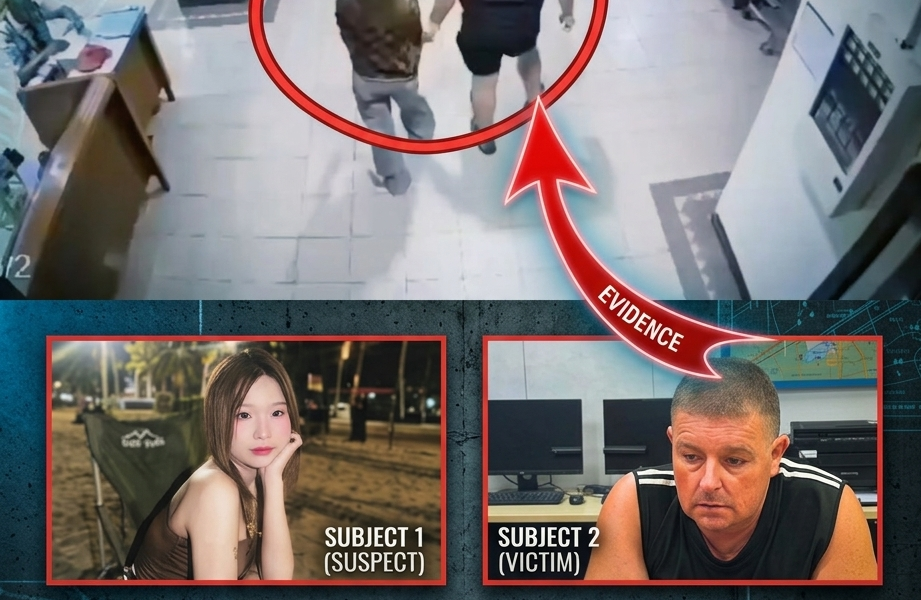
Investigators say CCTV cameras recorded the pair walking together beneath palm trees before entering Carman’s condominium at approximately 3:34 a.m. on June 25.
Police allege that the two had agreed to meet after discussing payment. Carman reportedly told investigators that he had agreed to pay the teenager 1,000 Thai baht but later offered only 500 baht, leading to an argument inside the room.
At this stage of the investigation, authorities have not publicly released forensic findings explaining exactly how Tunchanok died. However, police allege that the dispute escalated into violence.
The prosecution maintains that the evidence collected from the apartment, surveillance footage, and subsequent forensic examination supports a murder charge.
Surveillance Footage Forms the Backbone of the Investigation

One of the strongest aspects of the prosecution’s case appears to be the extensive network of CCTV cameras covering the condominium and surrounding streets.
Investigators say cameras recorded Carman leaving the building between approximately 9:25 p.m. and 9:48 p.m. while pulling a large black suitcase.
The footage allegedly shows him calmly exiting the building before fastening the suitcase onto a Yamaha motorcycle.
Police believe he then traveled roughly ten minutes away toward railway tracks located outside central Pattaya.
According to investigators, cameras recorded the motorcycle disappearing from view for approximately nine minutes before Carman returned to the condominium.
Later, police located the suitcase discarded in long grass beside the railway line.
Inside, investigators found the naked body of Tunchanok.
Authorities stated that visible injuries were present on her face and body. Personal belongings allegedly recovered from inside the suitcase included:
- White Onitsuka sneakers
- Jeans
- Underwear
- Wallet
- Mobile phone case
- Gold bracelet
- Necklace
Police said tattoos visible on the victim matched those shown on her publicly available social media photographs, assisting investigators in confirming her identity.
Missing Person Report Accelerates the Investigation
The investigation moved rapidly after Tunchanok’s friends reported her missing on June 26.

Police searched Carman’s condominium, collecting DNA samples, fingerprint evidence, and examining the motorcycle allegedly seen in surveillance footage.
During the search, investigators reportedly discovered Carman’s passport still inside the room.
Although he had already left the condominium, authorities considered him a person of significant interest and quickly requested an arrest warrant.
Thailand’s Immigration Bureau was then alerted.
This coordination between local police and immigration officials proved crucial.
Rather than allowing a suspected homicide investigation to become an international fugitive case, authorities intercepted Carman at Bangkok’s Suvarnabhumi Airport shortly before he was due to board Jetstar Flight JQ76 bound for Perth.
Police arrested him at approximately 1:15 a.m. on June 27.
Only minutes later, investigators located Tunchanok’s body near the railway line.
The close timing between the arrest and discovery of the body has become one of the defining moments of the investigation.
Timeline of Key Events
June 25
3:34 a.m.
CCTV allegedly records Carman and Tunchanok entering his condominium together while holding hands.
9:25–9:48 p.m.
Cameras allegedly capture Carman leaving with a large suitcase before riding away on his motorcycle toward nearby railway tracks.
9:57–10:06 p.m.
Surveillance footage reportedly shows Carman returning alone.
June 26
11:36 a.m.
Friends file a missing-person report for Tunchanok.
2:26 p.m.
Carman leaves the condominium.

Police later search the room, recover evidence, and request an arrest warrant.
June 27
1:15 a.m.
Carman is arrested at Suvarnabhumi Airport before boarding a flight to Australia.
1:30 a.m.
Police locate Tunchanok’s body concealed inside a suitcase near railway tracks.
Charges Filed
Thai investigators have formally charged Carman with multiple offenses:
- Murder
- Concealing a body
- Moving or destroying a body
- Taking a minor between 15 and 18 years old for sexual purposes
Under Thai law, individuals under the age of 18 receive additional legal protections regarding sexual exploitation, regardless of circumstances that may differ under the laws of other countries.
If convicted of murder, Carman could face life imprisonment or the death penalty under Thailand’s criminal justice system, although the application of capital punishment depends on judicial proceedings and sentencing decisions.
Carman’s Response
Police later released portions of recorded interviews conducted after Carman’s arrest.
Addressing the victim’s family, he said:
“I feel bad for what happened to your daughter.”
He then added:
“It was out of my control.”
When directly asked whether he had killed Tunchanok, Carman answered:
“No.”
Investigators also questioned visible scratches and bruises observed on his neck and arms.

Carman reportedly claimed the injuries were caused by spiders at the condominium where he had been staying.
He also allegedly told investigators that Tunchanok attacked him with a knife and that he acted in self-defense.
Whether physical evidence supports or contradicts that account will likely become one of the most significant issues during future court proceedings.
Background on the Accused
Australian media reports indicate that Carman is originally British-born before later living in Australia.
He reportedly worked as a truck driver and operated a mobile refueling business servicing routes between Perth and regional Victoria.
Public reporting has also identified previous encounters with Western Australian police, including charges involving disorderly behavior, driving while disqualified, and demanding property with threats.
At this stage, those prior matters are separate from the current homicide case and do not establish guilt regarding the allegations now before the Thai courts.
Authorities have also noted that Carman appeared to travel frequently to Thailand, based on publicly available information from his social media activity.
My Professional Perspective
The graphic nature of this case has understandably dominated headlines. Images of a suitcase abandoned beside railway tracks and surveillance footage showing an ordinary evening turning into an international murder investigation naturally command public attention.
But beneath those disturbing details lies a much broader story—one that deserves careful examination.
The first point many readers overlook is the remarkable speed of the Thai investigation.
Within roughly twenty-four hours of the missing-person report, investigators had gathered surveillance footage, searched the suspect’s accommodation, coordinated with immigration authorities, obtained an arrest warrant, and detained a suspect before he left the country.
That rapid coordination reflects the extensive CCTV infrastructure in urban Thailand and the close communication between local police and immigration officials in serious criminal investigations.
Another important aspect is the central role of digital evidence.
Unlike homicide investigations decades ago that often depended primarily on eyewitnesses, modern prosecutions increasingly rely on surveillance footage, electronic records, forensic science, travel data, and location evidence.
In this case, the prosecution’s narrative appears to be constructed around an uninterrupted sequence of recorded events rather than a single witness account. Whether every piece of that evidence withstands legal scrutiny will ultimately be determined in court, but the investigation illustrates how technology has transformed criminal investigations.
The legal issue of self-defense will almost certainly become another major focus.

Claims of self-defense require courts to examine whether force was reasonably necessary under the circumstances. Even if an initial confrontation occurred, investigators and judges may closely evaluate what happened afterward. Allegations involving concealment of a body, movement of evidence, or attempts to leave the country can become relevant in assessing a defendant’s overall conduct, although those issues are legally distinct from determining whether the original use of force was justified.
There is also a broader social dimension.
Pattaya has long attracted millions of international tourists each year. Alongside legitimate tourism, authorities have repeatedly confronted challenges involving exploitation, organized crime, human trafficking, and the protection of vulnerable young people. This case has inevitably renewed attention to those longstanding concerns, particularly because the alleged victim was 17 years old. Thai law provides specific protections for minors in situations involving sexual exploitation, and those protections shape the additional charges filed in this case.
Another point often overlooked is the importance of avoiding premature conclusions.
Public reaction to disturbing allegations can be immediate and emotional. Yet criminal justice systems are designed to test evidence through formal legal proceedings. Surveillance footage, forensic reports, witness testimony, and expert evidence will all be subject to examination before a court reaches its conclusions. Reporting responsibly means recognizing both the seriousness of the allegations and the presumption of innocence until guilt is established according to law.

The international dimension also matters.
Whenever a foreign national is accused of a serious crime overseas, the case often attracts intense attention in both countries. It raises questions about consular assistance, extradition misconceptions, media coverage across jurisdictions, and differing legal systems. In reality, because the alleged offense occurred in Thailand, Thai courts have jurisdiction, and any legal proceedings will take place under Thai law.
Perhaps the deepest lesson emerging from this investigation concerns how quickly ordinary moments can become evidence in a criminal case.
A casual walk captured on a hotel camera.
A motorcycle journey lasting only minutes.
An airport departure that never happened.
Each ordinary event, viewed separately, may appear insignificant. Together, investigators argue, they form a chronological narrative that prosecutors will present before the court. Whether that narrative ultimately proves guilt beyond a reasonable doubt remains for the judicial process to determine.
That distinction is essential. Headlines often suggest certainty long before trials begin. Good journalism requires separating verified facts from allegations, identifying what investigators claim, what evidence has been publicly described, what the accused says in response, and which questions remain unresolved.

Those unanswered questions include the precise forensic cause of death, whether any weapon has been recovered, whether additional witnesses may emerge, how physical evidence aligns with the self-defense claim, and what conclusions expert forensic testimony will support. The answers to those questions—not public speculation—will shape the outcome of the case.
Conclusion
The death of Tunchanok “Nong Cake” Donhomla has become one of the most closely watched criminal investigations involving an Australian citizen in Thailand in recent years. It combines disturbing allegations, extensive surveillance evidence, international legal issues, and profound human tragedy.
For the victim’s family, the case represents an immeasurable personal loss. For the accused, it marks the beginning of a legal process in which the prosecution must prove its case and the defense will have the opportunity to challenge the evidence. For investigators, it is a test of whether forensic science, digital records, and witness testimony can establish a complete and reliable account of what occurred.
Beyond the headlines, this story is a reminder that every criminal investigation unfolds in two stages: first in the court of public opinion, and then—more importantly—in a court of law. The final judgment will depend not on speculation or emotion, but on evidence that withstands judicial scrutiny.
As the proceedings move forward, one question remains at the center of this case: will the full body of evidence confirm the prosecution’s reconstruction of events, or reveal a more complex sequence of circumstances than the public currently understands?