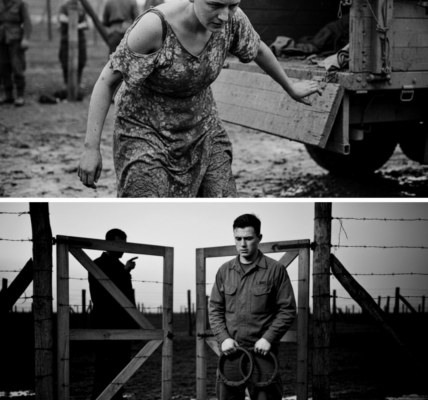
The first person to notice something was wrong was not Samuel.
It was Ruth.
She was ten years old by then, tall for her age, quiet in the way prairie children often were, and possessed of an unsettling habit of seeing things adults missed. One evening in late August, while the sky burned red over the western grasslands and the sheep drifted home in long pale lines, she stood beside the barn door and watched a rider appear on the distant ridge.
The rider stopped there.
Not for a moment.
For nearly an hour.
Just watching.
The figure never approached the house. Never waved. Never called out.
Simply watched.
Then disappeared.
When Ruth mentioned it at supper, Samuel set down his fork.
The room grew still.
Emily noticed it immediately.
The reaction was too small for anyone else to see.
But she saw the muscle tighten along Samuel’s jaw.
Just once.
“Probably a traveler,” he said.
Yet he did not sound convinced.
And for reasons she could not explain, neither was she.
That night the prairie wind arrived after midnight.
It rattled the windows and sighed beneath the eaves.
Emily woke to the sound of boots crossing the porch.
Not approaching.
Leaving.
She sat upright.
The room was dark except for moonlight.
When she looked through the curtain, she saw Samuel moving across the yard with a lantern.
Heading toward the old wool shed.
The shed nobody used anymore.
The one that remained locked.
The one he had never once offered to show her.
For months she had ignored it.
Now she found she could not.
The lantern disappeared inside.
Minutes passed.
Ten.
Twenty.
Almost forty.
When Samuel finally emerged, he carried nothing.
Yet his face looked older than it had the evening before.
As though he had been speaking with ghosts.
The next morning Emily said nothing.
Neither did he.
But secrets have a smell.
And she had learned long ago that hidden truths always reveal themselves eventually.
Especially on the frontier.
Especially when money begins to appear where none should exist.
Because by autumn the farm was thriving.
Thriving too quickly.
The wool contracts she negotiated with eastern buyers brought prices Samuel had never imagined.
The flock doubled.
Then nearly tripled.
New fencing appeared.
A second barn was built.
Neighbors who once pitied them now rode miles to ask advice.
People called it a miracle.
Emily did not.
Miracles rarely came wrapped in silence.
And Samuel remained silent about one thing.
Always one thing.
The locked shed.
Then came the stranger.
He arrived just before the first snow.
A black-coated rider with silver in his beard and cold eyes that seemed to measure everything they touched.
The town recognized him immediately.
No one looked pleased.
Old conversations stopped when he entered buildings.
Storekeepers lowered their voices.
Men turned away.
His name was Elias Crowe.
And the moment Samuel saw him, all color drained from his face.
Emily saw it happen.
Saw fear.
Real fear.
For the first time.
Crowe rented a room above the hotel.
Stayed three days.
Asked questions.
Lots of questions.
Questions about Samuel.
Questions about the farm.
Questions about wool.
Questions about a man named Daniel Mercer.
The name meant nothing to Emily.
Yet every time Crowe spoke it, Samuel became quieter.
The mystery deepened.
On the fourth day Crowe rode out to the farm.
Emily watched him approach from the kitchen window.
Snow drifted across the pasture.
The sheep clustered near the lower fence.
Samuel stepped onto the porch before the rider even arrived.
As though he had been expecting him for years.
The two men stood in the yard.
Speaking softly.
Too softly to hear.
But Emily saw enough.
Crowe handed Samuel something.
A folded paper.
Samuel read it.
Then looked toward the locked wool shed.
Crowe followed his gaze.
And smiled.
It was not a pleasant smile.
The kind of smile a man wears when he already knows the outcome.
That night Samuel barely touched his supper.
Ruth watched him.
Emily watched him.
The silence in the room felt heavier than winter.
Finally Ruth went upstairs.
The moment she disappeared, Emily placed her hand over Samuel’s.
“Who is Daniel Mercer?”
The question landed like a gunshot.
Samuel stared at her.
Long enough for the fire to crack twice in the stove.
Then he whispered.
“My brother.”
Emily had never heard of him.
Not once.
Not in two years.
Not ever.
And somehow she knew the real story had only begun.
Samuel stood.
Walked to the cupboard.
Removed a small iron key.
The key to the locked shed.
Without speaking, he handed it to her.
“Tomorrow,” he said.
“If you’re still willing to stay after you learn the truth.”
Emily slept very little.
The prairie seemed different somehow.
Darker.
Older.
As though something buried long ago had finally begun pushing upward through the soil.
Morning arrived gray and bitter cold.
Samuel left before sunrise.
He did not explain where he was going.
Emily waited until the sound of hoofbeats vanished.
Then she crossed the yard.
The key felt heavy.
The shed door resisted before opening.
Dust rose immediately.
The smell of old wood.
Old wool.
Old years.
Sunlight slipped through cracks in the walls.
And there, beneath a canvas tarp, stood three iron-bound chests.
One was open.
Inside were bundles of letters.
Photographs.
Ledgers.
Newspaper clippings.
Emily picked up the first clipping.
The date stunned her.
Nearly fifteen years earlier.
The headline read:
OUTLAW GANG ROBS UNION PACIFIC PAYROLL.
THREE DEAD.
ONE MISSING.
Below the article was a photograph.
Five men.
Young.
Hard-eyed.
Armed.
One of them was Samuel.
Emily froze.
For several seconds she forgot how to breathe.
The man in the photograph looked younger.
Wilder.
But unmistakably Samuel.
Beside him stood another man.
A near twin.
Daniel Mercer.
The brother nobody had mentioned.
The brother everyone seemed to fear.
The deeper she searched, the worse it became.
Train robberies.
Stagecoach attacks.
Posses.
Disappearances.
Murder accusations.
Names crossed out in ink.
Bounties.
And one final article.
Daniel Mercer had vanished after a robbery near Dodge City.
Presumed dead.
Body never found.
Emily sat on an overturned crate.
Unable to move.
Unable to understand.
Because the Samuel she knew was not this man.
Could not be.
Yet the evidence surrounded her.
Then she found the letter.
The final letter.
Written in Samuel’s hand.
Never mailed.
Never sent.
Never finished.
Dear Daniel,
If you are alive, I need you to know I tried.
I tried to leave that life behind.
I buried the money.
I buried the guns.
I buried every part of who we were.
But I cannot bury you.
Not anymore.
The letter ended there.
No signature.
No explanation.
Only silence.
The same silence that had haunted the farm from the beginning.
When Samuel returned after dark, Emily was waiting.
The letters lay on the table.
The photograph beside them.
He looked at everything.
Then sat down.
Like a man finally surrendering to judgment.
And he told her the truth.
Years earlier he and Daniel had ridden with outlaws.
Not because they were evil.
Because they were desperate.
Their father had died.
The banks took everything.
The frontier offered few mercies.
One bad decision became another.
Then another.
Until blood stained their hands.
Not directly.
But enough.
Enough to destroy a soul.
Samuel left after a payroll robbery turned deadly.
Daniel did not.
The brothers separated.
Never saw each other again.
Or so Samuel believed.
Until Elias Crowe arrived.
Because Crowe had news.
Daniel Mercer was alive.
And coming.
The revelation struck harder than any storm.
Daniel alive.
After fifteen years.
After all this time.
After Samuel had built an entirely new life.
But Crowe carried another truth.
Daniel wasn’t coming for reconciliation.
He was coming for revenge.
Because Daniel believed Samuel had betrayed him.
Believed Samuel had stolen the gang’s hidden fortune.
Believed Samuel had abandoned him to die.
And now he wanted payment.
The final weeks before Christmas passed beneath a cloud of dread.
Every distant rider became a threat.
Every barking dog raised alarm.
Every knock at the door felt dangerous.
Then one night the dogs exploded into furious barking.
Samuel was already standing before the first sound ended.
Emily saw it in his eyes.
He knew.
Outside, snow swept across the prairie.
A lone rider waited near the gate.
Daniel Mercer.
Older.
Scarred.
Harder than legend.
The two brothers stared at one another across fifteen years of silence.
No greeting.
No embrace.
Only ghosts.
Daniel dismounted slowly.
His hand never strayed far from his revolver.
Samuel stepped forward.
Alone.
Emily watched from the porch.
Ruth beside her.
The wind howled.
The brothers spoke.
Quietly.
Then louder.
Then louder still.
Years of betrayal.
Years of regret.
Years of misunderstanding.
Daniel accused.
Samuel denied.
The argument grew sharper.
More painful.
Until finally Samuel shouted the truth.
The money was still buried.
Exactly where they left it.
He had never touched it.
Never wanted it.
Never returned because he feared becoming the man he once was.
Silence followed.
The kind that changes destinies.
Daniel stared at him.
Searching.
Judging.
Then something extraordinary happened.
The anger disappeared.
Not completely.
But enough.
Because Daniel finally realized something.
Samuel’s wealth had not come from stolen money.
It had come from Emily.
From honest work.
From rebuilding.
From redemption.
The farm itself was proof.
And for the first time in decades, Daniel looked ashamed.
Before dawn the brothers rode together into the hills.
Following old memories.
Following an old map.
Following the last secret.
They returned two days later.
Without the treasure.
Without the gold.
Because they had left it where it lay.
Buried forever beneath frozen earth.
A grave for the men they used to be.
Daniel stayed through winter.
Then spring.
Then summer.
Helping with fences.
Helping with lambing.
Helping with life.
The outlaw slowly disappeared.
The brother returned.
Years later, long after Samuel and Emily became one of the most respected families on the prairie, travelers would ask about the prosperity of the Mercer ranch.
They expected stories about wool.
About markets.
About business.
Instead old-timers would smile.
Then glance toward the western horizon.
Toward the land where secrets slept beneath grass and snow.
And they would tell a different story.
A story about a woman who arrived with nothing.
A broken ranch.
A widower carrying ghosts.
A child waiting for hope.
And a buried fortune that turned out not to be gold at all.
Because the real treasure hidden beneath that lonely prairie was redemption.
The kind bought not with money, but with sacrifice.
Not with luck, but with forgiveness.
And according to the oldest people in that country, if the wind is right and the evening sun falls low across the grass, you can still see the Mercer ranch standing against the horizon—proof that sometimes the greatest legends of the Old West were not built by gunslingers or outlaws, but by ordinary people brave enough to choose a different ending than the one fate had written for them.
Note: Some content was generated using AI tools (ChatGPT) and edited by the author for creativity and suitability for historical illustration purposes.