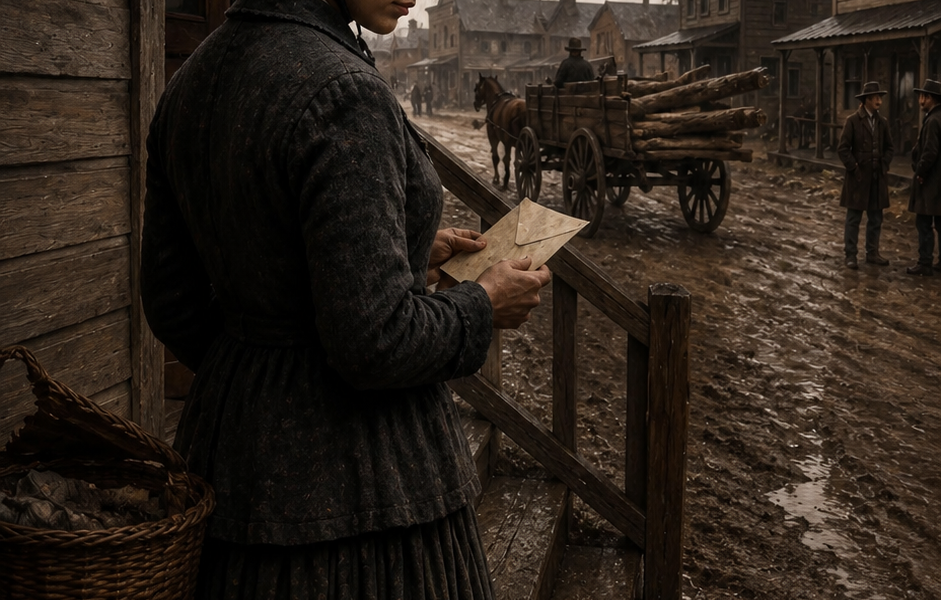

The first grave appeared before she ever saw the ranch.
Not on a hill. Not beside a church. Not marked by any minister’s blessing.
It stood alone in the middle of the prairie.
A single weather-beaten cross leaning crooked against the endless Kansas wind.
The train had barely slowed when Eleanor Finch noticed it through the frosted glass.
No fence.
No flowers.
No name.
Only a cross and miles of empty grass stretching beneath a sky so vast it looked capable of swallowing entire lives.
The sight should have meant nothing.
Yet she could not look away.
Because someone had tied a strip of red cloth around the wood.
Fresh cloth.
Not old.
Not forgotten.
Someone still visited that grave.
Someone still remembered.
And for reasons she could not explain, Eleanor felt a chill crawl through her chest that had nothing to do with the February cold.
Three days earlier she had been a woman with nowhere left to go.
Now she was traveling toward a stranger she had agreed to marry.
A man she had never seen.
A ranch she had never visited.
A future she could not imagine.
And somehow that lonely grave felt connected to all of it.
Years later, when old men in Dry Creek refused to speak certain names after sunset, they would claim the truth had begun there.
Not at the ranch.
Not with the sheep.
Not with the fortune.
But with the grave.
Because the grave belonged to a dead man.
The problem was that the dead man wasn’t supposed to be dead.
And by the time Eleanor discovered why, three more people would be buried beneath the prairie sky.
The letter had arrived during the coldest week of winter.
By then Eleanor’s savings had nearly vanished.
Her father was gone.
Her mother had followed him two years later.
The boarding house in Wichita charged more each month than the previous one.
Work was scarce.
Food scarcer.
Hope had become something measured in pennies.
Then came the advertisement.
A sheep rancher near Dry Creek sought a wife.
Practical.
Hardworking.
Capable of managing household affairs and assisting with wool production.
Compensation included lodging, legal marriage, and shared ownership interests.
The language felt less like a proposal than a business contract.
Perhaps that was why she answered.
Romance belonged to people who could afford it.
Survival belonged to everyone else.
Still, there had been one unusual detail.
A sentence handwritten beneath the solicitor’s official text.
Not written by the lawyer.
Written by the rancher himself.
“If you come, come because you want a future—not because you pity mine.”
The line had lingered in her thoughts for weeks.
Most lonely men begged.
Most desperate men exaggerated.
This one had done neither.
Instead he had issued something that sounded strangely like a warning.
She arrived in Dry Creek beneath a gray sky heavy with snow.
The town looked as though it had been assembled from stubbornness and rough lumber.
Wind rattled loose shutters.
Dust rolled along frozen streets.
The church steeple leaned slightly west as though decades of storms had pushed it there.
People noticed her immediately.
They always noticed newcomers.
But there was something different in the way these people stared.
Not curiosity.
Concern.
The blacksmith stopped hammering.
A woman carrying flour froze halfway across the street.
Two cowboys outside the saloon exchanged glances.
No one smiled.
No one waved.
And when Eleanor asked where she might find Jacob Mercer, silence spread through the street like spilled ink.
Finally an elderly shopkeeper pointed toward the livery stable.
“He’s coming.”
Then the old man looked away.
As if he regretted speaking.
Jacob Mercer arrived on horseback.
He was taller than Eleanor expected.
Broad shouldered.
Weathered.
Thirty-five perhaps.
A face shaped by hard winters and harder losses.
Yet none of that caught her attention first.
It was the scar.
A narrow white scar beginning above his eyebrow and disappearing beneath his collar.
The kind left by violence.
The kind people carried for life.
He dismounted without hurry.
Neither smiled.
Neither offered unnecessary words.
“You came.”
His voice sounded rough from disuse.
“Yes.”
He nodded once.
For several seconds they simply studied one another.
Then his eyes shifted toward her luggage.
“You travel light.”
“I’ve learned how.”
Something almost resembling sadness crossed his face.
A fleeting expression gone before she could identify it.
Without another word he lifted her trunk and led her toward a wagon waiting nearby.
As they departed town, Eleanor glanced back.
Half the street was watching.
Not openly.
Not obviously.
But watching nonetheless.
And every face carried the same expression.
The expression people wear when they know something terrible.
Something they hope never returns.
The ranch stood five miles beyond town.
Low hills rolled across the horizon.
Frozen grass bent beneath the wind.
Sheep moved like drifting clouds across distant pastures.
At first glance the property seemed ordinary.
Then she noticed the burned barn.
It stood near the far fence line.
Collapsed.
Blackened.
Long abandoned.
Even from a distance it looked wrong.
Like a wound that had never healed.
Jacob followed her gaze.
His hands tightened slightly on the reins.
“What happened?”
The answer took too long.
“Lightning.”
But Eleanor immediately knew he was lying.
Not because of what he said.
Because of how he said it.
And because lightning doesn’t usually leave bullet holes.
She had seen at least six.
The farmhouse itself felt strangely empty.
Not abandoned.
Not neglected.
Just haunted by absence.
A child’s rocking horse sat on the porch.
A woman’s sewing basket rested beside the fireplace.
Dust covered neither.
Yet something about them suggested they belonged to people no longer there.
People nobody wished to discuss.
The mystery deepened that evening.
At supper Jacob barely spoke.
His twelve-year-old daughter Abigail spoke even less.
The girl possessed her father’s guarded eyes and her mother’s silence.
Eleanor learned the mother’s name only because she found it stitched into an old quilt upstairs.
Sarah.
No one mentioned her.
Not Jacob.
Not Abigail.
Not even the neighbors.
It was as if Sarah Mercer had vanished from history.
And that frightened Eleanor more than death.
Because graves could be visited.
Memories could be mourned.
But erasure was something else entirely.
Three days later Eleanor found the ledger.
Hidden beneath loose floorboards in the wool storage room.
The discovery happened by accident.
She had been inspecting fleece inventory when her boot caught an uneven plank.
The board shifted.
A hollow space waited underneath.
Inside rested a leather-bound ledger wrapped carefully in oilcloth.
The pages contained years of records.
Wool shipments.
Sales.
Breeding notes.
Land purchases.
Nothing unusual.
Until the final entries.
Then everything changed.
Each page contained the same name.
Elias Crowe.
Again.
Again.
Again.
Payments.
Transactions.
Signatures.
And then one final note written in trembling ink.
“If anything happens to me, Crowe knows why.”
No date.
No explanation.
No further entry.
The handwriting belonged not to Jacob.
But to Jacob’s father.
A man dead for seven years.
Eleanor stared at those words while cold spread through her stomach.
Because she recognized the name.
Elias Crowe.
The dead man beneath the lonely grave she had seen from the train.
Or at least the man everyone claimed was buried there.
That night she asked Jacob a simple question.
The reaction nearly confirmed every fear she carried.
His face lost color.
The coffee cup slipped from his fingers.
And for the first time since her arrival, genuine fear appeared in his eyes.
Not anger.
Not annoyance.
Fear.
“Where did you hear that name?”
The room had suddenly become very quiet.
Eleanor realized Abigail had stopped breathing.
The girl’s hands trembled.
Jacob stood slowly.
Then walked to the window.
For a long moment he stared into darkness.
When he finally spoke, his voice sounded older.
“We don’t talk about Elias Crowe.”
“Why?”
“Because talking about him gets people killed.”
Outside, wind struck the house like an unseen fist.
Somewhere in the distance a coyote howled.
And Eleanor understood with absolute certainty that the greatest secret on the prairie had nothing to do with sheep, wool, or marriage.
Something had happened years ago.
Something involving Crowe.
Something involving Jacob’s family.
And whatever truth lay buried beneath the prairie was still powerful enough to terrify living men.
She did not yet know how deep the secret ran.
She did not know that Crowe had once controlled half the county.
She did not know that three ranches had burned in a single night.
She did not know that Sarah Mercer had disappeared while trying to uncover the truth.
And she certainly did not know that the grave beside the railroad tracks was empty.
But before summer arrived, she would learn all of it.
Because some secrets die with the dead.
And some secrets wait patiently beneath the prairie grass until the right soul arrives to uncover them.
Eleanor Finch had just become that soul.
And far beyond the ranch, beneath a sky glowing silver in the moonlight, a lone rider emerged from the darkness.
He stopped beside the forgotten grave.
Looked down.
Then slowly smiled.
Because after ten years hiding in the shadows, he had finally heard that someone was asking questions.
And the name whispered by the wind across the empty prairie was the same name written in the hidden ledger.
Elias Crowe.
The dead man who was still very much alive.
The following morning arrived wrapped in fog.
Not the gentle kind that drifted through river valleys.
This fog crawled low across the prairie like something alive, swallowing fences, corrals, and distant hills until the world seemed reduced to whatever stood within twenty yards of a man’s boots.
Old ranchers feared mornings like that.
Not because of weather.
Because bad news traveled best when nobody could see it coming.
Eleanor was carrying feed toward the lambing shed when she spotted the horse.
At first it appeared as nothing more than a shadow moving inside the mist.
Then the rider emerged.
A stranger.
Tall.
Black coat.
Black hat.
His horse dark as midnight.
The man stopped near the front gate and remained there without speaking.
Watching.
Waiting.
The sight sent a chill through her.
Something about him felt familiar.
Not personally familiar.
Historically familiar.
Like seeing a figure step from a nightmare someone else had once described.
Jacob appeared beside her moments later.
The instant he saw the rider, every muscle in his body tightened.
Abigail, standing on the porch, froze completely.
Nobody moved.
The rider removed his hat.
His hair had gone gray.
But the smile remained young.
Cold.
Predatory.
Confident.
The smile of a man who believed consequences belonged to other people.
“I heard my name being spoken,” the stranger said.
The fog seemed to grow thicker around him.
Jacob’s face drained of color.
For several seconds nobody breathed.
Then Eleanor heard him whisper two words.
“Elias Crowe.”
The rider smiled wider.
And that was when she understood the terrifying truth.
The grave by the railroad tracks was not a memorial.
It was a disguise.
Crowe had hidden behind his own death for ten years.
And now he had returned.
But the most frightening part wasn’t that he was alive.
It was that he seemed completely certain nobody could stop him.
Crowe stayed less than five minutes.
He never crossed the gate.
Never raised his voice.
Never issued a threat.
Yet the entire ranch felt different after he left.
As though darkness had stepped inside and refused to leave.
That evening Jacob finally spoke.
Not because he wanted to.
Because he understood the secret could no longer remain buried.
The truth emerged slowly.
Painfully.
Like an old wound reopening.
Ten years earlier, Elias Crowe had controlled nearly every ranch, freight route, and wool contract within a hundred miles.
Officially he was a businessman.
Unofficially he was something closer to a king.
Men who opposed him lost cattle.
Lost land.
Lost barns.
Sometimes lost their lives.
Nobody could prove anything.
Witnesses disappeared.
Records vanished.
Sheriffs looked away.
Judges forgot names.
Fear became law.
Jacob’s father had been among the few men willing to challenge him.
The old rancher discovered Crowe was stealing profits from dozens of sheep farmers through manipulated contracts and fraudulent buyers.
Families spent years believing they were poor ranchers.
In reality they were being robbed.
The evidence existed.
Ledgers.
Bills of sale.
Witness statements.
Enough to destroy Crowe forever.
Then came the fire.
One night three ranches burned.
Seven men died.
And by sunrise Elias Crowe had supposedly perished inside a freight warehouse consumed by flames.
The county celebrated.
The terror ended.
Or so everyone believed.
But Jacob’s father never believed it.
And apparently Sarah hadn’t believed it either.
At the mention of Sarah, silence filled the room.
Eleanor looked toward Abigail.
The girl stared into the fire.
Her eyes suddenly older than twelve years.
“What happened to her?”
The answer arrived in a whisper.
“She went looking for proof.”
Jacob stared at the flames.
“Three years ago.”
The room seemed smaller.
“Did she find it?”
A long pause.
Then:
“I don’t know.”
But Eleanor knew he was lying.
Not because he wished to deceive her.
Because hope frightened him more than grief.
Over the next weeks clues began appearing.
Tiny fragments.
Pieces of a forgotten puzzle.
A symbol carved into fence posts.
A red cloth tied to distant trees.
Messages left beneath rocks.
Signs invisible to outsiders.
Sarah had left them.
Not for strangers.
For anyone still brave enough to continue her search.
Each clue pointed west.
Toward badlands beyond the Arkansas River.
Toward canyons avoided even by outlaws.
Toward places where maps became guesses.
And legends became warnings.
The journey began in late spring.
Jacob insisted on going alone.
Eleanor refused.
For the first time since arriving, they argued.
Not loudly.
Not cruelly.
But honestly.
Two stubborn souls colliding beneath a prairie sunset.
The argument ended when Abigail quietly placed something on the kitchen table.
A silver locket.
Inside was a faded photograph.
Sarah.
Smiling.
Alive.
And behind the photograph, folded tightly into the metal backing, rested a tiny piece of paper.
Three words.
“Trust Eleanor completely.”
Nobody spoke afterward.
Because suddenly it felt as though Sarah herself had entered the room.
Guiding them.
Warning them.
Perhaps protecting them.
The trail led through forgotten country.
Red cliffs.
Dry riverbeds.
Abandoned mining camps.
Places where old bones disappeared beneath drifting sand.
Each clue brought another revelation.
Crowe had spent ten years rebuilding his empire in secret.
Using different names.
Different businesses.
Different men.
Entire towns unknowingly worked for him.
Entire fortunes flowed into his hands.
And somewhere hidden among those operations existed the final proof capable of destroying everything.
The proof Sarah had died trying to find.
Or so they believed.
Then came the cabin.
A lonely structure buried within a canyon.
Half collapsed.
Nearly invisible.
Jacob recognized it immediately.
Years earlier it had belonged to one of Crowe’s enforcers.
The door hung open.
Dust covered everything.
The place looked abandoned.
Until Eleanor found the teacup.
Clean.
Recently used.
Someone was living there.
Someone hiding.
Then she heard movement.
A footstep.
A gasp.
A shadow retreating into darkness.
Jacob drew his revolver.
The silence became unbearable.
And then a woman stepped into the light.
Thin.
Older.
Gray woven through dark hair.
Scar across one cheek.
Tears filling her eyes.
For several seconds nobody moved.
Nobody spoke.
Because the impossible stood before them.
Sarah Mercer was alive.
The reunion shattered something inside every person present.
Abigail’s mother.
Jacob’s wife.
The woman everyone had mourned.
Gone for three years.
Alive.
Breathing.
Waiting.
Sarah’s story proved even darker than anyone imagined.
Crowe had discovered her investigation.
She escaped before he could kill her.
But she couldn’t return home.
Too dangerous.
Too many spies.
Instead she spent years gathering evidence.
Names.
Accounts.
Witnesses.
Documents.
Enough to expose every crime.
Enough to end Crowe forever.
The final confrontation arrived beneath a storm-dark sky.
Crowe’s men outnumbered them three to one.
Rain hammered the earth.
Lightning tore open the heavens.
The old freight depot—the same place where Crowe had faked his death—became the battlefield where truth finally demanded payment.
Gunfire echoed across the prairie.
Years of fear exploded in a single night.
Men fell.
Secrets surfaced.
Lies died.
When the shooting stopped, Crowe stood alone.
Bleeding.
Cornered.
Finished.
Yet even then he smiled.
Because men like Crowe always believed they could escape.
Always believed somebody else would pay the price.
He raised his revolver.
Not at Jacob.
Not at Eleanor.
At Sarah.
The one witness he feared most.
The shot never came.
A crack of thunder rolled across the prairie.
Crowe staggered.
His weapon slipped from his hand.
And he collapsed onto the muddy ground where his empire finally ended.
For a long moment nobody moved.
Rain washed blood into the earth.
Wind swept across the empty plains.
And the man who had terrorized a generation became nothing more than another forgotten body beneath the vast western sky.
Months later, the sheep ranch stood transformed.
Not because fortune arrived overnight.
Because fear disappeared.
Fair buyers came.
Honest contracts followed.
The flock doubled.
Then tripled.
The ranch prospered.
Yet people in Dry Creek would later insist that wealth was never the real miracle.
The miracle was what survived.
A family.
A home.
A promise.
A second chance.
On certain evenings, Eleanor would stand beside the pasture fence watching sunset spread gold across endless waves of grass.
Jacob beside her.
Sarah laughing with Abigail near the barn.
And she would think about that lonely grave beside the railroad tracks.
The grave that had started everything.
Eventually they removed the cross.
Removed the red cloth.
Removed the lie.
Because the prairie had carried the secret long enough.
And as darkness settled across the land, Eleanor finally understood something the frontier taught only the patient.
The West was never truly built by gunslingers, outlaws, or powerful men.
It was built by ordinary people who refused to surrender when fear told them to.
People who guarded truth through impossible winters.
People who kept searching long after everyone else stopped.
People who believed redemption was worth fighting for.
And beneath the endless stars of the American frontier, where old legends still drift through the wind, the story of Elias Crowe became exactly what he feared most.
Not a legend.
Not a king.
Not a ghost.
Just another warning buried beneath prairie grass while better people lived on.
Note: Some content was generated using AI tools (ChatGPT) and edited by the author for creativity and suitability for historical illustration purposes.