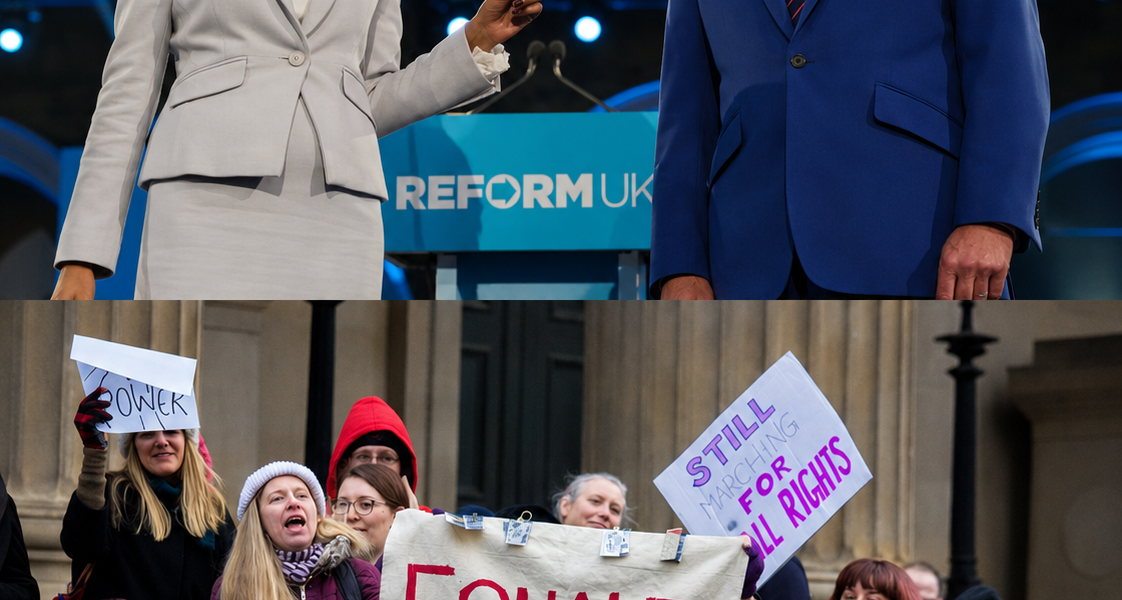
“The Consensus Is Being Challenged”: Inside Reform’s Plans To Scrap The Equality Act. n1

Reform UK’s Plan to Scrap the Equality Act Reignites One of Britain’s Biggest Constitutional Debates
For more than a decade, the Equality Act 2010 has served as the cornerstone of Britain’s anti-discrimination framework, bringing together over 100 separate pieces of legislation into a single legal code designed to protect individuals from discrimination based on characteristics such as sex, race, disability, religion, age, sexual orientation, and pregnancy.
Today, however, one of the country’s fastest-growing political parties wants to abolish it entirely.
Reform UK has pledged that, if elected at the next general election, it would repeal the Equality Act on its first day in government and replace it with a new Workplace Fairness Act. The proposal has ignited a fierce political debate, drawing criticism from Labour, the Conservatives, trade unions, and equality campaigners, while supporters argue the current legislation has evolved into a vehicle for bureaucracy, identity politics, and what they describe as preferential treatment.
The dispute has become one of the clearest illustrations of a broader ideological divide emerging across British politics—whether equality should be pursued through targeted legal protections for disadvantaged groups or through a legal framework that treats every citizen identically regardless of background.

From Cross-Party Consensus to Political Battleground
The controversy surrounding the Equality Act represents a remarkable reversal in British politics.
When Parliament passed the legislation in 2010, it attracted broad political support and was widely regarded as a modernisation of Britain’s equality laws rather than a radical constitutional change.
The Act consolidated more than 116 separate laws into a single framework covering employment, education, public services, housing, and other areas of public life.
It also introduced or strengthened several important principles, including protections against discrimination, equal pay provisions, safeguards for disabled people, maternity protections, and the Public Sector Equality Duty, which requires public authorities to consider how their decisions affect different groups within society.
Even after Britain voted to leave the European Union, Conservative ministers insisted these protections would remain intact.
In February 2018, then-Brexit minister Suella Braverman assured Parliament that Brexit would not lead to a rollback of equality rights. She praised Britain’s legal framework as one that exceeded many European standards, describing measures such as gender pay gap reporting and the Public Sector Equality Duty as “world-leading.”
Eight years later, Braverman now occupies a very different political position.
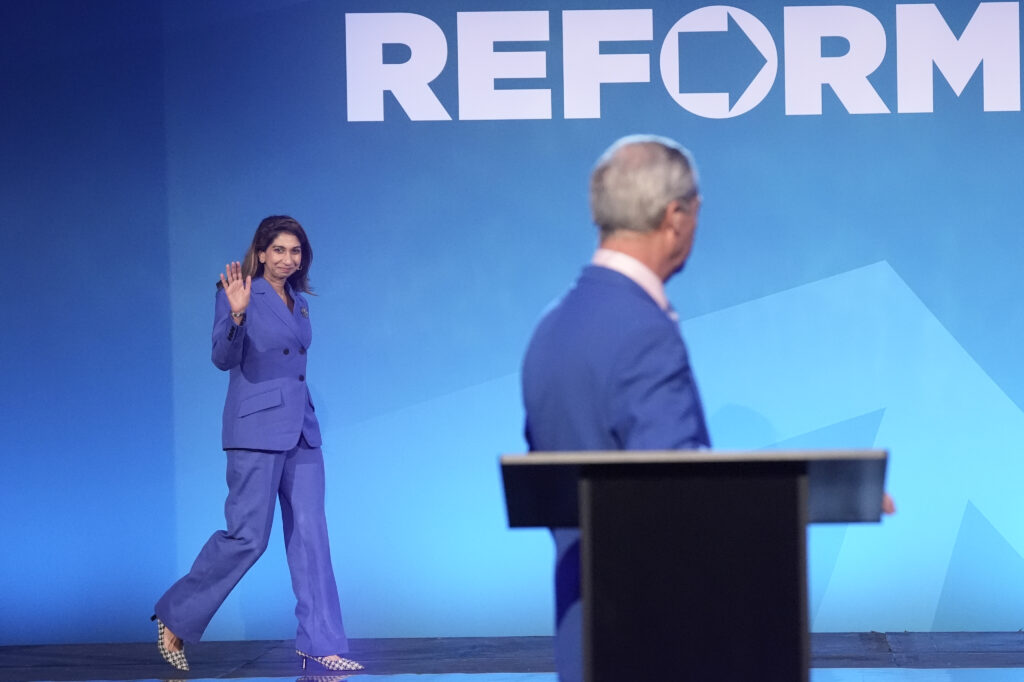
Having joined Reform UK as the party’s equalities spokesperson, she has become one of the strongest advocates for repealing the very legislation she once defended.
Reform UK’s Alternative Vision
Reform insists that abolishing the Equality Act does not mean eliminating legal protection against discrimination.
Instead, the party argues that existing protections can be preserved while removing what it considers unnecessary ideological provisions.
Under Reform’s proposal, the Equality Act would be replaced by a Workplace Fairness Act, which would largely reassemble many of the anti-discrimination protections that existed before 2010 while excluding elements the party believes promote identity-based policymaking.
Among the provisions Reform says it would remove are:
- The Public Sector Equality Duty.
- Positive action policies designed to improve representation of underrepresented groups.
- Other measures that, according to the party, encourage preferential treatment based on protected characteristics rather than individual merit.
Braverman argues that Britain should become “a country defined by meritocracy, not tokenism” and by “personal responsibility, not victimhood.”
According to Reform, repealing and replacing the legislation would occur simultaneously through the same Act of Parliament, ensuring that existing anti-discrimination protections remain in force while introducing a different legal philosophy.
The party also emphasizes that maternity rights, disability protections, and safeguards against direct discrimination would remain protected under its replacement legislation.
The Conservative Position: Reform, Not Repeal
Although the Conservatives have also begun advocating changes to the Equality Act, their approach differs substantially.
Rather than abolishing the legislation altogether, Conservative leader Kemi Badenoch has proposed beginning an overhaul by removing the Public Sector Equality Duty.
Shadow Equalities Minister Claire Coutinho argues that the Equality Act protects everyone—not only minority groups.
She points out that white men, for example, have successfully used the Act to bring discrimination claims because the legislation protects all individuals regardless of race or sex.
Coutinho contends that abolishing the Act entirely could unintentionally weaken legal protections for women, disabled people, and others whom Reform says it intends to protect.
Instead, Conservatives propose preserving core anti-discrimination rights while removing provisions they believe encourage unnecessary bureaucracy or social engineering.
The disagreement illustrates that although Reform and the Conservatives share concerns about aspects of current equality policy, they differ significantly on how extensive reform should be.
Labour and Equality Campaigners Push Back
Labour has taken the opposite position.
Rather than weakening the Equality Act, many within the party argue that it should be implemented more robustly and expanded where necessary.
Trade unions, equality organizations, and legal experts have also criticized Reform’s proposal.
The Trades Union Congress (TUC) described Reform’s plans as misleading, expressing particular concern about proposals affecting equal pay claims.
Current law allows workers to pursue equal pay cases where different jobs are judged to be of equal value despite involving different responsibilities.
Reform argues that these provisions allow courts and tribunals to compare fundamentally different occupations in ways that create uncertainty for employers.
Supporters say genuine discrimination would still be prohibited under their proposals.
Critics counter that removing “work of equal value” claims could weaken one of Britain’s most important legal mechanisms for addressing gender pay inequality.
Why the Equality Act Has Become Politically Controversial
For much of the past decade, the Equality Act attracted relatively little public attention.
Its growing political significance reflects broader cultural debates that extend beyond employment law.
Questions surrounding diversity policies, gender identity, affirmative action, free speech, race, and institutional decision-making have increasingly transformed equality legislation into a symbol of wider disagreements about modern Britain.
Supporters of the current framework argue that equality sometimes requires proactive measures to address historical disadvantage and structural barriers.
Opponents respond that equal treatment should mean applying identical rules to every individual regardless of background.
This philosophical disagreement now lies at the heart of Britain’s evolving political landscape.
My Professional Perspective
Having covered constitutional law, British politics, and public policy for decades, I believe this debate is about considerably more than one Act of Parliament.
The Equality Act has become a proxy for competing visions of fairness itself.
One vision argues that equality means recognizing historical disadvantage and sometimes taking targeted action to reduce unequal outcomes.
The other argues that equality means government should ignore group identity wherever possible and judge every individual solely on merit.
Both approaches claim to pursue fairness.
They simply define fairness differently.
Another frequently overlooked point is that repealing legislation is often easier politically than replacing it practically.
The Equality Act interacts with hundreds of areas of British law, including employment contracts, public procurement, education policy, disability accommodation, housing, and judicial precedent.
Replacing such an extensive legal framework would require careful drafting to avoid creating legal uncertainty for employers, public bodies, and the courts.
There is also an important political dimension.
For Reform UK, the proposal signals to voters that the party intends to challenge what it views as an entrenched political establishment.
For Labour, defending the Equality Act reinforces its long-standing commitment to anti-discrimination legislation.
For the Conservatives, proposing selective reform allows the party to position itself between those two competing approaches.
The debate therefore reflects not only differing legal philosophies but also competing electoral strategies.
Perhaps the most important question remains unanswered.
If Britain were drafting equality legislation from scratch today, would Parliament produce the same law it enacted in 2010?
Given how dramatically public debate has changed over the past fifteen years, the answer is almost certainly no.
That observation alone helps explain why legislation that once enjoyed broad cross-party support has now become one of the country’s most contested political issues.
Conclusion
Reform UK’s proposal to abolish the Equality Act marks one of the most ambitious constitutional reforms currently being discussed in British politics.
Supporters argue the existing law has evolved beyond preventing discrimination and now encourages identity-based policymaking that undermines merit and equal treatment.
Critics warn that repealing the Act could weaken legal protections that millions of people rely upon and create significant uncertainty across public life.
Whatever the outcome, the debate has already revealed a deeper ideological divide over what equality should mean in modern Britain.
Should governments actively promote equal outcomes where disadvantage exists?
Or should the law focus exclusively on treating every individual the same, regardless of circumstance?
The answers to those questions will shape far more than one piece of legislation.
They will help determine how Britain defines fairness, rights, and equality for the next generation.
“Just to get a political headline, Reform was willing not just to throw out the baby with the bathwater but pregnant women, new mums and disabled people as well”
The Women and Motherhood Protection Act would confer “explicit breastfeeding rights” for mothers. Reform’s spokesperson clarifies for The House that, in practice, this will not necessarily mean women gaining any new rights to breastfeed. Rather, breastfeeding rights that currently exist “across employment legislation and the Equality Act will be brought together and, where necessary, made explicit or further codified”.
In the case of older people, meanwhile, regulations introduced in 2006 were limited to employment. It was only under the Equality Act that older people gained additional rights in other areas like the provision of services.
Caroline Abrahams, charity director at Age UK, tells The House that scrapping the Equality Act “would be a disaster for older people”.
“We would strongly oppose any repealing of this act, because it would legitimise age discrimination, in a way. It’s bad enough with the act – it would be a lot worse without it,” she says. “It’s totemic and it gives a signal to society that we think it’s important to respect different people’s rights.”
The 2010 legislation, she argues, has played an important role in governing how NHS treatment decisions are made, for example.
“Certainly, digital exclusion is another issue that arises here – your ability to physically access or in other ways access a service,” Abrahams adds.
“Older people already have to pay more for things like travel and motor insurance, but without the Equality Act they would have total freedom to be very discriminatory in who they sold their products to.”
Asked whether Reform intends to carry over rights that were introduced for the first time in 2010, a party spokesman replies: “We are considering what additional protections would be needed for genuinely vulnerable groups in society.”
When Disability Rights UK raised similar concerns about protections specific to the 2010 legislation being lost, in an article published by Disability News Service, Reform was adamant that no protections would be removed.
“Of course these protections won’t be scrapped and all provisions for disabled people will be kept,” a spokesperson said. “A Reform UK government will always support protections against discrimination based on disability, including in services. Neither Suella nor the party have ever made any suggestion that we will water down provisions for disabled people.”
At the same time as the Equality Act is under fire, Labour is under pressure to fulfil its manifesto pledge to expand the legislation’s reach.
Section One of the Equality Act – the socio-economic duty – has never been implemented, as Theresa May cancelled its planned enactment within months of taking office as women and equalities minister in 2010.
The duty, which requires public bodies to consider how their decisions might help reduce inequalities associated with socio-economic disadvantage, has since been implemented in Scotland and Wales – but not in England.
In 2024, Labour promised to enact it, but Keir Starmer’s government never confirmed when this would happen.
“It was good that it was in the manifesto, but we should have done it straight away,” Harman, who was appointed as Starmer’s adviser on women and girls in May, tells The House.
“I’m a bit frustrated that two years in, we haven’t set a time for implementing it,” Harman says – not least, she adds, because when she was in government in 2010, working on the Equality Act with the then-chair of the Equality and Human Rights Commission Trevor Phillips, they drew up draft guidance for implementing the duty. “We were ready to go but we lost power. So, that guidance is still there and still ready.”
With the Equality Act’s principles being more politically contested than ever before, she urges: “It’s important for the government to recognise that that consensus is being challenged, and they need to remind everybody why it’s the right thing for this country to be done – and get on with the socio-economic duty.”
Labour says it remains “proud” of the Equality Act and will “robustly” defend it in government.
“It’s fair to say we will be talking more about the importance of it and defending the core principles of it,” says one party source, speaking prior to Starmer’s resignation announcement, “but where it’s challenged, we’ve pushed back pretty firmly.”
When it comes to implementing the socio-economic duty, they admit that the legislative timing is ultimately “a decision of the centre”, though they insist it will be delivered.
In answer to a written question in April, equalities minister Baroness Smith said: “We are currently working toward commencement of the duty, which includes drafting statutory guidance that will clarify how the duty can be applied effectively. As part of this process, we are working with listed public bodies to ensure the guidance supports them effectively.”