
Britain’s New Mask Rules Spark a “Two-Tier Policing” Row After Dover and Portsmouth Protests
A bitter clash over masks, migration, and policing has ignited across Britain after dramatic demonstrations in Dover and Portsmouth brought new public-order powers into the national spotlight.
What Happened
A weekend of high-voltage protests on Britain’s south coast has transformed a technical change in public-order law into a politically explosive debate over fairness, policing, and immigration.
On Saturday, September 5, approximately 150 people descended on the Port of Dover in a “no-notice” demonstration, with many participants wearing face coverings.
The following day, tensions shifted west to Portsmouth after a boat carrying roughly 120 people reached British waters near the Isle of Wight.
The vessel was directed by the RNLI, acting under HM Coastguard instructions, toward Eastney Marina.
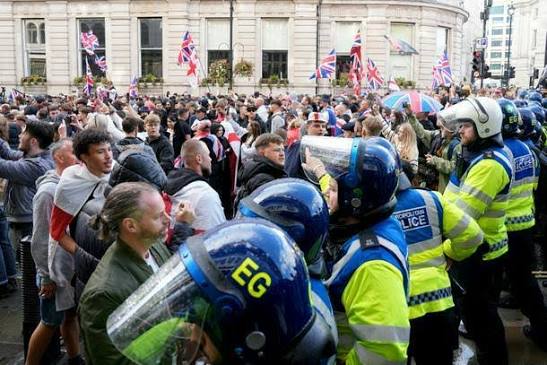
By 8 p.m., more than 200 protesters had gathered at the harbour, attempting to block coaches transporting the arrivals for processing.
Many demonstrators wore black clothing and balaclavas, prompting police to deploy dispersal powers to restore order.
The confrontations have forced a national reckoning over when protesters should be permitted to conceal their identities and whether the rules can be enforced consistently.
Why It Matters
The protests highlight the intense friction that occurs when border policy, public safety, and civil liberties collide.
For the government, the new legislative powers are designed to close loopholes that allow individuals to hide their faces and evade accountability during disorderly protests.
For critics, the enforcement of these powers raises immediate concerns about perceived double standards and political bias.
As immigration pressures continue to strain local communities and test police resources, the debate over how the state manages public dissent carries profound implications for public trust in law enforcement and democratic institutions.
The Reality Behind Britain’s New Mask Laws
Public rhetoric surrounding the legislation has frequently outpaced the actual legal framework.
Britain has not introduced a universal, nationwide ban on balaclavas, nor does the law specifically target any single political movement.
Under Sections 157 to 159 of the Crime and Policing Act 2026, police gain a conditional power: they can designate an area when they reasonably believe a protest is occurring or likely to occur, offences have been or may be committed, and restricting identity-concealing face coverings would help prevent or limit those offences.
Within such a designated zone, wearing or using items to conceal identity becomes a criminal offence carrying a maximum penalty of one month in prison, a £1,000 fine, or both.
The law is designed to give authorities a targeted tool rather than a blanket ban, aiming to stop individuals from hiding their faces to evade responsibility for criminal activity rather than outlawing anonymous political expression everywhere.
The “Two-Tier” Accusation and the Test of Neutrality
The central flashpoint in the current controversy is not just the presence of masks, but the question of consistent enforcement.
Critics point to past demonstrations—including various pro-Palestinian and environmental rallies where face coverings were worn—and ask why similarly robust restrictions were not always visible.
This perception has fueled accusations of “two-tier policing,” where demonstrators from different political backgrounds appear subject to different standards.
The government and senior police officials maintain that the offence is strictly cause-neutral, operating entirely on legally defined circumstances rather than the ideology of the participants.
Hampshire Police and Crime Commissioner Donna Jones noted that a subsequent protest in Portsmouth passed largely peacefully and that participants complied with the rule, signaling an intent to apply the power impartially across the political spectrum.
Religious Exemptions and the Legal Distinction
The legislation also addresses sensitive cultural questions by incorporating specific statutory defenses.
The Crime and Policing Act explicitly provides a defense for face coverings worn for religious observance, as well as those used for health or work purposes.
This means a balaclava used to conceal an identity during a confrontation and a religious face covering are not treated identically under the law.
Critics argue this distinction creates unfair exemptions, while supporters maintain that concealing identity to frustrate police identification is fundamentally different from observing a religious practice.
Regardless of the debate, legal experts emphasize that Britain has not enacted a general ban on covered faces in public spaces.
The RNLI Caught in the Crossfire
Adding another combustible element to the Portsmouth incident was the involvement of the Royal National Lifeboat Institution.
Operating under the direction of HM Coastguard, volunteer crews rescued and brought ashore individuals from the small boat, drawing fierce criticism from anti-immigration campaigners who view maritime rescues as part of an ongoing pipeline for irregular arrivals.
Defenders of the charity emphasize that its core mission is saving lives at sea rather than determining national immigration policy.
Volunteer crews cannot rewrite asylum laws, negotiate international agreements, or decide who remains in the country; those responsibilities rest entirely with Parliament and government agencies.
The friction underscores the immense pressure placed on humanitarian organizations when border enforcement and maritime safety occupy the same physical space.
What Different Sides Are Saying
-
Government and Law Enforcement: Argue that the new powers are necessary, cause-neutral tools designed to prevent intimidation and help police identify individuals committing criminal acts during protests.
-
Critics and Opponents: Express skepticism regarding consistent enforcement, warning that the rules risk creating the appearance of political bias depending on the nature of the demonstration.
-
Community and Human Rights Advocates: Emphasize the importance of balancing public safety with fundamental rights to peaceful assembly, while urging authorities to maintain strict impartiality.
What Happens Next
As local police forces evaluate the practical application of the new designated-area powers, scrutiny will remain high during future demonstrations.
The ultimate test for the legislation will not be ministerial statements, but whether citizens across the political spectrum see comparable behaviour receive comparable treatment.
Meanwhile, political pressure over small-boat crossings along the south coast shows no sign of abating, ensuring that public-order debates and immigration policy remain inextricably linked in the national conversation.
How do you think police forces can best demonstrate impartiality when enforcing new public-order laws during highly charged political protests?