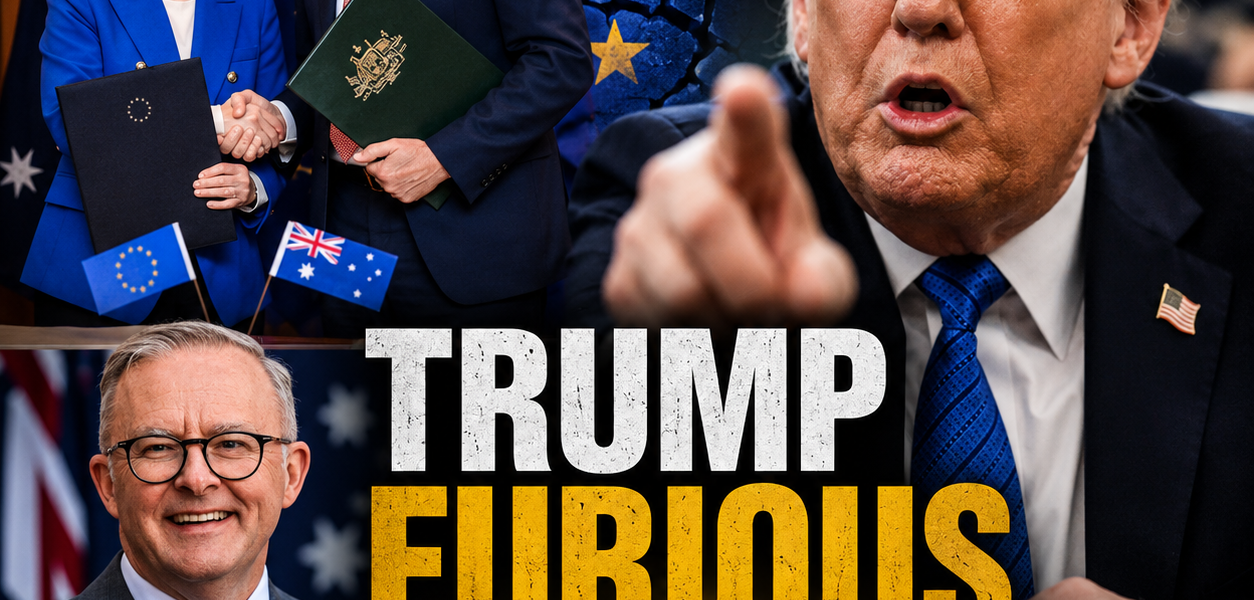
Australia Chooses Europe Over Washington in Landmark $30 Billion Trade Agreement. u111

Australia Chooses Europe: The Trade Deal That Sparked Questions About America’s Global Influence
For decades, the strategic relationship between Australia and the United States was considered one of the most durable partnerships in the Western world. Bound by military cooperation, intelligence sharing, and deep cultural ties, Canberra and Washington often appeared inseparable on major geopolitical questions.
Yet a newly finalized trade and security agreement between Australia and the European Union has triggered a fresh debate about the future of global alliances, economic influence, and the shifting balance of power in the Western world.
Some commentators have portrayed the agreement as a devastating rejection of the United States. Others argue that such claims dramatically exaggerate the reality.
The truth lies somewhere in between.

What is beyond dispute is that the agreement represents one of the most significant economic and strategic partnerships Australia has signed in recent years—and it arrives at a moment when many U.S. allies are actively diversifying their international relationships.
The Deal: What Actually Happened?
After eight years of negotiations, Australia and the European Union concluded a landmark Free Trade Agreement (FTA) in March 2026. The agreement was announced by Australian Prime Minister Anthony Albanese and European Commission President Ursula von der Leyen.
The agreement covers:
- Trade in goods and services
- Investment access
- Digital trade
- Critical minerals
- Government procurement
- Supply chain cooperation
- Environmental standards
- Labor protections
Alongside the trade agreement, Australia and the EU also signed a Security and Defence Partnership aimed at strengthening strategic cooperation in an increasingly unstable world.
The European Commission describes the deal as one that will remove tariffs on more than 99 percent of EU exports to Australia while expanding access to Australian critical raw materials such as lithium, manganese, and aluminum.
For Australia, the agreement opens expanded access to a market of approximately 450 million consumers and one of the largest economic blocs in the world.
Why This Matters Beyond Trade
Trade agreements are rarely just about trade.
In modern geopolitics, they are also about influence.
They shape supply chains.
They determine future investment flows.
They influence technology standards.
And increasingly, they help define which nations will lead emerging industries.
That is why European leaders have celebrated this deal as more than an economic agreement.

The EU has spent years attempting to strengthen its presence in the Indo-Pacific region, where strategic competition among major powers continues to intensify.
Australia is a critical player in that region.
The country possesses vast reserves of critical minerals essential for electric vehicles, batteries, renewable energy technologies, semiconductors, and defense manufacturing.
Those resources have become strategically valuable not only because of economic demand but because Western nations are attempting to reduce dependence on China-dominated supply chains.
The agreement therefore serves multiple purposes simultaneously:
- Economic diversification
- Supply-chain security
- Geopolitical influence
- Strategic cooperation
European officials openly acknowledge these objectives. Reuters reported that access to Australian critical minerals and reduced dependence on vulnerable supply chains were central motivations behind the agreement.
Did Australia “Choose Europe Over America”?
This is where many viral narratives begin to oversimplify reality.
Australia has not abandoned the United States.
Nor has it withdrawn from major security arrangements such as:
- AUKUS
- Five Eyes
- NATO cooperation frameworks
In fact, Australia’s defense relationship with Washington remains one of the closest in the world.
However, what Australia has done is diversify.
And that distinction is critical.
For much of the post-Cold War era, the United States occupied a uniquely dominant position in the global economy.
Many allies had little incentive to seek alternative economic arrangements because access to American markets was seen as indispensable.
That environment is changing.
Countries increasingly seek multiple partnerships rather than relying heavily on a single economic center.
Australia’s agreement with Europe reflects that trend.
It is less a rejection of America than an effort to reduce dependence on any single partner.
The Shadow of American Trade Policy
One reason analysts are paying close attention to this agreement is because it follows years of uncertainty surrounding U.S. trade policy.
Since the late 2010s, allies have experienced repeated shifts in American trade strategy.
Among the major developments:
- U.S. withdrawal from the Trans-Pacific Partnership (TPP)
- Tariffs imposed on allied countries
- Frequent renegotiation of trade arrangements
- Changing approaches across successive administrations
Many governments began asking a difficult question:
Can long-term economic planning rely on political stability in Washington?
Whether fair or unfair, that concern has become increasingly common among allies.
Several economists argue that Europe currently offers something many governments value highly:
Predictability.
Trade agreements often involve investments measured in decades rather than election cycles.
Businesses constructing supply chains need confidence that market access rules will remain stable.
That perception has helped Europe position itself as a reliable long-term economic partner.
The Critical Minerals Battle
Perhaps the most important aspect of the agreement receives less attention than the political headlines.
Critical minerals.
These include:
- Lithium
- Rare earth elements
- Manganese
- Cobalt
- Aluminum
Modern economies cannot function without them.
Electric vehicles require them.
Defense systems require them.
Semiconductor manufacturing requires them.
Artificial intelligence infrastructure increasingly depends on them.
Australia is one of the world’s most important suppliers.
The EU-Australia agreement creates deeper cooperation in securing access to these resources and strengthening associated supply chains.
This matters because the next phase of economic competition may not revolve around oil.
It may revolve around who controls the materials necessary for advanced technology.
That reality explains why policymakers in Washington, Brussels, Beijing, Tokyo, and Canberra are paying such close attention to critical minerals.
The Numbers: Separating Fact from Hype
Some viral reports claim the agreement locks American firms out of hundreds of billions of dollars in future contracts.
Those figures should be treated cautiously.
While the agreement unquestionably strengthens EU-Australia economic integration, publicly available sources do not confirm many of the more dramatic figures circulating online.
What is verified is that:
- The EU and Australia concluded the agreement in March 2026.
- The deal covers broad trade, investment, digital, and strategic cooperation.
- The agreement is expected to generate substantial economic benefits for both sides.
- Cooperation on critical minerals is a major component.
However, claims that American companies are automatically excluded from vast portions of the Australian market are not supported by the publicly available agreement summaries.
The reality is more nuanced.
American firms may face increased competition from European firms, but Australia remains an open market economy with extensive international commercial relationships.
My Professional Perspective
The most interesting aspect of this story is not the trade agreement itself.
It is what the agreement reveals about the changing psychology of America’s allies.
For decades, the central assumption of Western geopolitics was simple:
Economic leadership flowed from Washington.
Military leadership flowed from Washington.
Strategic coordination flowed from Washington.
That assumption is becoming weaker.
Not because the United States is collapsing.
Not because Europe has suddenly become dominant.
But because middle powers increasingly want options.
Australia’s decision reflects a broader trend visible across much of the developed world:
Countries are pursuing strategic flexibility.
They want multiple supply chains.
Multiple trading partners.
Multiple diplomatic channels.
Multiple security relationships.
The deeper story is not Europe versus America.
The deeper story is the end of dependence.
Many governments no longer want their economic future tied primarily to one capital, one administration, or one political system.
That trend extends beyond Australia.
It can be seen across Asia, Europe, and parts of Latin America.
Another overlooked detail is that this agreement emerged during a period of increasing global fragmentation.
Russia’s invasion of Ukraine.
Supply-chain disruptions.
Competition with China.
Energy insecurity.
Technological rivalry.
All have encouraged governments to seek resilience rather than efficiency alone.
In other words, this agreement is part of a larger global restructuring.
And that restructuring may ultimately matter more than the deal itself.
Conclusion
The Australia-EU trade agreement is not the end of American influence.
Nor is it evidence that traditional alliances are collapsing.
But it is a reminder that the international system is changing.
Australia has chosen to deepen its relationship with Europe while maintaining its strategic partnership with the United States.
The agreement reflects a world where nations increasingly seek flexibility, diversification, and resilience rather than exclusive dependence on a single partner.
The real question raised by this development is not whether Europe is replacing America.
It is whether the era of unquestioned American economic centrality is gradually giving way to a more distributed world order.
And if that transition is already underway, how will Washington adapt to a future where even its closest allies feel the need to build new pathways beyond the American sphere of influence?