
Beyond the Viral Post: In-Group Bias, Meritocracy, and Australia’s Workplace Cultural Friction
A controversial thread posted on the online forum Reddit by an anonymous Australian Public Service (APS) employee sparked an intense national debate surrounding recruitment practices, cultural diversity, and workplace integration in government agencies.
The original poster—who identified as a pro-diversity federal analyst—expressed frustration after watching their team broken down into specialized silos where every manager position was subsequently filled by individuals of Indian heritage. According to the employee, from that point forward, new hires across every single silo were exclusively Indian, effectively ending the team’s previously broad international diversity.
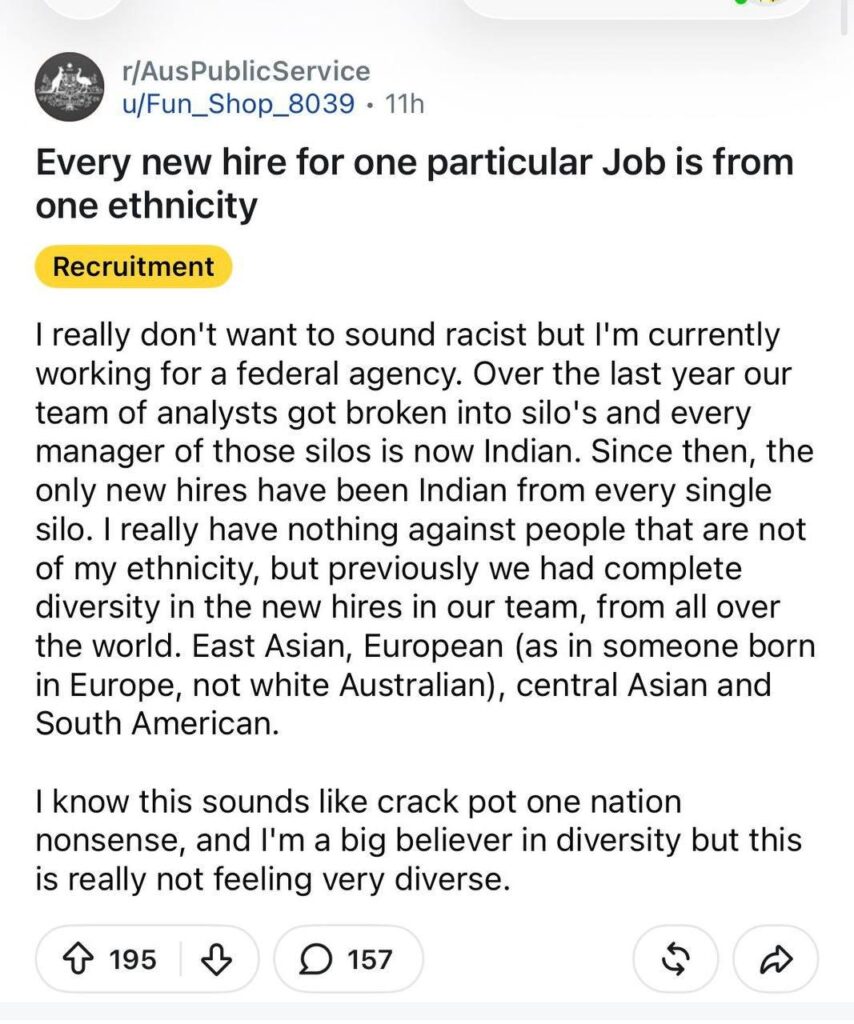
Although the thread was removed by forum moderators, it triggered hundreds of responses before being censored. The sentiment resonated broadly across social media platforms, with workers from various sectors—including retail banking, corporate technology, supermarkets, and state departments—sharing similar anecdotes of perceived “in-group hiring” or feeling linguistically isolated in lunchrooms where non-English languages were spoken.
========================================================================================
                      THE ANATOMY OF A VIRAL WORKPLACE DEBATE
========================================================================================
ORIGINAL ALLEGATION               COMMUNITY RESONANCE             CONTRASTING PERSPECTIVES
--------------------              -------------------             ------------------------
• Federal agency team split       • Hundreds of matching posts    • High volume of applications
• Indian managers in all silos    • Concerns in banking & tech    • Underrepresentation in leadership
• Exclusively Indian new hires    • Fears over workplace culture  • APS recruitment bound by merit
========================================================================================
Main Events: The Debate Over Workplace Dynamics
The controversy highlighted several recurring themes expressed by Australian workers:
-
In-Group Preferences vs. Meritorious Hiring: Critics argued that when managers from a specific ethnic background achieve supervisory control, recruitment can gravitate toward candidates of the same cultural or linguistic background, raising concerns about fairness and equal opportunity.
-
Linguistic and Cultural Isolation: Several commentators described experiences where lunchroom discussions or informal meetings switched to languages like Hindi, leaving non-speakers excluded from social and professional networking opportunities.
-
Political Exploitation: Commentators on both sides noted that perceived failures in corporate or public diversity initiatives fuel political alienation, directly benefiting anti-immigration platforms like Pauline Hanson’s One Nation.
Counter-Arguments and Structural Realities
Conversely, several public sector employees and employment analysts offered alternative explanations for the demographic concentration observed in entry-level and operational teams:
-
Application Volume and Demographics: In agencies with heavy service-delivery or IT functions (such as Services Australia), a massive proportion of entry-level applicants come from South Asian backgrounds. Observers argue that sheer application volume—rather than deliberate bias—naturally leads to higher representation in specific teams.
-
Statistical Underrepresentation at Executive Levels: Independent workforce data from the Australian Public Service Commission (APSC) shows that Culturally and Linguistically Diverse (CALD) Australians, particularly those of Asian background, remain statistically underrepresented at senior leadership and Executive Level (EL) ranks relative to their total numbers in the workforce.
-
Strict Merit Frameworks: Recruitment within the APS is legally governed by the Public Service Act 1999, which mandates panel-based selection based strictly on merit, limiting the ability of any single manager to unilaterally control hiring outcomes.
“My Professional Perspective”
As an investigative analyst who has spent decades studying workplace sociology, institutional recruitment, and public sector governance, this viral event serves as a classic case study in how organizational communication gaps convert into political polarization.
When an anonymous post triggers this level of public emotion, it is vital to separate the raw personal experiences of workers from the institutional mechanisms that govern modern workplaces.
========================================================================================
                      THE DUAL LENS OF WORKPLACE CONFLICT
========================================================================================

  [ THE PERCEIVED REALITY ]  --------------------->  [ THE STRUCTURAL FACT ]
  • "Managers only hire their own"                    • High volume of migrant applicants
  • Cultural cliques in lunchrooms                   • Institutional merit panel laws
  • Erosion of broader team diversity                • Leadership barriers for CALD staff
========================================================================================
1. The Myth of the Unilateral Hiring Manager in the Public Service
The claim that a single manager inside an Australian Federal Agency can quietly ensure that “only Indians get hired” ignores how public sector recruitment actually works under the law.

Unlike the private sector—where a small business owner or corporate manager can exercise broad discretion—the Australian Public Service operates under rigid statutory merit principles:
-
Panel-Based Selection: APS recruitment typically requires multi-person selection panels, often involving independent representatives from outside the immediate team.
-
De-Identified Testing and Standardized Scoring: Candidates are assessed against standardized position descriptions, capability frameworks, and structured interview questions.
Where bias can creep in is not in explicit corruption, but in subtle, unconscious alignment on “culture fit” during interview panels or informal internal references. However, attributing an entire team’s demographic shift solely to malicious favoritism overlooks the massive volume of migrant candidates applying for technical, operational, and entry-level public roles.
+---------------------------------------------------------------------------------------+
|                       RECRUITMENT: PRIVATE VS. PUBLIC SECTOR                          |
+-----------------------------------+---------------------------------------------------+
| PRIVATE CORPORATE ENVIRONMENT     | AUSTRALIAN PUBLIC SERVICE (APS)                   |
+-----------------------------------+---------------------------------------------------+
| • Direct manager discretion       | • Mandatory multi-person selection panels         |
| • Informal referral hires allowed | • Strict adherence to statutory merit rules       |
| • High risk of nepotism           | • Audit trails & formal appeal mechanisms         |
+-----------------------------------+---------------------------------------------------+
2. The Cultural Paradox: Inclusion vs. Informal Exclusion
One of the most legitimate grievances raised in the discussion involves the informal culture of the office—specifically, linguistic isolation in shared spaces.
                               THE INFORMAL EXCLUSION CYCLE
                                            │
                 ┌──────────────────────────┴──────────────────────────┐
                 ▼                                                     ▼
     COMMON LANGUAGE SWITCHING                              NON-SPEAKER ALIENATION
  • Staff speak native language informally               • Colleagues feel social exclusion
  • Intended as comfort/camaraderie                      • Perceived as unprofessional/cliquey
  • Unintentionally breaks team cohesion                 • Drives resentment toward "diversity"
When colleagues switch to a shared non-English language during work hours or lunch breaks, it is rarely intended as a hostile act. Human beings naturally gravitate toward the ease of their mother tongue when relaxing. However, in a professional environment, this practice creates an immediate, palpable barrier. It excludes non-speakers from casual conversations, informal mentoring, and social bonding—the exact social currency required to feel included at work.
When corporate management preaches “mandatory inclusion training” while failing to maintain basic ground rules regarding a shared language in professional spaces, employees perceive a glaring double standard.
3. The “Bamboo Ceiling” vs. In-Group Anxiety
The irony of this online debate is that academic data reveals an entirely different problem at the macro level: the persistent “bamboo ceiling” in Australian institutions.
Studies by the Crawford School of Public Policy show that public servants from non-English speaking backgrounds—particularly of Asian origin—face lower promotion rates into executive ranks (EL2 and SES levels) compared to colleagues with Anglo-Saxon backgrounds, even when controlling for language skills and education.
+---------------------------------------------------------------------------------------+
|                         THE DEMOGRAPHIC DIVERGENCE METRIC                             |
+-------------------------------+-------------------------------------------------------+
| WORKFORCE LEVEL               | STATISTICAL REALITY                                   |
+-------------------------------+-------------------------------------------------------+
| Entry & Operational Roles     | High concentration of migrant & CALD workers         |
| Executive Leadership (SES)    | Overwhelmingly Anglo-Australian & Australian-born     |
+-------------------------------+-------------------------------------------------------+
This creates a structural paradox:
-
At lower operational levels, native-born Australian workers experience anxiety when they see rapid demographic shifts in their immediate teams.
-
At upper management levels, culturally diverse Australians struggle to break through into executive leadership.
When organizations fail to communicate these workforce dynamics transparently, employees rely on anecdotal observations, turning localized team frustration into broader cultural anxieties.
A Powerful Summary
The viral debate surrounding hiring practices in the Australian Public Service is a symptom of a modern workforce undergoing rapid demographic change. While allegations of exclusive “in-group hiring” often break down under the scrutiny of statutory recruitment merit laws, the underlying feelings of cultural isolation, team friction, and perceived unfairness are deeply real to the workers experiencing them.
True organizational diversity cannot simply be measured by headcounts or corporate slogans. It requires active management, clear professional boundaries around shared workplace language, and absolute transparency in recruitment processes to ensure that every employee—regardless of heritage—feels that merit, fairness, and mutual respect govern their workplace.
Emotional Reflection
Workplaces are where citizens from vastly different walks of life are forced to interact, collaborate, and build common ground. When communication breaks down, lunchrooms become divided by language, and colleagues begin viewing one another through the lens of ethnic identity rather than shared purpose, the social fabric of the entire institution frays.
Navigating a multicultural society requires empathy from all sides: acknowledging the hard work and qualifications of new migrant citizens while respecting the need for native-born workers to feel included, valued, and fairly treated in their own national institutions.
A Thought-Provoking Question
As public and private institutions across Western democracies adapt to rapid demographic integration, leadership must answer a fundamental operational question:
How can modern organizations foster true diversity and global talent without allowing informal cultural cliques to erode team cohesion and public trust in meritocracy?