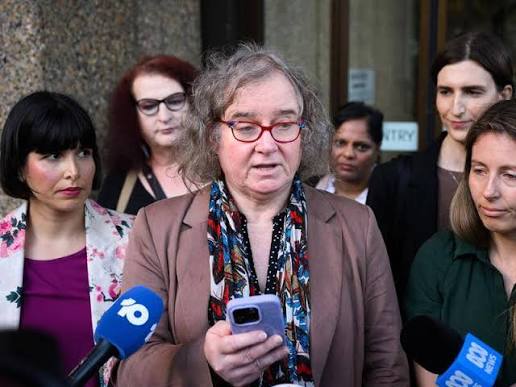
Discrimination Ruling Sparks National Debate Over Women-Only Spaces in Australia. u1

The Digital Sanctuary on Trial: Inside Tickle v Giggle, the Lawsuits Redefining Australian Identity and Anti-Discrimination
The Virtual Gated Community and the Selfie Test
In early 2020, Australian entrepreneur Sall Grover launched Giggle for Girls, a mobile social networking application promoted as a digital “online refuge” and safe space exclusively for women. Designed to provide a platform free from male harassment where female users could connect for freelancing, emotional support, room-sharing, and activism, the application built its core value proposition around strict biological exclusion.
To enforce this boundary, the platform integrated automated facial recognition software developed by third-party vendor Kairos. Prospective users were required to upload a real-time photograph (“selfie”) upon registration. The artificial intelligence algorithm analyzed facial structure and biometric markers to determine whether the applicant possessed a “female appearance” before granting entry.
In February 2021, Roxanne Tickle—a transgender woman from regional New South Wales who had undergone gender affirmation surgery in 2017 and held an updated Queensland birth certificate legally recognizing her sex as female—downloaded the application, passed the automated biometric scan, and was granted access.
However, seven months later, in September 2021, Tickle found herself suddenly logged out and blocked from the platform. After reviewing supplied user profile photographs, Grover concluded that Tickle possessed male physical traits and revoked her account access. When Tickle formally requested readmission, citing her legal status as a woman, the request was rejected.
                     THE DIGITAL GATEKEEPING PIPELINE
                                     |
    +--------------------------------+--------------------------------+
    |                                                                 |
 ROXANNE TICKLE (Applicant)                          GIGGLE FOR GIRLS (Platform)
 - Transgender woman (Transitioned 2017)             - Founded by Sall Grover as female safe space
 - Legally female (Qld Birth Certificate)            - Uses AI facial recognition for entry
 - Granted access Feb 2021; Revoked Sept 2021        - Manually revokes profile based on appearance
    |                                                                 |
    +--------------------------------+--------------------------------+
                                     |
                           THE LEGAL FLASHPOINT
             Australian Sex Discrimination Act 1984 (Cth)
             Direct vs. Indirect Discrimination on Gender Identity
The Landmark Federal Lawsuit

In December 2022, following an unsuccessful conciliation process managed by the Australian Human Rights Commission (AHRC), Tickle filed a formal lawsuit in the Federal Court of Australia against Giggle for Girls Pty Ltd and Sall Grover. She alleged unlawful discrimination on the basis of gender identity under Section 22 of the Commonwealth Sex Discrimination Act 1984 (SDA).
The case represented the first time since the Australian Parliament added explicit protections for gender identity, sexual orientation, and intersex status to the SDA in 2013 that a federal court was called upon to interpret the exact legal boundaries of gender identity discrimination within single-sex services.
Judicial Rulings and High-Profile Interventions
The legal journey traversed two major judicial milestones:
-
The August 2024 First-Instance Ruling: Justice Robert Bromwich held that Giggle for Girls had engaged in indirect discrimination against Tickle. The court observed that requiring users to possess a “cisgender female appearance” placed an unreasonable condition that disadvantaged transgender women. Justice Bromwich awarded Tickle $10,000 in damages.
-
The May 2026 Full Federal Court Appeal: Both parties appealed—Grover seeking a total overturn on the grounds that the app qualified as a legal “special measure” to address female historical disadvantage, and Tickle cross-appealing that she had suffered direct discrimination. In a unanimous bench decision issued on May 15, 2026, Justices Melissa Perry, Wendy Abraham, and Geoffrey Kennett dismissed Grover’s appeal and upheld Tickle’s cross-appeal. The Full Court found two distinct acts of direct discrimination: excluding Tickle based on her gender-related appearance and refusing her readmission. The court doubled Tickle’s compensation to $20,000 and ordered Giggle and Grover to pay capped legal costs.
                 JUDICIAL FINDINGS COMPARISON

  FIRST INSTANCE (Aug 2024 - Justice Bromwich)
  +-------------------------------------------------------------------+
  | - Found Indirect Discrimination under Sex Discrimination Act       |
  | - Established requirement to "appear cisgender female" was invalid|
  | - Awarded $10,000 in damages                                      |
  +-------------------------------------------------------------------+
                                   |
                                   v
  FULL FEDERAL COURT APPEAL (May 2026 - Justices Perry, Abraham, Kennett)
  +-------------------------------------------------------------------+
  | - Dismissed Grover's appeal (Rejected Section 7D "Special Measure")|
  | - Upheld Tickle's cross-appeal: Found TWO acts of Direct Discrimination|
  | - Doubled compensation to $20,000 + $100,000 legal costs order     |
  +-------------------------------------------------------------------+
The judgment triggered immediate political commentary globally:
-
J.K. Rowling: The British author publicly voiced financial and moral support for Sall Grover, criticizing the ruling and arguing that state enforcement preventing women from establishing biological single-sex spaces undermines female safety and autonomy.
-
Pauline Hanson MP: The One Nation leader denounced the ruling on domestic news outlets, arguing that Australian anti-discrimination laws had been interpreted in a manner that strips away sex-based protections for women, pledging to push for statutory amendments in Parliament.
-
Equality Australia & AHRC: Conversely, human rights groups and the Australian Human Rights Commission hailed the Full Court verdict as a milestone victory affirming that transgender Australians are entitled to equal protection, dignity, and access under federal law.
Grover confirmed she is seeking donations via crowdfunding to lodge a final appeal before the High Court of Australia.
“My Professional Perspective”
Having spent thirty years dissecting statutory jurisprudence, constitutional conflicts, and civil liberties disputes across Western democracies, I have learned that landmark legal cases are rarely about the mobile application or selfie photograph presented in evidence. They are structural battles over how a society defines fundamental human categories when statutory mandates collide.
“When a court is asked to determine whether a transgender woman can be excluded from a digital space built for women, it is not merely interpreting software terms of service—it is testing whether statutory law prioritizes biological origin or legal identity.”
What made Tickle v Giggle an extraordinary judicial battle was not the personal animosity between the litigants, but the direct collision between two distinct statutory doctrines embedded within the Commonwealth Sex Discrimination Act 1984.
                       THE STATUTORY DUALITY

     +-----------------------------------------------------------------+
     |                  GENDER IDENTITY PROTECTION                     |
     |         SDA 2013 Amendments: Prohibits discrimination based      |
     |         on gender-related identity, appearance, and characteristics.|
     +-----------------------------------------------------------------+
                                    VS
     +-----------------------------------------------------------------+
     |                  SINGLE-SEX SPECIAL MEASURES                    |
     |         SDA Section 7D: Permits differential treatment intended  |
     |         to redress historical disadvantage faced by women.       |
     +-----------------------------------------------------------------+
What Important Details Have People Overlooked?
1. The Fallibility and Biometric Trap of AI Gatekeeping
Lost amid the cultural commentary was a critical technical vulnerability exposed during expert testimony: The Biometric Discriminator.
Giggle relied on automated AI facial recognition (Kairos) to enforce its single-sex policy. However, facial recognition software does not evaluate chromosomes or biological sex; it evaluates geometric distance between facial features, bone density indicators, and soft-tissue distributions.
By relying on an AI tool that evaluates appearance to infer biological sex, the platform created an inherent legal vulnerability under Australian law. Because the statutory definition of “gender identity” under Section 5B of the SDA explicitly includes “gender-related appearance and characteristics,” excluding an individual based on an AI’s subjective assessment of their facial features constitutes direct discrimination on gender-related appearance.
       THE BIOMETRIC LOGIC FAILURE

 [ User Uploads Selfie ] ---> [ AI Scans Facial Geometry ] ---> [ Algorithmic Inference ]
   Roxanne Tickle submits       Software measures facial        Infers "female" in Feb 2021;
   registration photo.          proportions and features.       manual override in Sept 2021.
                                                                          |
                                                                          v
 [ Legal Liability ]     <--- [ Appearance-Based Exclusion ] <--- [ Statutory Violation ]
   Excluding user based       Court rules appearance-based     Violates SDA protection on
   on photo violates SDA.     exclusion = Direct Discrimination. "gender-related appearance."
2. The Misapplication of Section 7D “Special Measures”
Giggle’s legal defense hinged heavily on Section 7D of the Sex Discrimination Act, which allows “special measures” designed to achieve equality between men and women by redressing historical disadvantage.
Grover’s legal team argued that creating an exclusive online refuge for women to escape male harassment qualified as a protected special measure. However, the Full Federal Court affirmed a vital legal distinction: a special measure must be designed to remedy a specific disadvantage suffered by a protected class.
Because Tickle held a valid state birth certificate recognizing her as female, and because the SDA protects gender identity alongside sex, excluding a legally recognized woman who transitions from the class of “women” did not advance equality—it created an unlawful sub-classification within the protected group.
3. The Judicial Scrutiny of Litigation Conduct
A crucial element of the Full Court’s decision to double the damages awarded to Tickle to $20,000 was the conduct of the respondent during proceedings. The three justices highlighted that Grover’s repeated misgendering of Tickle in court, public social media commentary depicting Tickle in a derogatory light, and caricatures were “gratuitous, disrespectful, and unnecessary to the conduct of her case”.
In Australian administrative and federal jurisprudence, aggravating conduct during litigation directly increases general damages awards. Grover’s public campaign, designed to mobilize political support online, ultimately weaponized the judicial process against her own financial defense.

Comparative Structural Breakdown
To understand how Australian statutory law balances competing protections, let us examine the legal thresholds governing single-sex exemptions under the Commonwealth Sex Discrimination Act 1984:
| Statutory Exception | Legal Mechanism | Application to Tickle v Giggle | Judicial Finding |
| Section 7D: Special Measures | Differential treatment permitted if solely intended to achieve equality for a disadvantaged group. | Giggle argued app was a single-sex refuge protecting women from male harassment. | Rejected: Exclusion of trans women holding legal female status does not advance Section 7D objectives. |
| Section 30: Single-Sex Services | Exemptions for services where sex is a genuine occupational qualification or personal intimacy requirement. | App claimed digital intimacy and female-only social networking. | Inapplicable: Commercial digital platforms open to the public fail the strict statutory threshold for physical intimacy exemptions. |
| Section 44: AHRC Temporary Exemption | Organizations can apply to the AHRC for a formal 5-year statutory exemption to run single-sex spaces. | Giggle did not apply for an AHRC administrative exemption prior to enforcing its policy. | Fatal Omission: Operating a discriminatory policy without an AHRC administrative exemption leaves platforms fully liable under Section 22. |
What Deeper Meaning Lies Behind This Event?
Tickle v Giggle represents the formal arrival of the Demarcation War Over Digital Borders.
                         THE CRISIS OF DIGITAL SPACE

     +-----------------------------------------------------------------+
     |                     PHYSICAL SPACES                             |
     |         Clear statutory exemptions for communal showers,         |
     |         domestic violence shelters, and sports categories.      |
     +-----------------------------------------------------------------+
                                    VS
     +-----------------------------------------------------------------+
     |                     VIRTUAL PLATFORMS                           |
     |         Commercial digital networks attempting to enforce       |
     |         biometric entry requirements without statutory waivers. |
     +-----------------------------------------------------------------+
Historically, single-sex spaces existed in physical environments—changing rooms, domestic violence refuges, crisis shelters, and competitive sporting leagues. In those physical environments, statutory exemptions under Australian federal and state laws provided explicit, narrow carve-outs where biological sex could be prioritized for privacy or safety.
When developers attempt to build digital sanctuaries on commercial app stores, they enter a globalized, commercial marketplace governed by public accommodation laws. In the absence of a formal statutory exemption granted by the Australian Human Rights Commission, commercial software providers cannot invent their own biometric entry rules that bypass statutory anti-discrimination laws passed by Parliament.
Unanswered Questions
As Sall Grover prepares her application for special leave to appeal before the High Court of Australia, several pivotal constitutional and statutory questions remain unresolved:
-
The High Court Constitutional Test: Will the High Court accept special leave to define whether the term “sex” in the Australian Constitution (Section 51) carries an immutable biological meaning that overrides state-issued amended birth certificates?
-
The Future of AHRC Exemption Applications: Will other female-led organizations, domestic violence shelters, and single-sex service providers begin filing preemptive applications with the AHRC for formal 5-year statutory exemptions under Section 44 to protect their operational frameworks?
-
The Legislative Reform Push: Will the Coalition and minor parties like One Nation succeed in introducing statutory amendments to the Sex Discrimination Act 1984 to establish explicit biological carve-outs for digital platforms and commercial services?
The Cost of Boundary Enforcement
The Full Federal Court’s ruling in Tickle v Giggle marks a watershed moment in Australian jurisprudence. It establishes a clear judicial precedent: under current Commonwealth law, commercial services open to the public cannot deploy visual or AI-driven biometric filters to exclude transgender Australians who possess legal recognition of their affirmed gender.
For Roxanne Tickle, the verdict was a vindication of her right to exist in public digital spaces with dignity, free from arbitrary exclusion based on appearance. For Sall Grover and her supporters, the ruling represents an alarming erosion of female autonomy and the legal right to build private, female-only refuges.
As this landmark battle moves toward a potential final showdown in the High Court of Australia, it serves as a powerful reminder of the delicate balance required in a pluralistic democracy. Laws designed to protect vulnerable minorities from discrimination and laws designed to preserve safe spaces for women must co-exist. Until Parliament or the High Court provides absolute clarity, the digital frontier will remain a deeply contested battleground over identity, rights, and the meaning of equality.
A Question for Reflection
When a society’s legal framework recognizes gender identity as a protected right alongside biological sex, how can lawmakers craft precise statutory exceptions that preserve genuine safe spaces for women without stripping transgender citizens of their fundamental right to dignity and equal service access?