
Pauline Hanson’s Warning for Australia: Is the Nation Approaching a Political Turning Point?
For decades, Australia has often been viewed as one of the world’s most successful multicultural democracies.
It has maintained political stability, experienced sustained economic growth, attracted millions of migrants, and developed a reputation as a country capable of balancing diversity with social cohesion.
Yet beneath that success story, a growing debate is emerging about whether Australia is entering a period of profound political and social change.
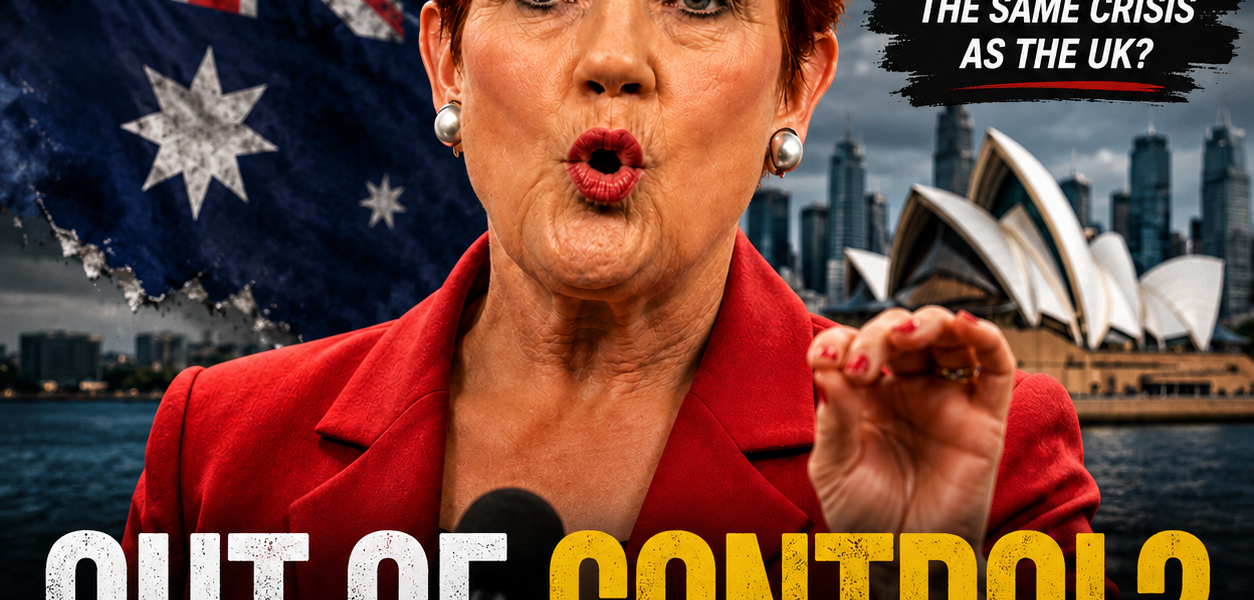
That debate has once again been thrust into the spotlight by One Nation leader Pauline Hanson, whose latest warning has reignited national discussions about immigration, housing affordability, economic pressure, social cohesion, and Australian identity.
While Hanson has spent much of her political career raising concerns about migration and national culture, her latest comments appear to go further than previous criticisms.
According to Hanson, Australia may be following a path similar to the one that transformed politics in the United Kingdom over the past decade.
Her argument is straightforward but politically explosive.
She believes that growing public frustration over migration levels, housing affordability, infrastructure pressures, and questions of national identity is being underestimated by Australia’s political establishment.

And if those concerns continue to be ignored, she argues, Australia could experience a political shift similar to the upheaval that reshaped Britain.
Whether one agrees with Hanson or not, her comments have touched upon some of the most contentious issues facing modern Australia.
The Cost-of-Living Crisis and Housing Pressure
One of the central themes of Hanson’s warning is housing affordability.
For many Australians, particularly younger generations, home ownership increasingly feels out of reach.
Property prices in major cities remain among the highest in the developed world relative to income.
Rental vacancies remain tight in many regions.
Households are spending larger proportions of their income simply securing accommodation.
Supporters of Hanson argue these realities cannot be separated from population growth and migration.
They point to increasing demand for housing, overloaded infrastructure, growing congestion, and pressure on public services as evidence that population growth is stretching Australia’s capacity.
In their view, the issue is not opposition to migrants themselves but concern about whether governments have adequately planned for sustained population expansion.
For these Australians, the debate is practical rather than ideological.
They ask questions such as:
- Can housing construction keep pace with population growth?
- Can transport infrastructure meet rising demand?
- Can healthcare and education systems absorb continued growth?
- How much population growth can major cities sustainably manage?
These concerns have become increasingly common in public discussions.
The Economic Counterargument
Critics strongly challenge Hanson’s interpretation.
Many economists argue that migration has been one of Australia’s greatest economic advantages.
Migrants contribute skills, entrepreneurship, tax revenue, and workforce participation.
Australia’s ageing population creates growing demand for workers in healthcare, construction, technology, education, and other industries.
Reducing migration significantly, many economists argue, could create labour shortages, reduce economic growth, and place greater pressure on public finances.
From this perspective, migration is not the cause of Australia’s economic problems but part of the solution.
Critics also argue that housing shortages stem from multiple factors, including:
- Planning restrictions.
- Slow approval processes.
- Construction costs.
- Land supply issues.
- Infrastructure bottlenecks.
- Regulatory complexity.
They contend that blaming migration alone oversimplifies a far more complicated problem.
This disagreement sits at the heart of the national debate.
Both sides acknowledge that housing affordability is a serious challenge.
The dispute concerns what is driving it and how it should be addressed.
The Identity Question
Perhaps the most controversial element of Hanson’s warning concerns national identity.
She argues that Australia is gradually losing confidence in its own traditions, history, and cultural identity.
According to Hanson, many Australians feel increasingly uncertain about what it means to be Australian.
Her supporters believe that successful societies require more than economic prosperity.
They argue that social cohesion depends on shared values, common expectations, and a strong sense of national belonging.
In their view, multiculturalism works best when newcomers are encouraged not only to contribute economically but also to embrace a broader Australian identity.
Supporters often frame the issue as a question of unity.
They do not necessarily reject diversity.
Rather, they argue that diversity must be balanced with a common national culture that unites citizens across different backgrounds.
Opponents see the issue very differently.
They argue that modern Australian identity is already multicultural.
Australia’s diversity, they say, is not separate from its national identity but a central component of it.
Attempts to define a singular national culture, critics argue, risk excluding many Australians whose backgrounds reflect the country’s increasingly diverse population.
This disagreement reveals a deeper philosophical divide.
Is national identity something fixed that newcomers should adopt?
Or is national identity something that continually evolves as society changes?
Australia continues to wrestle with that question.
The United Kingdom Comparison
One of the reasons Hanson’s comments attracted attention is her comparison with Britain.
The United Kingdom experienced years of debate surrounding immigration, cultural identity, economic pressure, and political representation.
For a long period, many voters felt their concerns were being dismissed by major political parties.
Eventually, those frustrations contributed to major political upheaval, including Brexit and the rise of political movements that challenged long-established institutions.
Hanson argues that Australia may be moving in a similar direction.
She believes many Australians increasingly feel uncomfortable expressing concerns about immigration, identity, and social cohesion.
Whether that perception reflects reality or not, it has become a powerful political argument.
The lesson Hanson draws from Britain is that issues ignored by mainstream political parties do not disappear.
Instead, they often grow until they reshape political landscapes.
Why Major Parties Are Paying Attention
Perhaps the most significant development is that discussions once confined largely to the political fringes are increasingly entering mainstream debate.
Concerns about:
- Housing affordability.
- Infrastructure capacity.
- Population growth.
- Immigration levels.
- Social cohesion.
are now being discussed across a much broader range of voters.
This creates challenges for both major parties.
Labor must balance support for migration with growing concerns about housing and infrastructure.
The Coalition must navigate tensions between economic priorities and increasingly vocal voters who want lower migration levels.
Neither side can easily dismiss concerns that appear to be gaining traction among the public.

As a result, questions that once seemed politically settled are being reopened.
And that may be the most important development of all.
My Professional Perspective
After thirty years covering political movements in Australia, Britain, Europe, and North America, I believe the most revealing aspect of Hanson’s warning is not what she said.
It is why so many people are listening.
Too often, political analysis focuses exclusively on personalities.
The deeper story is almost always about underlying social conditions.
In this case, Hanson is benefiting from a broader environment of uncertainty.
This Is Not Primarily an Immigration Story
Many observers immediately frame these debates as arguments about migration.
I believe that interpretation misses something important.
This is fundamentally a story about confidence.
When people feel economically secure, they are often more comfortable with social change.
When housing becomes unaffordable, living costs rise, wages feel stagnant, and infrastructure appears strained, public confidence begins to weaken.
Questions that once seemed settled suddenly become controversial again.
Immigration becomes part of the discussion because population growth is visible.
But the underlying anxiety is often economic insecurity.
History shows this pattern repeatedly.
Periods of prosperity tend to reduce cultural tensions.
Periods of economic pressure tend to intensify them.
Australia today is experiencing precisely the conditions that often generate identity debates.
The British Lesson Is More Complex Than Many Realize
Supporters of Hanson frequently point to Brexit as proof that political elites ignored public concerns.
Critics point to Brexit as a cautionary tale about simplistic solutions to complex problems.
Both interpretations contain elements of truth.
What many people overlook is that Brexit was never solely about immigration.
It was also about trust.
Millions of voters felt disconnected from institutions, experts, media organizations, and political leaders.
Immigration became one expression of that broader frustration.
Australia should pay attention to that lesson.
The greatest risk is not disagreement itself.
Healthy democracies depend on disagreement.
The real risk emerges when large numbers of citizens feel their concerns cannot be discussed openly.
That perception, whether justified or not, often fuels political disruption.
National Identity Remains the Central Question
The most difficult issue raised by Hanson is not migration.
It is identity.
Modern Australia is extraordinarily diverse.
That reality is unlikely to change.
The challenge is determining what binds citizens together.
Every successful nation requires some form of shared civic identity.
The question is what that identity should be.
Should it be primarily cultural?
Primarily civic?
Primarily institutional?
Or some combination of all three?
Neither side of the current debate offers a complete answer.
Advocates of multiculturalism sometimes underestimate the importance of shared national narratives.
Advocates of stronger national identity sometimes underestimate the ability of diverse societies to create new forms of unity.
Australia’s future likely depends on finding a balance between both perspectives.
Why This Debate Will Not Disappear
Many political controversies fade quickly.
This one will not.
The forces driving it are structural.
Housing affordability is unlikely to disappear overnight.
Population growth remains a reality.
Infrastructure demands continue to increase.
Questions about social cohesion will persist.
As a result, debates surrounding migration, identity, and national priorities will likely become more prominent rather than less.
That reality extends beyond Australia.
Similar discussions are occurring across much of the developed world.
Australia is not unique.
It is part of a broader international trend in which societies are reassessing the relationship between economic growth, demographic change, and national identity.
Conclusion
Pauline Hanson’s latest warning has reignited one of Australia’s most sensitive political debates.
On the surface, the discussion revolves around migration, housing affordability, and national identity.
Beneath the surface, however, lies something much larger.
A growing conversation about confidence.
Confidence in institutions.
Confidence in economic opportunity.
Confidence in social cohesion.
And confidence in the future direction of the country.
Whether Hanson ultimately proves correct about Australia’s trajectory remains uncertain.
Her critics continue to argue that she oversimplifies complex challenges and risks framing national issues through a narrow lens.
Her supporters believe she is highlighting concerns that many Australians increasingly share.
What is undeniable is that the debate itself is becoming more prominent.
Questions once considered politically peripheral are moving toward the center of public discussion.
That shift alone carries significant implications for Australia’s future.
Because history suggests that when large numbers of citizens begin asking questions about affordability, belonging, identity, and national direction, political systems eventually have to respond.
The most important question may not be whether Australia follows Britain’s path.
It may be whether Australia can find its own path—one that preserves economic prosperity, maintains social cohesion, embraces diversity, and sustains a shared sense of national purpose.
That challenge will likely shape Australian politics for many years to come.
And the answer may determine not only what Australia becomes, but how Australians define themselves in the decades ahead.