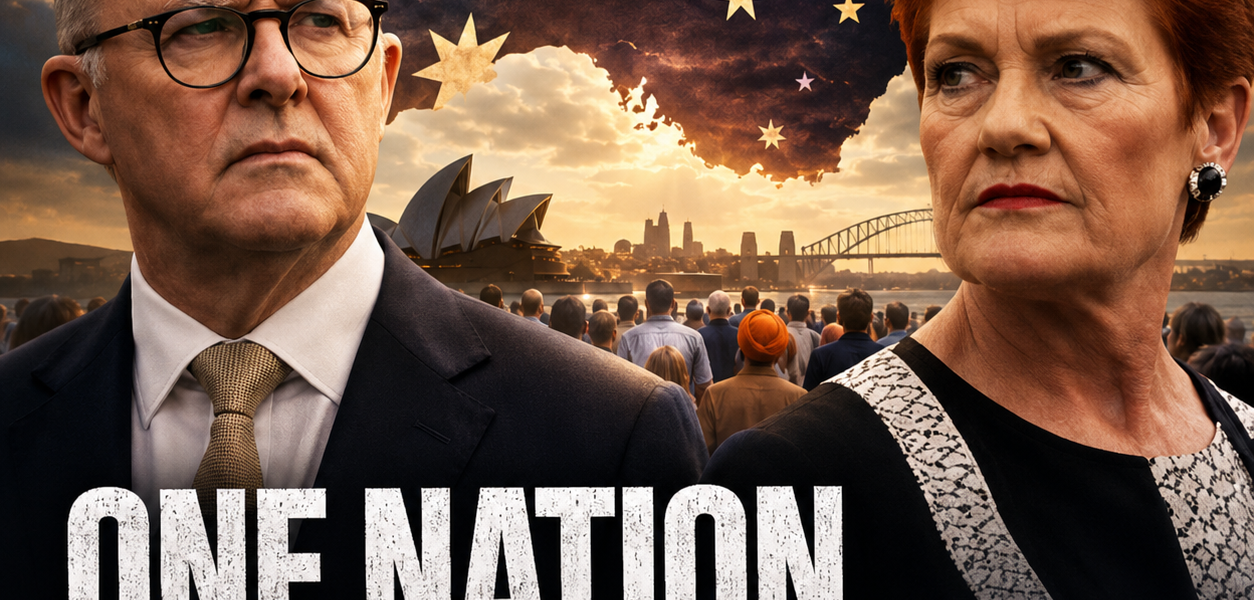
ALBANESE REJECTS HANSON’S “MONOCULTURAL” AUSTRALIA — BUT THE DEBATE OVER NATIONAL IDENTITY IS ONLY GETTING LOUDER. u1

Albanese Rejects Hanson’s “Monocultural” Australia — But the Real Battle Is Over the Meaning of Australian Identity
What began as another heated political exchange has rapidly developed into a broader national conversation about immigration, multiculturalism, social cohesion, and the future character of Australia.
At the center of the controversy are two political figures representing markedly different visions of the nation.
Pauline Hanson, the longtime leader of One Nation, renewed her criticism of multiculturalism and argued that Australia should place greater emphasis on a stronger, more unified national culture. Hanson also linked high levels of migration to growing pressures on housing, infrastructure, and public services, claiming that governments have failed to confront the practical consequences of rapid population growth.
Prime Minister Anthony Albanese responded by firmly rejecting the idea that Australia should become a “monocultural” nation. He argued that modern Australia has never been defined by a single culture and that its identity has been shaped by successive waves of migration, diverse communities, and the enduring heritage of First Nations Australians.
The exchange immediately reignited one of the most consequential political debates facing many developed democracies: How can a country remain culturally diverse while preserving a strong sense of social cohesion and shared national identity?
Why This Debate Is Bigger Than Australia
The Australian argument is not occurring in isolation.
Across Europe, North America, and parts of Asia, governments are grappling with similar questions as migration, economic pressures, housing shortages, and concerns about national identity become increasingly intertwined.
In the United Kingdom, debates about immigration and British identity have repeatedly shaped elections. In the United States, arguments over assimilation, border policy, and national culture remain deeply polarizing. Canada continues to promote multiculturalism while simultaneously debating integration and social cohesion.
Australia now finds itself confronting many of the same tensions.
The Legacy of Multicultural Australia

For much of the past half-century, multiculturalism has been widely regarded as one of Australia’s major national successes.
After the dismantling of the White Australia Policy, successive governments from both major parties largely embraced immigration as a driver of economic growth, population expansion, and international engagement.
Millions of migrants helped transform the country’s economy. They filled labor shortages, built businesses, strengthened universities, expanded trade relationships, and contributed to Australia’s increasingly global outlook.
Supporters of multiculturalism argue that this diversity is not separate from Australian identity — it is part of Australian identity.
They point to Australia’s relatively high levels of social stability compared with many other multicultural societies and argue that migrants have played central roles in virtually every major sector of national life.
The Critics’ Argument
Yet critics increasingly contend that the public conversation has become disconnected from everyday concerns.
Hanson and her supporters argue that sustained high migration has created pressures that governments can no longer ignore.
Among the issues they highlight:
- Rising housing costs.
- Infrastructure struggling to keep pace with population growth.
- Increased pressure on public services.
- Concerns about long-term planning and integration.
Importantly, many critics insist that questioning migration levels should not automatically be interpreted as hostility toward migrants themselves.
Instead, they argue for a more serious discussion about capacity, sustainability, and social cohesion.
A Shift in Public Opinion?
Recent polling suggests a more nuanced picture than political slogans often convey.
Australians generally continue to support immigration and diversity in principle. However, concerns about housing affordability, cost-of-living pressures, and population growth have become increasingly prominent.
That does not necessarily mean the public is abandoning multiculturalism.
Rather, many voters appear to be asking a different question: How should multiculturalism be managed in practice?
The Debate Is Moving From “Whether” to “How”

This distinction may be the most important development in the entire controversy.
The debate is increasingly shifting away from whether Australia should be multicultural and toward how a multicultural society should function effectively.
Even strong supporters of diversity often acknowledge that social cohesion cannot be taken for granted.
Successful multicultural societies typically depend on:
- Effective integration policies.
- Shared civic institutions.
- Common democratic values.
- A sense of national belonging that transcends ethnic or cultural background.
Without those foundations, social fragmentation can emerge.
The Problem With the Word “Monocultural”
One reason this debate has become so heated is that the term “monocultural” carries enormous historical and political baggage in Australia.
Critics argue that it implies a return to an earlier model that no longer reflects demographic reality. Modern Australia is one of the world’s most culturally diverse countries, and few serious observers believe a genuinely monocultural society could be recreated even if governments attempted it.
At the same time, many advocates for a stronger national identity insist that they are not seeking cultural uniformity.
Instead, they argue for greater emphasis on shared values, common institutions, and a stronger sense of what it means to be Australian.
That distinction often disappears in political combat.
My Professional Perspective
My Professional Perspective
Analysis
After covering immigration debates in Australia, Britain, and the United States for three decades, I believe the most important part of this story is not the argument between Albanese and Hanson.
The deeper story is that Australia appears to be entering a new phase of its multicultural experiment.
The Overlooked Detail
Many observers focus on the cultural rhetoric, but the real driver of public anxiety may be housing.
When people can afford homes, find jobs, and feel that public services are functioning, societies are often more comfortable with demographic change.
When housing becomes scarce and living costs rise, immigration debates tend to become far more emotionally charged.
In other words, this may be as much an economic story as a cultural one.
What Many People Miss
Another overlooked fact is that both sides are often arguing about different problems.
- Albanese is defending the principle that diversity is part of modern Australia.
- Hanson is highlighting concerns about the pace and management of population growth.
Those are not necessarily the same argument.
One concerns national identity; the other concerns national capacity.
The political danger is that the two become fused together.
The Bigger Historical Pattern
Historically, countries often revisit questions of identity during periods of rapid change.
Australia has experienced:
- Large-scale immigration.
- Rapid urban growth.
- Rising housing costs.
- Global economic uncertainty.
- Geopolitical competition for skilled workers.
Those forces naturally raise questions about belonging, fairness, and the future direction of the country.
That does not mean multiculturalism has failed.
It means the conditions that once produced broad consensus are changing.
The Unanswered Questions
Several important questions remain unresolved:
- What level of migration is economically beneficial and socially sustainable?
- How can governments expand housing and infrastructure fast enough to keep pace with population growth?
- What shared values should define Australian citizenship?
- How can leaders discuss integration without stigmatizing migrant communities?
- What does a confident Australian identity look like in a country where millions of citizens have roots elsewhere?
Why This Story Matters
Because the outcome will shape far more than election campaigns.
It will influence:
- Immigration policy.
- Housing policy.
- Education.
- Civic institutions.
- National security planning.
- Australia’s international competitiveness.
- The social fabric of future generations.
In my view, the central challenge for Australia is not choosing between diversity and unity.
It is ensuring that diversity strengthens a shared national identity rather than weakening it.
That is a much harder task than either political slogan suggests.
The International Context
One reason governments around the world are watching these debates closely is that migration has become increasingly linked to economic strategy.
Countries compete for skilled workers, students, and investment. Aging populations require larger workforces and tax bases. At the same time, governments must maintain public confidence that immigration systems remain sustainable.
Australia sits at the center of that dilemma.
Its future workforce, housing market, economic growth, and global competitiveness are all connected to migration policy.
That is why debates that once focused mainly on culture are now increasingly tied to economics and national strategy.
A Nation Searching for Balance

The evidence suggests that Australia’s success has been built on both diversity and unity.
Multiculturalism has contributed enormously to economic growth and international influence. At the same time, successful multicultural societies generally rely on strong institutions, shared civic values, and a common sense of national belonging.
Those goals are not mutually exclusive.
Indeed, many of the world’s most successful multicultural countries combine cultural diversity with a strong national identity rather than treating them as competing ideas.
Conclusion
The clash between Anthony Albanese and Pauline Hanson is ultimately about more than a single political phrase.
It is a debate about what Australia has become, what it wants to become, and whether a highly diverse society can maintain a strong sense of common purpose.
For now, Australians remain divided less over whether diversity exists than over how it should be managed and what should unite the country.
That distinction may prove crucial in the years ahead.
As an investigative journalist, I have seen similar debates emerge across many democracies. The countries that navigate them most successfully are usually not the ones that deny change, nor the ones that abandon national identity, but the ones that find a credible way to combine openness with belonging.
Australia now faces that test.
And the question that may define its next political era is not simply how many people arrive on its shores, but whether an increasingly diverse population can continue to believe in a shared idea of what it means to be Australian.
Can a nation become more diverse while also becoming more united?
That is the deeper story behind the headline — and it is a question Australia is only beginning to answer.