Uncategorized

The first grave appeared three days before the widow arrived. t1

The first grave appeared three days before the widow arrived.
No one in Black Hollow could explain where it came from.

That was what frightened them.

The grave sat alone on a rise overlooking the town cemetery, freshly dug beneath a twisted cottonwood tree that hadn’t produced leaves in years. There was no marker. No name. No cross. Just a rectangle of disturbed earth dark against the pale Wyoming prairie.

Old men riding past removed their hats.

Women crossing Main Street glanced toward the hill and then quickly away.

Nobody claimed responsibility.

Nobody admitted seeing who dug it.

And yet every person in town somehow knew the same thing.

The grave was waiting for someone.

By the second morning, rumors spread faster than wildfire through dry grass. Some said an outlaw was coming. Others swore a hanging had already been arranged. One drunk in the saloon insisted the grave belonged to Sheriff Caleb Mercer himself.

The sheriff laughed when he heard that.

But later that evening, when he rode alone to inspect the cemetery, nobody saw him laugh again.

Because nailed to the dead cottonwood above the empty grave was a single piece of paper.

Three words.

“I FOUND HIM.”

Nothing more.

No signature.

No explanation.

No clue who had written it.

Yet when Caleb read those words, the color drained from his face.

For fifteen years he had carried a secret buried deeper than any grave in Wyoming Territory.

A secret he believed had died with six men beneath a desert canyon hundreds of miles away.

Now somebody was telling him otherwise.

Somebody was coming.

And whatever had survived those fifteen years was finally on its way back to Black Hollow.

The widow arrived at sunset on the fourth day.

A freight wagon carried her into town through blowing dust and fading gold light. The sky above the prairie burned crimson behind distant buttes while shadows stretched across the empty road like fingers reaching from the past.

Nobody knew her.

Nobody expected her.

Yet every eye followed her arrival.

She stepped down from the wagon wearing a dark traveling coat faded by years of hard weather. She carried one trunk and a small wooden box bound with iron straps.

Nothing remarkable.

Except for the fact that she looked directly at Sheriff Caleb Mercer the moment her boots touched the ground.

As if she had come looking for him.

The sheriff stood outside the general store pretending not to notice.

But his pulse had already quickened.

Because he recognized her.

Not immediately.

Not by name.

Not even by face.

He recognized something else.

The eyes.

They belonged to a dead man.

Or at least a man who should have been dead.

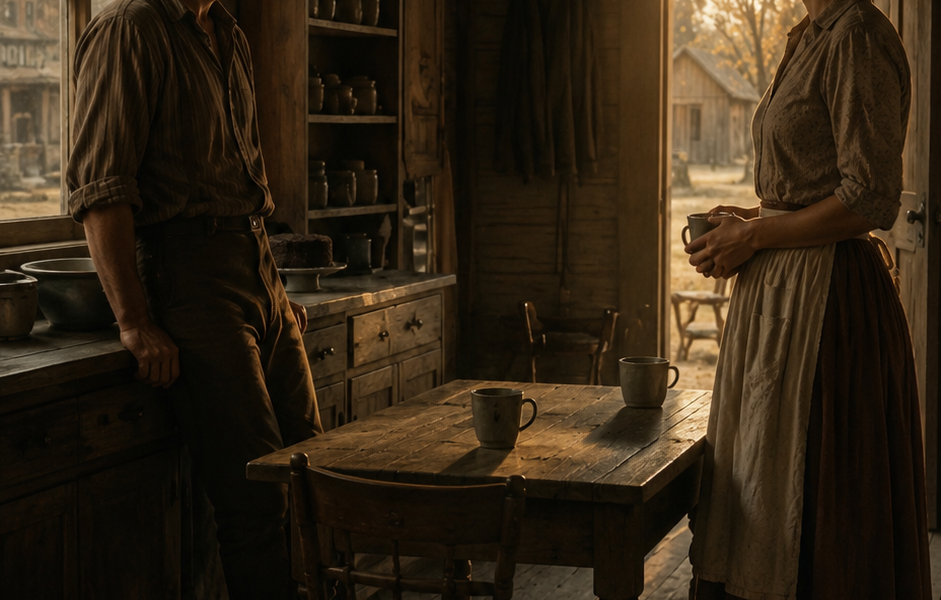
The widow rented a room above the hotel and spoke to almost nobody during her first week.

That alone would not have attracted attention.

Frontier towns saw strangers often enough.

But strange things began happening shortly after her arrival.

A rancher discovered an old silver badge buried beneath his barn floor.

The church caretaker found a rusted revolver hidden behind the bell tower.

A ledger vanished from the bank.

Then reappeared two days later on the bank manager’s desk opened to a page dated fifteen years earlier.

Every incident pointed backward.

Every clue reached into the same forgotten year.

And each time another secret surfaced, Caleb Mercer seemed to age a little more.

The townspeople noticed.

They whispered.

Speculated.

Wondered.

But nobody yet understood that the true mystery wasn’t what happened fifteen years ago.

The true mystery was why someone wanted the truth uncovered now.

The answer waited inside the widow’s wooden box.

Every evening she carried the box to the small room above the hotel and locked the door behind her.

Then she sat at a table beside the window and spread its contents before her.

Letters.

Photographs.

Maps.

Newspaper clippings.

And one leather-bound journal stained by blood.

The journal had belonged to her husband.

Thomas Reed.

Officially, Thomas Reed died from fever in New Mexico seven years earlier.

That was the story written on the death certificate.

It was also a lie.

The widow knew because she had buried an empty coffin.

Thomas Reed had not died from illness.

He had been murdered.

Murdered because he discovered something connected to Black Hollow.

Something powerful men were willing to kill for.

For seven years she had followed fragments across deserts, mining camps, cattle towns, and forgotten settlements scattered across the American West.

Every clue led here.

Every trail ended in Black Hollow.

And every answer pointed toward Sheriff Caleb Mercer.

Yet even she did not know the full truth.

Only that somewhere inside this town rested the final piece of a puzzle built from betrayal, greed, and blood.

Outside her window the prairie wind moaned through the night.

Inside, she opened her husband’s journal again.

Near the final page appeared a sentence written in shaking handwriting.

A sentence she had read a hundred times.

A sentence that still terrified her.

“If anything happens to me, don’t trust the sheriff. He was there when they buried the seventh man.”

The seventh man.

Those three words haunted her.

Because every official record mentioned only six men.

Six miners lost during a canyon collapse in Arizona Territory fifteen years earlier.

Yet Thomas insisted there had been seven.

One survivor.

One witness.

One man somebody desperately wanted erased from history.

The widow closed the journal and stared into the darkness.

Somewhere in Black Hollow, that survivor’s story still existed.

And she intended to find it before the people responsible discovered she was asking questions.

What she didn’t yet realize was that someone else had already begun watching her.

Someone who remembered the canyon.

Someone who remembered the gold.

Someone who remembered the screams.

And someone who would kill again before allowing the truth to surface.

The storm arrived shortly after midnight.

Thunder rolled across the prairie.

Lightning flashed behind the mountains.

And while Black Hollow slept, a lone rider emerged from the darkness.

He stopped beside the empty grave overlooking the cemetery.

For several moments he simply stared at it.

Then he dismounted.

Reached beneath his coat.

And placed something on top of the fresh dirt.

A sheriff’s badge.

Old.

Tarnished.

Splattered with dried blood.

The rider mounted again and disappeared into the storm.

By sunrise, the entire town would see the badge.

By sunset, another body would be found.

And before the week ended, Black Hollow would finally begin uncovering a secret so shocking that generations afterward people would still argue about what truly happened beneath the desert canyon fifteen years before.

Because some graves hold bodies.

Others hold stories.

And the most dangerous stories are the ones that were never meant to be remembered.

The spring roundup should have been a celebration.

Instead, it became the day Ruth Mercer discovered the first grave.

The sheep had multiplied. The lambs had survived. The sheds stood repaired. New fencing crossed the prairie where broken posts once leaned like defeated soldiers. Buyers from Kansas City had begun sending letters. Eastern mills were asking specifically for Mercer wool.

Everything that should have happened years ago was finally happening.

Yet prosperity has a way of disturbing buried things.

The grave appeared after three days of hard rain.

The creek east of the ranch swelled beyond its banks and tore a fresh channel through a low section of ground nobody had paid much attention to before. Ruth was riding fence when she saw something pale protruding from the exposed earth.

At first she thought it was driftwood.

Then she realized it was a human hand.

Not flesh.

Bone.

Weathered white by years underground.

The sheriff arrived before sundown.

So did half the town.

The skeleton lay beneath less than three feet of soil. Whoever had buried the body had done so quickly and without ceremony.

No coffin.

No marker.

No prayer.

Only bones.

And around one finger remained a silver ring.

The moment Elias saw it, all color drained from his face.

Ruth noticed.

So did Sheriff Talbot.

Neither man said anything.

But for the first time since she had arrived at the ranch, Ruth felt genuine fear.

Not fear of poverty.

Not fear of failure.

Fear of the past.

Because Elias Mercer looked exactly like a man staring at a ghost.

The sheriff collected the remains.

The crowd eventually dispersed.

Night settled over the prairie.

Still nobody spoke about the ring.

Not until Ruth found Elias sitting alone in the barn long after midnight.

A lantern burned beside him.

His father’s journal rested open across his knees.

And for the first time since she had known him, he looked broken.

“The skeleton belonged to Samuel Harlan,” he said quietly.

The name meant nothing to Ruth.

Yet the way he said it made her understand it should.

“Who was he?”

Elias stared into the darkness.

“My father’s best friend.”

The answer created more questions than it solved.

Because men did not usually bury their best friends in secret graves.

Especially not on their own land.

The lantern flame shifted.

Outside, wind moved through the cottonwoods.

And slowly, reluctantly, Elias began revealing a story that had been hidden for nearly twenty years.

Back when the ranch was thriving under his father’s ownership, two young men had arrived from Ohio together.

Jacob Mercer.

Samuel Harlan.

Partners.

Brothers in everything except blood.

They built fences side by side.

Survived blizzards together.

Fought rustlers together.

Dreamed together.

According to every story in town, their friendship had been legendary.

Then one autumn Samuel vanished.

Simply disappeared.

The official explanation claimed he had left for Colorado.

Most people accepted it.

A few doubted.

But nobody ever proved otherwise.

Now his bones had returned.

And with them came questions nobody wanted answered.

Ruth listened while Elias opened the journal.

Pages crackled beneath weathered fingers.

Entries stretched back decades.

Most described ordinary ranch life.

Weather.

Prices.

Births.

Deaths.

Yet scattered among them were cryptic references.

Arguments.

Warnings.

Mentions of money that never appeared in any ledger.

Mentions of men riding at night.

Mentions of fear.

The deeper they read, the stranger it became.

Then Ruth found a name.

Victor Kane.

The entry ended abruptly after it appeared.

As if Jacob Mercer had started writing something important and changed his mind.

Elias looked troubled.

“I’ve heard that name.”

“Where?”

“Old stories.”

His voice lowered.

“Outlaw stories.”

The revelation settled heavily between them.

Outside, coyotes began howling somewhere across the prairie.

And suddenly the skeleton seemed connected to something far larger than a missing rancher.

Over the following weeks Ruth pursued answers with quiet determination.

She spoke to elderly townspeople.

Store owners.

Widows.

Drifters who remembered fragments of forgotten conversations.

Each offered pieces.

None offered the whole.

Yet patterns emerged.

Victor Kane had once led a notorious gang operating between Kansas and Colorado.

Stagecoach robberies.

Train thefts.

Disappearances.

Violence.

Then the gang vanished almost overnight.

No final gunfight.

No mass arrest.

Just gone.

Like smoke.

The timing matched Samuel Harlan’s disappearance exactly.

And that could not be coincidence.

The mystery consumed Ruth.

The more successful the ranch became, the more determined she grew to understand the darkness buried beneath it.

Then one evening an old rancher named Walter Briggs arrived unexpectedly.

He was nearly eighty.

Blind in one eye.

Walking with a cane.

When he learned Samuel’s grave had been discovered, he asked to speak privately.

His hands trembled as he sat at Ruth’s kitchen table.

“I should’ve told the truth years ago.”

The statement silenced the room.

Elias leaned forward.

Walter swallowed hard.

Then the old man delivered a revelation that changed everything.

Samuel Harlan had never disappeared.

Walter had seen him die.

Not murdered.

Executed.

The words struck like thunder.

Executed by whom?

Walter’s remaining eye filled with sorrow.

“Your father.”

Silence.

Absolute silence.

Even the stove seemed to stop crackling.

Elias stared at him.

Unable to speak.

Unable to breathe.

Walter continued.

Twenty years earlier Samuel had confessed something horrifying.

He had secretly joined Victor Kane’s gang.

Not as an outlaw.

As an informant.

Samuel intended to help lawmen destroy them from within.

But Kane discovered the betrayal.

The gang planned to kill Samuel.

And anyone connected to him.

Including Jacob Mercer.

According to Walter, Samuel rode to the ranch one stormy night carrying proof.

Maps.

Names.

Evidence.

Enough to bring down the entire operation.

But Kane’s riders followed him.

There was no escape.

No time.

Samuel begged Jacob to do something unthinkable.

If captured alive, Samuel would reveal everything under torture.

The gang would slaughter families across three counties.

So Samuel asked his friend for mercy.

A final favor.

A bullet.

A quick death.

Walter had witnessed it from a distance.

Two friends standing beneath lightning.

One holding a revolver.

The other refusing to run.

Then a single shot.

One flash.

One sacrifice.

The old rancher lowered his head.

“Your father saved dozens of lives.”

Nobody spoke.

Because the truth hurt more than any lie.

Jacob Mercer had carried that burden alone for decades.

The town never knew.

His son never knew.

And Samuel Harlan had vanished into history without honor.

Yet the mystery still wasn’t complete.

Because one question remained.

Where was Victor Kane?

Walter answered that too.

Dead.

Or so everyone believed.

But Ruth wasn’t convinced.

The journal still contained unanswered clues.

Missing pages.

Missing names.

Missing money.

The story felt unfinished.

As though one final secret still waited in the shadows.

Weeks later she found it.

Hidden inside the journal’s leather binding.

A folded map.

Old.

Faded.

Marked with symbols.

And tucked beside it lay a single letter.

Addressed to whoever eventually discovered the truth.

The handwriting belonged to Jacob Mercer.

Ruth unfolded it carefully.

Her hands trembled.

The letter revealed everything.

Victor Kane had never escaped.

Samuel’s information had allowed Jacob and a handful of trusted ranchers to track the gang.

The outlaws had hidden stolen gold inside a canyon known as Devil’s Gate.

A battle followed.

Not one recorded in newspapers.

Not one preserved in official records.

Men died.

Others disappeared.

The survivors chose silence.

The gold remained buried.

The location remained secret.

Because greed would have destroyed every family in the territory.

Jacob had sworn never to reveal it.

Not even to his own son.

The final lines shook Ruth more than anything else.

If this letter is being read, enough years have passed.

Find the gold.

Use it to build what we never could.

Let something good come from all the suffering.

For a long time nobody moved.

The room felt suspended between past and present.

Outside, summer wind swept across fields of grazing sheep.

Fields that existed because one woman had answered a letter.

Because one man had trusted a stranger.

Because another man had sacrificed everything.

Months later Ruth and Elias located Devil’s Gate.

The journey took three days.

The canyon looked exactly as forgotten legends described.

Harsh stone.

Narrow passages.

Endless silence.

The gold remained there.

Thousands upon thousands of dollars hidden beneath collapsed rock.

Enough to change lives.

Enough to tempt anyone.

Yet what happened next became the final secret.

Because they kept only a small portion.

The rest funded schools.

Churches.

Roads.

Orphanages.

Projects across the prairie.

Anonymous gifts.

No monuments.

No celebrations.

No headlines.

Only quiet generosity.

The same kind Samuel Harlan had shown when he sacrificed himself.

The same kind Jacob Mercer had carried in silence.

Years passed.

The ranch became known as the finest sheep operation in three states.

Buyers traveled hundreds of miles to purchase Mercer wool.

Families found work.

Children found opportunity.

The prairie flourished.

And still very few people knew why.

Old-timers eventually began telling stories.

Some true.

Some invented.

Yet the deepest truth remained hidden.

Not because anyone feared it.

But because certain acts of courage belong to the people who performed them.

Long after Ruth and Elias were gone, travelers would ride past the ranch and notice three simple graves overlooking the pasture.

One belonged to Jacob Mercer.

One belonged to Ruth.

And one belonged to Samuel Harlan.

Visitors often wondered why the third grave received the most flowers.

The answer lived inside stories passed down through generations.

Stories about friendship stronger than fear.

Sacrifice stronger than greed.

Love stronger than loneliness.

And a secret buried beneath the prairie for twenty years.

A secret that nearly vanished forever.

Until a woman who arrived to save a failing sheep ranch ended up saving the memory of the men who built it.

And if you stand there at sunset, when the grass moves like waves across the endless frontier and the sky burns gold above the distant horizon, old ranchers will still tell you the same thing.

The greatest treasure ever found on the prairie was never the hidden gold.

It was the truth.

Note: Some content was generated using AI tools (ChatGPT) and edited by the author for creativity and suitability for historical illustration purposes.

LEAVE A RESPONSE

Your email address will not be published. Required fields are marked *