Otto Frank stood again inside the rooms where his family had once tried to disappear from the world. By June 1945, the hiding place was empty. Otto was the only member of the annex known to have returned from Auschwitz. The photographs and objects left behind would eventually become part of a story remembered across generations. But the most haunting photographs of the war are not always the ones showing battles. Sometimes they show a flag above an ancient monument, a child waiting in terror, soldiers resting, workers building machines, or an ordinary city continuing its daily life while history changes around it. What happens when a photograph survives long after the people inside it are gone?
The story begins in a place that was never meant to become a monument to memory: a concealed annex in Amsterdam.
On July 6, 1942, Anne Frank and her family went into hiding in the building at Prinsengracht 263, where Otto Frank’s business had been located. The hiding place would eventually contain eight people. For more than two years, they lived behind a concealed entrance, separated from the ordinary world outside. When the war ended, the annex was empty. In June 1945, Otto Frank returned from Auschwitz as the only person from the annex to survive the concentration camp system. The Anne Frank House records that he later became central to preserving the hiding place and bringing Anne’s diary to the public.
That fact gives old photographs a different weight.
A photograph can appear to show only a room, a street, a face, or a uniform. But sometimes what matters most is the absence inside the frame. The people who should have been there are gone. The furniture remains. The walls remain. The camera remains. History has left behind an image, but not necessarily the people who gave that image meaning.
And the photographs gathered in this collection repeatedly return to that strange contradiction.
One image described in the source shows a Jewish child with another child, holding a dandelion while waiting near the gas chambers at Auschwitz-Birkenau in May 1944. The precise identification attached to this caption should be treated cautiously because historical photograph captions can be altered, repeated, or misidentified over time. Yet the larger historical setting is not in doubt: in 1944, deportations to Auschwitz-Birkenau were taking place on a massive scale, and children were among those caught in the machinery of Nazi persecution and mass murder.
The tiny flower in such a caption is difficult to forget precisely because it is so ordinary.
A dandelion belongs to childhood. It belongs to fields, roadsides, springtime. It does not belong in a place created for systematic murder. That contrast is one reason photographs can sometimes communicate something historical prose struggles to express. They do not need to explain everything. They can place two realities beside one another and leave the viewer to confront the distance between them.
Elsewhere, another photograph brings the war into a completely different landscape.
In April 1941, German forces occupied Athens, and the Nazi flag was raised over the Acropolis. On the night of May 30, two young Greek resistance figures, Manolis Glezos and Apostolos Santas, climbed the Acropolis and removed the flag. The event is documented by the Greek national broadcaster ERT as an early and highly symbolic act of resistance.
The image of a Nazi flag above the Acropolis is powerful because of what surrounds it.
The Parthenon had already survived centuries of empires, occupations, religious transformations, and political upheaval. Then, in 1941, another occupying power placed its symbol above the ancient monument. The response came not through a battlefield victory, but through a dangerous act carried out by two young men.
The photograph, therefore, is not simply a photograph of a flag.
It is a photograph of occupation.
And the empty space left when the flag was removed became, in memory, almost as significant as the flag itself.
The war produced countless such moments in which ordinary objects acquired enormous historical meaning. A uniform could become a declaration of identity. A building could become a symbol of occupation. A photograph of a street could become evidence of a vanished world.
That becomes especially clear in another wartime image from Los Angeles in 1942.
The supplied caption describes a Chinese American worker wearing a handwritten identification sign intended to prevent him from being mistaken for Japanese. The exact image identification in the source should be treated carefully, but the underlying historical problem was very real. After the Japanese attack on Pearl Harbor, Chinese Americans faced the danger of being confused with Japanese Americans because of racialized assumptions about appearance and nationality. Historians have documented efforts by Chinese American organizations in Los Angeles to emphasize Chinese identity and alliance with the United States during the war.
The photograph, viewed today, raises an uncomfortable question.
How does a person prove who they are when strangers have already decided what they see?
War does not remain on battlefields. It enters streets, workplaces, shops, schools, neighborhoods, and even the way people identify themselves.
The same collection contains an image associated with an African American soldier reading a message attributed to the Viet Cong during the Vietnam War. The message appealed to the experience of racial discrimination in the United States and attempted to connect that experience with the war in Vietnam. Whatever the exact provenance of the photograph or wording of the caption, it reflects something important about twentieth-century warfare: soldiers were often confronted not only by military force, but also by competing political messages designed to influence how they understood the conflict.

That photograph belongs to a later war, but its presence beside World War II images reveals a broader pattern.
The twentieth century repeatedly turned photographs into arguments.
Sometimes governments created those arguments. Sometimes newspapers did. Sometimes soldiers carried them. Sometimes ordinary people appeared in them without knowing that decades later strangers would study their faces.
During the First World War, for example, one photograph in the source shows coins carried by a wounded soldier, described as having saved his life by being in his pocket when he was hit. Whether the exact story attached to the image can be independently established depends on its original provenance. But the photograph embodies a familiar feature of wartime memory: the transformation of small personal objects into symbols of survival.
The coins are not weapons.
They are not medals.
They are not military plans.
They are ordinary objects carried by someone who happened to enter an extraordinary historical moment.
Another photograph shows a Serbian soldier resting beside his father, who had visited him near the front between 1914 and 1915. Serbia suffered heavily during the First World War, including during Austro-Hungarian invasions. Yet the photograph does not show strategy or geography. It shows a relationship.

Father and son.
Soldier and civilian.
War and family.
That contrast appears repeatedly in the archive.
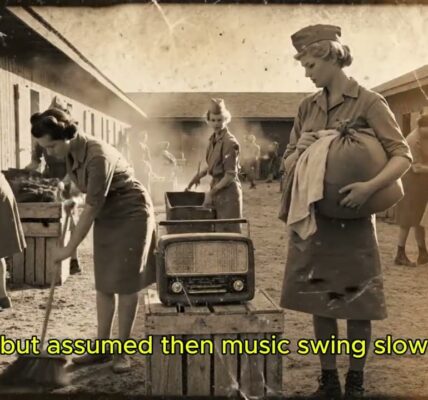
A nurse rests beside a twin 40-millimeter cannon on a Coast Guard vessel returning from Europe in 1945. A Royal Mail sorting office in London handles parcels in November 1939, only months after Britain entered the Second World War. A B-24 bomber assembly line in Fort Worth works at wartime speed in 1943. Coal miners in Yorkshire prepare to descend underground in 1943, performing work essential to Britain’s wartime economy.
None of these photographs shows the entire war.
Together, however, they show how enormous the war became.
It was fought by soldiers, but sustained by mechanics, miners, factory workers, nurses, engineers, railway workers, postal employees, farmers, and families.

The bomber on an assembly line was connected to a pilot thousands of miles away. The coal miner underground was connected to factories above ground. The postal worker sorting packages was connected to soldiers overseas. The nurse beside the cannon was connected to the enormous logistical system that carried men and equipment across the Atlantic.
This is one reason old photographs can be more revealing than dramatic battlefield scenes.
They show the machinery behind the headline.
And sometimes they show the strange moments when history becomes almost surreal.
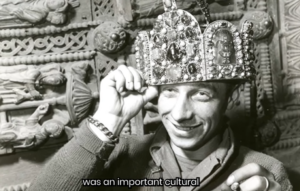
A photograph from 1945 reportedly shows an American soldier posing with the crown of the Holy Roman Empire in a German cave. The caption in the supplied material contains uncertain place identification, so the image should not be treated as definitive evidence for every detail attached to it. But the broader wartime reality is well documented: Allied troops encountered enormous quantities of cultural property and historical objects as German territory collapsed in 1945.
Elsewhere, the war appears through a completely different object: the USS Shaw.
On December 7, 1941, Japanese forces attacked Pearl Harbor. The destroyer USS Shaw was struck and dramatically damaged, and photographs captured the explosion. The image became part of the visual record of the attack that brought the United

States directly into World War II.
The photograph freezes an instant.
But history does not freeze with it.
Behind that single frame came mobilization, industrial expansion, battles across the Pacific and Europe, enormous casualties, and years of global upheaval.
The camera records the explosion.
It cannot record everything that followed.
That limitation is important.
Every historical photograph is a fragment.
The temptation today is to treat a dramatic old photograph as if it contains the entire truth. It does not. It contains one moment, seen from one position, selected by one photographer, preserved through a chain of ownership and reproduction.
Sometimes even the caption changes.
Names are misspelled.
Places are confused.
Dates drift.
Stories become simplified.
An image that was originally carefully documented can later circulate online with a dramatic but unsupported explanation.
That is why some of the stranger photographs in this collection should be approached with curiosity, but also caution.
A mug shot identified in the supplied material as Bertha Baranda, arrested in 1907 after a violent domestic incident, is an example of how an individual photograph can become attached to a larger story about abuse, crime, gender, and public fascination. The historical case may have generated sensational attention at the time, but a modern viewer cannot reconstruct every detail of the event from a mug shot alone.
The same principle applies to photographs of criminals.
In 1912, the standardized system of police identification associated with Alphonse Bertillon represented an important stage in the development of criminal identification. Bertillon’s system relied on measurements and standardized photographic records, creating a new visual language for police files.
The face became data.
A human being could now be photographed, measured, classified, and placed into a bureaucratic system.
It was a profound change.
And it reminds us that photography has never been used only to preserve memory.
It has also been used to control, classify, identify, advertise, entertain, persuade, and prosecute.
That same century produced photographs that seem almost playful.

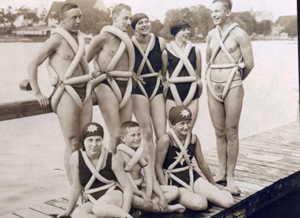
A salesman refuels motorized roller skates in 1961. A woman dances on top of a Marmon automobile in California in 1926. Young people in Germany in 1925 use bicycle tubes tied around their bodies while learning to swim. A steam-powered mechanical creation from the 1870s appears almost like a strange prophecy of modern robotics. An engineer in Germany tests a rocket-propelled bicycle in 1932.
These images reveal another side of the past.
People did not live every day thinking about history.
They experimented.
They joked.
They invented.
They went swimming.
They attended races.
They watched films.
They bought toys.
They played chess.
They drank coffee.
They went to amusement parks.
And they went to work.

That ordinary life continued even while the world was repeatedly transformed by war.
In 1952, Broadway in New York appears as a bright urban landscape of theaters and lights. In the 1940s, Detroit represents the enormous industrial capacity of American manufacturing. In 1955, the area that would become the Las Vegas Strip was still developing into the entertainment center later known around the world.
In London, the K6 telephone box designed by Sir Giles Gilbert Scott became one of the recognizable features of the British streetscape. In 1968, the old London Bridge was purchased and dismantled stone by stone for reconstruction in Lake Havasu City, Arizona. The move was documented in American architectural records.
The bridge itself had survived for generations.
Then it crossed an ocean.
A photograph can therefore capture not only people but transitions in civilization.
A bridge moves.
A city expands.
A telephone changes.
A car becomes smaller.
A machine becomes faster.
A toy becomes an icon.
And eventually, what once looked ordinary becomes historical.
That is also why photographs of famous people can feel unexpectedly intimate.

An eleven-year-old Charles Lindbergh stands beside his dog in 1912, long before his famous 1927 solo flight across the Atlantic. Alfred Hitchcock travels aboard the Queen Mary in 1938. Margaret Bourke-White poses on the Chrysler Building around 1930. Anita Ekberg is photographed in Rome in 1960, surrounded by the intense attention of paparazzi. Emperor Hirohito visits Disneyland in 1975 and is photographed with Mickey Mouse.
The people are famous now.
But the photographs remind us that fame has a beginning.
Before the headlines, there was a person.
Before the historical achievement, there was a young face.
Before the public image became fixed, there was an ordinary moment that nobody yet knew would matter.
And then there are the photographs of crowds.
New Year’s Eve in Times Square in 1938.
Broadway in 1952.
Central Park in 1942.

Women playing cards beside a swimming pool in the 1920s.
A public celebration in Venice Beach in 1935.
People drinking coffee in 1956.
A girl in Paris reading about Yuri Gagarin’s first flight into space in 1961.
These photographs show something easy to overlook when studying war.
History is not only made during battles.
It is also made in the spaces between them.
A girl reading about Gagarin could not have known that her photograph would one day become evidence of how quickly humanity’s imagination had moved from trenches and bombers toward spaceflight.
The same world that had built the B-24 bomber would build spacecraft.
The same century that had seen Nazi occupation would later see humans leave Earth.
The transition was not clean or peaceful.
It was complicated, uneven, and often painful.
But the photographs preserve the sequence.

A world at war.
A world rebuilding.
A world experimenting.
A world looking upward.
That is why the Apollo 1 photograph in the collection feels especially poignant.
In 1966, astronauts Virgil Grissom, Edward White, and Roger Chaffee practiced water-landing and emergency-escape procedures using mock spacecraft. NASA records the training sessions, including water egress exercises in Houston and later in the Gulf of Mexico.
The photographs show preparation.
They show people rehearsing what they hoped would happen.
But on January 27, 1967, the Apollo 1 crew died in a fire during a launch rehearsal.
The photograph taken before the tragedy therefore acquired a meaning nobody could have fully anticipated when it was made. NASA later remembered the three astronauts as members of the agency’s family who died while advancing human spaceflight.
This is one of the hardest truths about historical photography.

We know the ending.
The people inside the frame did not.
A photograph of a soldier in 1941 is different to the person standing in it than it is to someone looking at it eighty years later. To the soldier, the future was uncertain. To us, the past is already complete.
That difference creates the strange emotional power of old photographs.
We can see the moment before the future happened.
The same feeling exists in photographs connected to the liberation of Europe.
A French ambassador welcomes an American soldier in Strasbourg in November 1944, according to the supplied caption. The exact circumstances of the image should be checked against its archival record, but the larger historical context is clear: Strasbourg was liberated in November 1944 as Allied forces advanced through France.
Elsewhere, American nurses return from Europe.
Mail workers continue sorting parcels.
Factories continue producing aircraft.
Children attend school.
Families gather for Thanksgiving.

And in London, even the moat of the Tower of London becomes part of the wartime effort.
During the Second World War, Britain’s government encouraged the public to turn available green spaces into vegetable gardens under the “Dig for Victory” campaign. The Tower’s moat was converted into an allotment, allowing vegetables to be grown there. Historic Royal Palaces documents this transformation as part of the broader effort to cope with wartime food shortages and maintain morale.
It is an extraordinary image if one thinks about what the Tower represents.
A medieval fortress.
A place associated with kings, prisoners, executions, and centuries of British history.
And during the Second World War, part of it became a vegetable garden.
History does not always announce itself with a cannon.
Sometimes it looks like a cabbage growing in a medieval moat.
That is the larger lesson hidden throughout this collection.
The past was not one continuous dramatic scene.
It was thousands of ordinary moments happening simultaneously.

Some were terrifying.
Some were absurd.
Some were beautiful.
Some were deeply uncomfortable.
Some were simply strange.
A woman in motorcycle clothing in France in 1905.
A couple taking a baby ice skating in the 1930s.
An elderly man cooking in Ontario in 1910.
A mother teaching her children at home in rural Louisiana in 1937.
A rural store in Oklahoma in 1940.
Workers resting during the Great Depression.
Children preparing to enter coal mines in wartime Yorkshire.
A couple climbing into a BMW Isetta in the 1950s.
A Hot Wheels assembly line in the 1960s.

Bobby Fischer playing simultaneous chess exhibitions against dozens of opponents.
A kangaroo pushing away a woman trying to photograph it.
A strange old swimming aid made from bicycle tubes.
A mechanical experiment that looks almost impossible by modern standards.
The past is full of things that feel invented.
But they were real enough to someone.
And this is where photographs become more than decoration.
They become evidence of human possibility.
They show what people thought was normal.
They show what people feared.
They show what people tolerated.
They show what they celebrated.

They show how quickly the impossible could become ordinary.
The photograph of the Memphis Zoo in the 1950s, described in the source as reflecting racial segregation, carries another reminder. Old photographs can expose systems that were once treated as routine but later became subjects of intense social and legal challenge. The image does not need to shout. The fact that access could be restricted according to race is already a historical statement.
Similarly, photographs of Harlem in the 1960s sit inside the larger history of the civil rights era.
The camera does not resolve the debates of the time.
It preserves their setting.
That distinction matters.
A photograph is not an argument by itself.
It is a piece of the record.
And sometimes the most responsible way to look at a historical photograph is to resist the temptation to make it say more than we can prove.
That principle becomes particularly important with unusual images.
The source identifies one photograph as a rare image of a war veteran seeking assistance on the street. Another shows a woman wearing a mask during a “Miss Lovely Eyes” contest in Florida during the 1930s. Another depicts a champagne inspector wearing protective equipment after Prohibition ended in 1933, presumably because of the danger associated with opening bottles.

Whether every caption attached to these images is perfectly preserved is another question.
The photographs still tell us something.
They show what people wore.
What they feared.
What they invented.
What they considered entertainment.
What kinds of work existed.
And what seemed normal enough at the time to be photographed.
Sometimes that is enough.
Because the deepest value of an old photograph is not always the sensational story attached to it.
Sometimes it is simply that it allows us to look at a world that no longer exists.
A world in which London Bridge still stood in London.

A world before the modern Las Vegas Strip.
A world before the first human entered space.
A world before the Apollo fire.
A world before the United States entered World War II.
A world before the Nazi flag flew over the Acropolis.
A world before Otto Frank returned to the annex and found it empty.
The photographs connect these moments without pretending that they were all part of one story.
And perhaps that is what makes them so haunting.
History is usually taught backward.
We already know what happened.
We know who won.
We know which cities were liberated.
We know which technologies succeeded.

We know which people became famous.
But the people inside these photographs did not possess that knowledge.
They lived forward.
They waited.
They worked.
They worried.
They celebrated.
They made decisions without knowing how historians would later judge them.
That is the invisible dimension of historical photography.
Every frame contains a future that has not happened yet.
For Otto Frank, the future after the war meant returning to an empty hiding place and carrying the memory of his family forward. The Anne Frank House later preserved the annex as a place of remembrance, keeping the rooms empty at Otto’s request when the museum opened in 1960.
For the two young Greeks who removed the Nazi flag from the Acropolis, the future meant becoming permanently associated with one of the most remembered acts of Greek resistance.
For the workers photographed in factories, mines, post offices, and shipyards, the future was simply another day of work.
For the Apollo 1 crew, the photographs preserved a future that never arrived.

For the anonymous people in streets and public spaces, the future brought something stranger still: they became strangers to us.
Their names disappeared.
Their voices disappeared.
Their routines disappeared.
But the image remained.
And that may be the real mystery inside these photographs.
Not whether every caption is sensational.
Not whether every story attached to an image can be repeated exactly as it appears online.
The deeper mystery is how much of human life disappears even when history seems to remember everything.
A photograph can preserve a face without preserving a name.
It can preserve a building without preserving the people who lived inside it.
It can preserve a soldier without preserving what he thought.
It can preserve a crowd without telling us what each person hoped for.

It can preserve a moment while everything that came before and after slowly disappears.
That is why these photographs deserve more than a quick glance.
Some show war directly.
Some show the society that produced the war.
Some show the society trying to survive it.
Others show what came afterward: entertainment, technology, fashion, transportation, aviation, space exploration, civil rights, and the ordinary routines of people rebuilding their lives.
Together, they reveal something that a simple timeline cannot.
The twentieth century was not merely a sequence of wars and inventions.
It was a sequence of human lives.
Some were caught inside history’s greatest catastrophes.
Others lived beside them.
Some resisted.
Some suffered.
Some worked.
Some invented.
Some became famous.
Most did not.

Yet the camera occasionally found them.
And once the shutter closed, that tiny fragment of time became something almost impossible to destroy.
The world moved on.
The people aged.
Buildings disappeared.
Governments changed.
Wars ended.
New wars began.
Technology transformed daily life.
But the photographs remained.
Perhaps that is why the oldest images can feel strangely close.
They remind us that history was never experienced as “history” by the people who lived it.
It was simply Tuesday.
A train was arriving.
A child was waiting.
A soldier was resting.
A family was eating.
A worker was finishing a shift.

A young woman was being photographed.
A city was preparing for another night.
A spacecraft crew was practicing for a future mission.
And somewhere, perhaps without realizing it, a photographer pressed the shutter.
Decades later, we are left with the frame.
Not the whole story.
Not the complete truth.
But a doorway.
And sometimes, when we look carefully enough, what lies beyond that doorway is not another spectacular secret.
It is something quieter.
It is the realization that every historical photograph contains human beings who once believed they were living in the present, just as we are now.
The wars they feared eventually became chapters.
The streets they knew became landmarks.
The inventions they admired became obsolete.
The people they loved became memories.
And the photographs became the last witnesses.
That is why these images matter.
Not because every caption is perfect.

Not because every strange photograph hides a forbidden revelation.
And not because the past was somehow more mysterious than the present.
They matter because they remind us how easily an ordinary moment can become the only surviving trace of an extraordinary age.
When we look at them, we are not simply looking backward.
We are looking at people who once stood exactly where we stand now—in the present, unaware of what the future would make of them.
And perhaps that is the question these photographs leave behind: if someone photographed an ordinary moment of our own lives today, what would future generations see in it that we cannot see yet?
Some content was generated using AI tools (including ChatGPT) and edited by the author for creativity, storytelling, and historical illustration purposes. Historical facts and key details should be verified against reliable historical sources. Any AI-generated or reconstructed visuals are intended for illustrative purposes and should not be interpreted as original historical photographs or archival evidence.