“Who Made This Cornbread?” the Rancher Asked—Then He Saw the Cook Everyone Looked Past. t1

“Who Made This Cornbread?” the Rancher Asked—Then He Saw the Cook Everyone Looked Past
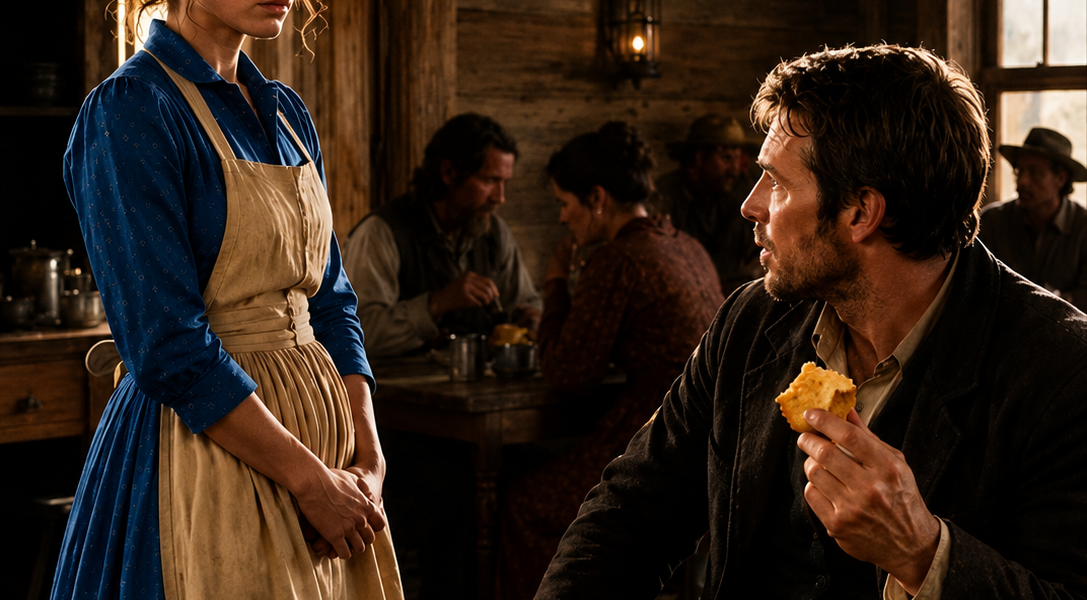
Jonas Harlan set his hat on the table and asked if there was anything besides stew. Edmund Hollis didn’t look up from his ledger. The only sound in the room the scratch of his pencil and the clatter of someone’s spoon. There’s cornbread if you want it. Woman in back made too much. He said it the way a man mentions leftover firewood.
Lucy brought it out herself. Plate in one hand, eyes somewhere past his shoulder. She set it down and turned to go. Hold on, Jonas said. He broke off a piece and ate it standing there in front of the whole dinner crowd because he hadn’t thought to sit first. That’s the best cornbread I’ve ever had. Lucy stopped.
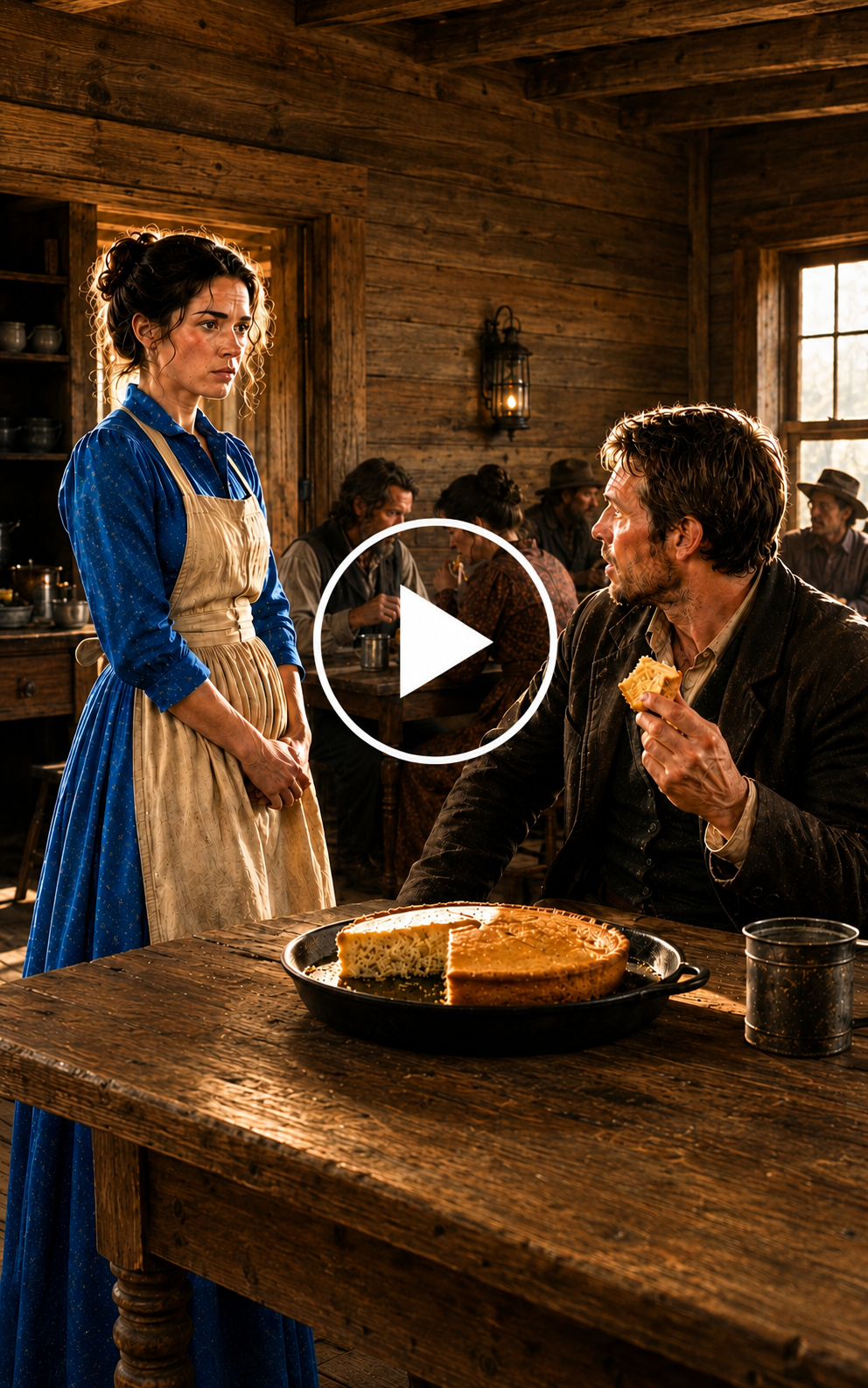
Something crossed her face that wasn’t quite gratitude. Glad it suits you. She went back to the kitchen like the compliment weighed something she didn’t want to carry. Jonas watched her go. Around him the dinner crowd kept eating. Rail men in off the new grading work. A drummer with a case of tin samples, two ranch wives in for supplies.
None of them looked up. Whatever had just happened, it had happened only to him. He thought about it on the ride home the way a man turns over a stone he doesn’t understand the shape of. Jonas was 26 and the Harlan ranch was his. Left to him 3 years back. A fair-size spread for the area, not the largest in the county but close enough to it with a handful of hands and more cattle each season than the one before.
The town had grown up around him without his much noticing. A second street now. Talk of a rail spur. And he’d grown with it in the dull steady way of a man who puts his attention into fence line and forgets to ask what else there might be to want. He’d been engaged once, 4 years before, to a woman who packed her things and went home to her mother without telling him why.
Since then, he had not gone looking for reasons to feel the lack of anything. Lucy had grown up at the county orphanage two towns over and stayed on past the age she needed to because the cooking there needed doing and she was good at it. She came into town on her own two feet when it started needing more hands than it had, found work at the boarding house and had kept it since.
People mostly looked past her, plain-faced, quick about her business, nothing in her manner that invited a second look. She had gotten used to being looked past and had stopped expecting otherwise. A few days later, Jonas rode through town on an errand that could have waited and saw her on the boarding house porch crouched to a boy of five or six breaking a heel of bread in two and handing him the bigger half.
The boy took it with both hands like it was the only thing he’d been given all week. His mother came up the street calling his name, found him, thanked Lucy plainly, the way you’d thank someone for holding a door. Lucy smiled, full and easy, the kind of smile Jonas hadn’t once seen cross her face in the dining room.
Then Edmund’s voice came from the doorway. “Lucy, back to it.” Not unkind, exactly, just a man minding his business the way he minded everything else, with no more weight behind the words than he’d have given to telling her the stove wanted wood. The smile went out like a candle pinched between two fingers. Lucy wiped her hands on her apron and went inside without a word.
Jonas sat his horse a moment longer than his errand called for. He did not understand what he had just watched. He knew he had watched something. The town was busy getting ready for the harvest festival that week, banners going up along the main street, the bank polishing its own front window like it mattered to anyone.
Twice that week Jonas found a reason to ride past the boarding house that hadn’t existed the week before, and twice he told himself it had something to do with supplies. Old Mrs. Vane, who missed nothing from her chair on the mercantile porch, remarked to her daughter that the Harland boy seemed to be eating an awful lot of stew lately for a man who didn’t care for stew.
Her daughter said she hadn’t noticed. Mrs. Vane said she had. He ate at the boarding house again two days after that and didn’t ask anything. He ate his stew and watched Lucy move through the room, quick, capable, closed up tight, and saw nothing of the woman who had knelt on the porch with a piece of bread. Whatever that had been, it didn’t come out for customers.
He found himself paying closer attention than the meal warranted, noting the careful way she cleared a table, the way she never let her eyes rest on anyone face longer than business required, and thought, not for the first time, that a person could spend a long while in a town this size and still manage to go mostly unseen.
That evening he found Edmund at the saloon, where Edmund ended most evenings with the same glass of the same whiskey in the same chair, like a man keeping an appointment with himself. The room was loud with rail crew and card games, but Edmund’s corner kept its own quiet country. “That cook of yours,” Jonas said.
“She always like that?” Edmond turned his glass a quarter turn. “Like what?” Jonas turned his glass the way Edmond had turned his. “Quiet.” “Like she’s waiting to be told to stop doing something.” Edmond didn’t answer right off. He took his time with the whiskey. The way he took his time with most things that mattered.
“She’s an orphan.” “Never had much cause to trust grown folks.” He drank. “Hardest worker I’ve got.” “She close herself off like that with everybody?” “Around grown people mostly.” He set the glass down. “Children she goes soft for.” “Rest of us she keeps her distance.” The saloon went on around them, loud in the way Thursdays always were.
And for a while neither man said anything more. Jonas turned that over. “Why?” Edmond gave him the kind of shrug that wasn’t really an answer. “Festival’s next week. I’m running the food again.” He looked at Jonas sideways. “There’ll be more cornbread than you can eat.” Jonas looked at him. Edmond said it like a man who meant nothing more by it and went back to his whiskey.
The festival filled the square with bunting strung between the feed store and the bank, fiddle music, and townsfolk turned out in clothes Jonas hadn’t seen them wear since Christmas. Lanterns hung from the porch posts, though the sun hadn’t gone down yet, ready for when it did. Edmond had tables set end to end along the boardwalk, loaded with food enough for twice the town.
Lucy worked them in her boarding house apron, hair coming loose at her collar, sweat at her temple, while around her people danced and laughed in their good boots. Nobody thought to ask if she wanted to. Jonas watched her a while from the edge of the crowd before he crossed over. “Dance with me.” Lucy looked at him like he’d asked her to fly.
She looked past him to Edmund, who was watching from the drink table with his arms crossed. Edmund gave one nod, small enough that most wouldn’t have caught it. She untied her apron and laid it over the table. She was stiff at first, counting her steps, watching her own feet instead of him. Then the fiddle changed tunes, and she wasn’t anymore.
And partway through the second song she smiled. At nothing in particular, at the lantern light or the noise of the crowd or just at having both hands free for once in an evening. Jonas decided he liked the sight of it more than he had any business deciding so fast. When the song ended he asked if he could speak with her a moment, off to the side, away from where the crowd could make something of it.
“I need a cook out at the ranch. Good wage and a cabin of your own.” Lucy glanced past him to where Edmund stood watching from the drink table. “Mr. Hollis needs me here.” “I’ll talk to Hollis.” She studied him the way a person studies a fence line before deciding whether it’ll hold a horse. “I’ll come look.
” “That’s not a yes.” “That’s fair.” Jonas touched the brim of his hat. She rode out the next morning alone in a wagon Edmund lent her without being asked twice. Jonas walked her through the kitchen, a long room with a good stove, a window over the sink that looked out on the corrals, a flower bin built into the counter that had clearly been put there by someone who knew what a cook needed and not what looked handsome.
He showed her the cabin out back with its own door and its own stove, the two maids who helped with the wash, the hands working cattle in the near pasture, dust rising soft over the herd. The maids were sisters, Hattie and Lilly, daughters of a homesteader 2 miles off, and they looked Lucy over the way young women look over anyone new who might outrank them in the kitchen.
Lucy looked back without apology, and something settled between the three of them before a word was spoken, the kind of understanding that didn’t need one. He told her supper was at 6:00 and breakfast before sunup, and that beyond that the kitchen was hers to run as she saw fit. He didn’t tell her how to do her work.
She noticed that and didn’t say so. Lucy looked at the cabin a long moment, then at the flower bin, then out at the corrals. I’ll come on a trial. We’ll see if it suits. It’ll suit. Then before she could turn back toward the kitchen, I have one condition. She waited. “I need you to smile more,” he said. Something in her face gave way before she decided to let it.
She smiled, small but real, and let it sit there a moment before she spoke. “I’ll see what I can do.” She came 2 weeks later with one bag and no complaint about the cabin being smaller than the boardinghouse kitchen. It was the first room she’d ever had that locked from the inside with her own key, and she took some private satisfaction in that fact without ever saying so aloud to anyone.
The hands took to her cooking fast. She fed eight men like she’d been doing it her whole life, which, in a way, she had. She kept the kitchen the way Edmund kept his ledger, exact and uncomplaining, and within a month the two maids had taken to calling her Mrs. half in jest, though nobody corrected them for it.
The hands fell for her cornbread the same way Jonas had. By the second week, one of them, a quiet rider named Levi Tupper, who rarely asked for anything, worked up the nerve to ask if there might be more of it some evenings than others. Lucy said there might. After that, there generally was, and the men ate it without remark, the way they ate anything good and steady and didn’t think to name.
Jonas noticed within that same month that she never sat down to eat. She fed the hands, fed the maids, fed him last of all, and by the time everyone else had cleared off, she was usually at the stove with a plate she hadn’t touched, scraping pots. He said nothing about it for a while. Then, one evening, after the hands had gone, he came back into the kitchen, pulled the second chair out from the table, and set her plate down on it himself.
Sit. I’ll wait. Lucy looked at the chair, then at him. You don’t need to wait on me, Mr. Harlan. I’m not waiting on you. I’m waiting for you. He sat down across from her. “Eat before it’s cold.” She sat. They ate in the quiet kitchen and neither of them made anything of it. Though after that night, it kept happening most evenings without either one suggesting it again.
The household took its shape around that habit the way a path takes its shape from repeated walking. The maids noticed and said nothing to her face. The hands noticed and said nothing at all beyond one or two looks traded across the bunkhouse that settled into something closer to approval than curiosity before the first month was out.
Jonas kept the ranch running the way he always had. Fences mended, cattle moved, accounts squared on schedule. And underneath all of it, the days had started arranging themselves around an hour in the evening that hadn’t existed in his life before her. And he noticed that without remarking on it any more than he remarked on weather.
By the second month, he’d learned she took her coffee black and her eggs not at all. And that she hummed when she thought the kitchen was empty and stopped the moment she heard a boot on the step. He never let on that he knew either thing. He just stopped wearing his boots quite so loud coming up from the barn.
That same month, the wind off the north pasture found a gap under her cabin door that no amount of rags stuffed along the sill would settle. She mentioned it to no one. One afternoon, while she was in town at market, Jonas took the door off its hinges, planing the bottom edge down true, and hung it back before supper.
He didn’t tell her. She noticed that night when the door swung shut quiet and even for the first time since she’d moved in and said nothing about it either. Only swept up the curl of wood shavings still on the floor and put another log on her stove with something close to a smile. In the spring, a heifer died calving and left a wet shaking calf nobody had time to nurse by hand.
Jonas brought it up to the kitchen porch in a feed sack because it was the warmest building on the place, expecting Lucy to object to the mess of it. She didn’t. She warmed milk on the stove and fed it from a bottle made of a flask and a glove finger, sitting on the porch boards in her nightclothes at 2:00 in the morning with the calf’s head in her lap, talking to it low and steady, the same way she talked to small boys with bread.
Jonas found her there near dawn, the calf finally asleep against her knee. He didn’t say anything about the hour or the cold or the state of her nightclothes. He brought out a blanket, draped it over her shoulders, and sat down on the step below her. And they stayed like that until there was enough light to see their own breath.
The calf lived. The hands named her cornbread before anyone thought to stop them, and the name stuck for the rest of the cow’s long life, repeated so often around the place that after a while nobody but Jonas and Lucy remembered why it had started. And neither of them ever explained it to anyone who asked. Come summer, Jonas noticed she slowed her step every time she crossed the near pasture where a stand of black-eyed Susans grew up wild along the fence line, and noticed too that none ever showed up cut and sitting in a jar anywhere in the
kitchen, which struck him as a strange kind of leaving alone for a woman who clearly liked the look of them. He didn’t ask. He started bringing in a handful himself when his work carried him past that fence, setting them in a jar on the window sill over the sink without comment, and said nothing when they wilted, and nothing when he replaced them.
Lucy never mentioned it, either. By August, she had started keeping the jar filled herself on the mornings he didn’t get to it, which was its own kind of answer given without a word changing hands. One evening not long after, mending a tear in an apron by the kitchen lamp, Lucy mentioned, without being asked, that the orphanage had kept a garden out back, and that she’d learned most of what she knew of cooking from making do with whatever that ground gave up each season.
She didn’t say more than that. Jonas didn’t ask for more, understanding by then that what she offered on her own was worth more than anything he might have pried loose. He told her in turn that his mother had kept a garden behind the old house once, gone to weeds long before Lucy arrived, and that he’d meant to put it right and never had.
The next week, without remark, the weeds along that stretch of fence were cleared, and a fresh-turned bed of earth sat waiting for whatever she meant to put in it. She put in herbs first, then vegetables the spring after, and never once thanked him for the clearing, which he understood by then as thanks enough.
In the fall, with the calf grown into a yearling that still came when Lucy called it, Jonas found her shelling beans on the cabin step in the last of the evening light, and sat down beside her without asking, the way he’d started doing most evenings. “Your cornbread’s better than the one Hollis used to ration me,” he said.
Lucy didn’t look up from the beans. That’s because Hollis’s flour was old. I told him so for 2 years. I believe you. She went on shelling beans like the compliment wasn’t worth pausing for. You’d believe near anything I told you. I’d believe most of it, wouldn’t take it on faith. The corner of her mouth moved.
She didn’t argue the point. By winter, the hands had stopped remarking on how often Jonas ate his supper late after everyone else at the same table as the cook. Nobody made a thing of it. It had simply become the shape the evenings took. The way the second chair had simply become hers. Snow came early that year and stayed.
The house settled into the kind of quiet long winters bring to a working ranch. Chores done early, evenings long, the fire doing most of the talking. One night Jonas asked her to come sit by the hearth instead of going straight to bed. She came, dish towel still over her shoulder, and sat across from him in the good chair he’d never once seen her use.
He poured her coffee himself and set the cup in her hands before he sat back down. “I’ve been thinking on something,” he said. She turned the dish towel over in her hands. “You usually are.” “This ranch ran fine before you came.” He looked at the fire, not at her. “It runs different now.” He reached over, took the cup from her hands mid-sip, and set it down on the hearthstone himself the way she’d set his plate down on so many nights without asking.
“I don’t need a cook anymore, Lucy. I need you to stay because the house doesn’t work right when you’re not in it.” Lucy sat very still. “Marry me.” he said. She looked at the empty space where the cup had been, then at him. “I told you once I’d come on a trial. See if it suited.” “Did it suit?” “Yes.” she said, and reached over and took his hand instead of the coffee.
“I’ll marry you.” He thought just then of another winter four years before. Papers signed, a trunk packed, a house gone quiet without his ever understanding why. He found he did not much want to think on it longer than that, and found, too, that he didn’t have to. Outside the snow kept on, steady and unhurried, the way it does when it has nowhere else to be.
Word got to town inside a week, the way word does in a town that size, and nobody much pretended to be surprised by it. Edmund told anyone who asked that he’d seen it coming since the festival, and said it in a tone that suggested he’d arranged the whole thing himself, which nobody believed, and nobody troubled him about.
She told him, the week before the wedding, that she didn’t want a fuss. “I’m not made for that kind of attention. Keep it small.” He knew better. He sent word to the orphanage two towns over, the one that had raised her, and three of the women who’d looked after her as a girl came by wagon to see her married, riding two days through the last of the snow to do it.
Half the town turned out besides, Edmund among them, looking almost proud of something he wouldn’t claim credit for, and Lucy stood in the church doorway in a dress three of the boarding house women had sewn between them, snow still melting off the boot tracks at the door. For one whole afternoon, she was the center of every eye in town.
And she did not mind it half as much as she’d claimed she would. The children came in the years that followed, one after another, and the house filled up with the particular noise of a place that had once been too quiet, and had stopped being so. Their oldest took to standing on a stool at Lucy’s elbow before he could properly talk, more often wearing the flour than using it.
And Lucy let him stay there through every mess of it, rather than send him off to play, the same way she’d once let a boy on a boarding house porch have the bigger half of a piece of bread. Jonas watched the two of them from the doorway some evenings, and didn’t say what he was thinking. He didn’t need to. It was written plainly enough on his face for anyone who cared to look, which by then was mostly just her.
20 years on, the Harlands’ bread had grown past what either of them had pictured that first festival night. More cattle, more hands, a second barn, the old cow named Cornbread long retired to the back pasture where she still came to the fence for scraps. The festival still happened every fall, and Edmond still ran the food tables until his knees gave out on it.
And every year without being asked, Lucy sent over more cornbread than the man could rightly use, which had become its own kind of joke between them that neither one explained to anyone who hadn’t been there at the start. Their oldest, a boy of 18, could outride any hand on the place and most of the county besides, and had his father’s way of saying little and meaning what he said.
The second boy, 14, had a gift with horses nobody had taught him and nobody could explain, and spent more hours in the barn than the house, same as his father once had before there was a reason to come in earlier. Their daughter, 10, informed anyone who’d listen that she intended to be a princess when she grew up, and saw no reason the ranch couldn’t accommodate it in the meantime.
And nobody had yet found the nerve to tell her otherwise. That evening the two of them sat by the fire, same as always, the house quiet behind them, the children long since to bed, the cattle settled for the night. Through the window the herb bed Lucy had put in years back sat dead with frost, waiting under its first dusting of snow for spring to ask anything of it again.
Lucy leaned her head toward his shoulder. I never told you. He looked at her. Told me what? She watched the fire instead of him. The day we met. What about it? The fire popped once in the grate before she answered. That cornbread wasn’t meant for customers. That was my supper. She let it sit there a moment. I went to bed hungry that night.
You should have told me, Jonas said. I’d have eaten the stew. Going hungry was worth it. She smiled. That was the best cornbread I ever made.
Note: Some content was generated using AI tools (ChatGPT) and edited by the author for creativity and suitability for historical illustration purposes.