
Viral Claims and Street Protests: Inside Britain’s Rising Immigration Tensions
A viral claim involving commentator Katie Hopkins highlights how fast unverified street footage can spread, underscoring a much broader and deeply contentious debate over immigration, public demonstrations, and national identity across the United Kingdom.
The modern political debate in the United Kingdom rarely stays confined to parliamentary chambers or carefully managed policy documents. Instead, it frequently erupts on public streets and across digital feeds within a matter of minutes.
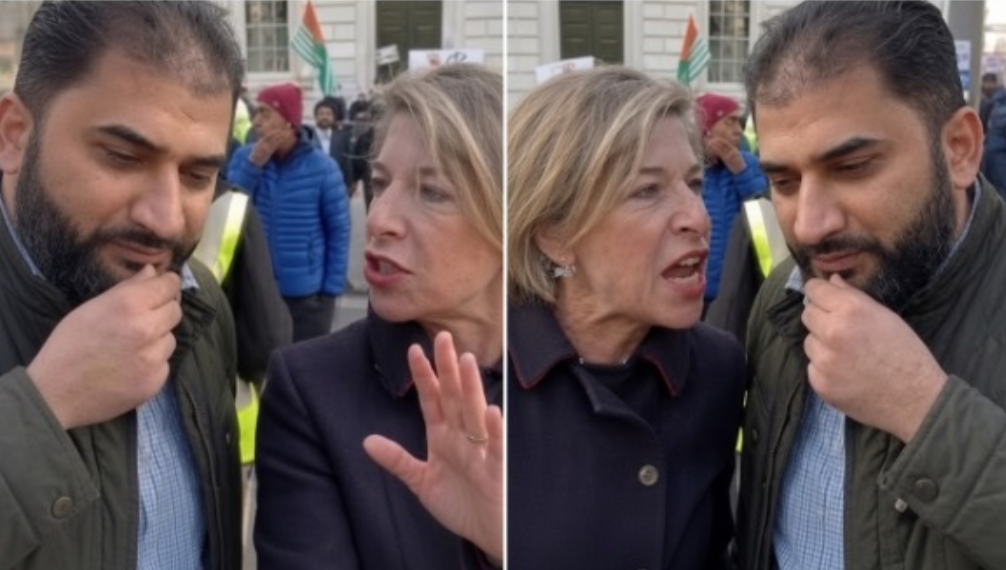
A recent online claim involving high-profile British commentator Katie Hopkins and an alleged street confrontation has spread widely across social media networks. The accompanying posts portrayed an explosive face-to-face argument over immigration, religion, and the future of Western society, featuring Hopkins entering a tense demonstration.
However, a review of reliable reporting reveals that the specific dramatic encounter has not been established as described.
While viral clips of street arguments regularly draw millions of views, separating verified journalism from unverified online narratives has become an increasingly urgent challenge in modern political discourse.
The story touches upon genuine tensions surrounding immigration, protests, and civil liberties in Britain. Understanding the real-world context behind these viral moments requires looking past sensational captions to examine what is actually happening on the ground.
The Reality of Street Protests and Public Demonstrations
The environment surrounding immigration in Britain has grown visibly tense, with frequent demonstrations and counter-demonstrations taking place across cities and towns.
For instance, Reuters documentation from Portsmouth captured anti-migration protesters carrying national flags and chanting in favor of deportation, while counter-protesters gathered nearby with signs rejecting racism and defending refugees. Police officers were deployed to stand directly between the opposing groups.
This type of scene has become increasingly common. Immigration debates have moved out of abstract policy discussions and into public squares, outside hotels housing asylum seekers, and through neighbourhood meetings.
In August 2025, demonstrations outside the Bell Hotel in Epping—which was utilized to accommodate asylum seekers—drew crowds demanding closures and immediate deportations while police maintained a protective perimeter.
Independent investigations have further highlighted the growing scale of public mobilization. A Guardian investigation identified numerous anti-migrant activist groups formed over recent years, engaging in activities ranging from organised street demonstrations and community patrols to more confrontational actions.
Supporters of these movements argue they are responding directly to government failures regarding border management and community safety.
Conversely, critics and civil-liberties advocates warn that such activities increase social intimidation, heighten community divisions, and elevate the risk of public disorder.
The Role of Controversial Public Figures and Misinformation
Commentators like Katie Hopkins remain central figures in these cultural and political friction points.
Known for her uncompromising commentary regarding immigration, Islam, and multiculturalism, Hopkins consistently polarises public opinion. Her scheduled public appearances frequently trigger pre-planned demonstrations by anti-racism campaigners, as seen during announcements of protests outside her events.
However, her high-profile status also makes her a frequent subject of unverified or misleading viral content.

In early 2026, fact-checking organisations investigated widely shared claims alleging that Hopkins had confronted Muslim members of Parliament directly inside the House of Commons. Investigators found no official parliamentary record of any such encounter in Hansard, concluding instead that circulated images had been generated using artificial intelligence.
That precedent serves as a crucial warning when evaluating dramatic descriptions of street confrontations. Social media footage is frequently edited to shorten timelines, combine clips from entirely different events, or amplify isolated remarks out of context.
When combined with the growing proliferation of advanced AI-generated imagery, digital audiences often encounter highly dramatized narratives that bear little resemblance to verified reality.
The Complexities of Human Rights and Public Order
The friction on Britain’s streets ultimately reflects deeper legal and philosophical disagreements about how a democratic society should balance competing rights.
Human rights organisations have repeatedly criticized legislative measures designed to restrict public protests, arguing that broad police powers under recent public order statutes can chill freedom of expression and peaceful assembly.
Supporters of stricter policing counter that public demonstrations cannot be allowed to cross the line into intimidating local residents, blocking essential infrastructure, or inciting violence.
The legal framework governing immigration adds another layer of complexity. Governments possess the sovereign authority to regulate borders and determine entry requirements under domestic and international law.
At the same time, formal asylum systems exist because individuals crossing international borders frequently claim protection from persecution or severe harm.
The core political debate centers on how rapidly and efficiently asylum claims should be processed, how unsuccessful applicants should be managed, and how governments should balance enforcement with humanitarian obligations.
Economic Pressures and Divergent Public Narratives
Underpinning the street-level protests are broader economic concerns regarding housing shortages, strained public services, and infrastructure capacity.
While public debates often treat immigration as a singular, uniform topic, economic analyses—such as recent evaluations published by the Financial Times—emphasize that labor migration, family migration, and humanitarian arrivals involve distinct economic and social considerations.
Proponents of lower net migration argue that rapid population growth places unsustainable pressure on rental markets, healthcare systems, and public transport.
Supporters of continued migration point out that key sectors—including aged care, health services, and agriculture—rely heavily on overseas workers to maintain basic operational capacity.
Because these two viewpoints stem from very different lived experiences and economic priorities, political arguments frequently struggle to find common ground.
When complex economic and social challenges are distilled into brief, highly charged social media videos, the nuance is often lost in favor of emotional polarization.
What Happens Next in Britain’s Immigration Debate
The viral claims surrounding a specific street clash may lack formal verification, but the political reality driving them is entirely authentic.
Britain in 2026 is grappling with a multi-layered debate that encompasses border security, asylum policy, integration standards, religious freedom, and the limits of free expression.
As long as public confidence in managing migration remains fragile, street protests and digital activism will continue to intersect, shaping how citizens perceive national developments.
Resolving these deep-seated divisions will require far more than viral confrontation clips or polarized rhetoric. It demands transparent governance, evidence-based policy, and a willingness to address the structural pressures facing communities across the country.
Until the major political institutions provide credible, long-term solutions to housing and infrastructure strain, the battle over Britain’s national identity will continue to play out loudly—both on the streets and across millions of digital screens.
How do you think social media platforms should handle unverified viral videos that inflame national debates on sensitive political issues?