
Mask Row Erupts as British Government Faces Growing Claims of Double Standards Over Protest Policing
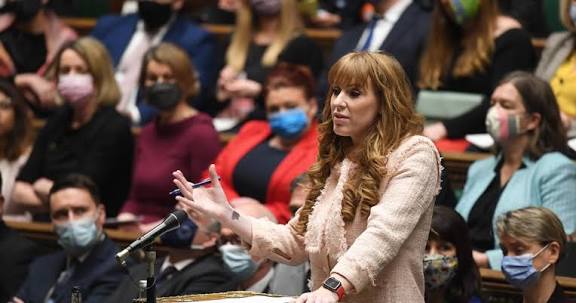
A fierce national debate over masked demonstrators has put Angela Rayner under pressure, with critics accusing ministers of applying different policing standards depending on the political cause.
A fierce new argument over masked protesters has erupted in Britain after Angela Rayner came under fire for condemning the use of balaclavas and face coverings during confrontational demonstrations.
The political clash has prompted critics to accuse the government of applying different standards depending on who is protesting.
The controversy follows a series of highly charged anti-immigration demonstrations in Dover and Portsmouth, where groups of masked activists dressed largely in black disrupted roads, confronted police, and attempted to interfere with the movement of migrants and emergency services.
Government figures condemned what they described as intimidating and disorderly behavior, while police faced separate criticism for not acting more aggressively against some of those involved.
Online commentators and political opponents have now turned the argument back on ministers, raising fundamental questions about equity in British law enforcement.
What Happened: The Flashpoints in Dover and Portsmouth
The current dispute centers on demonstrations that unfolded at key transport and reception hubs.
Hundreds of masked anti-immigration protesters gathered around the Port of Dover, causing significant disruption to local traffic and cross-channel ferry operations.
Just a day later, activists in Portsmouth attempted to obstruct the arrival and onward transportation of migrants who had been rescued at sea.
The government swiftly condemned the demonstrations as intimidating and “thuggish,” while maintaining the constitutional principle that peaceful protest remains protected under British law.
However, the dispute intensified because police made relatively few arrests during the initial Dover action despite the high level of disruption.
That outcome prompted an unusual reversal in the familiar “two-tier policing” debate.
In recent years, right-wing critics have frequently argued that police treat environmental, pro-Palestinian, or left-wing demonstrators more leniently than anti-immigration activists.
Following Dover, critics from across the political spectrum made the reverse argument: masked anti-immigration groups appeared to cause major disruption while facing less immediate enforcement than some environmental or Palestine-related protesters.
The same events were consequently used by different political camps as evidence of opposite forms of bias, laying bare the deep polarization surrounding modern street demonstrations.
Why It Matters: The Accusation of “Two-Tier” Policing
The political challenge directed at Rayner and the government addresses a central pillar of public trust in law enforcement: neutrality.
Masks and face coverings have appeared at protests associated with a wide variety of causes across the political spectrum.
Some participants cover their faces because they fear being identified by employers, political opponents, or online activists.
Others may be concerned about government surveillance or harassment.
However, some undoubtedly conceal their identities because they anticipate violent confrontations or want to make criminal identification significantly more difficult for police.
The political problem begins when ministers appear to focus overwhelmingly on one category of protesters.
If the government condemns balaclavas as inherently threatening at an anti-immigration demonstration, critics can reasonably ask whether the exact same standard should apply to masked protesters supporting other ideological movements.
A consistent approach would judge public behavior rather than political ideology.
Someone blocking an emergency vehicle, assaulting an officer, or deliberately hiding their identity during criminal activity should face the full force of the law regardless of whether they are protesting immigration, climate policy, or foreign wars.
The Legal Reality: When Is Wearing a Mask Illegal?
Amid the political rhetoric, the actual legal framework governing face coverings is considerably more complicated than public claims suggest.
Wearing a mask at a protest is not automatically a criminal offence everywhere in Britain.
Under the Crime and Policing Act 2026, police possess stronger statutory powers to deal with protesters concealing their identities, but those powers are strictly conditional.
A senior police officer must designate a specific area when authorities reasonably believe that a protest is taking place or may take place, that offences are likely to occur or have already occurred, and that restricting face coverings would help prevent or control criminal activity.
Within such a designated area, deliberately concealing one’s identity can become an offence punishable by up to one month in prison and a fine of up to £1,000.
Crucially, the law provides explicit exceptions for purposes including health, religious observance, and work.
Claims that ministers have declared all mask-wearing at protests universally illegal fundamentally oversimplify the legislation.
Context, geography, and specific statutory authorizations dictate how the law is applied on the ground.
Background: New Legislation and Operational Pressures
The current administration enacted the Crime and Policing Act 2026 precisely to deal with protesters who conceal their identities to evade criminal accountability.
Government guidance emphasizes that the measures respond to increasingly disruptive tactics, including attempts by activists to hide their faces while committing offences.
Because the legislation applies in principle across all political causes, ministers argue they possess an obvious defense against accusations of ideological double standards: the same legal powers can be deployed against any protest once statutory conditions are met.
Yet legislation alone cannot settle the ongoing public debate.
The true test lies entirely in enforcement.
If police repeatedly designate areas for one type of demonstration while leaving comparable protests associated with other causes untouched, accusations of selective policing will inevitably persist.
British police find themselves in an almost impossible operational position, caught between mutually contradictory public demands.
Arresting too many protesters draws accusations of suppressing free speech, while arresting too few invites charges of permitting disorder.
What Different Sides Are Saying
The controversy has exposed deep divisions among politicians, legal experts, and civil liberties groups.
Government Ministers maintain that their focus is entirely on public safety and public order rather than political messaging. They argue that new police powers are designed to protect communities from intimidation and ensure that unlawful disruption is met with a robust response, regardless of the cause.
Critics and Political Opponents argue that selective condemnation creates a perception of bias. They contend that if face coverings are condemned as tools of intimidation in one context, the government must show equal consistency when similar tactics appear in other demonstrations.
Civil Liberties Organizations have raised concerns that expanding police powers over clothing and identity risks infringing upon legitimate rights to protest and privacy, warning against broad enforcement that could chill peaceful assembly.
What Happens Next
As Britain’s street-protest culture remains volatile, the government and police forces face intense scrutiny heading into the next political cycle.
The primary challenge for Angela Rayner and the Home Office is demonstrating that new protest laws are enforced strictly according to observable behavior and risk assessment rather than political sympathy.
Until authorities can consistently prove that comparable conduct receives comparable enforcement across all ideological spectrums, the debate over policing standards will remain a defining flashpoint in British public life.
Interactive Discussion Question
Do you think new police powers restricting face coverings at protests strike the right balance between public safety and civil liberties?