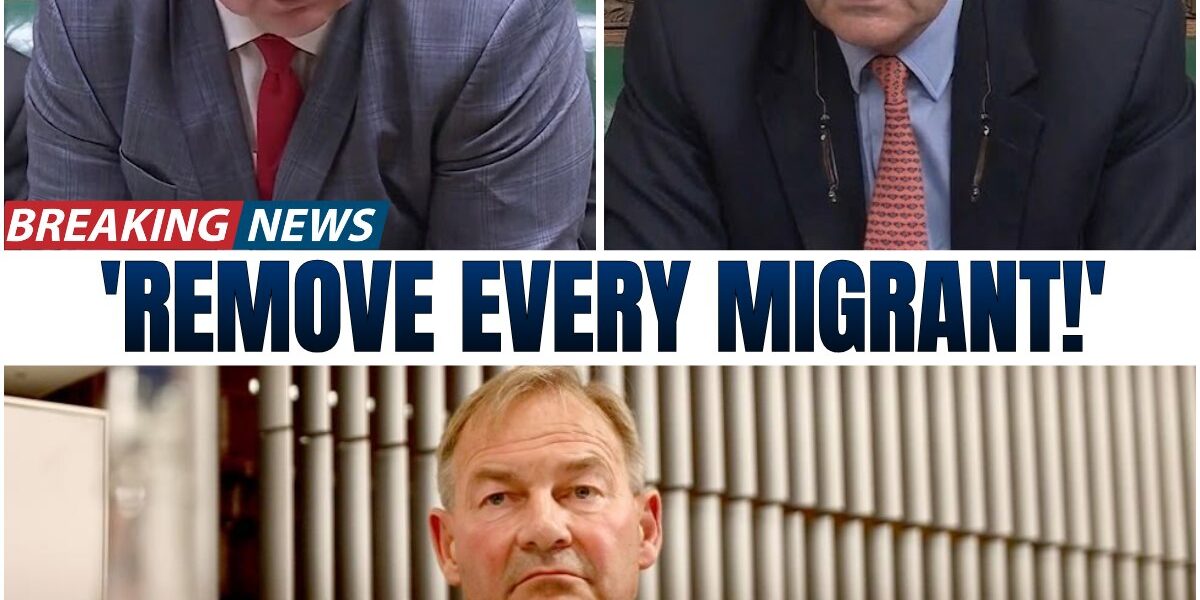
UK Benefits Row Erupts in Parliament After Claim Billions Went to Foreign Nationals! n1

UK Benefits Row Erupts in Parliament After Claim Billions Went to Foreign Nationals!
A heated exchange in the UK Parliament has reignited one of Britain’s most divisive political debates: whether foreign nationals should be entitled to welfare benefits, and how much taxpayer money is actually being paid out to migrants.
The clash unfolded after MP Rupert Lowe raised concerns over welfare spending figures tied to Universal Credit, Britain’s main working-age benefit system. Lowe claimed that a significant portion of taxpayer-funded support was being “gifted” to foreign nationals, and demanded a sweeping crackdown that would prevent foreigners from accessing benefits entirely.
In response, a government minister strongly rejected both Lowe’s framing and the accuracy of the figures being used, accusing him of exaggeration and misunderstanding the data.
The confrontation highlights a growing political fault line in the UK, as the government faces increasing pressure over immigration levels, public spending, and the future of welfare support in a strained economy.
Lowe Claims £10.1 Billion Went to Foreign Nationals
Speaking in the House of Commons, Lowe stated that Universal Credit spending reached £61.2 billion in 2024, and claimed that £10.1 billion of that total had been directed to foreign nationals.
He described the amount as “staggering” and argued that the solution should be immediate and uncompromising.
According to Lowe, foreign nationals should be barred from claiming benefits altogether. He further suggested that migrants who cannot financially support themselves should be removed from the country, and that taxpayer money should instead be returned to “taxpaying British men and women.”
His remarks reflected a hardline position that welfare access should be strictly tied to citizenship and economic self-sufficiency.
The statement is likely to resonate strongly with voters who believe immigration is placing unsustainable pressure on public services and welfare budgets, a sentiment that has been increasingly prominent in British political discourse.
Minister Rejects “Ban All Foreigners” Proposal
The minister responding to Lowe’s comments pushed back forcefully, calling the MP’s position unfair to people who have lived in the UK for years, contributed to the economy, and paid taxes.
The minister argued that many foreign nationals in the UK have worked and paid into the system “sometimes for decades” before requiring support, and that the idea they should be excluded from benefits ignores the reality of their contribution.
The minister’s response framed the welfare system as a safety net for those who have already contributed through taxation and employment, regardless of where they were born.
However, the minister’s sharpest rebuttal focused on Lowe’s use of the £10.1 billion figure, claiming it was misleading and did not prove what Lowe implied.
Government Claims Lowe’s Figures Are Misleading
The minister said the figure Lowe used was based on a statistical category that counts households containing at least one foreign national, rather than benefit payments made directly to foreign nationals.
According to the minister, this distinction is crucial.
The government’s position is that Universal Credit is calculated at the household level, and that a household recorded as having a foreign national could include multiple individuals who are British citizens, Irish citizens, or otherwise legally entitled to benefits.
The minister argued that Lowe’s claim therefore represents a “complete conflation” and “significant overestimation,” suggesting that it is impossible to conclude that the entire amount was paid directly to migrants.
In other words, the minister contended that the data does not necessarily show billions being “gifted” to migrants, but rather reflects mixed households where one member is classified as a foreign national.
This technical detail has been a recurring point of controversy in welfare and immigration debates, where statistical categories can significantly shape public interpretation.
Welfare and Immigration Remain a Volatile Political Issue
The parliamentary exchange reflects the intensity surrounding welfare and immigration policy in Britain, where public concern over migration levels has remained consistently high for years.
Universal Credit, introduced as a simplified system to replace several previous benefits, is now one of the government’s largest areas of social spending. With inflation, housing costs, and wage stagnation continuing to impact living standards, welfare spending has become an increasingly sensitive issue for taxpayers.
Critics argue that the welfare system can create incentives for migration, or that it places a financial burden on citizens already struggling with rising costs. Supporters argue that many migrants contribute more in taxes than they receive, and that welfare access is part of maintaining a humane and functional society.
The question of who qualifies for support is also tied to broader concerns about fairness, integration, and the sustainability of Britain’s public services.
Calls for Tougher Rules Are Growing
Lowe’s proposal to ban all foreigners from claiming benefits is among the most extreme versions of welfare reform demanded by immigration critics, but it reflects a broader trend toward tougher rhetoric.
Over recent years, several politicians have pushed for stricter eligibility rules, longer waiting periods, and expanded checks on claimants’ immigration status. Some have argued that benefits should be tied to stronger contribution requirements, such as minimum years of tax payments.
Supporters of tighter rules argue that benefits should be reserved primarily for citizens and long-term contributors, and that public money should not be used to subsidize migration.
They also argue that welfare access can become a “pull factor,” encouraging individuals to enter the UK without a clear ability to support themselves.
Opponents of such reforms argue that blanket restrictions could harm families, children, and legal residents who are integrated into British society, including those who have lived and worked in the UK for many years.
The Reality of “Foreign Nationals” in UK Benefit Data
The controversy also reflects the difficulty of interpreting welfare statistics in a country where many households include mixed immigration statuses.
For example, a household may include one non-UK citizen married to a British citizen, with children who are British by birth. That household could be categorized as containing a foreign national, even if the primary claimant is a British citizen.
Additionally, Irish citizens in the UK have longstanding legal rights under the Common Travel Area, allowing them to live and work in Britain with broad access to public services.
These complexities can make headline figures appear more dramatic than the underlying reality, even if the spending levels remain politically sensitive.
Government ministers and civil servants have frequently argued that welfare spending data must be interpreted carefully to avoid misleading conclusions.
Public Spending Pressure Fuels Political Anger
Despite the technical dispute, Lowe’s comments reflect real public anger over government spending.
Britain’s welfare system has been under heavy strain, with increasing demand driven by housing costs, health-related unemployment, and economic stagnation in certain regions.
The cost of Universal Credit alone has reached tens of billions of pounds annually, making it one of the largest items in public expenditure.
At the same time, many working taxpayers feel squeezed by rising living costs and believe they receive little in return for their tax burden. In that environment, claims that billions of pounds are being paid out to migrants can rapidly ignite outrage, regardless of whether the figures are disputed.
The minister’s response attempted to counter that narrative by emphasizing contribution and fairness, but the exchange is likely to fuel further polarization.
Political Stakes Rising Ahead of Future Elections
Immigration is expected to remain one of the most influential issues shaping UK elections. Parties across the political spectrum are increasingly pressured to show they can control borders, reduce illegal migration, and ensure public spending is sustainable.
The welfare system sits at the center of that debate, because it directly affects public finances and touches on questions of national identity, fairness, and entitlement.
While mainstream parties often avoid language as blunt as “ban all foreigners,” the pressure from populist voices has pushed the national conversation toward stricter measures.
Even when government ministers dispute the numbers, the very existence of large figures tied to foreign national households can be enough to keep the controversy alive.
A Clash Between Two Visions of Britain
The parliamentary exchange between Lowe and the minister reflects two sharply different visions of what Britain should be.
Lowe’s argument frames welfare as a national resource that should be protected primarily for citizens, and suggests that migrants unable to support themselves should not remain in the country.
The minister’s response reflects a more inclusive interpretation of the welfare state, emphasizing long-term contribution, taxation, and the idea that people who have worked in the UK should not be excluded simply because they were born elsewhere.
Both positions speak to real constituencies in British society.
But the disagreement over the numbers shows that the political battle is not only about ideology, but also about how statistics are interpreted, and how easily data can become ammunition in the immigration debate.
Debate Likely to Continue
As public finances remain tight and immigration continues to dominate political headlines, similar clashes are expected to recur in Parliament.
Whether the disputed £10.1 billion figure is accurate or not, the exchange underscores the broader challenge facing UK policymakers: balancing the cost of welfare, the rights of legal residents, and the public demand for stricter immigration controls.
For now, the government appears unwilling to entertain blanket bans on benefit access for foreigners, but the pressure from MPs and voters demanding tougher action is unlikely to disappear.
With the cost of living still high and public trust in institutions fragile, debates like this may become even more frequent—and more politically explosive.