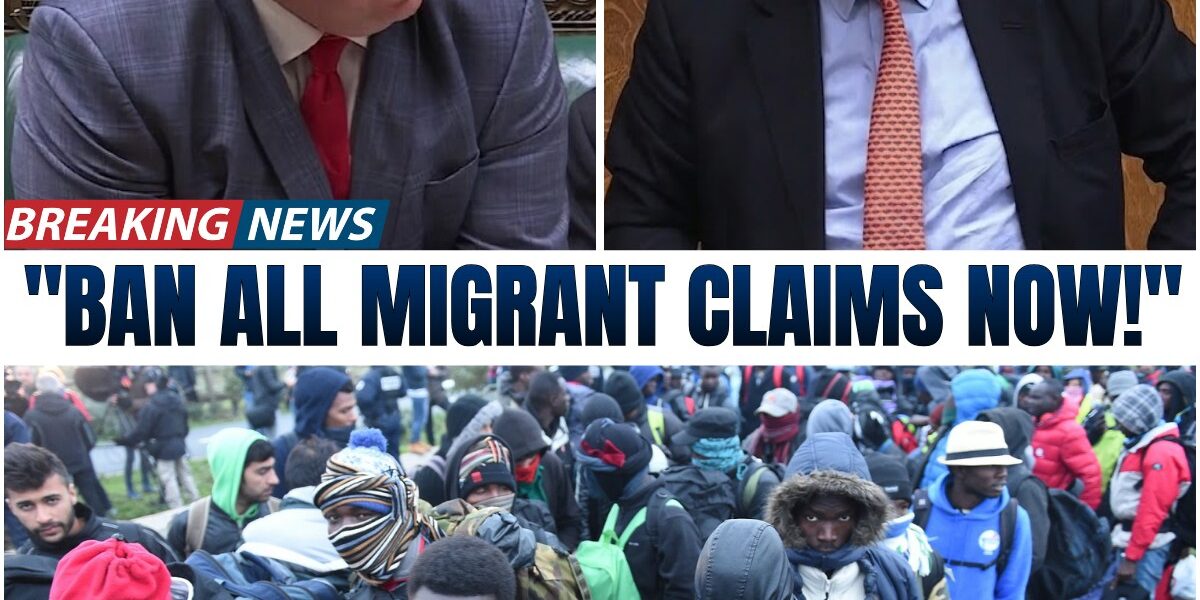
Rupert Lowe Sparks Westminster Clash After Demanding Ban on Migrants Claiming UK Benefits! n1

Rupert Lowe Sparks Westminster Clash After Demanding Ban on Migrants Claiming UK Benefits
A fierce political confrontation has erupted in the UK Parliament after Rupert Lowe demanded a sweeping ban on foreign nationals claiming welfare benefits, citing what he described as a massive financial burden on British taxpayers.
During an exchange in the House of Commons, Lowe claimed that £10.1 billion of the £61.2 billion spent on Universal Credit in 2024 was paid to foreign nationals. He argued that the solution was “straightforward” and called for immediate restrictions on access to state support for migrants.
The remarks quickly triggered backlash from the government, with the responding minister strongly rejecting Lowe’s interpretation and accusing him of using misleading statistics that fail to reflect how welfare data is recorded.
The exchange has reignited a wider debate in Britain over immigration, welfare entitlement, and the political pressures surrounding rising public spending.
Lowe calls for benefit ban and removals
In his statement, Lowe framed the issue as one of fairness and national priority. He claimed billions of pounds were being “gifted” to foreign nationals through the Universal Credit system and suggested that this money should instead be redirected back to British citizens.
He demanded that the government ban foreigners from claiming benefits entirely and urged the removal of migrants who cannot financially support themselves.
Lowe also claimed that British men and women who “actually keep the economy running” are being unfairly burdened while large sums of public money are spent supporting non-citizens.
His remarks reflect a growing political narrative among some lawmakers and commentators who argue that welfare spending is being stretched by immigration, particularly during a time of economic strain, high living costs, and pressure on public services.
Government rejects claims as misleading
The minister responding to Lowe rejected both his conclusions and the way the figures were presented.
The minister said they “fundamentally disagree” with Lowe’s broader perspective on migrants, pointing out that many individuals who arrive in the UK later become long-term residents, work for years, and contribute through taxes.
According to the minister, the government does not accept the idea that people who have spent years paying into the system should be denied access to support when they later require assistance.
More significantly, the minister challenged the figure Lowe used, calling it “a complete conflation” and “a significant overestimation.”
The minister argued that Lowe’s number appeared to come from statistics based on households where at least one person is a foreign national. In such cases, the minister said, it is incorrect to claim the entire benefit amount went to foreign nationals, because the household may also include British or Irish citizens who are eligible claimants.
In other words, the minister’s argument suggested that the data does not confirm what Lowe implied: that £10.1 billion was directly paid to non-citizens.
The minister accused Lowe of misunderstanding the way welfare entitlement data is recorded, saying it is impossible to state definitively that such a sum was “paid directly to foreign nationals” based on the category he referenced.
Universal Credit remains politically sensitive
Universal Credit is one of the UK’s most significant welfare programs, combining multiple benefit schemes into one payment system designed to support low-income workers, unemployed individuals, and those unable to work due to disability or other circumstances.
Because it covers such a wide range of claimants, it is often at the center of political arguments about government spending and national economic priorities.
As the UK continues to face economic uncertainty, inflation pressures, and concerns over public sector funding, welfare spending has become a flashpoint. Political parties across the spectrum have faced pressure from voters to tighten spending while also supporting struggling families.
The question of whether migrants should have access to benefits is one of the most divisive issues in this debate.
Immigration and welfare: a long-running political battlefield
The confrontation in Parliament reflects a long-standing tension in British politics: balancing immigration policy with public service capacity and welfare spending.
For years, political leaders have debated how to manage migration while maintaining public confidence in the fairness of the welfare system.
Supporters of tougher restrictions argue that welfare benefits should primarily support citizens and that open eligibility risks encouraging migration for economic reasons. They claim that taxpayers should not carry the burden of supporting people who have not contributed enough to the system.
Opponents argue that such framing ignores the economic contribution migrants make, including working in essential industries such as healthcare, construction, hospitality, and transport. Many migrants pay income tax, national insurance contributions, and VAT, and they argue that excluding them from benefits could be both unfair and damaging.
The government’s response to Lowe appears aligned with this second view, emphasizing the idea that migrants who have contributed over many years should not be treated as outsiders when they face hardship.
The dispute over numbers
The core of the argument revolves around how the £10.1 billion figure is interpreted.
Lowe framed the number as a direct transfer of welfare money to foreign nationals, suggesting that the UK is spending enormous sums on people who are not British.
However, the minister insisted the figure cannot be used in that way, stating that it is drawn from a broader category: households containing at least one foreign national.
Such households can include mixed citizenship families, including British citizens, Irish citizens, and naturalized individuals who are eligible for benefits.
This distinction matters because welfare claims are often assessed at the household level, not simply by individual citizenship. Payments can support children, partners, or other dependents, and eligibility rules vary depending on immigration status, residency requirements, and contribution history.
The minister’s argument suggests that Lowe’s figure may overstate the amount paid to non-citizens, because the data does not isolate payments going exclusively to foreign nationals.
Political impact and public reaction
The clash is likely to intensify the political conversation around immigration and welfare in the months ahead.
Calls for tougher immigration enforcement and benefit restrictions have gained traction among some voters, particularly amid cost-of-living concerns. Public trust in government spending decisions remains fragile, and arguments that billions are being spent on foreigners can quickly spark anger.
At the same time, government officials and immigration advocates warn that such rhetoric can inflame social tensions and oversimplify complex realities.
The minister’s response indicated that the government intends to defend existing principles around welfare access, especially for individuals who have lived and worked in Britain for years.
However, Lowe’s comments reflect a political strategy increasingly used by some lawmakers: tying economic hardship directly to immigration and welfare spending, and presenting hardline restrictions as the only solution.
Wider debate: fairness versus exclusion
The exchange highlights a deeper national argument about what welfare represents in modern Britain.
For Lowe and those who share his view, welfare should be tied tightly to citizenship and national identity. The idea is that the state should protect those born in Britain first, particularly during periods of economic stress.
For the government and its supporters, welfare is framed more as a system of contribution and entitlement. If a person has paid into the UK tax system, the argument goes, they should not be denied support simply because of where they were born.
This debate is not unique to Britain. Similar political battles have played out across Europe and North America, where immigration has become closely linked to economic anxiety, public service strain, and political polarization.
In many countries, the welfare system has become a symbolic battleground, representing either compassion and social stability, or perceived exploitation and unfairness.
A clash likely to continue
The confrontation between Rupert Lowe and the minister is unlikely to be the last of its kind.
As welfare spending continues to rise and immigration remains a central political issue, the government will likely face increasing pressure to justify benefit allocations and explain how public funds are distributed.
Opposition voices like Lowe are expected to continue demanding tougher restrictions, arguing that taxpayer money should not go toward supporting migrants.
Meanwhile, ministers appear determined to push back against what they describe as misinformation, insisting that welfare data must be interpreted carefully and that sweeping claims can distort public understanding.
The exchange illustrates a broader reality of British politics: immigration and welfare remain two of the most emotionally charged issues in the country, capable of triggering intense debate and dividing public opinion.
With the cost-of-living crisis still weighing heavily on many households, the political stakes surrounding Universal Credit and immigration policy are only expected to grow.