The Widow Who Bought the Driest Ranch in Arizona—But She Was Never Looking for Water. t1

The Widow Who Bought the Driest Ranch in Arizona—But She Was Never Looking for Water
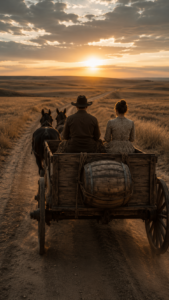
No one in Red Mesa could explain why she smiled when she saw the dead cottonwood.
Most newcomers stared at the cracked earth, the abandoned windmill, and the roof sagging beneath twenty years of desert wind. They usually asked how long the well had been dry.
She asked something else.
“How old is that tree?”
The question silenced every man standing outside the mercantile.
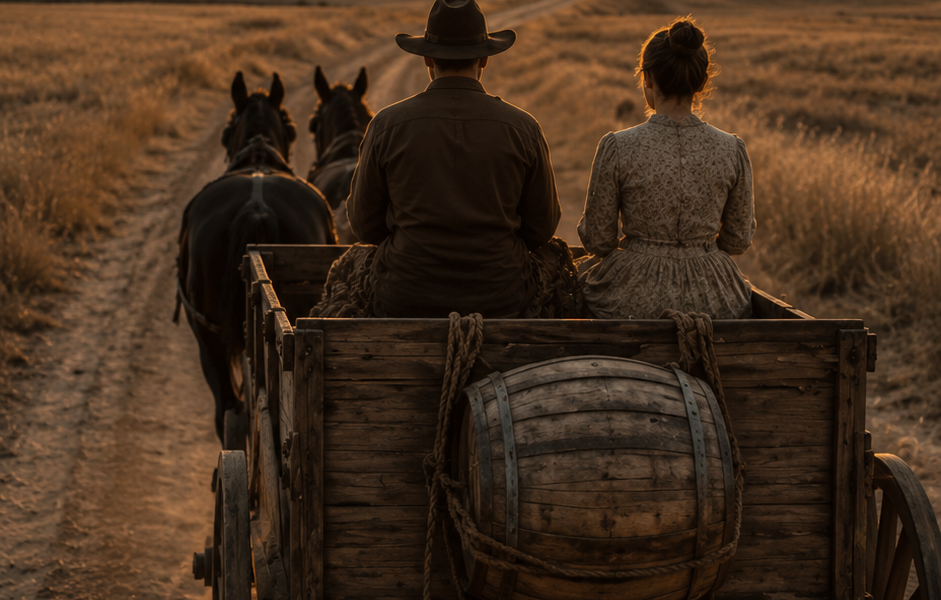
The widow arrived on the Thursday stagecoach carrying nothing but a cedar trunk, a weathered Bible wrapped in cloth, and a leather satchel she never allowed anyone else to touch. She wore mourning black despite the Arizona heat, and the silver streak in her dark hair made her appear older than the thirty-four years life had actually given her.
Sheriff Owen Hale stepped forward with the folded deed in his hand.
“You know this place hasn’t grown a decent crop since the Apache Pass drought.”
“I’ve read the reports.”
“The well’s nearly empty.”
“I know.”
“The previous three owners lost everything.”
“I know that too.”
The sheriff hesitated.
“Then why buy it?”
She lifted her eyes toward the dead cottonwood whose twisted branches clawed at the blazing sky.
“Because,” she answered quietly, “someone buried the truth here long before the water disappeared.”
Nobody laughed.
Something in her voice made laughter feel dangerous.
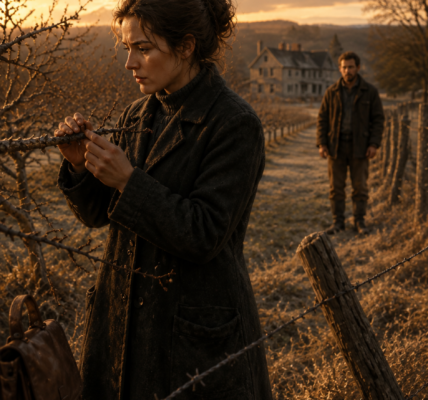
As the wagon carried her toward the abandoned ranch, every mile seemed older than the last. Dust devils danced across empty pasture where cattle trails had vanished years before. Rusted fence wire hummed beneath the desert wind like distant telegraph lines carrying messages no living person could hear.
The ranch itself looked defeated.
The barn leaned west as though exhausted from resisting another season. The corral gates hung open. A cracked stone well sat in the center of the yard, surrounded by footprints that ended abruptly, as if the last man who searched for water had simply walked out of history.
The widow stepped down without waiting for help.
She ignored the house.
Ignored the barn.
Ignored the dry well.
Instead, she walked directly to the old cottonwood.
Its trunk had split decades earlier, yet somehow it remained standing, stubborn against the desert. She rested one gloved hand against the rough bark and closed her eyes.
For nearly a minute she never moved.
When she finally opened them, she whispered four words no one else was supposed to hear.
“They were here first.”
Sheriff Hale frowned.
“Who?”
She looked toward the distant red cliffs.
“My husband… and the man who killed him.”
The wind stopped.
Only for a heartbeat.
But in that heartbeat the entire ranch felt as though it had been holding its breath for thirty years, waiting for the one person who knew where the story truly began.
The sheriff had buried too many secrets to believe in coincidence.
Yet as he watched the widow kneel beside the roots of the cottonwood and brush away a thin layer of dust, he noticed something no one else had ever seen.
A weathered iron survey marker, nearly swallowed by the earth.
It wasn’t pointing toward the well.
It wasn’t pointing toward the house.
It pointed straight toward the northern ridge—a place every rancher in Red Mesa avoided after sunset.
Years earlier, three prospectors had disappeared there without leaving so much as a bootprint behind.
The town blamed outlaws.
The soldiers blamed Apache raiders.
The widow blamed neither.
She already knew the ridge was hiding something far older than gold.
And before the first autumn rain touched the valley, Red Mesa would learn that the greatest fortune ever buried in Arizona had never been measured in coins… but in a promise powerful enough for men to kill, lie, and vanish to protect.
Sheriff Hale said nothing as the widow brushed more dirt away from the survey marker. The afternoon sun hung low above the crimson cliffs, stretching long shadows across the abandoned ranch until every fence post resembled a silent man standing watch. Something about the marker unsettled him. It wasn’t the iron itself. It was the symbol stamped into its rusted face—a circle crossed by three lines, a brand no ranch in Arizona had ever carried. He had seen it only once before, nearly twenty-five years earlier, carved into the stock of a rifle recovered beside three shallow graves that officially had never existed.
“You’ve seen that mark before,” the widow said without looking up.
The sheriff hesitated.
“I hoped I never would again.”
She rose slowly, dusting her gloves. The wind caught a loose strand of her dark hair, but her eyes never left the northern ridge.
“My husband drew this symbol every night for six months before he disappeared.”
“You never mentioned that in town.”
“I learned a long time ago that speaking too early gets people killed.”
Those words settled over the ranch heavier than the evening heat. Hale suddenly understood why she had chosen this place. She had not come to rebuild a dying homestead. She had come because someone had spent decades making certain no one would ever ask the right questions.
That night the widow unpacked only three things from her cedar trunk: a lantern, the cloth-wrapped Bible, and a leather journal swollen from years of use. Every page was crowded with careful handwriting, maps, weather notes, names, and dates stretching back nearly three decades. Between two brittle pages rested an old photograph of four smiling men standing beside a spring that no longer appeared on any map. On the back someone had written only one sentence.
If the water dies, the truth dies with it.
Sheriff Hale felt a chill despite the desert warmth.
“I knew two of these men.”
“The third was my husband.”
“And the fourth?”
She looked at the faded face in the corner.
“The only man who survived.”
“But he disappeared.”
“No,” she replied softly. “He changed his name.”
Outside, coyotes began calling across the mesas.
The widow closed the journal before Hale could ask another question.
“Someone in Red Mesa knows who he became.”
“After thirty years?”
“People change names.”
She looked toward the dark window where the northern ridge had disappeared into shadow.
“They rarely change their habits.”
The following morning she ignored the dry fields and walked instead along the old irrigation ditch that had once carried spring water across the ranch. Most of it had filled with drifting sand years before, yet every few yards she stopped to examine the soil, sometimes kneeling, sometimes touching broken stones as though reading words invisible to everyone else.
Hale followed several paces behind.
Finally he asked, “You’re not searching for water, are you?”
“No.”
“Then what?”
She pointed toward a patch of unusually green grass growing beside a collapsed section of ditch.
“Someone diverted the spring.”
“The drought did that.”
She shook her head.
“Drought doesn’t move stones uphill.”
Hale stared.
Half-buried beneath the weeds lay three massive rocks carefully stacked against the natural flow of the channel.
They had not fallen.
Someone had placed them there.
Long ago.
The sheriff crouched beside the obstruction, brushing away decades of packed dirt until chisel marks became visible beneath the moss.
“They were cut.”
“Exactly.”
“But why block your own water?”
The widow smiled sadly.
“They weren’t trying to stop the water.”
“They were trying to stop people from following it.”
The realization struck Hale with surprising force.
Every rancher in Red Mesa believed the spring had dried naturally.
Not one of them had ever considered that someone might have hidden it on purpose.
Word spread quickly through town.
By sunset nearly everyone knew the stranger from the abandoned ranch was digging through old irrigation channels instead of repairing fences.
Most laughed.
Some shook their heads.
Only one man left town before sunrise the next morning.
His name was Thomas Crowley.
Officially he owned the freight company.
Unofficially he owned half the valley’s debts.
When Hale learned Crowley had ridden north before dawn carrying a rifle and enough provisions for several days, an old uneasiness returned.
Crowley never traveled without a reason.
And he never traveled toward the northern ridge.
Unless something there frightened him more than staying behind.
The widow listened quietly as Hale described the departure.
Then she reached into the leather journal and removed a folded page neither of them had examined before.
It wasn’t a map.
It was a letter.
The paper had yellowed with age, but the ink remained clear.
She unfolded it carefully.
“My husband never mailed this,” she whispered.
She began reading aloud.
“If anyone finds these pages after I’m gone, don’t search for gold. There isn’t any. Search for the water. Because whoever controls the spring controls every ranch in this valley. Men will believe they are fighting over land while never realizing they are really fighting over life itself.”
Hale lowered his head.
Suddenly every failed ranch…
Every abandoned family…
Every mysterious bankruptcy…
Every disappearance…
They no longer looked like accidents.
They looked planned.
Someone had allowed the valley to die.
Not because nature demanded it.
Because profit did.
The widow folded the letter with trembling hands.
“My husband discovered the truth.”
“And they murdered him.”
She looked toward the distant ridge where storm clouds were slowly gathering over the desert.
“No.”
Her voice was barely louder than the wind.
“They murdered everyone who tried to uncover it.”
Far above them, the first rumble of thunder rolled across the mesas.
It was the first storm Red Mesa had seen in nearly two years.
And neither of them realized that before the rain stopped, the hidden spring would begin flowing again…
…bringing with it secrets that the desert had guarded for an entire generation.
Note: Some content was generated using AI tools (ChatGPT) and edited by the author for creativity and suitability for historical illustration purposes.