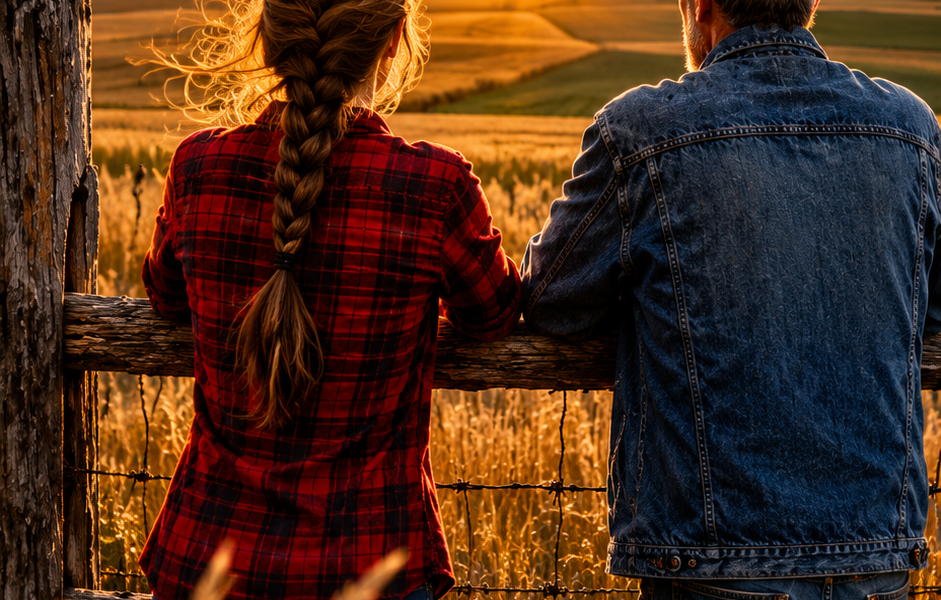
The Stranger Who Bought a Dying Ranch—But Came Looking for Something Buried Beneath It. t1

The Stranger Who Bought a Dying Ranch—But Came Looking for Something Buried Beneath It
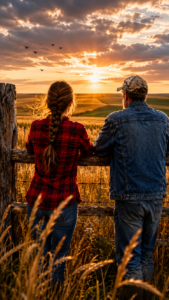
The old ranch should never have been worth a dollar.
Every soul in Black Ridge swore the same thing.
The wells had failed three summers in a row. The cattle had either been sold or died standing in the dust. Wind pushed through broken fence rails with the sound of distant whispers, and the abandoned farmhouse leaned toward the prairie as though it had finally grown too tired to keep pretending it belonged among the living.
Yet one cold October morning, just after sunrise painted the mesas in blood-red light, a lone rider appeared from the eastern horizon.
He carried no cattle.
No family.
No wagon full of supplies.
Only a weathered saddlebag… and an old brass key hanging from a leather cord around his neck.
The townspeople watched from porches without speaking. Even the blacksmith stopped his hammer mid-swing.
The stranger didn’t ask where the general store was.
He didn’t ask about water.
He didn’t even ask the price.
He rode straight to the dying ranch, tied his horse beneath a dead cottonwood, unlocked the front door as if he already belonged there…
…and smiled when he stepped inside.
That was the moment everyone in Black Ridge realized the ranch wasn’t what the stranger had come to buy.
It was what someone else had desperately tried to hide.
And before winter arrived, three men would be dead, one forgotten promise would rise from fifty years of silence, and the entire valley would discover that the greatest treasure in the frontier had never been gold.
It had been the truth.
The stranger introduced himself as Elias Mercer.
He looked like a man who had spent half his life sleeping beneath open skies and the other half carrying memories heavier than any saddlebag.
His beard showed streaks of gray, though he couldn’t have been more than forty-five. A long scar disappeared beneath the collar of his coat, crossing his neck like the faded signature of an old enemy.
He paid cash for the ranch.
Nobody understood why.
The deed had changed hands four times in twelve years. Every owner had failed. Crops withered. Wells collapsed. Livestock wandered away during storms as though frightened by something no one else could hear.
Children whispered that lights wandered the fields after midnight.
Old ranchers laughed at those stories.
Then quietly avoided riding past the property after dark.
Elias ignored every warning.
Instead of repairing the house first, he spent his first week walking the land.
Slowly.
Methodically.
Each sunrise found him studying hillsides, creek beds, limestone ridges, and ancient cottonwoods.
Sometimes he stopped, removed the brass key from around his neck, and compared it to strange symbols carved into weathered fence posts.
Nobody knew why.
Then one afternoon, twelve-year-old Caleb Foster wandered onto the ranch looking for a runaway calf.
He found Elias kneeling beside an enormous flat stone nearly hidden beneath prairie grass.
“What are you looking for?” the boy asked.
Elias remained silent for so long Caleb wondered if he hadn’t heard.
Finally he answered.
“I’m looking for the only thing my father ever asked me to find.”
“What is it?”
“I won’t know until I do.”
The answer haunted Caleb for weeks.
It haunted everyone once word spread through town.
Because old Samuel Harper, the oldest living man in Black Ridge, turned pale when he heard about the brass key.
He hadn’t seen one like it in over forty years.
And he prayed he never would again.
Samuel Harper refused to explain himself.
When Caleb asked why the old man looked frightened, Samuel simply stared through the dusty window of the mercantile toward the distant ridge where Elias had disappeared.
“I hoped that family would never come back,” he whispered.
“What family?”
“The Mercers.”
It was the first time anyone in Black Ridge had heard the name spoken aloud in decades.
Samuel stood slowly, leaning on his cane. His weathered hands trembled—not with age alone, but with memory.
“You tell that stranger,” he said quietly, “that some graves are kinder left unopened.”
Caleb delivered the message that evening.
Elias listened without changing expression. He thanked the boy, then returned to studying an old leather journal whose pages had nearly turned the color of tobacco.
Inside were rough sketches of hills, dry creek beds, and measurements that meant nothing to anyone else.
Except they weren’t maps to treasure.
They were maps to time.
Every page ended with the same sentence written in careful handwriting.
When the cottonwood loses its western limb, the valley will be ready.
Caleb frowned.
“What does that mean?”
Elias closed the journal.
“It means my father believed the land remembers.”
The answer only deepened the mystery.
Over the following weeks, the ranch slowly changed.
Not because Elias spent money.
Because he noticed things no one else did.
He cleared brush around springs everyone believed had dried forever.
He repaired irrigation ditches abandoned twenty years earlier instead of digging new ones.
He redirected runoff after autumn rains using nothing more than a shovel, stones, and patience.
The neighbors laughed.
Until water appeared.
Not much.
Just enough to fill a shallow basin that had been dust for as long as anyone remembered.
Then another.
And another.
People called it luck.
Samuel Harper knew better.
He remembered another Mercer doing the exact same thing nearly fifty years before.
Nathan Mercer.
Elias’s father.
Back then Nathan had arrived with impossible dreams and strange ideas about the land.
While everyone chased quick money raising cattle, Nathan studied grasses.
While others drilled deeper wells, Nathan planted trees.
He claimed healthy soil could hold rain like a sponge.
People mocked him.
Then came the Great Drought.
Nearly every ranch in the valley failed.
Nathan’s survived.
Not because he found more water.
Because he had learned how to keep the little he had.
Success should have made him respected.
Instead…
It made him dangerous.
Within months rumors spread through Black Ridge.
Some claimed he had discovered Spanish gold hidden beneath the mesas.
Others whispered Confederate payroll.
A few insisted he’d found silver beyond imagination.
Greed has always traveled faster than truth.
One freezing November night Nathan Mercer vanished.
His wife packed what little remained and left before sunrise with their young son.
No body was ever found.
The ranch slowly died.
The story became another frontier legend.
Until now.
One evening Elias invited Samuel Harper to supper.
The old man accepted reluctantly.
The meal was simple—beans, fresh bread, venison stew, and coffee brewed black enough to stain memory itself.
They ate mostly in silence.
Finally Elias laid the brass key on the table.
Samuel stared at it for a long time.
“I buried that.”
“So my father told the truth.”
“I buried it because I was afraid.”
“Afraid of what?”
Samuel looked toward the dark window where prairie wind carried dust across the yard.
“Afraid of the men who killed your father.”
The room fell silent.
Only the ticking of an old clock remained.
“You saw it?” Elias asked.
Samuel nodded once.
“I was sixteen.”
His voice had become little more than a whisper.
“They came after sunset. Five riders.”
“They demanded to know where Nathan kept the gold.”
“There wasn’t any.”
“No.”
“But they didn’t believe him.”
Samuel closed his eyes.
“They beat him.”
“They searched the house.”
“They tore apart the barn.”
“They dug half the field by lantern light.”
“And when they found nothing…”
He stopped speaking.
Elias didn’t interrupt.
Some grief deserves room to breathe.
“They rode away before dawn,” Samuel finally continued.
“I found Nathan alive… barely.”
“He knew he wasn’t going to survive.”
Samuel’s eyes filled with tears that had waited almost half a century.
“He handed me that brass key.”
“He said…”
Samuel struggled to repeat words he had carried since boyhood.
‘Tell my son the valley was always the treasure. Not what lies beneath it. Promise me he learns the difference.’
Samuel looked across the table.
“I broke that promise.”
“I hid the key.”
“I let everyone believe the stories.”
“I thought greed would die.”
Instead…
It only waited.
Elias picked up the key carefully.
“I didn’t come here looking for gold.”
“I came looking for the truth my father died protecting.”
The following morning they returned to the great flat stone where Caleb had first found Elias.
Samuel knelt despite his aching knees.
His fingers traced faded carvings almost erased by rain and decades of prairie wind.
“They’re still here.”
Elias smiled.
“They were never directions.”
“What were they?”
“Instructions.”
Together they levered the massive stone aside.
Beneath it wasn’t a chest.
There wasn’t gold.
No silver.
No jewels.
Only a narrow stone-lined chamber containing oilcloth bundles sealed against moisture.
Inside rested dozens of journals.
Hand-drawn maps.
Weather records spanning thirty years.
Crop experiments.
Water tables.
Tree-planting methods.
Soil restoration techniques.
Every lesson Nathan Mercer had discovered while learning how to make dying prairie live again.
Samuel began to cry.
“So this…”
“…this was what they killed him for?”
Elias gently shook his head.
“No.”
“They killed him because they couldn’t imagine something more valuable than gold.”
He lifted the first journal into the morning light.
“My father already had.”
Weeks later every rancher in Black Ridge gathered beneath the cottonwoods.
Instead of dividing treasure…
They copied the journals.
They rebuilt forgotten irrigation channels.
They replanted native grasses.
They restored springs long believed dead.
Within five years the valley became the richest hay country for a hundred miles.
Visitors claimed it was a miracle.
The old-timers simply smiled.
Because they knew miracles usually looked like ordinary people doing the right thing for a very long time.
Years afterward, when children asked why a single brass key hung above the meeting hall, Samuel Harper always gave the same answer.
“It never opened a treasure chest.”
“It opened our eyes.”
And perhaps that was the rarest treasure the Old West had ever buried.
Note: Some content was generated using AI tools (ChatGPT) and edited by the author for creativity and suitability for historical illustration purposes.