The Wealthy Rancher Only Needed a Housekeeper for Winter — Then The American Girl Changed His Life. t1

The Wealthy Rancher Only Needed a Housekeeper for Winter — Then The American Girl Changed His Life
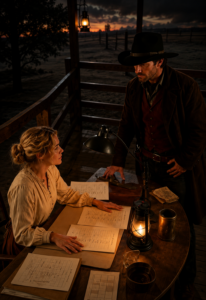
The train was 40 minutes late and the station master didn’t apologize for it. He was a heavy set man named Dobbins who spent most of his working hours sitting on a stool behind a ticket window that fogged with his breath. And when the locomotive finally groaned into Frost Creek just past 3:00 in the afternoon, he didn’t look up from the ledger he was pretending to read.
The passengers who stepped off onto the platform got a wall of cold that hit them before they had both feet on the ground. January in the Montana territory was not a season so much as a punishment. And Frost Creek sat in a valley between two ridgelines that funneled wind down from the north with a kind of personal efficiency.

Abigail Carter came off the train third behind a fur coated merchant and a man whose hat blew off the moment he cleared the door. She caught it before it reached the edge of the platform and handed it back without breaking stride. Her own coat was wool, dark gray, and had a small tear at the left cuff she’d been meaning to mend for 3 weeks.
She carried a suitcase that had belonged to her mother and a canvas bag over one shoulder. And she stood on the platform for a moment with her chin slightly up, the way people do when they’re trying to take in something large without showing that it’s larger than they expected. Frost Creek was not what the letter had described. The letter, written in a clipped business-like hand, had said a working town, well established with a proper main street and all necessary services.
What Abigail saw was a main street of packed dirt and gray slush, a general store with boards across one of its windows, a saloon with a painted sign that had been weathered past readability, and a barber shop that appeared to also be selling rope. There were maybe 200 buildings if you counted the ones at the edges that were more lean-to than structure.
There were horses at a hitching post outside the saloon and a dog sleeping against the door of the barber shop and exactly one woman visible on the street who took one look at Abigail and went back inside whatever building she’d been standing in front of. Abigail picked up her suitcase and went to find her contact, the man who’d written to her through an employment agency in Chicago that specialized in domestic placement was named Nathaniel Cross.
He owned somewhere north of 4,000 acres north of town, a cattle operation, and what the agency had described as a large ranch house requiring experienced domestic management. The position was housekeeper. The pay was fair. The agency had been clear that she would be the only household employee aside from ranch hands, and that the employer was particular but reasonable.
Abigail had read that phrase three times before she signed the contract because in her experience particular but reasonable meant something different to every man who hired help. She’d taken the job anyway. Chicago had stopped offering her much worth staying for. There was no one waiting at the station to meet her.
She stood for a few minutes with her bag and her suitcase watching the other passengers disperse, watching Dobbins finally close his ledger and pull on his coat, watching the merchant with the fur coat get loaded into a wagon by someone who’d clearly been there a while. Then she walked to the edge of the platform and looked north up the main street and thought about what it would cost to rent a room for the night if no one came.
You, Carter? She turned. The man who’d spoken was leaning against the back corner of the station building in the shadows past the edge of the platform overhang. He was young, maybe 22, with a face that hadn’t decided yet whether it wanted to be handsome or just weathered, and he was wearing a heavy canvas coat with the Cross brand stitched on the pocket.
He had a cigarette he didn’t appear to be smoking so much as holding. I am, she said. Supposed to pick you up. He said this in the tone of someone who’d been asked to do something he considered beneath him. Train was late. I noticed. He looked at her suitcase, then at the canvas bag, then at her. That all you brought? That’s all I own, she said.
Are you going to help me with it, or are we going to keep discussing it? He pushed off the wall and took the suitcase without another word. His name, he told her on the walk to the wagon, was Jesse, and he’d been working for Mr. Cross for 2 years, and he was under instructions to bring her out to the ranch before dark because the temperature dropped serious after sunset, and the north road had drifts.
He said all of this to the middle distance ahead of them rather than to her. What’s Mr. Cross like? She asked once they were in the wagon and moving. Jesse was quiet for longer than the question warranted. Fair enough, he said finally. Doesn’t say much. That’s not what I asked. He glanced at her sideways. He’s not what you’re expecting.
I don’t know what I’m expecting. Good, Jesse said and left it at that. The Cross Ranch was 4 miles north of town up a road that in summer was probably fine, and in January was a negotiation between the wagon wheels and God. Jesse drove with the particular focused quietness of someone who’d made this trip enough times to know exactly where the road got bad, and exactly what you had to do to get through it without losing a wheel in a rut.
Abigail held the sideboard and watched the landscape open up around them, wide, gray-white. The ridgelines dark against a sky that had the low, pressed-down look of a sky that was deciding whether to snow. The house came up on the right side of the road before she expected it. It was large, not ostentatiously large, not the kind of building that was trying to make a point, but substantial, two stories with a wide front porch and windows that caught the flat winter light.
It had been built to last. She could see that from the road. The bones of it were serious, but something about it looked She searched for the word. closed. Like a face with its expression held deliberately neutral. The curtains in the ground-floor windows were drawn. There were no lights visible yet, though it was getting toward dusk.
“He’s been out since morning,” Jesse said, following her gaze. “Checking fence line on the east quarter. Should be back by now.” He wasn’t. Jesse carried her suitcase inside and showed her the kitchen and the room she’d be staying in, a small room off the back hallway that was clean but bare, with a bed, a chest of drawers, and a window that looked out at a wood pile and past it, the outline of the main barn.
He lit the stove in the kitchen and told her there was food in the larder and that Mr. Cross usually ate at 7:00 when he was home, and then he left her to it. She stood in the kitchen for a minute. The house was cold in the way that big spaces get cold when they haven’t been properly warmed in a while.
Not just the temperature, but something in the air itself that felt like absence. She opened the larder. There was flour and dried beans and some potatoes going soft at the ends, and a haunch of smoked meat and two tins of something without labels. She opened one. Peaches. She put it back and started making inventory. She’d had the stove going for 20 minutes and was halfway through an assessment of the pantry situation, which was, to be kind, a charitable disaster, when she heard the front door open.
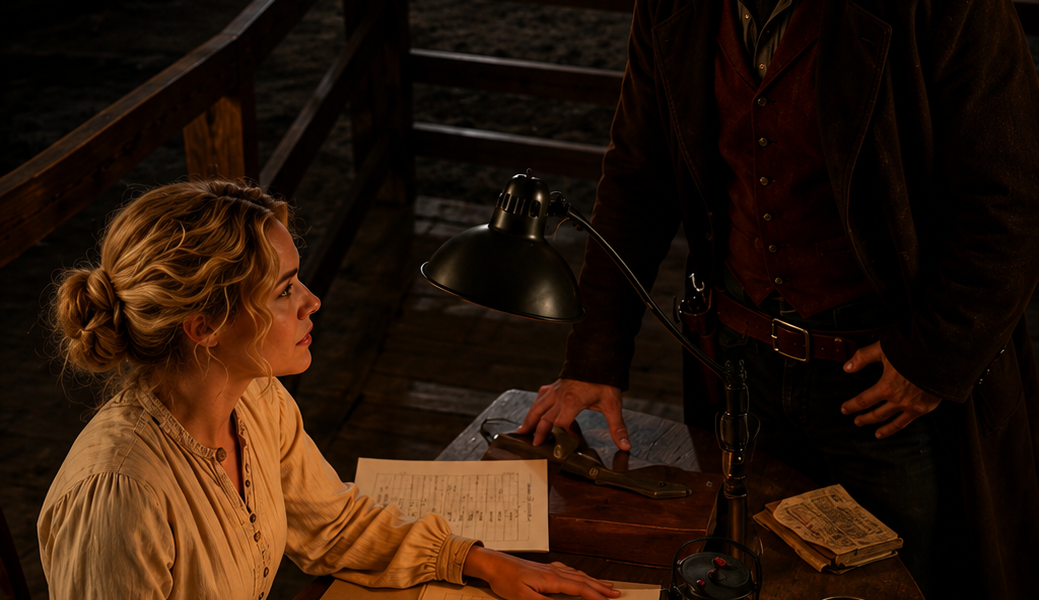
Heavy boots on the wooden floor, the sound of something being set down, a thud that had weight to it. Then nothing for a moment. Then footsteps toward the kitchen. Nathaniel Cross came through the doorway and stopped when he saw her. He was taller than she’d pictured, not dramatically so, but enough that the doorway framed him squarely, with dark hair that needed cutting and the kind of face that had been outside in hard weather long enough to show it.
Mid-30s, she thought. Maybe a year or two past. He was still wearing his coat and gloves, and there was snow on his shoulders and hat brim, and his expression when he saw her was not unwelcoming, exactly, but not warm, either. Careful, like someone who’d learned that being careful was usually smarter than the alternative. “Mr.
Cross,” she said, “I’m Abigail Carter. I arrived this afternoon.” “I know,” he said. “Jesse sent a boy in.” She waited to see if he was going to say anything else. He didn’t, immediately. He pulled off his gloves and looked at the stove and the open larder door, and then at her, taking in the room with the same systematic thoroughness she imagined he applied to most things.
“You’ve eaten?” he asked. “Not yet. I was taking stock first. Your pantry situation is” she paused. “I’ll need to make a list.” Something shifted in his expression. Not quite amusement, something more like resignation. “That’s probably fair,” he said. “The last housekeeper left in October. I’ve been getting by.” “What happened to the last housekeeper?” “She went back to her family in Billings.
” He said it without particular emotion. “Personal matter.” “Before her?” “Before her was my wife.” He said that without particular emotion, too. But the room changed slightly when he said it. The way air changes before weather. “She passed 4 years ago.” “I’m sorry,” Abigail said. “Thank you.” He moved to hang his coat and hat on the hook by the kitchen door.
“The agency said you’re from Chicago.” “Yes.” “Long way to come for a housekeeper job.” “I was looking for a change,” she said. It was true, as far as it went. He looked at her for a moment like he was considering whether to ask what kind of change, and then decided not to. “Supper at 7:00,” he said.
“Whatever you can manage is fine. I’m not particular.” He paused at the doorway. “Jesse will show you the house tomorrow. The upper rooms haven’t been opened in about a year. Most of them aren’t in use.” “I’ll start there, then.” He almost said something. She could see it. Something that flicked across his face and then didn’t make it out.
Instead, he nodded once and went upstairs. She listened to his footsteps across the ceiling above her and thought, “Fair enough. Doesn’t say much.” Tia, the first week was mostly about getting the house to a standard she could work with. The front parlor had been used as a catch-all for papers and equipment catalogs and at least three pairs of boots that appeared to have been set down and forgotten.
The dining room was clean but had a film of disuse on everything. The kind of dust that settles when a room is maintained out of habit rather than use. The upstairs hall had two doors that stuck and one window that wouldn’t close all the way, which had left a drift of cold along that whole side of the second floor.
Nathaniel Cross was gone before sunrise every morning and back by dark most evenings. He ate what she cooked with the systematic thoroughness of a man who has conditioned himself to treat food as fuel and he said please and thank you and not much else. He left the kitchen promptly after eating. She heard him sometimes in his office late, the door at the end of the main hall, and sometimes the creak of floorboards overhead when he couldn’t sleep, but he made very little impression on the spaces he occupied, which she thought was an odd quality in
a man who owned so much of them. The ranch hands ate in the bunkhouse. She met them gradually over the first week. Six men ranging from a boy of about 17 named Tommy, who looked at her sideways from under his hat brim, to an older man called Hatch, who’d been with Cross for eight years and moved with the deliberate economy of someone whose joints had opinions about the cold.
They were polite to her in the remote, watchful way of men who were waiting to see what kind of trouble she was going to be. She wasn’t trouble. She was just there, working, which seemed to confuse them initially. On the fifth day, she found the upstairs room at the end of the hall still locked.
She’d tried the handle twice before, assumed it was a storage room, moved on. On the fifth day, she asked Jesse, who was fixing the barn door hinge and didn’t look up when she appeared, “What room?” he said. “End of the upstairs hall, east side.” A pause. His hands kept working the hinge. “That was Mrs. Cross’s sitting room,” he said. “Leave it.
” She left it. The town of Frost Creek decided what it thought of Abigail Carter by the end of her second week, and it wasn’t flattering. She’d gone in twice for supplies, once with Jesse driving the wagon, once on her own with the small list of things she needed that couldn’t wait. The second time she went alone was when she understood what she was dealing with.
The general store was run by a man named Alderman Prior, and in practice by his wife Dorothea, who was a small, sharp-featured woman with the particular social authority of someone who has positioned herself at the intersection of information and judgment for long enough that they’ve become the same thing. Dorothea Prior knew everything that happened in Frost Creek, and she had feelings about all of it.
She was polite to Abigail. That was the thing, perfectly surface-level polite. But while she was being polite, she was also making sure that the two other women in the store could hear every word. “Miss Carter,” she said, with the particular emphasis of someone who wants to make sure everyone catches the miss. “Settling in all right at the Cross place?” “Yes, thank you,” Abigail said.
“Nathaniel must be glad for the company. Big house like that.” She was wrapping something in brown paper. She didn’t look up. “The last girl didn’t stay long. Funny how that goes.” “I understand she had family circumstances,” Abigail said. Dorothea’s mouth curved in a way that wasn’t quite a smile. “Is that what he told you?” It wasn’t a question.
“Well, I suppose every arrangement has its own reasons. She slid the wrapped package across the counter. You’re from Chicago, is that right? That’s a long way to come. It is. And here you are, all alone out there with him. She let that sit for a moment. Brave of you. Abigail paid for her goods and said good morning and walked out into the cold and stood for a moment on the board sidewalk, taking a breath of air that was sharp enough to be useful for that purpose.
She had known abstractly that there would be talk. There was always talk. When a woman came into a situation like this, young, unmarried, working in a man’s house. She’d known it. But knowing it and standing in a general store while a small woman wrapped packages and poisoned the air around her were two different experiences. She went back to the ranch and made dinner and didn’t say anything about it.
She might not have said anything at all, except that two days later she overheard Jesse and Tommy talking in the yard. She’d gone out to the woodpile for kindling and they hadn’t heard her come around the corner of the bunkhouse. Jesse was saying something and Tommy was laughing in the way boys that age laugh when they know something is funny but aren’t entirely sure they understand why.
“Whole town’s got opinions,” Jesse was saying. “Mrs. Pryor told Hatch’s wife she’s here for the money, that she’s got her hooks in him already.” “You think so?” Tommy said. “I think she makes better biscuits than anyone’s made in this house in four years.” Jesse sounded tired rather than amused. “What I think doesn’t matter. What matters is what Cross thinks.
And he doesn’t say what he thinks about much.” She picked up her kindling and went back inside. That evening she made dinner, salt pork and potatoes and the biscuits Jesse had apparently noticed. And when Nathaniel Cross came in and hung his coat and sat down at the table, she sat down across from him instead of leaving him to it the way she usually did.
He looked up. “I need to tell you something,” she said, “because you’ll probably hear it anyway, and I’d rather you hear it from me.” He put down his fork and gave her his full attention in the particular way of a man who doesn’t give it lightly. “The town thinks I’m here because I’m after your money,” she said.
“Mrs. Prior seems to be leading that particular conversation. I don’t know what your last housekeeper’s situation was, and I’m not asking, but I wanted you to know what’s being said, so you can decide what you’d like to do about it, if anything.” Nathaniel Cross looked at her for a long moment. “Mrs.
Prior has been having opinions about my household since my wife died,” he said. “She thought my first housekeeper wasn’t properly trained. She thought my second was too young. She thought I should close the house and winter in town.” He picked his fork back up. “I don’t pay attention to what Mrs. Prior thinks. Other people might. Other people do,” he agreed.
“That’s their business.” He looked at her steadily. “Is that going to be a problem for you?” She thought about it honestly. “No,” she said. “I just wanted you to know.” “I know,” he said. “I’m not blind, Miss Carter.” He ate for a moment, then without looking up, “The biscuits are good.” It wasn’t much, but it was more than he’d said at dinner any night before that one, and she thought, walking back to her room that night, that she could probably work with more than he’d said.
Um, the winter deepened in the way Montana winters do. Not in one dramatic event, but in accumulation, cold layering on cold, snow coming and compressing into the cold, and then more snow on top of that until the ground was a thing of the past, and the world was just white and gray, and the relentless wind off the northern ridge.
In a city, winter was an inconvenience. Out here, it was a condition of existence. Abigail learned the rhythms of it. The The the pipes in the back of the house were the first to freeze if she let the kitchen stove go down too far. The way the barn needed to be checked in the middle of the night sometimes when the temperature dropped suddenly because there were pregnant cows in there and Jesse couldn’t do everything.
The way the supply road became impassable for days at a stretch after certain storms and what that meant for planning. What had to be in the house before the road went bad. What could wait. What couldn’t. She was not a frontier woman by origin. She’d grown up in Chicago in rooms above a tailor shop in a world of gaslight and delivery wagons and pavements that got cleared eventually.
But she’d grown up working and she understood that work was work. That it bent to need and not to preference and that complaining about it was mostly a waste of the energy you needed for doing it. The ranch hands watched her figure this out and adjusted [clears throat] accordingly. Hatch was the first one to stop avoiding her eye. He came to the kitchen door one afternoon when the temperature had dropped hard and fast and asked without particular preamble if she knew how to check a pipe joint because the one in the feed room was showing frost and he
couldn’t leave the cattle. “Show me what you need me to look for.” she said and put on her coat. Tommy stopped laughing at things she couldn’t hear after that. Not because anything had been said but because she’d walked into the barn in her wool coat at 11:00 at night with a lantern when the temperature was somewhere around 15 below zero to help Jesse with a calf that was coming wrong and she’d stayed for 2 hours.
And when it was over and the calf was alive, she’d gone back to the house and made coffee for the men without anyone asking her to. It wasn’t that she was trying to prove something. She was just trying to do the job. But the job turned out to be larger than what the letter had described and she didn’t complain about that either. Chat.
Nathaniel Cross noticed. He wasn’t the kind of man who said so. Four years of running a ranch alone. Four years of making decisions without anyone to talk to about them. Of eating meals in a house that had too many rooms and too much silence, had compressed him into the habit of interior processing. He thought things through alone and then acted, and the space between thinking and acting was not one he generally populated with words.
But he was observant. He’d had to be, for the ranch, for the work. You watched the sky and the cattle and the ground because they told you things if you paid attention. And he paid attention to Abigail Carter the same way he paid attention to those things, which was constantly and without making a production of it.
He noticed that she was up before he was most mornings. He noticed that she’d reorganized the pantry in a way that actually made sense, a thing he wouldn’t have admitted was necessary but obviously was. He noticed that the upstairs hall didn’t have a cold draft anymore because she’d found a piece of rope and a bit of rubber tubing and fixed the window herself rather than asking anyone to do it for her.
He noticed that Hatch, who didn’t like people on principle and had never made an exception in the years he’d worked for Cross, asked Abigail about her coffee at breakfast one morning when he was in the house for something, asked her specifically what she put in it that was different. She told him, and they had a short conversation about coffee, and Hatch left looking almost as if something in his face had moved.
He noticed that, too. He was not going to make anything of it. He’d made that clear to himself in the early weeks. She was an employee. She was capable. That was the end of the relevant thinking. He didn’t know her. She didn’t know him. What she knew was the house and the work and the bare minimum facts he’d offered about himself, and what he knew about her was similar.
That was correct. That was how it should be. But there was an evening in late January when the stove in his office went cold because he’d been absorbed in accounts and let it go too long, and he came out into the hall to get wood and found her there holding a small stack of logs about to knock. They stood for a moment with the logs between them.
“I noticed the smoke stopped,” she said. Which meant she’d been watching the chimney, which meant she’d been paying attention to whether he was cold without being asked to think about that. “Thank you,” he said. She handed him the logs. Her fingers were cold. She’d come from outside.
She she’d actually gone to the wood pile rather than taking from the kitchen stack. “You didn’t have to do that,” he said. “I know,” she said. She said it simply, not as a reprimand and not as a bid for appreciation, just as a fact. She’d done it because it needed doing, and that was the kind of person she was. He took the logs into the office and rebuilt the fire and sat for a while afterward not looking at the accounts.
February brought three storms in succession that sealed the north road for most of the month. The first storm lasted four days. The second started while the roads were still clearing from the first, which effectively meant 12 days of being entirely self-contained. No town, no supplies, no one in or out. The bunkhouse had enough in stores.
The main house was all right because Abigail had seen it coming in the way the sky had looked, and had been deliberately overstocking for 3 weeks. Nathaniel noticed that, too. On the seventh day of the second storm, with the wind loud enough outside that conversation in normal tones was actually a little difficult near the windows, he came into the kitchen at an unusual hour, mid-afternoon, which he never did, because something in the office had made him want to not be in the office. Abigail was at the table
with the ledger she’d apparently been keeping for the house. Expenditures and inventory, detailed and organized in handwriting that was clearer than his own. She looked up when he came in, but didn’t stop what she was doing. He poured himself coffee and stood at the window for a moment, looking out at the wall of white and gray.
“Do you miss it?” she asked. She wasn’t looking at him. She was still writing. “Miss what? Town? People? Being able to go somewhere when you want to?” He thought about it. “Not especially,” he said. “Do you?” “I miss the noise sometimes,” she said. “Not the people, the noise. Chicago is loud even at 3:00 in the morning.
It takes getting used to the quiet out here.” “Have you gotten used to it?” She put her pen down and looked up and thought about it honestly, which he’d noticed was something she did. She actually thought before she answered, rather than saying the polite thing. “Mostly,” she said. “Some nights it still catches me.
You go to the window and there’s just nothing out there. No streetlights, no carts, no people. Just sky and wind.” She paused. “But then some mornings you go out and the light on the snow is” She stopped, made a small gesture. “It’s different from anything else I’ve seen.” “It is,” he said.
They were quiet for a moment, which was unusual because they were usually quiet for extended periods, but this felt different from that. This was the quiet of two people who’d reached the comfortable plateau of a thing said, rather than the quiet of two people who hadn’t found the footing yet. “You kept a ledger for the household,” he said.
He’d seen it before he realized he was pointing it out. She glanced down at it. “I hope that’s all right. I like knowing what comes in and goes out.” “It’s more than all right,” he said. “I’ve been guessing at supply costs for 2 years.” He hesitated, then “Could I look at it?” She slid it across the table. He pulled out a chair.
The first time he’d sat in the kitchen voluntarily for any purpose other than eating. And opened the ledger, and she moved back to her end of the table and went back to what she’d been doing. And they sat at the same table in companionable quiet for the better part of an hour, which was something neither of them had done with another person in a long time.
Neither of them mentioned that afterward, but he came back the next afternoon and the one after that. And the afternoon after that, it had snowed again, and she’d made soup and put a bowl on his side of the table without asking. And he’d sat down and they’d talked. Actually talked in sentences about the ranch finances and what the spring should look like and whether the eastern pasture could support more cattle or if the water was the limiting factor until the lamps needed to be lit.
When Abigail went back to her room that night, she sat on the edge of the bed and looked at the window for a while. She thought about Chicago, about the last 2 years there, which had been a series of positions she’d been overqualified for and underpaid in, and a rented room above a bakery, and the particular freedom of having nowhere anyone was waiting for her, which she’d told herself was fine, which had mostly been fine, which some mornings had been very far from fine.
She thought about Nathaniel Cross sitting across from her with a household ledger and asking questions that were actually questions, not tests, not assessments, but genuine want-to-know questions. And she thought about how it had felt to be taken seriously, which was a thing she’d been doing without for long enough that she hadn’t noticed until she felt the difference.
She got up, blew out the lamp, and reminded herself that she worked here. That was the beginning and end of it. She was mending a shirt at the kitchen table on a Friday morning in late February when Hatch came in from the cold looking the particular combination of alarmed and controlled that meant something had gone wrong. “The east fence,” he said, “section near the creek. Something took it down.
Big section.” She was already up. “Cattle?” “12 head got out in the night. Jesse’s tracking them now, but the temperature this morning” He stopped. She understood. In the temperatures they’d had the last week, cattle that had been out all night were cattle you were losing. Mr. Cross? He’s out at the north section, doesn’t know yet.
Hatch was pulling his gloves back on. I need you to go to the road. There’s a neighbor, Caleb Marsh, half a mile east. He’s got a horse that can cover ground faster than ours. We need him today. She went. She didn’t know Caleb Marsh. She rode out on a horse she’d barely used since arriving in cold that made the inside of her nose feel like tin.
And she found the Marsh place by the smoke from its chimney, and she knocked on the door and explained the situation to the serious-faced man who answered it, and he had his coat and his horse inside of 3 minutes. They found eight of the 12 cattle. The other four were dead in a gully where they’d sheltered against the wind in the wrong direction.
It was a bad morning. By the time it was over, Hatch and Jesse and Cross, who’d ridden in from the north sector when a hand came to find him, had been in the cold for 6 hours. Caleb Marsh had given them two extra hands and didn’t ask for anything in return. Abigail had kept the stove hot and the coffee coming and had taken one of the horses to cut off a cattle run going east that nobody had noticed until she did.
That afternoon, sitting in the bunkhouse with the men, Nathaniel Cross told the story of how Caleb’s horse had gotten there in time. And Jesse filled in the part about the cattle run, and Abigail sat in the corner not drawing attention to herself, and Hatch looked at her once, just once, briefly, with a nod that had more weight in it than most speeches she’d heard.
March came in with some warmth in the afternoon sun, just enough to make the icicles on the eaves drip and leave dark patches in the snow on the south sides of the buildings. Not spring, not yet, but the threat of it. The promise that the world had not in fact been frozen forever. Abigail had been at the ranch for 8 weeks.
She’d stopped thinking about Chicago as a place she might go back to, which she noticed without quite analyzing it. She’d started thinking about the spring gardens, what the kitchen garden needed, what could be planted and what order given the frost calendar out here, whether the beds on the east side of the house got enough light, or whether she’d need to move things.
Planning for a future that was, she supposed, assumed. She was thinking about the garden on a Wednesday afternoon when Nathaniel found her outside, crouched at the edge of the nearest bed with her hand in the soil testing the depth of the frost. And he stopped on the porch and watched her for a moment before she heard the door. “What are you thinking about planting?” he said.
She stood up. “Kitchen herbs first, then potatoes and carrots further in the season. Your wife” She caught herself. “Was there ever a kitchen garden?” “Yes,” he said. He came down the porch steps and looked at the bed she’d been examining. “She kept it.” “After she died, I let it go.” “I won’t do anything with it you don’t want,” she said.
He was quiet for a moment, looking at the bed, then “Do what you think it needs.” It was such a simple thing to say. She’d heard him say harder things more easily, but something about the way he said that one, “Do what you think it needs,” made her throat feel tight in a way she wasn’t prepared for.
She went back inside and made dinner and didn’t say anything about it. The problem arrived in the middle of March, the way problems in Frost Creek arrived, through the general store. Dorothea Pryor, who had been refining her opinions all winter, had settled into a position that she was sharing broadly and with what seemed like genuine conviction that Abigail Carter was angling for more than a housekeeper’s salary.
That a woman didn’t ride out in 15 below temperatures to find a neighbor’s fast horse unless she had a stake in the outcome that went past her pay. That Nathaniel Cross was a good man, but he was alone. And alone men were easily turned. And this woman from Chicago had come out here for a reason. It was one of the wives of one of the ranch hands, Tommy’s mother, who worked at the laundry in town, who told Abigail specifically what was being said.
She came out to the ranch on a Saturday morning to bring Tommy’s good coat, which he’d left at home for his mother to repair. She was a spare, straight-backed woman named Ruth, who had the look of someone who’d spent a long time being practical about hard things. She sat at the kitchen table and accepted the coffee Abigail offered and then said without particular preamble, “You ought to know what Dorothea Pryor’s been saying.
” Abigail sat down across from her. “Tell me,” she told her. Some of it Abigail had guessed. Some of it was new and more specific than she’d expected. Apparently, there was a story going around that she’d been dismissed from her last position in Chicago for improper conduct, which was not true, but which had the kind of specific shape that made it travel.
When Ruth finished, Abigail looked at her coffee cup for a moment. “Why are you telling me this?” she asked. Not defensively, she genuinely wanted to know. Ruth was quiet for a moment. “Because Tommy’s told me what you did in February. The fence and the cattle.” She set her cup down. “And because I know Dorothea Pryor and I know how she works and I think somebody ought to be honest with you about what you’re walking into.
” “I appreciate it,” Abigail said. “What are you going to do?” Abigail thought about it. “Keep working,” she said. “What else would I do?” Ruth looked at her for a moment with something that might have been approval if you knew how to read a face like hers. “That’s probably right,” she said. She finished her coffee and collected Tommy’s coat from where Abigail had put it by the door and she left.
Abigail sat at the table for a while after the sound of the wagon faded. She thought about the story about Chicago. She thought about how a lie, once it was loose in a place like Frost Creek, had a particular kind of persistence that made it almost self-sustaining. How people passed it along not because they wanted to hurt her specifically, but because stories about women who weren’t quite what they seemed were a certain kind of satisfying.
How the satisfaction was in the smallness of the container it put her in. She thought about getting up and writing a letter. She thought about the train and Chicago and whether it was actually as uninhabitable as she’d left it. Then she thought about the household ledger and the kitchen garden and Hatch’s brief heavy nod in the bunkhouse after the cattle run.
She thought about dinner and what needed to come out of the larder first. She got up and made dinner. She was still there when Nathaniel came home that night, later than usual, with snow in his hat brim and a particular tightness around his mouth that she’d learned meant he’d been dealing with something. He sat down, ate, didn’t say anything for a while.
She was clearing the table when he finally spoke. “Hatch said something to me today,” he said, without prelude. “About talk in town.” She set down the plate she was holding. “What did Hatch say?” “That there’s a story going around.” His voice was careful and flat. “About Chicago.” “It’s not true,” she said. “I know that,” he said.
She looked at him. He said it the same way he said most things, without drama or performance, just as a fact. “You don’t know that,” she said. “You’ve known me 8 weeks.” “I know your work,” he said, “and I know your character, which is what the story is about.” He looked at her steadily. “8 weeks of watching someone work tells you more than 8 years of being told what to think about them.
” She stood there with a plate in her hand and didn’t say anything for a moment, because there wasn’t anything immediate that came to mind that would have been adequate. “What are you going to do about it?” she asked finally. “Nothing yet,” he said. “Lies die when they don’t get fed. If it keeps” He stopped. “We’ll see.
” He got up and took his plate to the counter and went to his office, and she finished clearing the table, and the house settled into its nighttime quiet around her. For the first time since January, she didn’t lie awake thinking about the train. It was the last week of March when she found the door at the end of the upstairs hall open.
She hadn’t touched it. She’d respected what Jesse had told her and left it alone. But it was open, just slightly, just enough to show that the latch hadn’t caught. And she stood in the hallway looking at it for a moment before she pushed it wider. It was a small room, east-facing, with a window that looked out over the front pasture.
There was a rocking chair and a low table and a bookshelf and a work box for sewing. Everything in it was tidy, not dusty, recently tended. Someone had been in here. The curtains were pulled back and the late afternoon light came in at a long angle and caught dust motes in the air. She stood in the doorway and didn’t go in.
She heard him on the stairs a few minutes later. She’d been standing there, waiting, uncertain. He came up and stopped when he saw her there. They looked at each other. “I didn’t mean to intrude,” she said. “The door was open.” He looked at the room for a moment. His face didn’t do much, but something behind his eyes did something complicated. “It’s all right,” he said.
“You can go in if you want. You don’t have to. It’s a room,” he said quietly. “Just a room now.” But the now had weight in it. She went in, stood at the window. The front pasture was turning, just barely, in the places where the ground caught sun, from white to the first suggestion of brown, the beginning of something.
“What was she like?” Abigail asked. She didn’t know why she asked it. It was too much, probably, but it came out before she’d finished thinking about whether there say it. Nathaniel stood in the doorway with his shoulder against the frame. He was quiet for long enough that she thought he wasn’t going to answer.
“Impatient,” he said finally. She didn’t have a lot of tolerance for people who weren’t trying. He paused. She laughed a lot at unexpected things. Another pause. She would have liked you. Abigail didn’t say anything. She looked out the window at the pasture. “I’m sorry,” she said. It felt insufficient, but she meant it.
“Yeah,” he said, and then after a moment, “So am I.” They stood like that for a little while, him in the doorway, her at the window, and the light moved the way late afternoon light moves in winter, slow and low and a little sad. And then it shifted and the room was ordinary again and she turned and said she’d start on dinner.
“Abigail,” he said as she reached the doorway. She stopped. He was looking at the window, not at her. “I’m glad you’re here,” he said. It was a simple thing. It was probably the simplest thing he’d said to her, but the house felt different when she went back downstairs, and she couldn’t entirely account for why.
Well, she stood at the kitchen stove that evening and thought about eight weeks and about what it meant to be in a place where your absence would be noticed, not as a crisis, not as an inconvenience, but as an actual loss. She’d spent a long time in places where she could disappear without remainder. Chicago had been that way by the end, a series of rooms and positions where she’d done her work and then ceased to exist in the off hours and nobody had needed to care about the difference.
Here, Hatch had noticed when she’d been sick for a day in early February, had brought her a jar of something his wife made and left it at the kitchen door without knocking. Tommy had started telling her things about his day with the offhand ease of someone who’d forgotten to be uncertain. Jesse still wasn’t what you’d call warm, but he’d stopped doing things despite her and started doing them alongside her, which was its own kind of change.
And Nathaniel, she didn’t let herself think too long about Nathaniel. That was a direction she wasn’t going to walk in because it was not a direction available to her, and thinking about available directions was how you preserved your capacity for practical action. She was here to work. She was here for the job.
He was a fair employer who’d said something kind in a room where his grief lived, and that was real, and she was grateful for it, and that was as far as it went. She put the lid back on the pot and went to set the table. The wind had come up from the north and the house creaked slightly in it, the way old well-built houses creak, a sound that was less distressed than personality.
She’d stopped noticing it weeks ago. She noticed it now in the way you sometimes notice sounds you’ve become accustomed to and find in the noticing that the place they’re coming from has somehow become, without you quite deciding, a place you’ve claimed. She put the fork on the left side of the plate, the way she’d been putting it for 8 weeks.
She thought, I am still here. She thought, I am still here. And the word that came after that, the word that kept rising before she could set it aside was good. April came the way it always did in Montana, not with gentleness, but with argument. The snow didn’t so much melt as surrender grudgingly in patches, leaving the ground a mess of mud and standing water, and the particular kind of cold that was more penetrating than January because you’d stopped preparing for it.
The cattle came through winter with fewer losses than expected. The east fence that had come down in February had been rebuilt. The kitchen garden at the back of the ranch house showed the first dark lines of turned earth where Abigail had started working the beds on the warmer afternoons, her hands in the soil before anyone else was awake.
She had been at the Cross Ranch for 11 weeks. The work had settled into a shape she understood now. What needed doing first, what could wait, where things were kept and why. Which of the ranch hands would tell her when something was wrong and which would wait until wrong became worse before saying anything. Hatch was the latter.
Jesse was, surprisingly, the former. Tommy had somewhere along the way started appearing at the kitchen door after his morning chores on the pretext of needing coffee and staying for 20 minutes to talk about nothing in particular. And Abigail had started making enough coffee for that extra cup without being asked.
The mornings were hers, mostly. Nathaniel was up early, but he moved through the house quietly and was gone before breakfast needed to be on the table. And the hour between his leaving and the ranch hands coming in for their first meal of the day was the closest thing to solitude she got. And she’d come to value it the way you value something you didn’t know you needed until you’d had it taken away and given back.
She would stand at the kitchen window with her first cup of coffee and watch the light come up over the eastern ridge. The way the sky went through four or five different colors in the space of 20 minutes, colors that had no good names in ordinary language. And think about what the day needed. She was not unhappy.
That was the thing she kept turning over in the quiet moments. She had not expected to be anything in Frost Creek. She’d expected to work and to be competent at working and to be paid for it and to stay the winter and see what the spring looked like. She had not expected to care about the kitchen garden or about whether the east pasture had enough water in a dry spring or about what Tommy’s situation was at home, which was apparently more difficult than he made it sound.
She had not expected to be not unhappy. She didn’t examine it too carefully. She put the cup down and got back to work. What’s The problem with Dorothea Pryor was not that she was malicious. That would have been simpler. The problem was that Dorothea Pryor was a woman who had constructed her own importance out of the management of other people’s opinions, and she was genuinely good at it.
And the story she’d been circulating about Abigail had the particular quality of good fiction. It was specific enough to feel true and vague enough to be unfalsifiable, and it answered a question people had already been quietly asking. Why would a young woman from Chicago come all the way out to a remote frontier town to be a housekeeper? It was a reasonable question.
Abigail knew that. She’d asked it about herself. And the answer she’d given, that she needed a change, that the pay was fair, that she’d seen enough of Chicago to want something different, were all true. But they were also thin in the way that true things sometimes are. And in the absence of a more substantial explanation, Dorothea Pryor had helpfully provided one.
The story had evolved over the winter. By April, it had a shape. Abigail Carter had come to Frost Creek because she’d run out of respectable options in Chicago. She was clever, and she was patient, and she’d identified Nathaniel Cross as a man with money and no wife, and a household that would give her access. The incident in Chicago, the improper conduct that hadn’t actually occurred, was referenced obliquely but consistently, in the way you reference something you’re too polite to say outright, but want people to know you
know. Abigail heard versions of it from Ruth, who had a useful network for this kind of information. She heard pieces of it from Jessie, who seemed to feel that she deserved to know and didn’t seem to enjoy telling her. She heard most of it eventually from the source itself. It happened at the general store on a Wednesday in early April.
She’d come in for flour and salt and a length of cotton for recovering the kitchen table bench, which had worn through at one end. She’d come alone, which she did more often now that the roads were reliable. She had a list, and she worked through it with Dorothea’s husband Alderman, who was a man of consistent goodwill and minimal personality, and she was nearly finished when Dorothea came in from the back.
Two other women were in the store. Abigail had seen them before. One was the wife of the man who ran the livery, a round-faced woman named Cecily, and the other was someone she didn’t know well, a younger woman who always looked as if she was waiting to be told what to feel. “Miss Carter,” Dorothea said with that careful warmth.
“We were just talking about you.” There was a particular skill in how she said it, how she made it land as a pleasantry, as if being talked about was simply what naturally happened to people of note. “Were you?” Abigail said. She was folding the cotton. >> [clears throat] >> “We were saying that it must be difficult being so far from home, so little company.
” Dorothea moved behind the counter and began straightening things that didn’t need straightening. “I imagine winter was a challenge.” “Winter was fine,” Abigail said. “Well,” a small smile. “Nathaniel’s always been self-sufficient. He’d have to be with so much on his plate.” A pause, perfectly timed. “Has he said anything about the spring contracts? I know he had some concerns about the eastern grazing rights last year.
” It was an odd question. Abigail looked at her. “That’s not something I’d be involved in.” “Of course not. I only wondered because well,” Dorothea set a tin down with a small, decided click. “People talk, you know. Some of them think you’ve become rather more involved in the ranch business than a housekeeper would typically be.
” The room was quiet. Cecily had found something absorbing to examine on a nearby shelf. Abigail put the cotton under her arm and picked up her flour and her salt. She looked at Dorothea prior with a straightforwardness that she’d learned in Chicago in a series of rooms where people expected her to disappear was more effective than anything more elaborate.
“I keep the house and I help with what needs helping,” she said. “That’s the job. If people have questions about the job, they can ask Mr. Cross. He’s the one who gave it to me.” She nodded at Alderman. “Thank you for your help.” She walked out. She made it to the wagon before her hands started shaking slightly, which she was annoyed at.
Not frightened, she knew the difference, just the body’s unhelpful way of processing something that the mind had already moved past. She put her things in the back of the wagon and sat on the seat for a moment before picking up the reins. She drove back to the ranch without deciding anything. She unloaded the supplies and put them away and made dinner and was quiet at the table.
And when Nathaniel asked, not in so many words, but he had a way of asking that didn’t use words, she told him what had happened. He listened. He ate. Then he put his fork down and looked at the table for a moment. “She asked about the spring contracts,” he said. “Yes. She’s finding out what you know about my business.” His voice was flat.
“That’s not about you. That’s about what she thinks you can tell her.” Abigail hadn’t thought of it that way. She turned it over. “Why would she want to know about your spring contracts?” “Because her husband’s been trying to get the grazing rights on the east section for 3 years, and I’ve been saying no.” He picked his fork back up.
“Information is leverage out here, same as anywhere. She’s using me to get to you. She’s trying to,” he said. “Doesn’t mean you have to let her.” He looked at her directly. “You handled it right. Leave it.” “It’s not that simple,” she said. “She’s been talking about me all winter. People believe what she says.
” “Some people do,” he agreed. “Other people watch what you do and form their own opinions. That’s what’s been happening, too. Slower and quieter, but it’s happening.” She wasn’t fully convinced, but she understood what he was saying, and she also understood that he was a man who’d been navigating this town’s particular social currents for long enough to know which ones could be steered and which ones you just had to sit in.
She didn’t push it. She cleared the table and went to her room and lay on the bed and looked at the ceiling for a while and thought about what slow and quiet actually looked like and whether she had the patience for it. She thought she did. She wasn’t sure. She’d been patient her whole life and she knew both the value of it and its cost.
What Nathaniel hadn’t said and what she figured out on her own over the following weeks was that people in Frost Creek were starting to sort themselves. Not dramatically. Not in any way you could point to and call a turning point. But the town had decided something in February and some of the people in it were starting to have second thoughts.
And the second thoughts expressed themselves in small ways that she might have missed if she hadn’t been looking. Cecily, the livery owner’s wife, stopped her on the street one afternoon in mid-April. She looked slightly embarrassed, which suited her face. “I just wanted to say,” Cecily began and then seemed to lose the thread of it.
She tried again. “My husband’s horse threw a shoe last month and Jesse brought your mare over to pull the grain wagon when ours was down. Didn’t ask for anything.” “Jesse’s a good man,” Abigail said. “He said it was your idea.” Cecily was looking at the middle of Abigail’s coat. “He said you suggested it when he mentioned we were having trouble.
” Abigail didn’t remember it as a significant decision. Jesse had mentioned it over breakfast one morning. She’d said it seemed worth offering the help and that had been that. “It was nothing,” she said. It wasn’t actually. Cecily finally looked at her. She was a woman in her mid-30s with a plain, honest face that was doing something genuine.
“I know what people have been saying. I wanted you to know I don’t” She stopped. “I think you’re doing good work out there. That’s all.” She walked away before Abigail could say anything else. Which was probably for the best because Abigail wasn’t sure what she would have said. She stood on the boardwalk for a moment and thought about what Nathaniel had said about slow and quiet, and thought that maybe he’d been right about the timeline, even if he’d been optimistic about how simple it would feel. But, the other thing that
was happening, the thing she was being most careful not to think about directly, was that she and Nathaniel had started talking in the evenings. Not every evening. Some nights he was in his office until late, and she heard the lamp burning under the door and went to bed without seeing him. Some nights the day had been hard enough that he came in with nothing left for words and ate in silence, and she didn’t push.
But, more often than not, lately, he ended up in the kitchen after dinner. Sometimes with a purpose, something he needed from a cupboard or the small repairs that accumulated in any house, and sometimes without one. And she would be doing something at the table or at the counter, and they would talk. The conversations were practical, mostly.
Spring plans, ranch logistics, the state of the roads, what needed ordering before summer. But, practical conversations are how people who don’t talk about themselves eventually start talking about themselves. And by mid-April, they had moved, without quite announcing it, into something that had slightly more texture.
She told him about her father’s tailor shop. Not all of it. Not the years after her father got sick and the shop started going wrong, and the way the family had been quietly dissolving for 3 years before it finished doing it. But, the parts that came to mind naturally, the way you offer pieces of your history when you’re in a room with someone who’s making you feel like the pieces are worth offering.
He told her about the ranch, how he’d come here at 26 with his wife and a plan that was mostly optimism and not enough capital, and how the first 3 years had been close enough to catastrophe that he didn’t like to think about them, and how it had eventually found its footing and kept finding it season by season until it became what it was.
He didn’t talk about his wife much. When he mentioned her, it was always sideways. She was the one who figured out the East pasture drainage, or she would have known what to do about the prior situation. She was better at people than I am. Small appearances. Enough to show that she was still present in the way that people who’ve loved someone and lost them keep them present.
Not as a grief, exactly, not anymore, but as a reference point, a way of measuring things. Abigail didn’t push those threads. She let them be what they were. What she did notice was that the silences between them had changed. In January, the silences had been the spaces between strangers who had nothing yet to say to each other. By April, they were something different.
The silences of two people who were comfortable enough to not have to fill everything, which was a thing that took time and required trust in a way that most people didn’t articulate, but everybody recognized when they were in it. She noticed it on a Tuesday evening when they were both in the kitchen. She was making a list for the spring order, and he was mending a leather strap, which was a task he did himself rather than give to the hands, apparently out of preference rather than necessity.
And they hadn’t said anything for almost half an hour. And neither of them had moved to end the evening. And it was fine. It was easy in the way that things are easy when they’re right. Not in the comfortable and unchallenging sense, but in the sense of fitting correctly, like a piece of work done well.
She finished her list and looked up, and he was looking at her. Not the way she was afraid of, not with anything that she’d have to decide what to do with, just looking the way he sometimes looked at something he was trying to understand, taking it in and considering it. She looked back. “What?” she said. “Nothing,” he said, and went back to the leather strap.
She went back to the list, but she lay awake for a while after, which she’d told herself she wasn’t going to do anymore. The difficulty with Jesse arrived in late April and was about something different altogether. She’d been aware since early in the winter that Jesse had a chip of some kind. Not about her specifically, but something underneath the surface of his general manner that was heavier than the ordinary distance of a young man doing a hard job.
She’d noticed it the way you notice things you’re not sure are your business, and she’d left it alone for the same reason. But she came out to the barn on a Saturday morning to find him sitting on a hay bale doing nothing, which was not something Jesse did. He did everything with the forward momentum of someone running from the alternative.
Sitting doing nothing was out of character enough to make her stop in the doorway. He heard her and looked up, and his face did the thing faces do when they’ve been somewhere private and haven’t finished getting back. “Sorry,” she said. “I was just coming to check the” “It’s fine,” he said. He stood up, brushed hay off his coat with the slightly too deliberate motion of someone whose hands needed something to do.
“Horse is in the back stall if you need her.” She didn’t move toward the back stall. She stood in the doorway and read the room. “What happened?” she said. He looked at her with the particular expression of someone deciding whether they’re going to answer. Then he sat back down on the hay bale, which she took as an answer.
She came in and sat on a nearby crate. She didn’t push. She’d found since arriving here that the men on this ranch responded to patience better than to questions. You waited, and what they needed to say eventually got there on its own. “My mother’s in Billings,” Jesse said after a while. “She wrote. She’s sick. Doctor says” He stopped. Worked his jaw once.
“I don’t know how serious it is. She says not serious. She doesn’t tell me things so they don’t worry me, so it’s probably serious.” “Have you talked to Mr. Cross?” “Not yet.” “You need to. If you need to go to Billings, he’ll let you.” Jesse was quiet. Outside the barn, one of the horses shifted and stamped. “It’s not the right time,” he said.
“The spring work Jesse.” She waited until he looked at her. “Tell him today. He’s a fair man. You know he is.” She paused. “Your mother is more important than the spring work. He knows that, too.” He looked at the floor. She could see him working through it. Not whether to go, but whether to ask, which was a different problem and one she recognized.
She’d grown up asking for things in a house where asking was complicated. “He won’t tell you no,” she said. “But you have to tell him first.” Jesse nodded once, the way he did when he decided something. He got up and went to find Cross. She found out later from Tommy, who heard it from Hatch, that Cross had told Jesse to take whatever time he needed and had not made a production of it.
That Jesse had been gone for 8 days and had come back with the report that his mother was unwell but stable, and that Cross had not asked for an account of the time or what it had cost him. She found out also that Jesse, on his return, had said to Hatch, who had relayed it to Tommy, who had relayed it to her with the guileless efficiency of a 17-year-old who didn’t understand what information was private, that it had been Miss Carter’s idea that he ask.
She was pretty sure that she saw something shift in Jesse’s manner toward her after that. It wasn’t dramatic. He didn’t suddenly become a different person or say anything about it, but the slight angle of resentment that had been a [clears throat] low-grade current in how he dealt with her was gone. He just treated her like a person after that, which was actually all she’d been looking for.
May arrived in a hurry. The spring that had been threatening for weeks finally committed itself and the world went from gray-white to green in the space of about 2 weeks. The kitchen garden was in. The The were out on the spring grass and moving the way cattle move when they’re eating well. The light lasted past 8:00 and the ridge to the north went from iron colored to blue to green as the elevation thawed in stages.
Abigail turned the last bed in the kitchen garden on a Friday afternoon in the second week of May. She was on her knees at the far end of the bed when she heard boots on the porch and she turned to find Nathaniel standing there watching her, which she hadn’t noticed before he made a sound. “How long have you been there?” she said. “Couple minutes.
” He came down off the porch. He crouched at the near end of the bed and looked at what she’d done. The turned rows, the markers she’d made from sticks with scraps of cloth tied around them to identify what was planted where. His expression was the careful considering one. “You’ve got everything in rows.” “That’s how you plant.” she said.
She planted in clusters. He was looking at the markers. Said it looked friendlier. Abigail sat back on her heels. She had dirt on both hands and on one knee. “I can pull them up and redo it.” she said. “If you’d rather.” “No.” He said it quickly. Then a little quieter. “No.” “Rows are fine.” “Rows make sense.” He stood up and looked at the garden for a moment and whatever was in his face was not anything she was going to name, but it was there and she could see it.
“It’s a good garden.” he said. She’d say the same. He went back inside. Abigail stayed where she was for a moment and then went back to the last section of the bed and worked. And didn’t think about the way he’d looked at the stick markers as if they were a message in a language he was still learning to read.
The letter from her sister arrived on a Thursday in the second week of May. Abigail almost didn’t open it right away. She recognized the handwriting, Margaret’s neat slightly rightward slant. And she’d been expecting it in the general sense because Margaret wrote every 6 weeks and the last letter had been from January.
She set it on the kitchen table and looked at it while she finished the morning’s work. and then sat down with her second cup of coffee and opened it. Margaret wrote in this compressed practical style of a woman with three children and a husband and too many things to do. She covered the children first, who had done what, who was sick, who had said something funny, and then the household, and then her husband Thomas’s work.
And then at the end, in a paragraph that was written with slightly more care than the rest, she said, “Thomas has been offered a position in St. Louis. A good one. We’re going. I know you’re settled in Montana now, or as settled as you ever get, but Abby, St. Louis is not Chicago. You could start fresh.
There are decent positions here, people who don’t know you, a place to build something that’s yours. I’m not telling you what to do. You know I never do. I’m just saying the door is open if you want to walk through it. Let me know before June because that’s when we leave.” She read it twice. She set it down on the table and looked at the kitchen, at the pantry she’d organized in January, the stove she’d learned the particular habits of, the bench with the new cotton she’d put on it in April, the window over the sink where she’d put a jar of the first wildflowers from the
east pasture 3 days ago. She thought about St. Louis. She tried to make it real, a city she’d never been to, a household she didn’t know, a fresh start that Margaret was right about in the abstract and wrong about in the specifics because fresh starts didn’t come with what she’d built here over 4 months, and what she’d built here wasn’t nothing.
She folded the letter and put it back in its envelope. She didn’t write back that day. She told herself she needed to think, which was true, and also that she already knew what she was going to say, which was also true, and which she wasn’t ready to admit because admitting it required admitting why, and why was something she wasn’t prepared to look at directly yet. Book.
She told Nathaniel about the letter that evening, not immediately. They’d had dinner and she’d cleared the table and he’d stayed in the kitchen the way he sometimes did now. And she’d sat down across from him and said without preamble, “My sister has written. She’s moving to St. Louis. She’s invited me to come.” He was very still for a moment.
“Is it something you’re considering?” he asked. His voice was careful, the way his voice got careful when he was being cautious about something that mattered. “I don’t know.” she said. And then, because she’d made a habit of being honest with him, “I think probably not.” “Why probably not?” She looked at her hands on the table.
“Because I’ve got a job here.” she said. “And because” She stopped. “It would feel like leaving something unfinished.” He was quiet for a long moment. Outside the wind had come up the way it did in the evenings and the house made its small noises. “You’re not obligated to stay.” he said. “I want you to know that.
” “If St. Louis is” “I know I’m not obligated.” she said. “I’m telling you what I’m thinking.” He looked at her. She looked back. “I don’t want you to go.” he said. He said it quietly and without drama and without seeming to have planned to say it. Just it came out. The way things come out when you’ve stopped monitoring them as carefully as you’d meant to.
The kitchen was very quiet. “Okay.” she said. Not an answer to the implied question because it wasn’t a question, just an acknowledgement that she’d heard it, that it had landed. “Okay.” he said. They sat there a little longer not saying anything else and then she got up to do the last of the kitchen work and he went to his office and she stood at the sink for a while afterward thinking about the word unfinished and what it actually meant.
She was still thinking about it when she wrote to Margaret the following morning. She kept the letter short. She said she was well and the position was good and she hoped the move to St. Louis went smoothly. She said she would visit when she could. She did not say she was staying because the man who employed her had said he didn’t want her to leave.
She did not say it because it wasn’t the whole reason, and giving someone a reason that’s only partly true is its own kind of dishonesty. She sealed the letter and left it for the post and went back to the garden, which needed the last of the spring feeding if it was going to be what she’d planned. And she spent the rest of the morning on her knees in the dirt with her hands in the soil, and the sun came down warm on her back for the first time in a season that had been a long time coming.
She was still here. That still felt quietly and without the sentiment she’d have been embarrassed to say aloud, like the right thing. The man arrived on the first Friday of June on the afternoon train, which was the same train Abigail had come in on 5 months earlier, and he came off it the way certain men come off things, with the particular forward momentum of someone who has already decided that wherever he’s arrived is a place that will benefit from his presence.
His name was Gerard Whitfield. He was 43, well-dressed in the way that was slightly too deliberate for a working town, with a dark suit that had been tailored somewhere that wasn’t Montana, and a hat that cost more than most of the ranch hands made in a month. He carried a leather case and a roll of papers, and he took a room at the boarding house on the east end of Frost Creek’s main street, and by the following morning most of the town knew he was there, and half of them knew why.
Railroad money. That was the word going around. A surveying party had passed through the territory 2 years back, and there had been talk then, the kind of talk that small towns generate when the idea of a railroad gets close enough to smell. But nothing had come of it. Now Whitfield was here with his papers and his leather case, and the air of a man representing capital with a plan, and Frost Creek had the particular nervous excitement of a place that understood that railroad money could make it or leave it behind, and both
outcomes were possible and neither was certain. Abigail heard about it from Tommy, who heard about it at the feed store. She filed it away as something that was Nathaniel’s business rather than hers, and went back to the kitchen garden, which was coming in well. The rows she’d planted in May were up and needed thinning on the east end, and the carrots were further along than she’d expected.
She was thinning the carrots on a Tuesday afternoon when Nathaniel came back from town earlier than she’d expected. Tied the horse at the post without the usual deliberate unhurrying of a man done for the day, and came through the gate with his face doing the controlled flat thing that meant something had happened that he hadn’t finished processing.
She sat back on her heels. “What?” He stopped at the edge of the garden. He looked at her and then at the fence line past the barn, the way he did sometimes when he needed a moment. “Whitfield came to see me this morning,” he said, “at the feed store, where I was minding my own business.” He pulled off one glove, put it back on.
“He wants the north grazing land, the section past Caleb Marsh’s property, 400 acres that run up to the ridge. He wants to build a rail depot and a stockyard. Says the survey route runs right through the edge of that land.” Abigail stood up. “Does it?” “I don’t know yet. He showed me maps.
I need to look at the actual survey records.” He came through the garden gate, which she’d left open, and stopped a few feet from her. “He offered a fair price. More than fair, technically. But but the north section is the best winter grazing I’ve got. Without it he stopped. The calculation was evidently complicated enough that he didn’t finish the sentence because she could see him running it.
“You’d have to reduce the herd,” she said, “significantly.” He finally looked at her directly. He was polite about it, professional, but I got the impression that polite and professional’s how he starts, and not necessarily how he finishes. She thought about that. Did he threaten you? Not in so many words.
He said the railroad had options for how to run the route. That accommodating landowners who cooperated was easier than the alternative. He said it flatly, which meant he was more bothered by it than the flatness suggested. He’s going to be in town a while, meeting with people, getting his footing. He’ll talk to the Priors, she said. He already has.
He was at their store this morning before he found me. He looked at the garden for a moment. The rows of young plants, the stick markers, the jar she’d moved outside to use as a watering measure. He’s smart, he said. He knows how to read a town. She nodded. She understood what he meant and she also understood something he hadn’t said yet, which was that a smart man reading Frost Creek would not take long to read her and what he read would give him a tool if he decided he needed one.
She went back to the carrots without saying that out loud. She met Whitfield four days later, not by arrangement. She’d gone into town for the weekly order, flour, salt, two things from the dry goods and he was leaving the general store as she was arriving. He held the door, which was ordinary manners and then he looked at her with the particular attention of a man who has been told things and is assessing whether the things were accurate.
Miss Carter, he said, which told her Dorothea had already briefed him thoroughly enough to include her name. I’ve heard about you, Gerard Whitfield. I know who you are, she said. She went through the door he was holding. He let it close behind him and came to the counter where she was already pulling out her list.
He didn’t leave, which was a choice. He stood to the side, giving himself the position of someone making casual conversation rather than someone who decided to do something. How long have you been at the Cross Ranch? He asked. Five months, she said. To Dorothea’s husband, flour first, please. Settling in well, it sounds like.
Whitfield had his hands in his pockets, the relaxed posture of a man who’d learned to make pushiness look like ease. Nathaniel’s a good man, stubborn as a post in frozen ground, but good. She didn’t respond to that. I understand you’ve become quite involved in the running of things out there, he said, beyond the household.
She looked at him then. He was watching her with a pleasantness that didn’t quite reach his eyes, which were the gray of something assessing assessing risk. I do my job, she said. Of course. He smiled. It was a practiced smile, warm enough on the surface, professional enough underneath to let her know it was professional.
I only mention it because I think a woman of your capabilities understands the value of a good opportunity. The railroad changes things for this territory. Significantly. People who are on the right side of that change do well. She paid for the flour and waited for the salt. People who help facilitate certain decisions, Whitfield continued, still in the same pleasant tone, find that the railroad is very good at expressing gratitude.
She turned and looked at him fully. Mr. Whitfield, she said, I’m going to ask you to be direct with me because I find I don’t have a lot of patience for the long version. He seemed to like that. His expression shifted slightly. Appreciation for efficiency, maybe, or for the fact that she’d said what they were both thinking.
Fair enough, he said. I’m asking whether you might have a conversation with Nathaniel about the north section. Help him see the practical side of a decision that’s going to be difficult for him on his own. You’re asking me to work on him for you. I’m asking you to help him see an opportunity. She picked up her packages. No, she said.
He looked at her for a moment. The pleasantness stayed on his face, but it was thinner now, like a coat that wasn’t quite right for the weather. “I hope you’ll reconsider,” he said. “Positions like yours can be precarious, depending on how people see you.” She walked out. She didn’t shake this time, which she noted with something that wasn’t quite satisfaction.
She put the packages in the wagon and drove back to the ranch and went straight to the kitchen and put the supplies away and made herself do it methodically, because methodical work was how she’d gotten through worse things than a railroad man with a soft threat and a practiced smile. That evening she told Nathaniel all of it, including the last part.
He was quiet for a long time after she finished. “He threatened you,” he said obliquely. “That’s still a threat.” His voice was very even, which she’d learned meant he was genuinely angry. “He told you your position here was precarious.” “He implied it.” “Did he think I wouldn’t find out?” “I think he assumed I’d weigh the options and make a quiet choice,” she said.
“He seems like a man who’s used to that working.” Nathaniel was at the window. He’d been standing there since partway through her telling of it, which she’d noticed. He moved when he was processing something that had edges. “He’s going to move on this publicly,” he said, “now that you’ve said no.” “He’ll use you, your position here, what people have been saying to make it harder for me to fight the sale.
” He turned. “He’ll say I’m not thinking clearly, that I’m being managed.” She had thought of that, too. She thought of it on the drive home and turned it over and looked at the underside of it, which was unpleasant. “Can he make a case for that?” she asked, not defensively. She needed to know. He looked at her.
Something in his expression was complicated and direct at the same time. “No,” he said. “He cannot make a credible case for that to anyone who knows anything about how this ranch is run.” He paused. “But he doesn’t need a credible case. He just needs a plausible sounding one. She understood. That was exactly the kind of story Frost Creek had already been half ready to believe.
It started the following week. She knew something had changed the moment she went into the general store on Thursday and Dorothea Pryor didn’t say a word to her. Not the careful pleasantness she’d been maintaining for months. Silence. The kind that has decision in it. Then Ruth came to the ranch on Saturday.
Not Tommy’s visiting day, not with any stated reason. And she sat down at the kitchen table with her hands folded and her face arranged in the serious way that meant she was about to say something uncomfortable. “There’s a story going around.” She said, “Whitfield’s been talking.” “What is he saying?” Abigail asked.
“That you came out here with a plan. That you’ve been working Nathaniel Cross for months, making yourself indispensable, getting into the ranch business, positioning yourself.” Ruth’s voice was careful, not unkind, but she looked directly at Abigail the way people do when they’re giving you something real. “He’s saying you talked him out of a railroad deal that would have benefited the whole territory.
That you have influence over him that isn’t professional.” Abigail set down the cup she’d been holding. “He said all of that publicly?” “At the saloon two nights ago. Apparently a few of the men had a lot to say in agreement.” Ruth paused. “Dorothea Pryor hasn’t said anything new. She doesn’t need to. What Whitfield said lines up with what she’s been saying all year, so it just fits.
” “Like a key in a lock.” Abigail said. “Yes.” Ruth unfolded her hands and folded them again. “I wanted you to know because you ought to hear it clearly, not in pieces.” “I appreciate that.” They sat for a moment. “What are you going to do?” Ruth asked. “I don’t know yet.” Abigail said. And then, because Ruth deserved the honest version, “I’m trying not to do anything angry because that’s what he wants.
He wants me to react so that what he said about me looks true. She looked at the table, but I don’t I don’t know how long I can be careful. Ruth nodded once. I know a few people who know the real situation, she said. Caleb Marsh, Hatch’s wife, some others. They’re not loud people, but they’re not they’re not going to just accept Whitfield’s version.
They shouldn’t have to fight my battles, Abigail said. They’re not doing it for you, Ruth said. They’re doing it because they don’t like being told what to think. She left shortly after and Abigail sat alone in the kitchen long enough that the stove started going cold and she got up and fed it and stood at the window looking out at the kitchen garden and thought about what it meant to have built something small and specific and good in a place.
And what it felt like to watch someone try to take it apart because it was useful to them. She was still at the window when she heard the front door. Nathaniel had been in town most of the day. She heard him come in and hang his coat and then go directly to his office, which he did sometimes when the day had been difficult.
She let him be for half an hour. Then she made coffee and took two cups down the hall and knocked. Come in. He was at his desk with the survey maps spread out, which he’d been working on for days. He looked up when she came in and then at the second cup and she set it beside his papers without comment and sat in the chair across from the desk, which she’d sat in once before when they’d talked through the spring supply order.
You heard, he said. Ruth came. He looked at the maps. I heard it more directly. Whitfield found me at the hardware store. She waited. He told me, Nathaniel said, with the particular evenness that meant real anger, that he was concerned about me, that as a man of standing in the territory, he felt obligated to share his concerns, that a woman with Abigail Carter’s history had no business being involved in major land decisions.
He stopped. He used the word involved three times in one conversation. I counted. “What did you say?” I told him that Miss Carter was my housekeeper and the land decision was mine and that his concerns could be directed somewhere I wasn’t standing. He looked at her. And then I walked away because the alternative would have been worse.
“What would the alternative have been?” “I would have said something I couldn’t take back in a public place.” He pushed the maps aside slightly. Which is what he wanted. Which is how he does this. He pushes until someone does something that makes them look like what he’s already saying they are. She had figured that out, too.
She thought about saying so and then just said, “He’s going to keep pushing.” “Yes.” Nathaniel leaned back in his chair. He looked tired, which was different from his usual evenings. He was usually the contained kind of exhausted that came from physical work. But this was different. This was the thing that drains you without making you productive.
“He’s calling a town meeting next Thursday. Wants to present the railroad proposal publicly. Let people weigh in.” He looked at the maps. “He knows the town wants the railroad. And he knows that if people believe what he’s saying about you, about us, they’ll read my refusal as personal rather than practical.” “Is it personal?” she asked.
He looked at her steadily. “The land decision is practical. I’ve looked at the survey records and the route he’s proposing clips the northwest corner of the north section, not the center of it. There may be a way to accommodate the depot without selling the full 400 acres.” He paused. “The reason I’m not interested in being cooperative with Whitfield specifically has more to do with how he operates than what he’s proposing.
” “That’s fair.” she said. “He’s betting that I’ll fold.” Nathaniel said. “He thinks the social pressure, the the town, the meeting, what people are saying, will make the practical decision feel like the path of least resistance.” He was quiet for a moment. “He might be right. That’s the thing.” Abigail looked at the maps on the desk.
She could read them, not with the precision of a surveyor, but she’d been learning the layout of the land since February, and the shapes were familiar now. “What happens at the town meeting if you go?” she said. “People ask questions. Whitfield his case. I either look like a man protecting his legitimate interests, or I look like a man who’s being handled by the woman in his house.
” He said it without softness, because that was how he was with hard things. He named them rather than going around. “And if you don’t go?” “That looks worse.” She nodded. She sat with it for a moment. “I should leave before Thursday,” she said. He looked at her sharply. “Not permanently,” she said quickly.
“I mean, I should not be here in town, visible, for the meeting. It removes the the visual argument. If I’m not present, if I make myself absent enough that there’s no version of me for people to look at while he’s talking, it’s harder to make the case stick.” He was quiet. “That’s strategic thinking,” he said finally.
[clears throat] “It’s the obvious move. It’s also He stopped, started again. I don’t think you should have to disappear because someone’s lying about you.” “I know you don’t think that,” she said. “But what I should have to do and what’s actually useful aren’t always the same thing.” She looked at him. “You should go to that meeting.
You should go, and you should make the practical case and about the survey, about the corner, about the depot alternative, and you should make it clearly and without anyone being able to say you’re distracted by something personal.” She paused. “I can go to the Marsh place for a few days.
Caleb offered weeks ago to show me the east fence situation and I’ve been meaning to follow up on it. You do that. It’s a few days. He was looking at her the way he did sometimes when he was deciding whether to say something. The office was quiet. The lamp on his desk put yellow light across the survey maps. I want you to understand, he said, that I don’t care what Whitfield says about you. I don’t care what the town says.
I’ve had 5 months of watching you work and I know what’s true. He said it without drama. Just that’s the fact of it. She held his gaze. I know you do, she said. That’s not the problem. The problem is the meeting. You’re right, he said. I hate that you’re right. I know. She got up and took the cups and went back to the kitchen and she stood at the stove for a while with her hands wrapped around the warmth of it and she thought about the word disappear and how wrong it was for the thing she’d decided because the thing she’d decided was not
disappearing. It was the opposite. It was choosing the shape of the fight, which was what you did when you didn’t want to lose. She went to Caleb Marsh’s place on Tuesday morning. Caleb was a quiet man, widowed, practical in the way of people who’ve solved most of their problems through plainness rather than cleverness.
He had a daughter of about 12 who looked at Abigail with the frank, total assessment of a child who hadn’t learned yet to hide her curiosity. Her name was Nora and she asked on the first evening why Abigail had come to Montana and whether she liked it. I do, Abigail said. More than I expected.
More than Chicago? Nora asked. That’s a harder question, Abigail said. Nora thought about it. I’ve never been anywhere else, she said, so I don’t have the comparison. That’s honest, Abigail said. Papa says that’s a problem, that I should travel someday so I understand what I’ve got. Nora looked at her plate. Do you think that’s true? I think your papa’s probably right, Abigail said.
But I also think there are people who leave and never find anything as good as what they left, and they spend a long time not knowing that. She paused. I think it depends on what you’re looking for when you go. Nora considered this with the seriousness of a child who’d been talked to like an adult enough to take it seriously.
Then she went back to her dinner. Caleb from across the table gave Abigail a brief nod. She wasn’t sure if it was agreement or appreciation for talking to his daughter like a person. She thought about Nora’s question for a long time that evening. What she’d found in Montana that she hadn’t gone looking for. The answer was more than she wanted to examine closely in someone else’s spare room, so she looked at it sideways.
The kitchen garden, the ledger, the weight of Hatches nod, the particular quality of the silence she and Nathaniel had built between them that was different from every other silence she’d been in. Thursday came. She didn’t go to the meeting. She mended a length of harness for Caleb and helped Nora with a piece of arithmetic and stood on the porch in the evening and watched the light go over the western ridge and thought about what was happening in the meeting hall in Frost Creek 7 miles east.
She found out the following morning. Jesse came. He rode out early enough that the dew was still on the grass, which meant he’d left before breakfast. Which meant it was something he’d decided overnight he needed to tell her. She saw him coming from the porch and went to the gate. He stopped his horse and sat for a moment looking at her with the expression she’d learned meant he was organizing what he’d come to say.
He went, Jesse said, stood up in front of the whole room and made the case about the survey, the corner, the depot. He had it drawn out. Marsh was there. He nodded toward the house behind her. Marsh backed him up. Said the route didn’t require the full north section, that there was an accommodation possible if Whitfield actually wanted one.
What did Whitfield say? Jesse’s expression shifted. He tried to bring you into it. Said Cross wasn’t thinking clearly, that there were complications to his judgment. Said some things. He paused. Hatch stood up. She looked at him. Hatch Hatch stood up and said Jesse almost smiled, which was rare enough to be worth noticing.
He said that he’d worked for Nathaniel Cross for 8 years, and the man’s judgment had never been clearer than in the last 5 months, and that if Mr. Whitfield’s argument required impugning the character of a woman who’d gone into a barn at 15 below zero to keep a calf alive, then Mr. Whitfield’s argument had a problem. He paused again.
Then Tommy’s mother said she seconded that. Abigail was quiet. Then Cecily Henderson said she did, too, Jesse said, and maybe four, five others. And Whitfield? Whitfield said he was going to review the survey route. Said the railroad was committed to working with landowners where possible. Jesse said it in the flat tone of someone translating something they didn’t entirely believe.
He didn’t say what that means in practice, but he didn’t have much room left to push from after Hatch. Abigail held the gate post with one hand. She was aware that she was holding it more firmly than necessary. Hatch, she said again. Yeah, Jesse said. I know. He tilted his head toward the road. Cross wants you back whenever you’re ready, he said.
He paused, and something in his face suggested this was the part he’d been deciding whether to include. He said the house doesn’t feel right when it’s too quiet. She looked at him. Jesse shrugged, which was as close as he got to I’m just repeating what I was told. She went inside and thanked Caleb and said goodbye to Nora, who hugged her around the middle with the unself-conscious enthusiasm of a child who decided something and who said, “Come back when you can.
” in the serious way of someone making a genuine request. On the drive back to the Cross Ranch, she thought about Hatch standing up in the meeting hall. She thought about a man who didn’t like people on principle, who’d brought her a jar of something his wife made when she was sick, who’d nodded at her once in the bunkhouse and put more weight in that nod than most people put in long speeches.
Standing up in a public meeting in a town that had been making stories about her since January and saying what he’d said. She thought about what it meant when a place that had been looking at you sideways for 5 months started looking at you straight. The road north was dry and warm and the landscape on both sides of it was green in the particular full summer way that came after a wet spring.
She’d never seen this land in summer before. It was different from the winter in every way. The color of it, the sound of it, the feeling of it. More open somehow. Less like something you had to endure. She turned up the drive to the ranch and the house came into view the way it did from the road, solid and squared and real.
The front porch in afternoon shadow, the kitchen garden visible on the east side, rose she’d put in herself, things she’d grown. She stopped the wagon. She sat there for a moment looking at the house. She thought about the word home, which was a word she’d been careful about using her whole adult life because using it required a level of certainty she’d found difficult to maintain in the places she’d been.
She thought about what certainty actually required, whether it needed the absence of doubt or whether it was something else, something that included doubt and existed alongside it. The front door opened. Nathaniel came out onto the porch and stopped there. He didn’t wave. He didn’t do anything particular.
He just stood there and looked at her in the direct way he did when he wasn’t performing the looking. She picked up the reins and drove the rest of the way in. She got down from his wagon and he came down off the porch steps and they were standing in the yard about 6 ft apart and she looked at him and he looked at her and neither of them said anything for a moment that was not uncomfortable, just full.
“Hatch stood up.” She said. “I know.” He said, “I was there.” “You should have told him not to on my account.” “I didn’t tell him to.” Nathaniel said. “That’s the thing about Hatch.” “He does what he thinks is right and he doesn’t ask permission.” He paused. “I may have mentioned to him a few days ago what Whitfield had said to you at the store.
” “What he’d implied about your position here.” She looked at him. “He might have formed some opinions about that.” Nathaniel said with the closest thing to dry that his face ever did. “He might have.” She agreed. She got her bag from the wagon. He took the horse by the bridle without being asked and led it toward the barn.
She went inside and the house was warm and smelled like the wood stove and the dried herbs she’d hung in the kitchen. And it was quiet in the way it was always quiet. It’s own particular quiet. The one she’d learned the shape of. She put her bag down in the hallway and stood there for just a moment. She thought Whitfield had wanted to make her feel like something temporary.
Something passing through. She thought about how he’d looked at her in the general store. Assessing, calculating, measuring what she was worth as a tool. She thought about Nora do you like it here more than Chicago? And the answer that had come out before she’d finished thinking about it. She went to the kitchen and started on dinner and when Nathaniel came back in from the barn and washed up at the sink and sat down at the table she put the food in front of him and sat across from him the way she always did now and neither of them said
much. But what they didn’t say was comfortable and what they did say was easy. And the kitchen was warm and the evening was long, and somewhere outside the kitchen garden was still growing in the rows she’d made it. She was back. That was enough for now. That was actually a great deal. Whitfield left Frost Creek on a Wednesday in the third week of June.
He didn’t announce it. He simply wasn’t at the boarding house one morning, and his room was cleared. And the woman who ran the boarding house told Alderman Prior that he’d settled his bill the night before and taken the early stage south. Whether the railroad route was genuinely under review, or whether that was the kind of language men like Whitfield used when they’d lost the particular ground they’d chosen and needed a dignified exit, nobody in Frost Creek could say for certain.
What they could say was that he was gone, and that Nathaniel Cross still owned 400 acres of north grazing land, and that the town meeting had gone the way it had gone. The story didn’t die when Whitfield left. Stories like that one don’t die on a schedule. But something shifted in its quality. It went from active to ambient, from something being spread to something that was simply there, losing energy gradually the way a fire does when you stop feeding it.
Dorothea Prior still had her opinions. She would always have her opinions. But even she seemed to understand that the meeting had moved something, and that the ground under the story was less solid than it had been before Hatch stood up. Abigail went back to work. That was the only thing she knew to do with the particular aftermath of something like this.
Not to celebrate the turn, not to make anything of the shift in the town’s attention, just to do the next thing. The kitchen garden needed weeding after 3 days of her absence. The linen closet upstairs had been waiting on her since April. There was a crack in the north wall of the root cellar that Hatch had mentioned twice, and she’d been meaning to look at properly.
She worked through the end of June with her head down, and the ranch worked the way it worked in summer. The days long and full, the hands in and out from the fields and the fence lines and the grazing rotation. The kitchen always needing something. The rhythm of it was familiar now in a way it hadn’t been in January when everything had required conscious thought.
Now the work came from somewhere closer to muscle memory and that left room in her head for other things. The other things were mostly Nathaniel. She didn’t want them to be. She’d had a clear understanding of her situation since January and she’d been maintaining it diligently which was not difficult when the situation was what it was.
Employer, employee, the lines clear and functional and respected. The difficulty was that the lines had shifted so gradually and so naturally that she couldn’t point to a moment when they’d moved. She could point to conversations, to the ledger on the kitchen table, to an afternoon in his wife’s sitting room, to the night he’d said I don’t want you to go and the word okay that she’d offered back.
She could point to those things without being able to say that was when it changed. She spent the first two weeks of July working on not thinking about it which is the kind of thinking that takes more energy than the thing you’re trying not to do. The evening that things changed, that they changed in a way she could point to afterward, that had a before and an after with a scene between them, started like most evenings.
Nathaniel had been out since early morning on the north section which he’d been surveying himself with a new thoroughness since the Whitfield situation. He came back later than usual, after dark. With his shirt dark at the back from a day in the July heat and he ate what she’d left for him on the stove without sitting down, standing at the counter and eating the way he did when he was too tired to do the social thing of the table.
She was at the table with her mending. She did most of her mending in the evenings now. It was the kind of work that didn’t require much light and didn’t ask anything of the parts of her that were tired. “Surveys finished.” He said, setting the plate in the basin. “The northwest corner is the only section Whitfield actually needed, about 60 acres, not 400.
Could the depot work on 60 acres? With some modification to his original plan, yes. He dried his hands. I’m going to write to the railroad company directly. Go over Whitfield’s head. If they want to negotiate in good faith, there’s something to negotiate. If they send him back, he stopped. Then they’ve told me what I need to know about how they operate.
“That’s a good plan.” She said. He came and sat at the table, not with food, just sat. He’d been doing that more lately, the sitting without purpose. And she’d stopped noticing it as a thing worth noting, which was itself a kind of noticing. They were quiet for a while. She worked on the mending.
Outside the summer dark was full of the sounds that summer dark brought. Things moving in the grass, the barn settling, the far off sound of the creek that she’d stopped hearing consciously months ago, and now only noticed in the absence. “Can I ask you something?” He said. She looked up. “Yes.
” He had his hands flat on the table, which was the posture of someone who’d been thinking about what they wanted to say long enough that they’d rehearsed it and then decided to abandon the rehearsal. He was looking at his hands rather than at her. “When you wrote to your sister in May,” he paused. “You told me you’d probably decided to stay.
And I asked you why, and you said the job wasn’t finished.” “I remember.” She said. “That’s not the whole reason.” He said it without accusation. He said it as a thing he was fairly certain of and was asking her to either confirm or correct. She set down her mending. The lamp on the table was between them, and it made the kitchen feel smaller than it was.
Warm and close, the way kitchens feel in the evening when the day is over. She looked at her hands for a moment and then at him. “No,” she said. “It’s not the whole reason.” He waited. “I didn’t want to leave.” She said carefully. “The work is part of that. The house is part of it. Hatch and Jesse and the garden and Caleb Marsh’s daughter asking me questions.
” She paused. “But you’re part of it. I I don’t” She stopped. Started again. “I didn’t come here thinking anything other than what the letter said. I took the position because I needed work and it paid fair and I needed to be somewhere new. That’s all it was.” “I know that.” He said. “And somewhere in this winter it stopped being just that.” She said.
“And I’ve been very careful not to do anything about it because you’re my employer and it’s not it would complicate something that’s been working well and I didn’t want to complicate it and I also didn’t want to misread” She stopped. She made herself look at him directly. “I didn’t want to assume.” He looked back at her.
His face was doing the complicated thing behind the eyes that it sometimes did when the front of it wasn’t showing much. “You didn’t misread anything.” He said. The kitchen was quiet. “Nathaniel.” She said. She said his name the way you say someone’s name when you want to make sure they understand you’re not speaking generally. “I’m not looking for something easy.
I’m not I don’t want to be taken care of. I’ve taken care of myself for 10 years and I know how to do it and I’m not looking for someone to take over that job. I know that.” He said again. He said it with a kind of patience that suggested he had actually thought about what she was going to say before she said it.
“I don’t want to take care of you. I want to” He paused searching for the word with the particular discomfort of a man who is not accustomed to reaching for words like this one. “I want to be in the same room with you for reasons that have nothing to do with the household.” She laughed. It surprised them both.
Not a big laugh, just a short genuine thing that came out before she’d processed whether it was appropriate. He almost smiled. That’s not how I meant to say it. I know, she said. But it’s the right thing. It’s exactly the right thing. He did smile then, slightly, which was still rare enough to be remarkable, and exactly what it looked like when it happened.
They sat with that for a moment. This is going to be complicated, she said. Not as a complaint, as a fact. Yes, he agreed. The town has been talking about me for 7 months. When this becomes whatever this is, they’ll say they were right. They’ll say Dorothea Pryor called it in January. They’ll say that, he said, and they’ll be wrong in every way that matters, and some of them will figure that out eventually, and some of them won’t.
You’re not worried about it. He considered that honestly. I’m worried about some things, he said. I’m not worried about this. She looked at him. He looked back. She understood what he meant, which was that there were uncertainties here, real ones, the kind that came with any change, but that this specific question, whether he was certain about the direction he was choosing, was not one of them.
I need to tell you something, she said. Tell me. I’m not an easy person. She said it plainly because he should know. I’m particular about how things are done, and I have opinions that I’m not always willing to revise, and I don’t ask for help naturally, and I’ve been alone long enough that I’ve gotten set in certain habits.
She paused. I’m not I don’t want you to have a picture of me that’s better than the actual thing. He was quiet for a moment. Abigail, he said, I’ve watched you work for 7 months. I know exactly what you’re like. His voice was dry in the way it got when he was being more honest than comfortable. You reorganized my pantry and didn’t tell me until I noticed.
You fixed the upstairs window with a piece of rubber tubing and mentioned it about 2 weeks after the fact. You went to Billings. He caught himself. You went to the Marsh place because it was strategically sensible and you didn’t complain about the reason once. He looked at her. I don’t have a picture that’s better than the actual thing.
I’ve been looking at the actual thing since January. She didn’t say anything for a moment. Okay. She said finally. Okay. He said. It’s The days after that were not dramatically different and were completely different in a way that was difficult to articulate. They hadn’t named anything formally. There’d been no declaration, no articulated plan, no agreement on terms.
That was partially Nathaniel’s way. He was not a man who built scaffolding around things before he was sure they’d hold weight. And partially hers because she’d lived long enough to know that naming something too early was a way of making it brittle. What they had instead was a shift in the texture of ordinary things.
He started eating breakfast in the kitchen, which he hadn’t done since she arrived. Not every morning. Some mornings he was out before she had the stove lit, but enough mornings that it stopped being remarkable. He would come in from the early chores and she would have coffee ready and they would sit at the table for 20 minutes before the day pulled them in different directions.
And those 20 minutes were quiet and ordinary and had nothing particular in them and were nevertheless something she started to look for. She stopped moving out of a room when he came into it, which she hadn’t consciously realized she’d been doing until she stopped. The ranch hands noticed the change the way ranch hands notice things.
Without comment. With a certain calibration of how to behave around it. Jesse’s response was to stop leaving a gap between them when all three were in the same space, which was his version of acceptance. Tommy, who had no instinct for subtlety, told her once while she was weeding the garden that he was glad she was staying.
“I’m not going anywhere,” she said. “I know,” Tommy said with the confidence of someone who’d already sorted this out. I mean staying staying, like permanently.” She looked at him sideways. “Did someone tell you something?” “Nobody tells me anything,” Tommy said in a way that confirmed he’d overheard something specific.
He picked up a bucket. “I’m just saying it’s good, that’s all.” She decided not to follow that thread. Hatch said nothing, which was how Hatch registered approval. He continued to bring in firewood without being asked, continued to take the difficult conversations with the younger hands so she didn’t have to, continued to leave coffee in the kitchen when he was in early and she wasn’t up yet.
His way of showing care had been the same since February, that it was directed at her now with the same steadiness he’d shown Nathaniel for 8 years was something she understood quietly and didn’t mention aloud. The letter from Margaret arrived in the middle of July. She’d written to Margaret in May saying she was staying in Montana and Margaret, who knew her better than most, had sent back a short reply that was mostly approval and a small amount of I told you so about something Abigail couldn’t quite trace.
This new letter was longer and had the particular shape of Margaret settling into the St. Louis situation and wanting to share it. The last paragraph said, “Thomas says the railroad money is moving through St. Louis like weather. Everyone talking about the West. I thought of you. I hope the frontier is treating you well.
I hope you’re not just working, Abby. I hope there’s something besides work. Write me with the truth this time.” She wrote back that evening at the kitchen table. She wrote about the garden and the ranch and the winter, the way she’d meant to write for months but kept putting off because putting it into words for Margaret required deciding what the words were.
She wrote about Hatch standing up at the town meeting without fully explaining why that mattered. She wrote about Nathaniel in three sentences that were careful and specific and more honest than anything she’d written to her sister in years. She did not write, “I think I love him.” because she hadn’t said it to herself yet in those words, not directly.
She’d been circling it the way you circle something you’re not ready to step onto, testing the ground around the edges. She sealed the letter and left it for the post and went to bed and lay in the dark and said it to herself in the dark, not dramatically, just clearly, the way you say a thing you’ve known for a while when you finally stop pretending you don’t know it.
She thought, “Well, that’s true.” And then she thought, “What do I do with that?” The answer, when it came to her, was the same one that had gotten her through most of the things she’d needed to get through. You didn’t do anything precipitous with it. You kept working. You let the shape of it be what it was, and you were honest, and you stayed.
The Nathaniel asked her to walk with him on a Sunday evening in late July. He asked with the particular formality of someone who doesn’t usually ask for things and is therefore slightly more careful about the asking than is strictly necessary. He appeared in the kitchen doorway at around 6:00 in the evening and said, “There’s something I’d like to show you on the north section if you have time.
” “Now?” she said. “If you’re not busy.” She wasn’t busy. She had a pot that could sit in the rest of the evening to fill. They walked out through the gate and up the north track, which she knew from the winter but had only seen in mud and snow and the gray of February. In July, it was a different thing. The grass long on both sides, the ridge line green against a sky that was still pale blue at 7:00 in the evening with the sun dropping to the west.
He walked at his pace, which was slightly faster than hers, and then adjusted without saying anything. And they walked at a middle pace that was neither of theirs exactly. She could see as they came over the low rise, the corner of the north section he’d been surveying. The northwest corner, the 60 acres Whitfield had actually needed.
From up here, she could see the logic of it. The natural flat along the ridge that would make a decent depot, the access from the south. She could also see the rest of it. The wide, long stretch of good grass that ran east from the ridge. The dark line of the creek at the bottom of the slope. The scale of it.
400 acres of land that fed his herd through winter. That was the backbone of what he’d built out here. “It’s a good section.” She said. “It’s the best I’ve got.” He stopped and looked over it. “The depot could work at the corner. Like I said, if the railroad negotiates straight, there’s a deal to be had.” He paused. “I’m not against the railroad.
I’m against being handled.” “I know.” She said. He turned and looked at her. They were standing close enough that the distance was deliberate from what it would have been 3 months ago. “I didn’t bring you up here to look at the land.” He said. “I know that, too.” She said. He was quiet for a moment.
He looked at the ridge and then back at her, and the expression on his face was the one she’d seen in fragments, in the sitting room doorway, in his office, on the drive after she’d come back from the marsh place. But here it was whole, unguarded in the way people are when they’re outside and the setting makes pretense feel small.
“I’ve been trying to figure out how to say something for about 3 weeks.” He said. “And I keep talking myself back from it, which is not something I usually do.” “You can just say it.” She said. “I know.” He looked at the grass. “I want to ask you to stay, not as He stopped. Not as my housekeeper. “I know what you mean.
” “I want to ask you to stay as Another stop. I want you to stay as my partner, my wife, if you’ll have me.” He looked at her directly when he said it, which cost him something. She could see that, and he paid it anyway. I know that’s a large thing to ask. I know you’ve built something here on your own, and I’m not asking you to give that up.
I’m asking if there’s room for this. He held her gaze. For us. The evening was very still. The grass moved slightly in a wind that was barely there, and the light on the ridge was going gold. And she looked at him and thought about January so the platform, the cold, the door at the end of the hallway, the ledger, the cattle in the snow, the kitchen in February when the road was shut and they’d sat at the same table and discovered that the same silence could hold two people instead of one.
She thought about what she’d written to Margaret, about what she’d said to herself in the dark. Yes, she said. He looked at her. Yes, she said again. I’ll stay. Something crossed his face that she didn’t have a precise name for. Not relief, exactly, though it was partly that, and not happiness in the simple sense, though it was that, too.
It was something older than either of those things. Something that had been compressed for a long time and was finding room again. He reached out and she took his hand, and they stood on the north section with the grass around them and the light going on the ridge, and neither of them needed to say anything else for a while.
Walking back, she thought about fear. Not in the abstract. She thought about the specific fears she’d carried for the last several years. Of being permanently unattached to anything, of being good at work and nothing else. Of asking for something and being told there wasn’t enough of it for her. She’d carried them quietly and managed around them and called it being practical, which it partly was, but partly wasn’t.
She thought about how fear and practicality could look identical from the outside, and how the difference between them was the thing you did when the path opened up. Fear stayed where it was. Practical moved forward. She had moved forward. “You’re quiet,” Nathaniel said beside her on the track back to the house. “I’m thinking,” she said.
“About what?” She considered how to say it. “About how I almost didn’t come here,” she said. “The agency sent me three other positions before this one. One in Ohio, two closer to home. Better situations on paper.” She paused. “I almost took the one in Ohio.” He was quiet for a moment. “What made you take this one?” “The pay was better,” she said, “and the letter said the position required someone self-sufficient, which I am.
And” she paused. “I don’t know. Something about it felt like the right size of hard.” He made a sound that was almost a laugh. “The right size of hard.” “That’s how I choose things,” she said, slightly defensive and slightly amused. “Not the easiest and not the impossible. The right size.” “And was it?” he said.
“The right size?” She thought about January, about February’s 12 days of closed roads and the cattle in the snow and the cold that had opinions about you, about Dorothea Prior in Whitfield and Ruth sitting at the kitchen table with her hands folded telling her the truth because it was worth telling, about a man standing in the kitchen doorway with snow on his hat brim looking at her with the careful attention of someone who had learned not to give it without reason.
“Yes,” she said, “it was exactly right.” The house came up at the end of the drive the way it always did, solid and settled and lit from inside. The kitchen lamp making a warm square in the dusk. The kitchen garden was a dark shape off to the side. The rows she’d planted in May gone full and thick. The front porch where she’d stood a hundred times looking at whatever the sky was doing.
She walked through the gate and up to the door and she went inside and it was warm. They told people in the way that suited them, which was without ceremony and without announcement, just the ordinary course of things allowing the information to move through Frost Creek at its own pace.
Nathaniel told Hatch first the morning after the walk on the north section. He found him in the barn before the other hands were up and said it plainly, the way he said most things. Hatch listened without interrupting, which was his way. And when Nathaniel finished, Hatch was quiet for a moment and then said, “About time.” He said it to the horse he was brushing rather than to Nathaniel, which was also his way, and that was the end of the conversation.
Abigail told Jesse because Jesse had earned it. She caught him at the fence line on the east side of the property that afternoon and told him straight, and he looked at her with the expression he’d been refining since February, the one that was starting slowly to have warmth underneath the practical surface, and said, “You’re not leaving, then.
” “I told you that months ago,” she said. “You told me you were staying for the job,” he said. “This is different.” “It’s not so different,” she said, and he looked at her like he wasn’t sure that was true, but he wasn’t going to argue it. Tommy found out from Jesse, which was inevitable, and he appeared at the kitchen door the following morning with a look on his face that suggested he’d been waiting for permission to be openly glad about something for several months.
He didn’t say much. He just stood in the doorway with his hat in his hands and said, “I’m real happy for you, Miss Carter,” with a formality that he’d clearly been practicing, and she thanked him with an equivalent seriousness that she thought he deserved. The town found out the way the town found out about everything, through the general store.
Nathaniel went in on a Thursday for supplies, and he mentioned it to Alderman Prior while Alderman was wrapping his order in the same tone he’d used to mention that the creek was running high or that he’d adjusted the summer grazing rotation. Alderman said, “Congratulations.” and shook his hand.
And by the time Abigail came in the following Tuesday, it had made a full circuit. Dorothea Prior was behind the counter. Abigail had thought about this moment. She thought about what Dorothea would do with the information, whether the confirmation that Abigail had indeed gotten what people had been saying she was after would satisfy something in her, or whether it would require a new posture, a new story, a new way of maintaining her position as the person who’d known first.
What Dorothea did was something Abigail hadn’t predicted. She looked at her when she came through the door, and she was quiet for a moment, and then she said, “I heard the news.” “I expect you did.” Abigail said. Another moment. “Nathaniel Cross is a good man.” Dorothea said. She said it carefully, like she was putting something down on a table and wanted to see how it landed.
“He deserves someone who’ll take the work seriously.” “I know.” Abigail said. Dorothea looked at her. Whatever she was looking for, she seemed to find some portion of it. “I’ll have your flour in a moment.” she said, and turned to the shelves. It wasn’t an apology. It wasn’t an acknowledgement of anything specific, but it was something, and Abigail understood that for a woman like Dorothea Prior, something was the full distance she was capable of traveling, and demanding the extra mile would have cost both of them more than it was
worth. She took her flour and said, “Good morning.” and went back to the ranch. Margaret arrived in August. She came on the train from St. Louis, having organized the trip in the 3 weeks between Abigail’s letter arriving and the first available date, which was very like Margaret. She didn’t deliberate once she’d decided.
She came off the train at Frost Creek with two bags and a hat that was slightly too fashionable for the platform, and she stood looking at the town with the expression of someone recalibrating expectations in real time. Abigail was waiting at the station. They hadn’t seen each other in 14 months.
Margaret looked at her for a long moment before she did anything else. She had the particular way of looking that older sisters develop. Comprehensive, diagnostic, the kind of look that takes in everything from the posture to the hands to something less tangible that she would have called, if pressed, whether my sister is actually all right.
“You look different,” Margaret said. “I’ve been outside a lot,” Abigail said. “Not that kind of different.” Margaret picked up her bag and kept looking. “You look settled. Like you weigh more, but not you know what I mean.” “I think so,” Abigail said. She drove Margaret out to the ranch, and Margaret looked at the road and the landscape and the ridge with the increasing interest of a woman who’d imagined Montana from St.
Louis and was now performing the correction. When the ranch came into view, she said nothing for a moment, taking it in. “It’s real,” Margaret said finally. “What did you think it was?” “I thought it might be something you were telling yourself,” Margaret said, which was honest in the way only sisters are and which Abigail didn’t take offense at because it was also not entirely wrong.
She had told herself things about this place. Some of them had turned out to be accurate. Nathaniel came out to meet them, which Abigail had not specifically asked him to do, but which he’d apparently decided was correct. He shook Margaret’s hand and took her bag and said there was coffee if she wanted it, and Margaret looked at him with the same diagnostic look she’d used on Abigail, and then looked at Abigail with an expression that said, “All right, I understand now.
” The three of them had coffee in the kitchen, and Margaret asked Nathaniel questions with the directness of a woman who felt she had earned the right to ask them, and he answered them with the same plainness he answered most things, and Abigail sat at the table and watched the two most important people in her current life figure each other out, which was a thing she’d been more anxious about than she’d admitted.
After dinner, when Nathaniel had gone to his office and the evening had settled, Margaret sat across from her at the kitchen table and looked at the room. At the pantry and the bench with its cotton covering and the jar of late summer wildflowers on the windowsill, and then at her sister. “This is yours.” Margaret said, not as a question.
“Some of it.” Abigail said. “No.” Margaret shook her head. “I mean, you made this. This isn’t just a place you work. You made it into something.” She paused. “I can tell the difference.” Abigail looked at the kitchen. She’d been in it every day for 7 months and she’d stopped seeing it with the eyes of someone looking in from outside, and having Margaret look at it was like having a window opened in a room you’d gotten used to living in.
Sudden light, sudden clarity about what was actually there. “I didn’t do it alone.” she said. “No.” Margaret agreed. “But you were the one who decided to stay when it would have been easier to leave. That’s the part that’s yours.” Abigail didn’t say anything for a moment. She thought about January and the train platform and the coat with the torn cuff and the calculation she’d run.
Whether the pay was fair, whether the position was real, whether she was making a reasonable decision or an impractical one. She thought about how the decision had been all of those things and also something she hadn’t measured for because you couldn’t measure for it in advance. You could only find out by staying.
“I wrote to you in May.” she said, “that the job felt unfinished.” “I remember.” Margaret said. “That was true, but the reason I knew it was unfinished was because I already knew I didn’t want to leave and I didn’t want to say that yet because saying it would have required me to know why and I wasn’t ready to look at why.
” She paused. I’ve been not courageous exactly about certain things. About wanting things. I was better at deciding I didn’t need them than at asking for them. Margaret was quiet for a moment. I know, she said. You’ve been doing that since you were 12. I know. It’s not a criticism. I know that, too, Abigail said.
I’m just I see it more clearly now. That’s all. Margaret reached across the table and covered Abigail’s hand with hers for a moment, briefly, in the way sisters do when words have reached their useful limit. Margaret stayed for 10 days. In those 10 days, she helped Abigail with the last of the summer garden harvest, argued cheerfully with Jesse about the best way to store root vegetables.
One hatches guarded respect by knowing more about cattle management than he’d expected her to, and spent an afternoon with Nathaniel walking the north section while Abigail let them have it without her, because she understood that some conversations needed to happen without her present in them.
She didn’t know exactly what they said. She didn’t ask. But Nathaniel came back from that walk with something lighter in his face, and Margaret came back and said, over supper, he’s a serious man, in a tone that meant she’d decided this was a good thing. I know, Abigail said. He doesn’t say much. He says enough. Margaret considered this. Yes, she said.
I think he does. On her last evening, Margaret sat on the front porch with Abigail while the late summer dark came in, and they talked in the easy, going nowhere way they’d talked when they were girls. Not about anything important, just moving through words the way you move through a room you know well. And then Margaret said, without particular transition, are you happy? Abigail thought about it the way she thought about things she wanted to answer correctly.
I’m not unhappy, she said. “I said that to myself in January and I thought it was a small thing, but I think it’s actually I think it’s a larger thing than people give it credit for. Not being unhappy. Not just getting through.” “That’s not what I asked,” Margaret said. Abigail was quiet for a moment. The night sounds came in from the fields.
The creek, the grass, the particular Montana dark that she’d told Nathaniel in February still caught her sometimes. “Yes,” she said. “I’m happy. It’s not a simple happy. It has a lot in it that isn’t easy, but yes.” Margaret nodded. She looked out at the dark. “Good,” she said. And that was the end of it. The wedding was in September on a Saturday when the summer had started its long reluctant shift toward fall.
The light going golden in the afternoons. The grass beginning to yellow at the edges. The ridge to the north gathering the first blue of coming cold. It was not large. That had been the one point on which both of them had been clear from the start without needing to discuss it much. Not large, not formal, not a production.
What Frost Creek might have expected of the richest rancher in the territory and his new wife was something more elaborate. What they got was a gathering in the yard behind the ranch house. About 30 people. Most of them ranch hands and neighbors and the people who’d been present for the actual year of it.
Hatch and his wife Jessie, Tommy and his mother Ruth, Caleb Marsh and Nora, Cecily Henderson from the livery, a few others whose presence meant something specific. Margaret stood beside Abigail. Hatch stood beside Nathaniel, which had been Nathaniel’s idea and which Hatch had received with the expression of someone who had strong feelings he was not going to express.
The ceremony was short and plain and said what needed saying without ornamentation. The justice of the peace was a thin man from Billings who did this as a secondary occupation and read the necessary words in a tone that was professional and not unkind. Nathaniel said what he needed to say in a voice that was low and even and meant every word of it.
Abigail said what she needed to say and did not cry, which she’d been mildly worried about and was relieved to get through. And then it was done and the yard had a different quality to it. The same people, the same afternoon light, but something having formally shifted that had been informally shifting for months.
Nora Marsh appeared at Abigail’s elbow approximately 30 seconds after the ceremony concluded and said, with the seriousness she brought to most things, “I’ve been thinking about what you said, about traveling to understand what you have.” “Have you?” Abigail said. “I think you were right,” Nora said, “but I also think you can understand what you have without leaving sometimes.
If you pay attention.” “That’s a better version of what I said,” Abigail told her. Nora seemed pleased with this. She went to find the food. Ruth came and stood beside her a little later watching the yard and said without preamble, “I want you to know I’m glad I came out and told you in April what was being said.
” “So am I,” Abigail said. “Some people thought I shouldn’t, that it wasn’t my place.” Ruth was looking at the yard, not at her. “But I’ve always thought if you know a thing that matters to someone and you don’t tell them, that’s a choice, too, and I didn’t want to make that choice.” “You were right,” Abigail said.
“It mattered.” Ruth nodded once. She went to find her son. Hatch appeared at some point and stood near Abigail without saying anything for a while, which was comfortable in the way that only genuinely comfortable silences are. And then he said, “Good day for it.” “Yes,” she said. “House needed this,” he said. He wasn’t looking at the house.
He was looking at the yard, at the people in it, at Nathaniel talking to Caleb Marsh near the fence with the ease of a man who was, for the first time in several years, not carrying everything alone. Been quiet too long. She thought about the house, about the January version of it, the cold, the closed rooms, the weight of absence that had settled into the walls.
She thought about how you could walk into a place and take its measure and think you understood it and then find over months that you’d only understood the surface, that the house was what it was because of what had happened in it and what had stopped happening. And that some things that had stopped could start again.
“It won’t stay quiet,” she said. “No,” Hatch agreed with something in his face that she thought was as close to pleased as it got. “It won’t.” “What?” October came and the temperature dropped in a serious way. Not the February catastrophe kind, not yet, but the firm, clear cold of a Montana fall that reminded you what was coming and gave you time to prepare.
The kitchen garden was done for the season. She’d put it to bed the way she’d been learning, what to pull, what to leave, what the soil needed to rest and be ready for spring. The rows were empty and dark, and she’d stood at the edge of them one afternoon thinking about what she’d plant next year, already planning forward.
She was planning forward. That was the change she noticed most clearly. If she tried to locate the difference between the woman who’d come off the train in January and the woman standing in the October yard, in January she’d been thinking about getting through the winter, about whether the position would last, whether she’d last in it, whether she was making a tolerable decision or a good one.
The horizon of her thinking had been season length. Now she was thinking in years. The railroad negotiation concluded in October, which was separately satisfying. Nathaniel had written to the railroad company directly in August as he’d said he would, and a different representative had come, a man named Foss, older with a quieter manner and more genuine interest in a workable arrangement.
He’d looked at the survey, looked at the 60-acre northwest corner, and proposed a modified depot design that worked on that footprint without touching the main grazing section. The price was fair, the terms were clear. Nathaniel signed, and the north section remained, and the railroad got its depot, and Frost Creek got what it had been wanting from the beginning, which was the growth that the depot would bring, the routes, the connection to the larger world.
Whitfield’s name was not mentioned in the final negotiation. Abigail thought about him occasionally, not with bitterness, exactly. Bitterness required more ongoing attention than she wanted to give him, but with the clarity of someone who’d been used as a tool and understood exactly how it had worked and what it had been meant to accomplish.
He’d wanted to make her a liability. He’d wanted the story about her to be the thing that unlocked the door, and it had worked for a while, in the way that certain kinds of pressure work on certain kinds of structures. It had made things difficult. It had required more of her than she’d expected. It had forced her and Nathaniel both into decisions they might have come to more slowly on their own, but the structure had held.
That was the thing about pressure. It revealed what a thing was actually made of, and sometimes what it revealed was stronger than what you’d have built deliberately. She thought about that on a Friday evening in late October, sitting at the kitchen table with the lamp burning and the stove warm and Nathaniel in his office at the end of the hall, the door open the way it usually was now.
She could hear him moving papers. She could hear the small sounds of the house around them, the wind off the ridge, the barn, the particular voice of the structure in the cold. She’d been afraid, she understood now, of exactly this. Not of the work, not of the frontier, not of Dorothea Pryor or Gerard Whitfield or any of the specific things she’d navigated.
She’d been afraid of being somewhere where her absence would be a loss because she’d learned from too many rooms and too many positions and places where she came and went without remainder that wanting that was a way of making yourself vulnerable. If you could leave without remainder, you could also never be left.
She had made herself leaveable all those years in Chicago. And the decision had felt like independence, which it partly was. But it had also been armor, which she’d called something more respectable. What she’d found out in Frost Creek, in the cattle and the cold and the ledger on the kitchen table and the 900 small decisions of 7 months of showing up was that the armor was costing her more than the vulnerability it was preventing.
That the thing she was protecting herself from was also the thing she was keeping herself from. That these were the same thing. She didn’t have a tidy way to say this. She wasn’t sure it needed a tidy version. It was one of those understandings you arrive at through living it and couldn’t have reached through logic because the logic doesn’t work until you’ve done the thing and looked back and seen it.
She got up and went to the door of the office. Nathaniel looked up. “I’m going to bed,” she said. “All right,” he said. He looked at her for a moment, the direct way he did. “You were thinking about something.” “I was.” “You going to tell me what?” She considered it. “I was thinking about Chicago,” she said.
“About the version of me that came off the train in January.” She leaned against the door frame. She would have taken the St. Louis job if she’d known what the year was going to be like. He was quiet, listening. “Not because this was bad,” she said, “because it asked too much of her. She didn’t have the the capacity yet for this size of thing.
She thought she was going somewhere to work and come out the other side intact, and what actually happened was more complicated than that. She paused. I’m glad she didn’t know. I’m glad she got on the train anyway. Nathaniel put down his pen. He looked at her in the way he had of looking at things he wanted to understand, which she’d come to know meant he was taking her seriously, not agreeing automatically or finding something diplomatic to say, but actually thinking about what she’d said.
She got on the train because it was the right size of hard, he said. She smiled. He’d remembered that. Of course he’d remembered. He didn’t keep many things you said to him, but what he kept, he kept accurately. Yes, she said, “Exactly.” He looked at the papers on his desk and then back at her.
“I’m glad she did, too,” he said, “for what it’s worth.” “It’s worth a lot,” she said. “Good night.” She went down the hall into her room, their room now, though she still sometimes thought of it with the old possessive out of habit. And she lay in the dark with the wind outside and the warmth inside and thought about a year.
A year is both a short time and a very long one, depending on what happens in it. Some years are just years, a sum. They pass, they hold weather and work, and the ordinary churn of days, and when you look back, you can’t find the seam where one left off and the next began. And some years are the kind that make a before and an after that you will always be able to locate yourself in relation to, that are not better or worse than other years necessarily, but more weight-bearing, more foundational. This had been that
kind of year. She thought about the things it had made her understand, not in the way of lessons learned, which implied a classroom and a curriculum and a clear point at which understanding was conferred, more in the way of she had gone through something and come out the other side knowing things she hadn’t known before and couldn’t have known any other way.
She knew that belonging somewhere was not a thing you were given. She’d spent a long time waiting for it to happen to her, for some situation to arrange itself in such a way that she would feel, without effort, that she was where she was meant to be. What she’d found out was that belonging was built, the same way everything worth having was built, through repeated small acts of showing up and deciding to care about a thing, and then caring about it consistently, even when caring was inconvenient.
You didn’t find belonging, you made it. She knew that being seen by someone, genuinely seen, not flattered, not managed, but looked at clearly and accurately, and found sufficient, was one of the more significant things that could happen to you. She had been seen that way by a man who was himself difficult to see, who kept his own interior life at some distance from the world, who had watched her for 7 months with the same patience and precision he brought to reading weather and land, and had not once suggested she was something other than what she was.
She knew that the stories other people told about you, the Dorothea Pryor versions, the Gerard Whitfield versions, had exactly as much power as you consented to give them, and that the way to reduce their power was not to fight them directly, but to outlast them with the evidence of your actual life. And she knew, more clearly than she’d known anything in a long time, that the decision to stay, made first in the practical language of the job, isn’t finished, and then in the more difficult language of I don’t want to leave, and
then finally in the real language of yes, I’ll stay, as your wife, as your partner, in this house, in this life. That decision had been the right size of hard. It had asked her to be larger than she’d been. She’d grown to fit it. That was, she thought, the best possible version of how a thing like that could go.
The first snow of the new winter came in November, which was later than the year before. She was in the kitchen garden, not working, just standing at the edge of it in the gray morning light looking at what was left of the season when the first flakes came down. Not dramatically, just there. And then more of them, the way snow begins.
She heard the front door and looked up and Nathaniel was on the porch watching the snow come down with the appraising look he used for weather. “Early this year?” he called to her. “Later than last year.” she called back. “Fair enough.” He came down the porch steps and across the yard and stood beside her at the edge of the garden.
They stood there together watching the snow find the rose, the dark turned earth going slowly white. “We’re ready.” she said. She meant the house, the larder, the ranch. She’d been thinking about the winter since September. The preparation was better than last year’s, um more deliberate, more thorough. The knowledge of what the cold would actually require built from experience rather than anticipation.
“We are.” he said. She looked at the garden. She looked at the snow accumulating in the rows she’d planted in May and harvested in September. She thought about the version of this garden she was already planning for spring, the things she’d do differently, the things she’d keep, the bed she wanted to expand if the south-facing wall dried out fast enough in April.
She thought about Hatch’s wife saying, “I heard the news.” and meaning the wedding and bringing a jar of her preserved plums to the ranch in September in a gesture that had no words around it but didn’t need them. She thought about Nora Marsh at the wedding saying that you could understand what you had without leaving if you paid attention, which was better wisdom than she’d offered at 12 than most people managed at 40.
She thought about a January morning on a train platform in a coat with a torn cuff looking at a town that was smaller than the letter had implied, standing with a suitcase that had been her mother’s and deciding that this was the right size of hard. She thought about how you could stand at the beginning of something and not know what it was.
How the beginning never looks like what it is. How the thing about a life is that you’re living it from inside, which means you can’t see the shape of it until you’ve gotten far enough through to look back, and even then you only see a piece. What she could see from here was enough. A year and the things it had made. A man standing beside her watching snowfall on a garden she’d planted herself.
A house with its lights on, rooms that weren’t empty. A town that had looked at her sideways for 7 months and was slowly, unbeautifully, with setbacks and residual opinions and the ordinary friction of human beings adjusting their views, learning to look at her straight. None of it was perfect. The winter would be hard because winters out here were hard, and there would be days when the cold had opinions about you, and the work was too much, and the road was shut, and patience wore thin.
There would be days when she and Nathaniel said the wrong thing or said nothing when something was needed because they were two people who were good at working and had to keep learning, both of them. How to say what mattered while it still mattered. There would be things that didn’t resolve neatly because nothing worth having resolved neatly.
But the house had warmth in it. That was real. And the warmth was not an accident. It had been built deliberately through the long daily effort of two people who decided, separately and then together, that this was worth building. The snow came down. The garden held its rows. She was home.
Note: Some content was generated using AI tools (ChatGPT) and edited by the author for creativity and suitability for historical illustration purposes.