“The Australians Wouldn’t Go, So the British Did” — The Desert Patrol That Changed North Africa. nu

“The Australians Wouldn’t Go, So the British Did” — The Desert Patrol That Changed North Africa
Six weeks. That’s how long a British major with sand in his boots and a sun compass he’d built himself was given to create a military unit from nothing. Six weeks to recruit men, find vehicles, scavenge weapons, learn to navigate a desert the size of India, and prove to the most skeptical generals in the British Army that a handful of volunteers in stripped-down trucks could do what entire divisions could not.
He’d already been turned down once. He’d flown to Palestine, walked into the headquarters of the Australian Corps, and asked Lieutenant General Thomas Blamey for 80 of his best men. Farmers, mechanics, men who understood machines and endurance and heat. Blamey, acting on orders from his government, refused.
The Australians wouldn’t go. Not because they lacked courage, not because they doubted the mission, because their government would not allow Australian soldiers to be led by a British officer on what sounded, to anyone who hadn’t spent a decade driving Model A Fords across the Great Sand Sea like a suicide run into oblivion.
So, the British major turned around, flew back to Egypt, and walked into the camp of the Second New Zealand Division. Within days, he had his volunteers. Over half the division had offered to go. He selected 87 of them, the toughest, the most resourceful, the men who could strip an engine in a sandstorm and navigate by the stars.
And with those 87 New Zealanders, a handful of old desert exploration companions, and a 6-week deadline from General Archibald Wavell, Major Ralph Alger Bagnold built the most cost-effective special forces unit in the history of warfare. A unit that would carry out over 200 missions across a million square miles of desert.
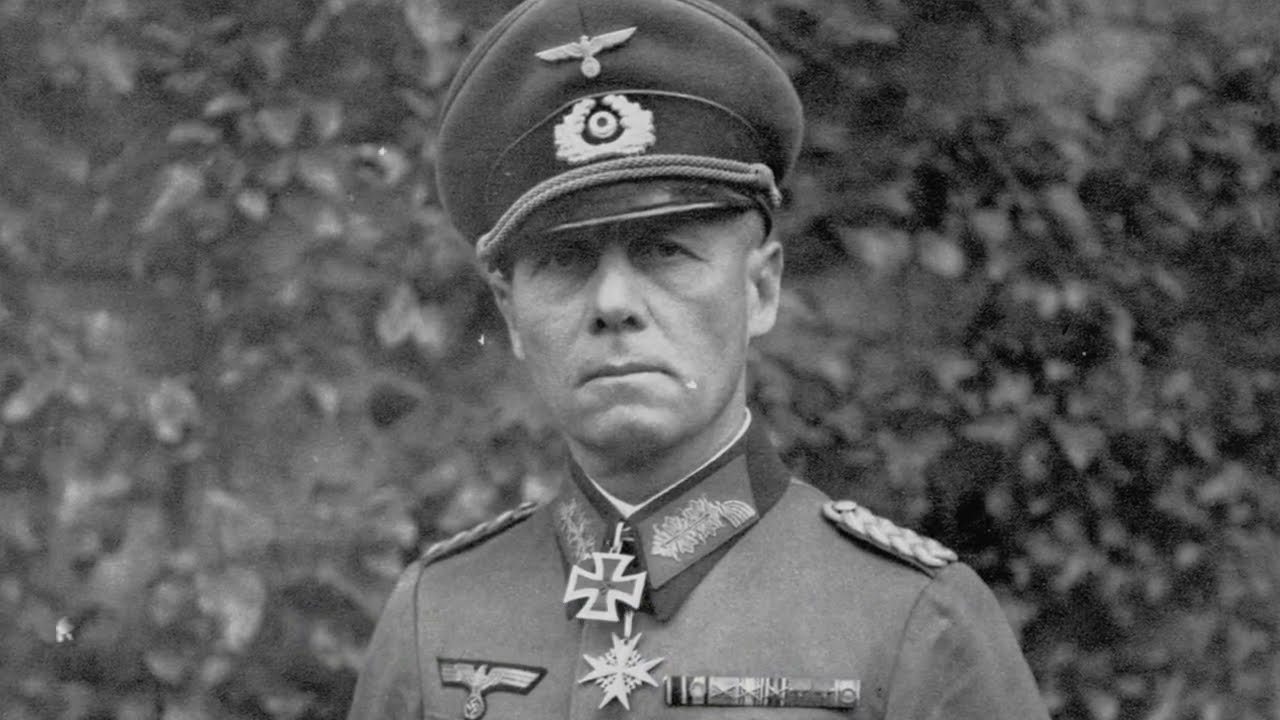
A unit that would operate behind enemy lines for nearly 3 straight years, missing only 15 days in the entire desert campaign. A unit that would be described by Field Marshal Erwin Rommel himself, in a concession that must have tasted like ash, as having caused more damage than any other British unit of equal strength.
This is the story of the Long Range Desert Group. And it begins not with a battle, but with an accident, a refusal, and a man who knew the desert better than any soldier alive. The accident happened in the Mediterranean in 1939. A collision between ships in a British convoy forced a troopship to dock at Alexandria, Egypt, for repairs.
Among the passengers deposited on the quayside was Ralph Bagnold, a 43-year-old Royal Signals officer who’d been heading to a posting in East Africa. He had no intention of staying in Egypt. The war had other plans. Bagnold was no ordinary Signals officer. Between 1925 and 1935, he had spent a decade exploring the Libyan Desert, one of the most hostile landscapes on the planet.
Stretching 1,100 miles east to west and 1,000 miles north to south, the Libyan Desert was a place that most military planners treated as impassable. The Great Sand Sea alone, a rolling ocean of dunes rising hundreds of feet into the air, was considered a barrier as absolute as any mountain range. No army could cross it.
No supply line could survive it. It existed on military maps as a void, a blank space between the narrow coastal strip where wars were fought and the deep interior where nothing lived. Bagnold had crossed it multiple times. In modified Ford Model A trucks, he and a small circle of friends, men like Patrick Clayton, William Kennedy Shaw, and Guy Prendergast, had driven thousands of miles through terrain that every desert explorer of the era said was impossible to traverse by vehicle.
They’d developed techniques for reducing tire pressure to float across soft sand. They’d invented a condensation system that recaptured engine coolant water, extending range by hundreds of miles. And Bagnold himself had designed and patented an improved sun compass, a navigation instrument that used the position of the sun relative to time to determine direction, unaffected by the magnetic anomalies and iron ore deposits that rendered traditional compasses useless in the deep desert.
These weren’t hobbies. They were, as events would prove, the foundation of a new kind of warfare. When Italy entered the war on the 10th of June, 1940, the strategic situation in North Africa transformed overnight. Marshal Rodolfo Graziani commanded an Italian Army in Libya numbering approximately 215,000 troops.
Facing them across the Egyptian frontier, General Wavell had roughly 36,000 soldiers, many of them scattered across the Middle East in garrison duties. The Suez Canal, Britain’s lifeline to India and the Far East, lay exposed. If Graziani advanced east with his full strength, there was nothing between his army and Cairo but a thin screen of British armor and a great deal of empty sand.
Wavell understood the danger, but he also understood something else. The vast Libyan Desert that everyone treated as impassable ran along the entire southern flank of the Italian position. If someone could operate in that desert, if someone could move through it unseen, gathering intelligence, striking at isolated outposts, and creating the impression of a threat that didn’t actually exist in conventional terms, the Italians would be forced to divert troops from their coastal advance to guard against phantoms in their rear.
It was a classic economy of force problem. And Bagnold had the solution. On the 23rd of June, 1940, 13 days after Italy entered the war, Bagnold walked into Wavell’s office at Middle East Command headquarters in Alexandria, and laid out his proposal. A small force of specially trained men in modified trucks could penetrate deep behind Italian lines, operate for weeks at a time without resupply, gather intelligence on enemy dispositions, and conduct raids that would force the Italians to look over their shoulders.
Wavell, a man who understood unconventional warfare and had observed similar mobile desert patrols during the First World War, grasped the concept immediately. He gave Bagnold approval and a deadline. Six weeks. Build the unit, train the men, and get behind enemy lines before the Italians reach the Nile. The clock started running.
And the first obstacle was manpower. Bagnold knew exactly what kind of men he needed. Not parade ground soldiers drilled in routine. Not men who needed orders for every action. He needed self-reliant individuals who could fix their own vehicles, navigate without landmarks, endure temperatures that swung from over 60° C during the day to below freezing at night, survive on 6 pints of water a day, and fight if they had to, all while operating hundreds of miles from the nearest friendly position with no possibility of
rescue if something went wrong. He looked at the forces available in Egypt and concluded that farmers from the Dominions, men raised in rural landscapes who understood machinery and physical endurance, would adapt fastest to what he had in mind. His first choice was the Australians. He flew to Palestine and made his case to General Blamey.
The refusal was not personal. The Australian government had specific policies about the command arrangements for its troops overseas. And placing Australian soldiers under the direct command of a British officer for an irregular, unproven operation in the deep desert fell outside those boundaries. Blamey said no, and that was that.
Bagnold pivoted without hesitation. He turned to the New Zealand Division in Egypt, whose commander, Lieutenant General Bernard Freyberg, was a Victoria Cross recipient from the First World War and a man personally known to Wavell. Freyberg listened to Bagnold’s pitch and gave his approval. The response from the ranks was extraordinary.
Over half the entire Second New Zealand Division volunteered. Bagnold selected 87 men, drawing primarily from the Divisional Cavalry Regiment and the 27th Machine Gun Battalion. He chose them for their mechanical aptitude, their physical toughness, and something harder to define but immediately recognizable, a quality of quiet competence that suggested they would keep functioning when everything around them was falling apart.
The New Zealanders arrived at the improvised training area and found Bagnold and his old desert hands waiting for them. What followed was 6 weeks of the most concentrated practical education in desert survival, navigation, and vehicle operation that any military unit has ever undergone in such a compressed time frame.
Kennedy Shaw, Bagnold’s intelligence officer, and a man who had crisscrossed the Sahara on camelback before the war, taught the navigators. They learned to use the sun compass on the move to plot dead reckoning courses across featureless terrain, and to fix their position at night using a theodolite and astronomical tables.
One New Zealander, Private Dick Croucher, turned out to be an ex-merchant navy officer with a first mate’s ticket who had hidden his qualifications to avoid being assigned to a desk job. He became one of the units best navigators overnight. The men learned to drive across sand dunes by deflating their tires and charging the slopes at precisely the right speed.
Too fast and the vehicle would bury itself, too slow and it would stall halfway up. They learned to unstick bogged trucks using sand channels, pierced steel plates carried on every vehicle. They learned to maintain engines in conditions where fine sand penetrated every seal and bearing. They learned to conserve water with a discipline that most human beings would find unbearable.
Six pints a day when the air temperature exceeded 50°. They trained with the weapons they would carry. Lewis machine guns, Vickers medium machine guns, Boys anti-tank rifles and a single Bofors 37 mm anti-tank gun. They learned to strip and reassemble them blind because sand and darkness would be constants of their operating environment.
And on the 5th of September 1940, with General Wavell himself coming to see them off, the long-range patrol slipped out of Cairo in secret. Two patrols, approximately 30 men in 10 vehicles each, headed west into the void. Captain Edward Mitford’s W patrol drove west across 5° of longitude deep into the heart of Libya and began burning Italian fuel dumps scattered along the air route to Kufra.
They attacked isolated landing grounds destroying unguarded aircraft and supplies. They captured an entire Italian motor convoy complete with vehicles, supplies and official mail. Captain Patrick Clayton’s T patrol struck southwest crossing between Kufra and Jebel Uweinat, driving entirely through enemy held territory to make contact with an astonished French outpost in Chad in French Equatorial Africa.
The two patrols rendezvoused in the open desert as planned and returned to Cairo. They had covered approximately 4,000 miles. Not a single vehicle had suffered a serious mechanical breakdown. 150,000 truck miles had been logged without a major incident. A testament to both the quality of the preparation and the mechanical skill of the New Zealand drivers who kept the Chevrolets running through terrain that should have destroyed them.
The captured prisoners and letters were handed to intelligence and proved to be, as Bagnold later noted, a mine of information for General Wavell. But the intelligence value was almost secondary to the psychological effect. The Italians had no idea what had hit them. Their outposts, scattered across hundreds of miles of what they considered their own secure rear area, had been attacked simultaneously by forces that seemed to materialize from nowhere.
British radio monitors in Cairo intercepted a flood of alarm messages and cries for help pouring into Graziani’s headquarters from across Eastern Libya. Enemy desert outposts were bombed and destroyed, their garrisons routed or taken prisoner. Simultaneously, the garrison at Jebel Uweinat was attacked 500 miles to the south, aircraft destroyed on the ground, a dump of bombs and ammunition blown sky high.
The attackers seemed to emerge from a fourth dimension to strike and vanish like lethal ghosts. They appeared, struck and disappeared at widely separated points seemingly within hours of each other. The Italian response was exactly what Bagnold had predicted. They pulled troops from the coastal front to reinforce garrisons in the interior.
They increased patrols along routes that the LRDG had already abandoned. They began looking south and west into the desert when they should have been looking east toward the British forces gathering for what would become Operation Compass, the devastating counteroffensive that General Richard O’Connor would launch in December 1940 with the Western Desert Force.
When O’Connor’s 36,000 men struck Graziani’s forward positions at Sidi Barrani, they faced an enemy that was already psychologically unsettled, already doubting its own intelligence assessments, already looking over its shoulder into the desert behind it. Operation Compass would drive the Italians out of Egypt entirely, push them back 500 miles across Libya and capture over 130,000 prisoners.
The LRDG did not win that battle, but they helped create the conditions in which it could be won. And this was the true genius of what Bagnold had created. The LRDG didn’t need to destroy the Italian army. It needed to distract confuse it and make it doubt the security of its own rear. Fewer than 100 men in modified trucks operating on a budget that would barely have funded a single armored battalion accomplished what would have required a full division in conventional operations.
Wavell himself recognized this with a nickname that captured the LRDG’s philosophy perfectly. He called them his mosquito columns. Small, persistent, impossible to swat and cumulatively maddening. By November 1940, Wavell was so pleased with the results that he promoted Bagnold to acting lieutenant colonel and authorized a doubling of the unit’s strength.
The long-range patrol became the long-range desert group. New patrols were formed from British volunteers, Guards regiments and Yeomanry units that Bagnold considered the cream of the regular army. G patrol, drawn from the Coldstream Guards and Scots Guards, was commanded by Captain Michael Crichton-Stuart. Southern Rhodesian volunteers formed S patrol.
An Indian long-range squadron would later be added. The original New Zealand patrols, T and R, remained the core of the unit and would continue operating through the entire desert campaign. The LRDG quickly developed into something unprecedented in military history. An average patrol consisted of approximately 40 men in 10 vehicles, most of them carrying fuel, water, ammunition, spare tires and food.
A typical mission lasted 3 weeks and covered 2,000 miles. The patrols were entirely self-sufficient. Every man was a specialist of some kind, a navigator, a radio operator, a mechanic, a medic. But every man was also expected to fight, drive, navigate and maintain his vehicle. There were no passengers on an LRDG patrol. There was no room for them.
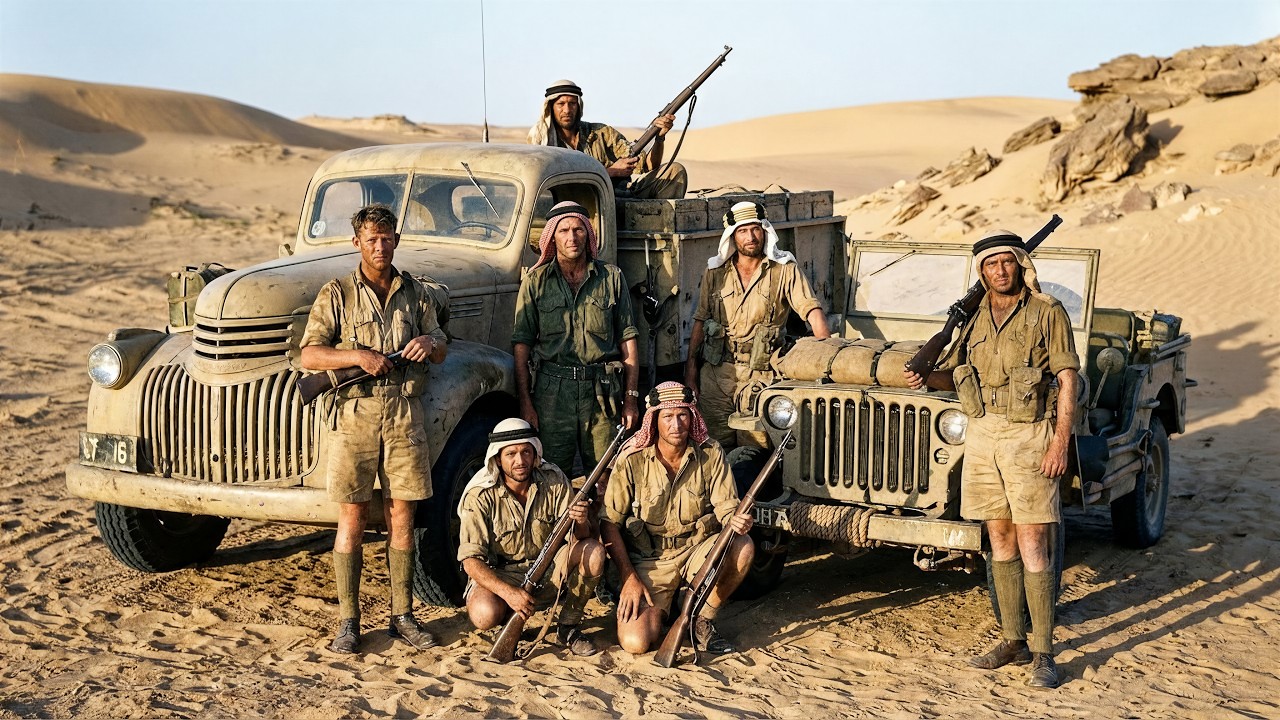
The vehicles themselves became icons of improvised military engineering. Stripped of doors, windscreens and roofs to save weight and improve visibility, the Chevrolet 30 hundredweight trucks were fitted with larger radiators, condensation recovery systems, built-up leaf springs for rough terrain and wide low-pressure desert tires.
Every vehicle carried multiple gun mountings, though usually only two or three were in use at any time. Bagnold’s sun compass was bolted to every dashboard. The trucks carried sand mats, theodolites, star charts and enough fuel and water to operate for weeks without resupply. The men who rode them looked nothing like conventional soldiers.
Bearded, sunburned, dressed in ragged shorts and Arab headcloths obtained from the Transjordan Frontier Force stores, they resembled, as one author noted, a bunch of wild-eyed biblical hermits emerging from the wilderness. Their appearance was deliberate. In the deep desert, military smartness was irrelevant.
What mattered was function, the ability to see without being blinded by glare, to protect skin from sand and sun, to move without overheating. The LRDG’s operational area was staggering in its scale. It stretched roughly 1,500 km south from the Mediterranean coast to the Tibesti Mountains and Jebel Uweinat and approximately 1,900 km from the Nile Valley in the east to the mountains of Tunisia and Algeria in the west.
An area the size of the Indian subcontinent with no paved roads, no reliable water sources and temperatures that could kill in hours. Navigation in this landscape was an art form bordering on the mystical. Magnetic compasses were useless because of iron deposits in the ground and the metal of the vehicles themselves.
The sun compass gave direction during daylight hours. At night, the navigators used theodolites and astronomical tables to fix position by the stars, exactly as a ship’s navigator would do at sea. Between fixes, they dead reckoned, counting distance by odometer readings and correcting for the drift of soft sand.
They were navigating a sea without water and they did it with a precision that consistently astounded conventional forces. One of the few maps the LRDG possessed for Libya had been captured from the Italians and it was comically inaccurate. Mountains marked as impassable ranges turned out to be gentle rises. The LRDG made their own maps as they went, building a picture of the terrain that became one of the most valuable intelligence assets in the entire theater.
As the war progressed, the LRDG’s role expanded far beyond Bagnold’s original concept. Three distinct mission sets emerged, each critical to the broader campaign. The first was strategic reconnaissance, and its most important expression was the road watch. Beginning in early 1942, when the LRDG was based at Siwa Oasis Egyptian-Libyan border, patrols maintained near continuous surveillance of the Via Balbia, the main coastal road between Tripoli and Benghazi, the jugular vein of Rommel’s supply line. The method was
simple in concept and brutal in execution. A patrol would drive to within a few miles of the road, parking about 2 miles back, and camouflage their vehicles under netting, local foliage, and sand. The road watch site was approximately 5 miles from the Marble Arch monument, a grandiose Italian colonial structure that served as an ironic landmark for the men who were methodically documenting the decline of Italian ambitions in Africa.
Before dawn each day, two men would crawl into a carefully prepared concealed position approximately 350 yd from the road. They lay there from first light to last, recording every vehicle that passed, noting its type using specially prepared identification binders containing silhouettes of German and Italian military vehicles.
They could not move. They could not stand. They could not do anything that might draw the eye of a passing driver or a curious shepherd. The boredom was excruciating. One LRDG man described the experience with grim precision. You look at your watch at 11:00 and look again 4 hours later, and it’s 11:15. At night, they moved closer, sometimes to within 30 yd of the tarmac, identifying vehicles by the rumble of their engines and the shadow of their silhouettes against the sky.
Every detail was transmitted by radio back to British Army headquarters using wireless sets that required meticulous handling to prevent the signals from being intercepted by German direction-finding equipment. Three patrols rotated continuously, one watching, one traveling to relieve the watchers, one returning to Siwa for debriefing and rest.
Between March and July 1942, the road was under practically 24-hour surveillance. The LRDG did not lose a single man or vehicle during road watch duties, though they had close encounters. On one occasion, R1 patrol found itself surrounded when a convoy of 27 vehicles and about 200 enemy troops stopped for the night between the watchers and their own vehicles.
The patrol lay motionless in the darkness until the convoy moved on at dawn. The intelligence produced was priceless. The head of military intelligence in the Middle East later assessed the road watch as the LRDG’s single most important contribution to the entire campaign, providing confirmation of the strength and movement patterns of Rommel’s Africa Corps at a time when the fate of Egypt hung in the balance.
That intelligence fed directly into the planning for the battles of Alam Halfa and El Alamein, engagements that turned the tide of the war in North Africa. The second mission was direct action, and here the LRDG revealed a capacity for violence that belied their reputation as quiet watchers. They planted mines on supply routes, ambushed convoys in the darkness, and roared out of the night onto enemy bases and runways with machine guns blazing, blowing up fuel depots and aircraft before vanishing back into the sand.
The Italians found these attacks psychologically devastating. The raiders seemed to appear from nowhere, as if from a fourth dimension, Bagnold later wrote, and to disappear as rapidly. The raid on Murzuk in January 1941 demonstrated just how far behind enemy lines the LRDG was willing to operate. The target was an Italian fort and airfield 1,100 miles from Cairo, deep in the Fezzan region of southern Libya.
76 raiders in 23 vehicles, including Clayton’s T patrol and Creighton Stuart’s G patrol, along with nine Free French soldiers who had provided forward supply dumps from their base in Chad, drove for days to reach the objective. They stopped for lunch just a few miles from the fort and finalized their plan in the shade of their vehicles.
Clayton’s patrol would hit the airfield. G patrol would hit the garrison. As the convoy approached, they passed a lone cyclist who turned out to be the local postmaster. He was quietly added to the party along with his bicycle. The guard at the fort turned out, and the LRDG opened fire at 150 yd. Clayton’s patrol circled a hangar and ran straight into a concealed machine gun nest.
The Free French officer beside him was killed instantly, but Clayton silenced the position and pressed on. By the time his patrol withdrew, they had destroyed three bombers, a sizable fuel dump, and killed or captured all 20 guards. G patrol subjected the fort to mortar fire until the garrison surrendered. Two prisoners were selected for interrogation in Cairo.
The rest were left in the ruins. The entire raiding force then disappeared back into the desert from which it had come. The attack on Barce in September 1942, the LRDG’s most celebrated offensive operation, was even more audacious. Commanded by Jake Eason Smith, two patrols traveled over 1,150 miles to simultaneously strike an airfield and barracks complex.
The airfield assault claimed 35 aircraft destroyed. It was the kind of damage that would normally require an entire bomber squadron to inflict, delivered instead by a handful of men in trucks who had driven halfway across North Africa to get there. But it was the third mission, guiding and transporting other special forces units, that produced the LRDG’s most enduring legacy for the history of warfare.
In November 1941, a young officer named David Stirling led the first operational mission of his newly formed unit, L Detachment Special Air Service Brigade, a parachute raid against Axis airfields in Libya. The mission was a disaster. A catastrophic thunderstorm scattered the parachutists, injured many on landing, and left the survivors stranded in the desert.
Of the original force, only 21 men made it out, rescued by LRDG patrols who drove to their position and extracted them. It was Lieutenant Colonel Guy Prendergast, who had taken command of the LRDG from Bagnold in August 1941, who suggested a solution to Stirling. Forget the parachutes. The LRDG would drive the SAS to their targets and pick them up afterward.
The partnership that followed was one of the most productive special operations collaborations of the entire war. The LRDG’s Rhodesian S patrol, navigated by a young Englishman named Mike Sadler, who had emigrated to Rhodesia before the war and possessed an almost uncanny ability to find his way across trackless desert, transported SAS raiding parties hundreds of miles across the open sand to strike airfields at Sirte, El Agheila, Agedabia, Tamit, and dozens of other targets.
The logistics alone were extraordinary. To deliver an SAS team to an airfield target and extract them afterward meant driving a round trip of 700 miles or more across terrain that offered no shelter, no resupply, and constant exposure to air attack. The LRDG navigators had to find not just the target, but the exact rendezvous point where they would collect the raiders afterward, often in total darkness, with nothing but dead reckoning and the stars to guide them.
In December 1941 alone, SAS teams ferried by the LRDG destroyed 151 aircraft and 30 vehicles on the ground. The SAS called the LRDG the Libyan Desert Taxi Service, a nickname that was simultaneously affectionate and dismissive, and which the LRDG accepted with the quiet patience of men who knew that without their navigation and transport, Stirling’s raiders would have been walking home across 400 miles of sand.
Stirling himself, for all his brilliance and daring, acknowledged the dependency. After his catastrophic first parachute operation, it was Prendergast who saved not just the surviving SAS soldiers, but the very concept of the SAS as a viable military force. Without the LRDG’s offer to provide overland transport, the SAS might have been disbanded after a single failed mission.
Prendergast, who had explored the Libyan desert with Bagnold in the 1920s, was in many ways the opposite of the flamboyant Stirling. Dour, laconic, and precise, he kept his emotions hidden behind a cool exterior and a pair of circular sunglasses. He was considered by his men to be the most mobile commander in the entire desert campaign, constantly moving between patrols and headquarters.
He never sent out a patrol unless he was certain it was capable of accomplishing the mission, and he set a standard that no officer in the LRDG was above the most common or tedious task. There were no batmen for LRDG officers. Everyone dug, everyone drove, everyone fought. The relationship illustrated a fundamental truth about the LRDG that is often overlooked in accounts that focus on the more flamboyant SAS.
The LRDG was not primarily a raiding force, it was an enabling force. Its greatest contribution was not the damage it inflicted directly, though that was significant. It was the intelligence it gathered, the routes it mapped, the forces it guided, and the strategic confusion it sowed in the enemy’s rear. It was the invisible infrastructure of the desert war, the unseen foundation upon which more celebrated operations were built.
General Bernard Montgomery, who commanded the Eighth Army during the decisive battles of 1942 and 1943, acknowledged this directly. When his forces faced the formidable Mareth Line in Tunisia in March 1943, it was the LRDG that found and navigated the flanking route through the desert that allowed the British to outmaneuver the position.
Montgomery stated afterward that without the LRDG’s reconnaissance, his attack would have been a leap in the dark. The flanking movement succeeded, and the Axis position in Tunisia began its final collapse. The cost of this three-year campaign was remarkably light for its scale and intensity. The LRDG lost 16 killed and 24 missing and captured during the entire desert campaign.
The unit never numbered more than 350 men at any point, all volunteers. They operated behind enemy lines almost continuously from September 1940 to May 1943, missing only 15 days. They covered hundreds of thousands of miles in vehicles that were, by the standards of armored warfare, completely unprotected. And they did it in conditions that were, in their own way, as merciless as any battlefield.
The desert did not forgive mistakes. Water discipline was life and death. Six pints a day in temperatures exceeding 50° C meant perpetual thirst, cracked lips, and the constant mental effort of rationing every drop. There was no washing. Patrols returned from month-long missions looking like men who had been dragged through the underworld, emaciated, blackened by sun and wind, their clothing rotting off their bodies.
The temperature swings were savage, furnace heat by day, freezing cold at night. Men slept in kapok-lined coats and sheepskin Hebron jackets and still shivered. Mechanical breakdowns in the deep desert meant either fixing the vehicle on the spot or walking, and walking in the Libyan desert was a sentence measured in hours, not days.
Yet the men of the LRDG endured it, not once, but repeatedly, rotation after rotation for 3 years. The New Zealanders who had formed the original patrols served through the heaviest period of the desert campaign, and their contribution was disproportionate to their numbers. New Zealand patrols, T and R, were considered among the most reliable in the entire group.
Bagnold had been right about them. The self-reliance bred into men who had grown up farming in the remote valleys and high country of a young nation translated directly into the kind of independence that the desert demanded. They could fix anything, drive anything, and endure conditions that would have broken men raised in softer circumstances.
And when the desert campaign ended and the war moved to Italy and the Mediterranean, the LRDG followed, conducting operations in the Greek Islands, the Balkans, and the Adriatic until the end of the war. The unit adapted, as it always had, learning to operate on rocky islands and in mountain terrain with the same resourcefulness it had shown in the sand.
But the Mediterranean proved crueler than the desert. Their heaviest single losses came on the Aegean island of Leros in November 1943, where 41 were killed, and their commanding officer, Jake Eason Smith, the man who had led the Barce raid, died leading an operation. Eason Smith had been handpicked by Bagnold in 1941, a former wine merchant from Bristol who had proved himself a natural leader with an instinctive ability to read danger and outthink the enemy.
His death hit the unit hard. Command passed to David Lloyd Owen, a yeomanry officer who had commanded Y Patrol and who would lead the LRDG through its final campaigns. When the war in Europe ended, the LRDG volunteered almost to a man to transfer to the Far East to fight the Japanese. The War Office refused, and the unit was disbanded in August 1945.
The legacy stretches far beyond the operational statistics. The Long Range Desert Group was the first British special forces unit of the Second World War. Every subsequent formation, the SAS, the Special Boat Service, Popski’s Private Army, drew from its example. The techniques it pioneered, deep penetration reconnaissance, extended self-sufficient patrolling, intelligence-led targeting, navigation across featureless terrain, became the foundation of modern special operations doctrine. The SAS’s mobility troop,
which until recently operated modified Land Rovers armed with multiple machine guns and trained specifically for desert warfare, was a direct descendant of the LRDG’s patrol concept. And the entire enterprise existed because one man was turned down by the Australians and decided to ask the New Zealanders instead.
That moment, Bagnold standing in Blamey’s headquarters in Palestine, hearing the word no and immediately pivoting to the next option, contains everything you need to know about the kind of thinking that built the LRDG. There was no self-pity. There was no delay. There was no report filed back to headquarters requesting guidance on alternative recruitment strategies.
There was a problem, the Australians wouldn’t go, and there was an immediate solution, the New Zealanders would. And within weeks those New Zealand farmers and cavalrymen and machine gunners were driving stripped-down Chevrolet trucks across the Great Sand Sea, navigating by sun and stars, attacking Italian outposts that had never seen a hostile vehicle, and sending intelligence back to Cairo that would reshape the entire campaign.
Rommel’s assessment stands as the most economical summary of what they achieved. The LRDG caused us more damage than any other British unit of equal strength. From a commander who understood the desert better than almost any other general in the war, that was not flattery. It was a statement of operational fact.
A unit that never exceeded 350 men operating from oasis bases deep behind enemy lines using vehicles that cost a fraction of a single tank, staffed by volunteers who were paid standard military wages and required no special equipment beyond a sun compass and a theodolite, had caused the Africa Corps more difficulty, mile for mile and man for man, than any equivalent force in the theater.
The answer to why is the same answer that has driven every successful special operation in history. It was not the equipment. It was not the budget. It was the quality of the individual and the system that selected and trained him. Bagnold understood this from the beginning. His recruitment criteria, spelled out in the advertisement he circulated to Allied units in North Africa, were characteristically blunt.
Only men who do not mind a hard life with scanty food, little water, and lots of discomfort, men who possess stamina and initiative, need apply. Those words could serve as the founding charter of modern special operations. They describe not a superhuman, but a specific type of human being, one who functions when comfort disappears, when support vanishes, when the only resources available are the ones carried on the back and between the ears.
Bagnold found those men first among the New Zealanders, then among the Guards and Yeomanry and Rhodesians and Indians who followed. He built them into the most efficient fighting formation of the desert war. And it all began because the Australians said no, and a British major with sand-worn hands and a compass of his own invention said, “Fine.
” and caught the next flight to Egypt. That refusal didn’t stop anything. It redirected the course of a war. The Long Range Desert Group went out into the void, and the void answered to them.