She Baked a Pie for a Wealthy Widowed Rancher – Then His Words Stole Her Heart. t1

She Baked a Pie for a Wealthy Widowed Rancher – Then His Words Stole Her Heart
The morning Ethan Cole turned 53, he didn’t know it was his birthday until he walked into the kitchen and found a folded calendar page on the counter, the kind his foreman, old Pete Hadley, left every year with a penciled X on the relevant square. The gesture was practical, not sentimental. Pete wasn’t a sentimental man, and Ethan had long since stopped being one.
He made coffee by himself. He drank it standing up looking through the kitchen window at the ridgeline to the east where the sun was still deciding whether to commit to the day. The mountains out there were purple-gray in that uncertain light, and the pasture between the house and the fence line was covered in a frost that would burn off by 8:00, but for now made everything look clean and temporary, the way things looked right before they showed their real condition.

He was a big man, Ethan Cole, not fat, years of ranch work had seen to that, but substantial, wide across the shoulders, hands that had built fences and pulled calves and signed contracts worth more money than most of Harding County would see in a decade. His hair had gone silver at the temples sometime in his mid-40s and simply kept going.
So now it was the color of ashwood. His face had lines in it from weather and from something harder to name. People in Harding County respected him. Some feared him mildly. Very few understood him, and he’d stopped caring about that particular problem around the same time his wife, Margaret, died.
That had been 4 years ago, a fever that came fast and left faster, taking her with it in 11 days. He didn’t talk about it. He worked instead. He expanded the cattle operation. He bought the southern pasture when the Hallett family sold it. He hired four more hands and fired two who weren’t worth the feed bill. He did what needed doing, and he kept his grief somewhere in the region of his sternum where it sat like a stone he’d learned to carry without leaning.
He heard the gate latch from the kitchen. He didn’t need to look. He knew the sound of it. Clara Whitmore’s property sat on the other side of the split-rail fence that divided the east edge of Ethan’s ranch from the Whitmore land, 40 acres that had been her father’s before her father’s lungs gave out. And before that, her grandfather’s.
And before that, a piece of open territory that nobody had bothered to claim because the soil was rocky and the winters came early. The Whitmore family had made a life out of land that other people passed over, which told you something about them if you were paying attention. Clara had been 22 when her father died.
22 and already running the operation largely on her own because her father had been sick for 2 years before the end, and she’d taken over the feeding and the breeding records and the fence repairs and everything else without making much noise about it. She was not the kind of woman who made noise about things.
She was 25 now, compact and capable-looking with dark hair she kept pinned back because loose hair had no place in a working day. Her eyes were a color that described differently depending on the light. Sometimes green, sometimes a muddy hazel, sometimes something in between that didn’t have a clean name. She wasn’t what you’d call conventionally beautiful, not in the way of the women in the dressmaker’s window cards.
She was something else, something that took you a minute to see, and then once you saw it, you kept seeing it. Every Tuesday for 3 years, she had come through the gate in that fence with something cooked or baked or put together in a dish or a basket. It had started in the week after Margaret Cole’s funeral when Clara had shown up with a venison stew and left it on the post without knocking.
The second week she brought cornbread. The third week, bean soup. Ethan had never thanked her formally, and she had never asked for thanks. This was not an arrangement they had discussed. It existed the way some things exist on the frontier, through repetition and mutual silence and a kind of unspoken understanding that neither party was required to explain.
That morning she came through the gate carrying a covered dish, specifically a tin plate covered with a cloth, which meant a pie, and she walked the path between the fence and the kitchen door with the easy familiarity of someone who knew exactly where the ground was uneven. Ethan was already on the porch by then.
He’d brought his coffee with him. He watched her come. “Morning,” she said. “Morning.” He stepped down off the porch to meet her at the foot of the steps, the way he always did, so she didn’t have to climb up and he didn’t have to accept the food in the doorway like he was receiving charity, which they both knew it wasn’t, but the geography of it mattered anyway.
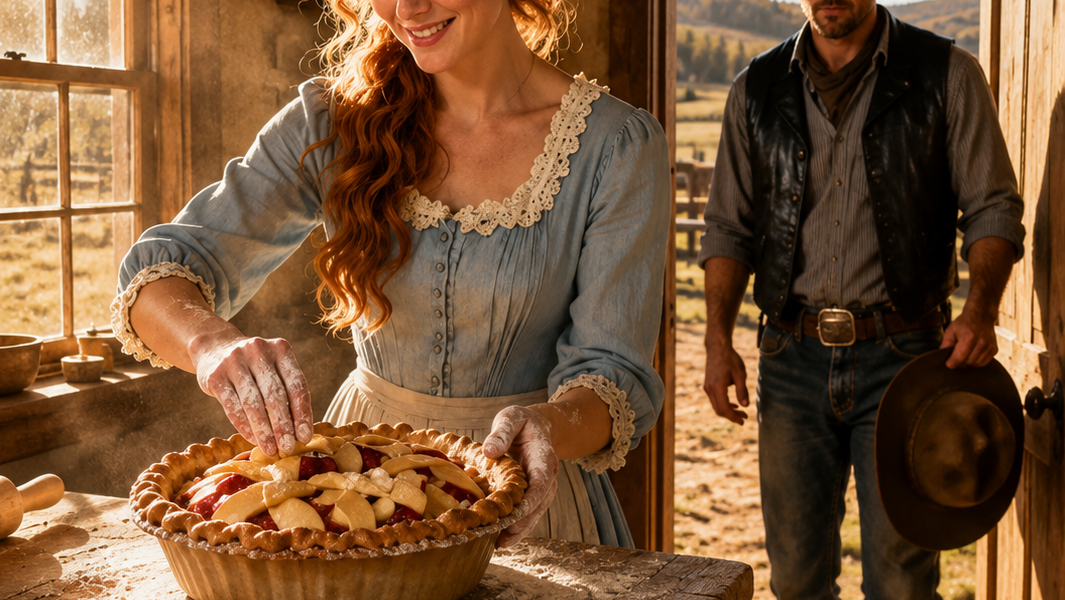
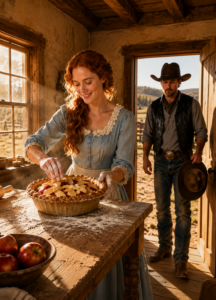
She handed him the dish. He lifted the cloth and looked. Apple pie. The crust was rough-edged and a little uneven, brown dark on one side where the oven ran hotter on the left. It smelled like cinnamon and something sharper beneath it. Maybe cloves, maybe nutmeg. He couldn’t tell. It smelled good. It smelled like something made by a person rather than a recipe.
“You didn’t have to,” he said. “I know,” she said. He looked at the pie for a moment longer than necessary, then set it down on the porch railing and looked at her. She had a smudge of flour on the side of her jaw that she hadn’t noticed, and something about that detail hit him sideways.
The fact that she’d gotten up early enough to bake this thing, probably before dawn, and walked over here before half the county was awake, and still hadn’t managed to get all the flour off her face. And she didn’t know it was there and wouldn’t care if she did. “You’re going to make some man very lucky,” he said. He was aiming for something light, something to bridge the gap between the pie and the day, but what came out was more direct than he intended.
He let it sit. She tilted her head just slightly. “I suppose that depends on the man.” “Lucas Granger’s been making eyes at you since Easter.” “Lucas Granger makes eyes at anything that holds still for more than 30 seconds. She said this without heat. Fact, not complaint. Ethan almost smiled. Almost. He’s a good enough young man.
He’s perfectly fine. Plenty of women in this county would be grateful. Then one of them should have him. She looked out at the pasture, not at him. The frost was starting to pull back at the edges, the grass showing through in patches. I didn’t bring you a pie to talk about Lucas Granger.
He leaned against the porch post. The morning air was cold enough that he could see his breath, just barely, and hers. Why did you bring the pie? She looked back at him. Her expression was matter-of-fact, but there was something behind it that he didn’t quite know how to categorize. Same reason I always do. Because you live alone and you work too much and Tuesday’s your slowest morning and I had the apples.
It was a perfectly reasonable answer. It was also not entirely an answer and he knew it and she knew he knew it and they left it there. He picked up the pie from the railing. It smells good. “It is good.” She said with the flat confidence of someone who had no reason to be modest about their cooking because modesty about things you were genuinely good at was a waste of everyone’s time.
She turned to go. “I’ll have Pete return the dish.” “I’ll return it myself.” She paused with her hand on the gate latch, turned back. “You never return it yourself.” “Maybe I should start.” She looked at him for a moment with that expression he couldn’t categorize. Then she nodded once like she’d filed something away and went back through the gate.
He watched her cross the pasture toward the Whitmore property, her stride even and unhurried, the frost crunching under her boots until she was far enough away that he couldn’t hear it anymore. He looked at the pie. He stood there with it for a full minute before he went inside. The day proceeded as days on the Cole ranch tended to, loud, complicated, and demanding.
Three of the northern fence posts needed replacement after a section of the herd got spooked by something in the night and pushed through. Two of the spring calves had scours and needed watching. His foreman, Pete Hadley, was 61 years old and moved like a man of 61, but thought like a man of 40, and ran the ranch operation with a competence that Ethan had long since stopped taking for granted.
Pete had been with Ethan for 11 years. He knew things about Ethan Cole that Ethan’s own brother didn’t know, and he kept them to himself, which was one of the reasons the arrangement worked. They were replacing the third fence post around midmorning when Pete, without looking up from his work, said, “Miss Whitmore came by.” “I know, I was there.
” “Apple pie?” “Apple pie.” Pete set his post driver down and straightened up and stretched his back. He had a face like a map of everywhere he’d been, creased and weathered and honest. “That woman makes a good pie.” “She does.” “Makes a good woman, too.” Ethan picked up his end of the new post. “I noticed.
” Pete picked up the other end. They set it in the hole without discussing it further. But when they were tamping the earth down around the base, Pete said, very quietly, like he was commenting on the weather, “She doesn’t do it for anybody else, you know.” “Tuesday meals.” “Just you.” Ethan didn’t answer. “Doesn’t have to.” Pete continued.
“She’s running her own place. She’s got enough to do.” “Pete.” “I’m just saying.” “I know what you’re saying.” Pete tamped the earth. “And?” Ethan looked at him. “And I’m 45 years old and she’s 25 and I buried my wife 4 years ago, and that’s a lot of complications stacked on top of each other.” Pete considered this.
“You’re 53.” He said. A pause. “What?” “It’s your birthday.” Pete nodded toward the main house. “Left you a calendar. You’re 53.” Ethan looked back at the fence post. He didn’t say anything. What was there to say? “The numbers were the numbers. That doesn’t change what I said.” He said finally. Pete picked up his tools.
“No.” He agreed. “It doesn’t, but” The town of Millard Creek, not much of a town really, more of an idea of a town that had been stubborn enough to become real over time, had about 300 permanent residents in the kind of social economy where everyone knew approximately everyone else’s business and the gaps were filled in with speculation.
It was not a cruel place exactly. It was a specific place. It had its own sense of how things ought to go and when they didn’t go that way, people noticed. The question of Clara Whitmore’s future had been a topic of informal discussion in Millard Creek for at least 2 years. She was young, she was capable, she was what people called good stock, which was a frontier way of saying that she came from people who knew how to work and survive.
She had a piece of land that, while modest, was genuinely productive. She was by any reasonable measure an excellent prospect. The consensus candidate was Lucas Granger. Lucas was 29. His family had the feed and supply business, Granger’s Mercantile and Feed, which meant they sat at the center of the local economy in the way that only businesses everyone needed tended to do.
Lucas himself was tall and even featured with a disposition that ran to the pleasant side of neutral. He wasn’t brilliant, he wasn’t particularly interesting, but he was reliable, financially stable, and good-tempered. And on the frontier, those qualities were not small things. He had been courting Clara with the patient confidence of a man who believed the outcome was essentially settled.
He brought flowers when the season allowed for them. He sat across from her at the church social in April, or had tried to until Clara sat at the wrong end of the table and didn’t move to accommodate him, which he’d laughed off with his easy good humor, and which had nonetheless been noted by those in attendance.
On a Thursday afternoon, 2 weeks after the apple pie morning, Lucas came into the Millard Creek General Store while Clara was there picking up flour and dried beans, and he angled himself into her path with the practiced ease of someone who had done this several times. Clara. He touched the brim of his hat. Lucas.
She kept moving toward the flour barrel, not impolitely, just efficiently. He fell into step beside her. Fine morning. It was. It’s afternoon now. He smiled. He had a good smile, the kind that reached his eyes, which made it harder to be annoyed with him than might otherwise have been warranted. I was wondering if you’d allow me to drive you to the harvest festival next month.
I know it’s early to ask. It is early. But I wanted to be sure before anyone else got the same idea. Clara scooped flour into her bag with the measuring scoop and didn’t stop what she was doing. I appreciate you asking. I haven’t decided about the festival yet. Of course. He leaned against the counter. I hear Ethan Cole’s been fixing that eastern fence line.
Lot of work for one crew. Clara looked up at that briefly. It’s his ranch. He can fix what he likes. Just making conversation. Lucas’s tone was light, but his eyes were doing something more careful. He was 29, not stupid. He’d noticed, as had others, the Tuesday ritual, the way Clara’s gate opened at the same time every week and closed again 20 minutes later.
He’s a good man. Cole? I just think He paused, reconsidered. You just think what? Clara asked. She said it without hostility, but with the directness that tended to make people either finish their thought or wish they hadn’t started it. Lucas looked at her for a moment. I think he’s older than your father would have been.
It was quiet in the store. The woman at the counter had gone very still in the way of someone pretending to arrange things while actually listening. Clara set down the measuring scoop. She looked at Lucas Granger, really looked at him, the way she rarely did, and it wasn’t an unfriendly look so much as a very clear one.
“My father was a smart man,” she said. “He respected people based on what they did, not what year they were born.” She picked up her bag. “I’ll let you know about the festival.” She paid at the counter and walked out. Lucas stood there for a moment, then straightened up and put his hat back on with the resigned good nature of a man who had just understood something he’d been hoping to avoid understanding.
That evening, Clara sat on her porch with a mug of coffee that had gone cold because she’d forgotten to drink it while she was thinking. She wasn’t thinking about Lucas Granger. She was thinking about the look on Ethan Cole’s face that morning when he lifted the cloth off the pie. He’d looked at it the way people look at things that they can’t quite believe are meant for them.
Not suspiciously, just with a kind of careful surprise, like he needed a second to verify that it was real and not something he’d imagined. She’d watched him do this every Tuesday for 3 years. He never assumed, never just took. Always that brief pause, that checking, that something in his face that she didn’t know how to name, but that she’d come to watch for the way you watch for particular birds.
Margaret Cole had been a good woman. Clara had known her to say hello to, nothing more say. The age difference between them made that unlikely, but she’d been kind-eyed and capable and clearly loved her husband in a real way, not a performance way. Clara had not envied her exactly. She just paid attention. And then Margaret was gone, and the light went out of Ethan Cole in a way that was visible from a distance.
And Clara, who was 22 and running her dead father’s ranch and had precisely nobody to lean on, had understood something about loneliness that she hadn’t expected to understand at 22. She’d brought the stew because it was what you did. You brought food when people were hurting. Her mother had taught her that before her mother left, not died, just left, which was its own kind of hurt, different shaped, and the lesson had stuck.
But she’d kept bringing it for 3 years because of Ethan, not because she pitied him. Pity was for people who didn’t do anything. Ethan Cole worked harder than any man in the county and ran his place with the competence that was almost painful to watch because you could see the cost of it, the way he poured himself into the work to keep from having to be still.
She’d brought the food because she saw him, because she had, gradually and without deciding to, come to see him as clearly as she saw anything. And what she saw was a man who was still worth seeing. She was not naive about the complications. She wasn’t naive about much. A 25-year-old woman and a man who just found out he was 53 and had a dead wife in his history and a ranch that needed his full attention.
She understood all of that. She just also understood that some things were simpler than they looked when you stopped worrying about what they were supposed to look like. The coffee was cold. She drank it anyway. So, the weeks following the pie ran in the ordinary current of ranch work and passing time, but something had shifted under the surface, barely perceptible, like a change in the depth of the water you couldn’t see until you stepped in a different place.
Ethan returned the pie tin himself. He’d said he would, and he did, on the following Friday morning, walking through the gate in the fence for the first time in 3 years. Clara was in her kitchen when she heard the knock. She had a door, solid pine with a proper latch. And when she opened it and found him standing on her step with the empty tin in his hand and in expression like a man who had committed to something and was now dealing with the immediate consequences, she stepped back and let him in without comment. Her kitchen was
smaller than his, but more lived-in. There was a cast-iron stove, a table with two mismatched chairs, shelves lined with labeled jars, and dried herbs hanging from hooks in the ceiling beams. It smelled like wood smoke and coffee and the lingering ghost of the apple pie she’d baked 4 days ago. He handed her the tin.
She put it on the shelf. Coffee? She asked. If it’s made. It’s always made. She poured two cups. He sat down at the table, the chair with the slight wobble in its left back leg, because that was the chair facing the window, and he turned out to be a man who wanted to see out if there was a window to see out of. She noticed this.
They drank coffee. The morning outside was quiet except for the wind, which was picking up from the northwest, the kind of wind that carried the smell of change in it. Good pie. He said after a while. I know, she said. He almost smiled. You always do that. Do what? Say I know instead of thank you. She considered this.
Thank you suggests I needed your opinion to tell me it was good. I don’t. It was good because I made it correctly. Your opinion just agrees with the facts. He looked at her. That’s one way to think about it. It’s the accurate way. There was a pause. Outside a hawk crossed the window line banking south.
Why haven’t you married? He asked. It came out more direct than he probably intended. He’d been sitting here building up to something and came out with the wrong end of it. She didn’t flinch from the question. I haven’t found the right circumstances yet. Lucas Granger seems to think he represents the right circumstances. Lucas Granger thinks a lot of things.
She turned her cup on the table. What he actually represents is the acceptable answer, the thing that makes sense to everyone watching. And you don’t want the thing that makes sense to everyone watching. She looked at him directly. I want the thing that makes sense to me. Those aren’t always the same.
He looked down at his coffee. The kitchen was quiet. He was a man who’d spent his adult life making decisions about land, about money, about cattle and hands and weather and timing. And he knew with the recognition of something practiced that he was standing at the edge of a decision right now. He just wasn’t sure he’d earned the right to make it.
I’m 53 years old, he said as if reminding himself. My wife’s been gone 4 years. I’ve got calluses on my hands and gray in my hair and I still wake up at 4:00 in the morning when the cattle are restless. I know, she said. That’s what I am. I know what you are, Ethan. He looked up at her. She was watching him with that clear-eyed steadiness that he’d been looking at from across a fence for 3 years without letting himself look at it directly.
He was looking at it directly now and it was If I were younger, he said and then stopped. He hadn’t planned to say it. It just came out. The way things come out when you’ve been keeping them in too long. Clara set down her cup. She looked at him in a way that he couldn’t read and then said with a quietness that had nothing soft about it, 10 years wouldn’t be enough.
He stared at her. She picked up her cup again. More coffee? He didn’t answer the coffee question. He was still working on the other thing. What does that mean? It means what it means. Clara. She stood up and refilled her cup at the stove then turned back to face him. Her expression was that matter-of-fact thing, that flat clear thing, but something behind it was running differently than usual.
It means that 10 years of being younger wouldn’t be enough to replace what you already have. Which is what I’ve been looking at for 3 years. She set the coffee pot down. Now, did you want more coffee or not? He sat back in the chair. The wobble in the leg shifted slightly under his weight. No, he said finally.
I think I’d better go. All right. He stood. He picked up his hat from the corner of the table where he’d set it. He walked to the door, then he stopped with his hand on the frame and turned back. I don’t know what to do with that, he said. She looked at him from across the small kitchen. I know. That’s not helpful. I know that, too.
He looked at her for a moment longer. This woman who had fed him for 3 years and driven him half crazy in a Friday morning kitchen and said things that didn’t fit any box he knew how to use. And then he walked out into the morning and back across the field toward his own fence. And he didn’t look back, but he heard her door close behind him and the sound of it followed him across the frost-hard ground all the way home.
Up then. That afternoon, Pete Hadley found him at the backwater trough doing maintenance work that Pete could have done perfectly well on his own. And the fact that Ethan was doing it himself told Pete everything he needed to know about the state of affairs. He worked alongside him for a while without saying anything.
Then, she say something? Ethan kept working. She said something. Good something or bad something? I genuinely cannot tell. Pete wiped his hands on his work cloth. That sounds like a good something. How does that sound like a good something? Because bad somethings are usually pretty clear. Pete picked up a wrench. Was she unkind? No.
Was she discouraging? Ethan stopped working. He stood there for a moment with his hands on the water trough and thought about the small kitchen and the cold wind outside and a woman telling him that 10 years wouldn’t be enough. No, he said slowly. She was not discouraging. Pete nodded like this was the answer to a math problem he’d already worked out.
Then you’re just scared. Ethan looked at him. Which is fine, Pete said. Being scared is appropriate. This is a significant situation. He picked up the other end of the trough fitting they were replacing. But scared and wrong aren’t the same thing. Ethan stood there. Hold this, Pete said. He held it. Come on.
The days after that Friday moved with a slowness that Ethan recognized from certain kinds of difficult work. The kind where every hour felt twice as long as it was because your mind was somewhere else. He worked. He managed. He made decisions about cattle and feed and winter prep and the south pasture fencing and all the other machinery of a large working ranch.
And he did it with his usual competence because competence was a thing he could rely on when other things failed him. But Claire was 300 yards away on the other side of a fence and every Tuesday she came through the gate. And every Tuesday they stood at the foot of his porch steps and traded the minimum necessary words. And neither of them said anything about Friday morning in her kitchen and the weight of that unsaid thing sat in the air between them like weather.
He lay awake on a Wednesday night. A thing he rarely did because he was a man who worked hard enough to sleep. And stared at the ceiling of his bedroom and thought about the word enough. 10 years wouldn’t be enough. What did that mean? It meant she wasn’t looking for a younger version of him. It meant she was looking at the version that existed.
The actual one. The gray-haired 53-year-old man who woke up at 4:00 in the morning and hadn’t figured out how to be happy since 1878. It meant she was looking at him. He didn’t know what to do with that and he told her so and she told him she knew and that had been entirely unhelpful except that somewhere between awake and almost asleep on that Wednesday night he realized that she hadn’t taken it back.
She’d said it and then handed him a choice and let him go home with it, and it was still sitting in his chest like the stone that he’d been carrying since Margaret died, except that this one was shaped differently. This one had warmth in it. That realization scared him more than any of the rest of it.
What? The Tuesday after that, she came through the gate with a cloth-covered basket, and he was waiting on the porch. “Morning,” he said. “Morning.” She climbed the steps this time without being invited and set the basket on the porch table. He hadn’t moved to meet her at the foot of the steps. She’d climbed the steps.
Neither of them commented on this. She lifted the cloth. Biscuits and a crock of butter and a tin of something that turned out to be last summer’s strawberry preserves. “You didn’t have to,” he started. “Ethan.” He stopped. She looked at him. “Stop saying I didn’t have to. I know I didn’t have to.
I’ve known I didn’t have to for 3 years.” She picked up the preserves and handed them to him. “I want to.” He took the tin. It was heavier than he expected, or maybe his hands felt the weight differently now. He looked at her. Really looked at her, the way he’d been careful not to do in the kitchen that Friday. The way he’d been careful not to do for a longer time than that.
And she looked back at him without flinching or pretending or doing any of the things that people usually did when someone looked at them that directly. “I don’t know how to do this,” he said. His voice was quieter than he expected. “Neither do I,” she said. “Not exactly.” “That’s not reassuring.” “It wasn’t meant to be reassuring.
It was meant to be honest.” She turned to go, then stopped with one foot on the top step. “But I’ll tell you what I do know. I know how to show up. I’ve been doing that for 3 years.” She glanced back at him, and for just a moment, a half second, maybe less, something crossed her face that was less guarded than her usual expression.
Something that cost her something to show. I’m not planning to stop. She went down the steps. He stood on the porch holding the strawberry preserves and watching her walk back through the gate. And the morning light was doing something particular to the frost on the grass, turning it gold the way frost does right before it disappears entirely.
And Ethan Cole, who was 53 years old and had not let himself want something for a very long time, stood there in that gold light and understood. Not clearly, not without complication, not without the weight of everything it meant, that he was not after all past wanting. He went inside and ate two biscuits with butter and strawberry preserves and stood at his kitchen window looking out at the fence line.
And the morning burned off cold and clear, and somewhere on the other side of that fence Clara Whitmore was going about her day. He didn’t know what came next, but he knew for the first time in four years that he was going to find out. The strawberry preserves lasted four days. Ethan knew this because he ate them deliberately.
Not all at once, but in careful portions, one biscuit at a time, the way a man rations something he isn’t sure will be replaced. On the fourth morning, he scraped the last of it from the tin with a knife and stood at the kitchen window and acknowledged to himself that he was being ridiculous about strawberry preserves, and that the preserves were not the point, and that he was 53 years old and had built a cattle operation worth more than anything in Harding County, and he was standing in his kitchen being sentimental about a tin of jam. He set
the tin in this basin and went to work. But the thing that had shifted in him on that porch, the understanding or the beginning of understanding, didn’t unshift. It stayed. It sat in his chest alongside the other stone, the heavier one, and he was aware of it throughout the day the way you’re aware of a change in the weather before it arrives.
That pressure behind the eyes, that particular quality in the air. Pete noticed. Pete always noticed. “You’re walking different.” Pete said on the Monday morning, not looking up from the harness he was mending. “I walk the same as I always walk.” “You’re walking like a man who made a decision but hasn’t told the decision what to do yet.
” Ethan picked up a length of fence wire. “That may be the most useless thing you’ve ever said.” “Probably not.” Pete pulled a stitch through leather. “You going with that wire or are you going to do something with it?” He did something with it. Tuesday came the way Tuesdays had always come, with that particular quality of arriving slightly before he was ready for it, which had not used to be the case.
Used to be he just heard the gate and took the food and said thank you and went on with his morning. Now he heard the gate and felt his shoulders do something involuntary, a kind of tightening and releasing. And by the time she was halfway across the yard, he’d managed to compose himself back into something that looked like a person standing normally on a porch.
She came with a pot of bean soup covered with cloth still warm through the bottom of the pot from the walk over. He took it. “Morning.” “Morning.” She looked at him with those clear eyes that had a way of doing a rapid inventory of whatever they landed on. “You sleep?” “Enough.” “That’s not yes.” “No.” He admitted. “Not entirely.
” She nodded like this confirmed something she’d already suspected. She didn’t say anything about it, which he appreciated more than he could have explained. They stood there for a moment in the cold morning air, the kind of November cold that got into your coat if you weren’t moving. “I meant what I said.” She told him.
She said it without preamble, without easing into it. Last week. “I meant it.” “I know you meant it. I’m just making sure because sometimes people say things and then they don’t know if the other person took it seriously, and I’d rather just confirm. He looked at her. I took it seriously. Good. She pulled her coat tighter, not from cold exactly, or not only from cold.
And are you going to tell me what you think about any of it? This was the question. He’d known it was coming because Clara Whitmore was not a woman who floated things out into the air and let them drift. She’d said her piece and waited a week, and now she was here with bean soup and a direct question, and he owed her more than he’d been giving her.
I think, he said carefully, that this is more complicated than a Tuesday morning conversation. I agree. So, what do we do about that? I don’t He stopped, tried again. Clara, I’m not a simple situation. I’m aware of that. I’ve got history, I’ve got He gestured vaguely at the ranch behind him, at the fence line, at the air.
All of this. And I’ve got He stopped again. He couldn’t bring himself to say Margaret’s name out loud in this context, but Clara understood it anyway, because she understood most things. I know, she said quietly. And you’re 25. And you’re 53. We’ve established all the numbers. Her voice was patient, but not soft. Numbers aren’t the thing I’m asking about.
Then what are you asking about? She looked at him for a long moment. The wind moved across the yard between them, rattling the dry leaves in the corner of the fence. I’m asking whether you’re willing to try, she said. That’s the whole question. Everything else is just detail. He stood there with the pot of bean soup in his hands and looked at this 25-year-old woman who had been showing up at his gate for 3 years, and who had, on a Friday morning in her own kitchen, said something to him that he hadn’t been able to put down since.
And he understood, standing there on that cold Tuesday morning, that he was afraid. Not of her. Not of the numbers or the history or the town’s opinion. He was afraid of wanting something again and losing it. He was afraid of what that had cost him the first time and of what it would cost him to be wrong a second time.
He was 53 years old and he knew exactly what grief weighed. “I need some time.” He said. Clara looked at him. Something moved in her expression. Not disappointment exactly, but something adjacent to it. Something that she pulled back quickly and replaced with the steadiness she always carried. “All right.” She said. “Clara.” “I said all right.” She turned to go.
“The soup needs about an hour on low heat. Don’t let it boil.” She walked back through the gate. He stood there holding the soup. He gave her two weeks, which was not time in any meaningful sense. Two weeks on a working ranch in November were consumed entirely by the logistics of winter preparation and left no space for anything else.
But it was time in the sense that he needed to stop circling and land somewhere. He landed somewhere on a Thursday afternoon when he was alone in the south pasture checking the condition of the winter feed bales and the sky over the mountains went from pale blue to that particular shade of gray-white that meant snow before nightfall and he stood there in the coming cold and thought, “I’m going to lose more time being afraid of losing time than any honest risk could actually cost me.
” It was not a complicated thought. It was the thought of a man who had done his accounts and found that the math only worked one way. He rode back to the main house and found Pete in the barn. “I’m going to ask Clara Whitmore to let me court her properly.” He said. He said it the way he said most things, without decoration, without softening.
Pete looked up from the horse he was currying. He looked at Ethan for a moment with an expression that was carefully neutral and that was also, in the way of a man who had worked alongside another man for 11 years and knew his silences, quietly satisfied. “About time,” Pete said. “Don’t.” “I’m just saying.” “I know what you’re saying.
I need you to not say it.” Pete went back to currying. “You going tonight?” “No, not tonight.” Ethan hung his coat on the barn nail. “Tomorrow.” “In the morning.” “She’ll be up before dawn.” “I know she’ll be up before dawn, so will I.” He picked up the spare halter from the hook. “I’ve been up before dawn every day of my adult life.
” “True enough.” Pete smoothed the horse’s flank. “You know what you’re going to say?” “Roughly.” “You practice it?” Ethan looked at him. “I’m not practicing a speech for a Friday morning conversation.” Pete almost smiled. “No, I suppose you wouldn’t.” He set the curry brush down. “She’s a good one, Ethan.” “I know she is.
” “I mean genuinely good.” “Not just useful good or capable good.” “Good in the way that’s harder to find.” Ethan stood there with the halter in his hands. Outside the wind was picking up and the sky was doing the thing it did before snow, that particular darkening and pressing down. “I know,” he said.
“That’s what makes it complicated.” “That’s what makes most good things complicated,” Pete said. He didn’t sleep particularly well that Thursday night, which he’d expected, and was up well before dawn on Friday, which he’d expected, too. He made coffee and didn’t drink most of it, which was unusual. He was not a man given to nerves.
He’d negotiated land purchases that involved more money than most men in Colorado would see in a lifetime, and he’d done it without his hands shaking. But this was a different kind of thing. This was not a transaction. It was not a negotiation with a known structure and a knowable outcome. This was walking through a fence gate with nothing in his hands and saying something he hadn’t said out loud to anyone in four years.
And the vulnerability of that was something he didn’t have a practice defense against. At just past 6:00, when the sky was starting to lighten in the east and the frost was heavy on the grass, he went through the gate. Her kitchen light was on. He could see it from halfway across the field, that warm yellow square in the dark of the Whitmore house, the only light in all that cold gray morning.
He walked toward it. He knocked. A pause. Footsteps. The door opened and she was there in her work clothes. She’d already been up for a while by the look of it, her hair pinned back, flour on her hands, which meant she’d been baking before dawn again. She looked at him, then at the empty yard behind him, then back at him.
“You don’t have a dish,” she said. “I know.” “Or a fence wire or a work reason.” “No.” She studied him for a moment, then she stepped back from the door. “Come in.” He came in. Her kitchen smelled like it always smelled, wood smoke and coffee and whatever she was making, and it was warm after the cold of the walk over, and he stood there just inside the door with his hat in his hands because he’d taken it off without thinking.
“Coffee’s made,” she said. She’d gone back to the counter, her back to him, her hands working at something. “Clara, you can tell me whatever you came to tell me and have coffee at the same time,” she said without turning around. “You don’t have to stand there like a man waiting for sentencing.” He almost laughed.
“Almost.” “Is that what I look like?” “Little bit.” She turned then and looked at him across the small kitchen. Her hands were still floury. She didn’t wipe them. “Say what you came to say, Ethan.” He said it. He said, “I don’t know how to do this right. I haven’t courted a woman since I was 28 years old, and I’m aware that was a long time ago, and things may work differently now, but I would like to try.
If you’re willing, I would like to spend time with you in a way that is that has intention behind it. He stopped. He’d planned to say it better than that. He hadn’t quite managed. I’m saying I want to know you better than I do, on purpose. She looked at him. I know that’s not particularly eloquent, he said. No, she agreed. It’s not. But she was looking at him with an expression that was not what he’d classify as discouraging.
It’s honest though. I meant it to be. She turned back to the counter, wiped her hands on her apron. When she turned back again, her expression had settled into something he couldn’t read as clearly as he wanted to. I’ve been waiting for you to say something like that since about February, she said. February? February last year? She said it without drama, just information.
When you helped me get my heifer out of the east ditch and you stayed to make sure the leg was right, and we stood in the mud for an hour and talked about nothing in particular, and you made me laugh three times. She paused. I thought, there it is. But then you went home and went back to being careful, and I waited.
He stood there. You never said. It wasn’t mine to say first. I was 24 and you were however old you were, and you had things to work through that I couldn’t work through for you. She poured him coffee without asking this time, just did it and handed it to him. But I didn’t bring those Tuesday meals over because I had extra food.
He took the coffee. His hand was steadier than he expected. I know that. Do you? I think I’ve known it for a while, he said honestly. I just didn’t know what to do with knowing it. She nodded slowly. And now? Now I’m standing in your kitchen at 6:00 in the morning asking if you’ll let me take you for a proper dinner in town.
He said it with the flat directness of a man who had practiced precisely this sentence and was not going to let it slip into something vaguer. Saturday. Not the harvest festival, just dinner. A long pause. She looked at him over her coffee cup. The stove was crackling. Outside a crow called once and went quiet.
“All right,” she said, “Saturday.” He nodded, “Saturday.” They drank their coffee. He stayed longer than he’d planned, an hour, maybe more. And they talked about the coming winter and her east fence and his south pasture and the price of feed in Millard Creek and a dozen small ordinary things. And at no point during any of it did he feel the particular loneliness that had lived in his rib cage for 4 years.
He noticed this. He didn’t mention it. But he noticed it. Well, Millard Creek noticed the Saturday dinner before it had even happened. The frontier was like that. News moved through it by some mechanism that had nothing to do with formal communication, a kind of atmospheric transmission between people who lived in close quarters and paid close attention to each other’s business because there wasn’t enough happening to not pay attention.
By Thursday afternoon the word was around that Ethan Cole had been seen going through the fence gate to the Whitmore property on a morning that was not Tuesday. And by Friday morning it had been attached to the additional information or speculation, which on the frontier was often the same thing, that Clara Whitmore had been seen at the dressmaker’s on Wednesday afternoon, which she was not typically known to visit.
People drew their own conclusions. The reactions in town were mixed in the way that reactions to unexpected things are mixed. Which is to say that they were distributed across a spectrum from genuine approval to the kind of disapproval that presents itself as concern. The approval camp, which was smaller than one might hope, included Pete Hadley, obviously, the woman who ran the Millard Creek general store and who had witnessed the Lucas Granger conversation and drawn her own conclusions about Clara’s character, and a handful of older residents who had
been around long enough to find most social expectations tedious. The disapproval camp, which was larger and louder, organized itself around a feeling that was harder to name than simple disapproval, something closer to unease at a thing not going the way it was supposed to go. Lucas Granger was 29.
He was local, established, appropriate in every way the frontier understood appropriate. The match between Lucas and Clara had been, in the collective understanding of Millard Creek, a near settled thing, and settled things had weight. And when settled things came unsettled, people were forced to recalibrate, and most people found recalibration uncomfortable.
The conversations happened as they always did in Millard Creek, in the spaces between other things, at the feed store, on the street outside the post office, in the back room of Granger’s Mercantile, which was perhaps not the most sensitive location, but was convenient. Dorothea Hallis, who was 50 and ran the dry goods end of the Mercantile with the tight efficiency of a woman who had been doing it since her husband’s back gave out, said to the woman next to her while sorting incoming fabric bolts, “I don’t see what Clara Whitmore thinks
she’s about.” “She can choose whoever she likes,” said the other woman, who was Helen Marsh, wife of the county surveyor, and who was more diplomatic than Dorothea in most situations. “She can choose whoever she likes, yes, but there’s choosing and there’s good sense, and Ethan Cole is” Dorothea paused, looking for the word.
“Finished,” she settled on. “Not unkind, not anything wrong with him, but he’s a man who’s already lived his life.” “Some people might say he’s lived enough to know what matters,” Helen said. Dorothea made a sound that expressed what she thought of this. What nobody said out loud, but what was present in the room in the way that certain things are present in rooms without being spoken, was the question of Lucas Granger, who was the proprietor’s son, and who worked 3 days a week in the same store, and who had, in the week since the pie and the
dinner and the general reorientation of Clara Whitmore’s social horizon, taken on a quality of careful cheerfulness that was clearly costing him something. Lucas himself said very little about any of it. He came to work. He helped customers. He was unfailingly pleasant. He made a point, a visible, deliberate point, of not being the man who was angry or bitter or said things he’d regret because Lucas Granger understood himself well enough to know that that kind of man was not what he wanted to be.
And because he had enough native decency to recognize that Clara had not done anything wrong, even if the outcome was not what he’d wanted. But on a Friday evening when the store was closing and the last customer had gone, his father, Henry Granger, a solid, practical man with a merchant’s instinct for the way things actually were, found him in the back room rearranging stock that didn’t need rearranging and said, “You all right?” Lucas looked at a crate of canned goods.
“I’m fine.” “You’ve been rearranging that same shelf for 20 minutes.” “It was disorganized.” “It wasn’t.” A pause. Lucas set down the tin he was holding. “It just doesn’t make any sense to me,” he said quietly. “And I know it’s not supposed to make sense to me. I know it’s her choice, but” He stopped. He was not a man who was good at leaving things unfinished, but this one he couldn’t finish.
Henry Granger sat down on the work stool. He was 60 and he’d been in Harding County long enough to have seen most things. “You know what I think?” he said. “You’re going to tell me.” “I think Clara Whitmore has known her own mind since she was about 14 years old and nothing that’s happened since has changed that.
” He picked up a pencil and turned it in his fingers. “And I think you knew that going in. I think you were hoping you’d be the thing that finally persuaded her to want what made sense. Lucas was quiet for a moment. Is that so wrong? No, it’s just not how it worked out. Henry set the pencil down. The question is what you do with it.
I do nothing with it. She’s made her choice. That’s right, Henry said. So you let her. He stood up. Lock up when you’re done. He left. Lucas stood in the back room of the mercantile for a long time in the quiet, and then he went home. The Saturday dinner happened at the only place in Millard Creek that could reasonably be called a restaurant.
A dining room attached to the Millard Creek Hotel, run by a woman named Francis Aubert who made three dishes well and knew enough to serve only those three. The room had six tables. Four of them were occupied when Ethan and Clara arrived, which meant approximately eight people witnessed the arrival and reported it to approximately 30 more by the following morning.
Ethan had made an effort. He was clean-shaved. He was generally clean-shaved, but this was a particular clean-shave with attention paid to the corners. And he’d worn the good dark coat that he mostly reserved for business meetings in Durango. He looked in short like a man who had understood that the occasion required something.
Clara had also made an effort, which was how he knew she’d been at the dressmaker’s. She was wearing a dress in a deep green that he had never seen before. Not fancy, not fussy, but well-made and deliberate. And her hair was down, which was the first time he’d seen it that way. And it was longer than he’d realized. He didn’t say anything about the dress or the hair because he didn’t know how to say it without it coming out wrong, and instead he pulled out her chair, which made her look at him with a slight surprise and then a slight smile.
“Thank you,” she said. “You can just say thank you when someone does something for you,” he said, sitting down across from her. “It doesn’t imply their opinion. She looked at him with the smile still there, smaller now, but still there. Did I say that to you? You said something like it. Then I take your point.
Francis O’Baird brought bread and butter and left without taking an order because she knew what people needed and tended to bring it before being asked. Ethan poured water and they sat there in the dining room with four other tables of people trying not to obviously watch them, and he looked at Clara Whitmore across the table and felt not comfortable, exactly, because there was a fine current of something more alert than comfort running through him, but right, like something had been put down in the correct place.
You look He stopped. She looked at him over her water glass. Go ahead. Nice, he said. He said it without decoration because decoration wasn’t something he was particularly good at. She set her glass down. You, too, she said. And she said it the same way he had, plain, without flourish, just accurate. And he understood that they were doing this the way they’d always done everything in the three years of Tuesday morning conversations, without performance.
This is strange, he said after a moment. Yes, she agreed. You’ve been in my kitchen 20 times. Closer to 150. And we’ve never done this. No. She looked around the dining room, say, briefly, just taking it in. It’s different with people watching. Does that bother you? She considered. No. Does it bother you? He thought about it honestly. It bothers me that it seems to be the primary thing people here are interested in, but the dinner itself He looked at her. No.
The dinner doesn’t bother me. She nodded. Good. Francis brought soup, which was the kind of vegetable soup that frontier winters required people to eat a lot of and they ate it and talked and the talking came easier than he’d expected it to which should not have surprised him because they’d always talked easily in the mornings across the fence or in her kitchen or his.
But somehow the restaurant context had made him expect it to be harder. He asked about her fall harvest. She told him the numbers accurately without false modesty or inflation. Her yield on the south acre, the unexpected blight on the north, what she planned to do differently next year. He told her about the price negotiations he’d had with the feed supplier in Durango which had not gone as he’d wanted and what he was considering doing about it.
She listened with the kind of listening that involved actual thought and then she said, “Have you tried trading directly with the Halverson operation in Mesa County? They sell feed. They don’t go through Durango.” Gould saw Mountebank’s advantages. He hadn’t considered that. “I don’t know them.” “I do. My father dealt with them years ago. They’re fair people.
” She reached for more bread. “I can write you the contact if you want.” He looked at her. “You’d do that?” “Why wouldn’t I?” She said it with genuine puzzlement. “It makes sense. You have a larger operation. You’d be a better client for them than we ever were and Durango is cheating you on the markup.” “Durango is cheating me by less than I thought.” “Still cheating you.
” She said it with the flat practicality of someone who regarded unnecessary financial losses the way she regarded unnecessary words. Wasteful. “Send them a letter. Use my father’s name.” He sat back and looked at her across the table. This woman who had brought him 152 meals and who knew the Halverson operation in Mesa County and who had hair he’d never seen down before tonight and who had said 10 years wouldn’t be enough with the same tone of voice she used to tell him not to let the soup boil.
Clara, he said. Mhm. I want you to know that I understand what you’ve been doing for 3 years and I’m sorry it took me this long. She went quiet. It was a different kind of quiet from her usual matter-of-fact silences. Something more considered, more careful. You’re not required to apologize for grieving, she said finally.
That’s not exactly what I’m apologizing for. I know. She looked down at her bowl then back up. I wasn’t waiting around pining. I want you to know that. I have a life and I was living it. I just She paused, choosing the words. I saw something worth being patient about. He didn’t know what to say to that. He wasn’t sure there was anything to say to it that wouldn’t be smaller than the thing itself.
So he picked up his spoon and finished his soup and she did the same and Francis came and took the bowls and outside the window of the Millard Creek Hotel dining room, the first snow of the season was beginning to fall. Light and slow and entirely indifferent to the eight people pretending not to watch them.
And Ethan Cole looked across the table at Clara Whitmore and felt underneath all the complication and the history and the weight of everything that had happened and would still happen, that particular thing he’d been afraid to feel for so long. He felt like himself again. Not the before Margaret version of himself or the after Margaret version, but some third version that was made of both and neither, that was made partly out of apple pie and strawberry preserves and 150 Tuesday mornings and a woman across the fence who had never once asked him to be anything other than
what he actually was. He picked up his water glass. I’ll want that contact for Halverson, he said. I’ll write it down tonight, she said. The snow kept falling. Nobody at the other four tables stopped watching, but neither Ethan nor Clara paid them the attention they were hoping for and that, as it turned out, was only the beginning of what they would and wouldn’t give to the opinion of Millard Creek.
The snow that had started falling during Saturday dinner did not stop until Sunday afternoon, and when it finally quit, it left 8 in on the ground and a silence over Harding County that only heavy snow produces. That particular muffled quality, like the world had been wrapped in something that absorbed sound before it could travel. Ethan rode his fence line Monday morning and found two sections down under the weight of it, which meant two days of cold repair work, which was fine.
He needed something physical and demanding, and he needed it to occupy the part of his mind that kept returning involuntarily to a woman across a table in a green dress with her hair down. He fixed the fence. He went to sleep tired both nights. He woke up Tuesday before dawn and lay in the dark for a few minutes listening to the ranch settle around him.
The creak of the house walls, the distant sound of cattle shifting in the south pasture, and then he got up and made coffee and stood at the kitchen window and waited for the gate. She came at quarter past seven, earlier than usual, with a covered pot that turned out to be oatmeal with dried apples and brown sugar, which was a winter morning thing, practical and warm and not at all romantic except in the way that something made for a specific person always is.
“Thank you for Saturday,” he said when she handed it over. “You paid for it.” “That’s not what I meant.” She looked at him. “I know what you meant.” She pulled her coat tighter against the morning cold. Her cheeks were red from the walk across the field. “It was a good evening.” “It was.” A small pause. The kind that had started to feel different between them, less like absence and more like space where something was being held carefully.
“The Halverson letter,” she said, “I left it with Pete yesterday. He said he’d get it to you.” “He did. I’m sending a reply this week.” She nodded. “Then, people are talking.” “I know.” “Dorothea Hallis told Francis Aubert that I’ve lost my good sense, and Francis told the woman who buys thread from her, and that woman told at least four more people, so.
She said it without apparent distress, just reporting. He looked at her. Does it bother you? Dorothea Hallis’s opinion? Clara considered this with genuine thought rather than reflexive dismissal. No, not particularly. What bothers me is the idea that a woman choosing something unexpected is automatically evidence of poor judgment.
She looked at the snow on the fence rails, as if the expected choice is the same as the correct one. Lucas Granger is the expected choice. Lucas Granger is a perfectly decent man who is not the right choice for me. She said it without cruelty, just with the flat precision she brought to most things. Those are two separate facts that people are having trouble holding at the same time.
Ethan was quiet for a moment. He taking it all right? From what I can tell. She looked back at him. He’s not my concern anymore. He stopped being my concern when I sat down to dinner with you on Saturday. He nodded. The morning was still and cold and bright on the snow. A woodpecker was working somewhere in the tree line to the north, a rapid mechanical sound against the silence.
I want to keep going, he said, with this. Whatever this is. She looked at him steadily. So do I. I want to do it carefully, not because I’m uncertain about wanting to, but because He stopped trying to find the honest version of it. Because I’ve seen what it looks like when a man doesn’t think carefully about what he’s taking on and what it costs the people around him.
She understood he was talking about himself in the past tense, about things that had happened before Margaret died. The years of being so absorbed in building the ranch that he’d missed things, left her alone in ways he couldn’t fix after the fact. Clara understood this without needing him to say it explicitly because she was good at understanding the architecture of what people left out.
“Carefully is fine,” she said. “I’m not in a hurry.” “You’re 25.” “I’m aware of my age, Ethan. Most women at 25 I’m not most women at 25.” She said it without edge, just fact. “I never have been.” “Can we stop measuring me against a hypothetical woman who isn’t me?” He almost smiled. “Fair.” “Thank you.” She turned to go.
“The oatmeal will get cold.” He went inside with the pot. He ate it at the kitchen table looking out at the snow and thought about carefully and what it meant and whether he knew how to do it. December in Harding County arrived with the kind of seriousness that Colorado winters reserved for years when they meant business.
The temperature dropped hard in the second week and stayed down. And the Cole ranch shifted into its winter operating mode. Reduced outdoor work, heavier focus on shelter maintenance, feed management, water line monitoring so the pipes didn’t freeze. It was work that Ethan knew in his bones, the winter rhythm of a cattle operation in high country.
And he moved through it with the automatic competence of a man who had done it for two and a half decades. Clara ran her operation through the same cold with the same competence and on a scale that her 40 acres required rather than his 400. Which meant she did most of it herself with only a part-time hand named Tomas Vega who came three mornings a week and was 17 years old and worked hard and didn’t talk much, which Clara found ideal in a worker.
The Tuesday meals continued. Some weeks she came through the gate and they stood on the porch and talked for 20 minutes. Some weeks she handed the dish over and went straight back because she had too much to do and so did he and they both understood that. Once in mid-December he helped her carry a load of winter hay to her barn because her hand was sick and she was short on labor.
And they worked alongside each other for 2 hours in the cold without talking much, [clears throat] just working. And at the end of it, she made coffee and they stood in her barn doorway drinking it, watching the last light go orange on the snow. “You don’t have to do this kind of thing,” she said. “You’ve been bringing me food for 3 years.
” “That’s different.” “Is it?” She thought about it. “No,” she admitted. “I suppose not.” He looked at her profile in the barn doorway. That straight, matter-of-fact profile, the line of her jaw, the way she held her coffee cup with both hands around it for warmth. “I had dinner with two people from Durango last week,” he said. “Business.
” “How’d it go?” “Fine. One of them asked if I thought about selling the south pasture.” She turned to look at him. “Are you considering it?” “No.” He said it flatly, without hesitation. “I built that section up from nothing. It’s the best feed land I have.” “Then why did you bring it up?” He was quiet for a moment.
“Because the other one asked if I was seeing anyone and I said yes, and then he asked who, and when I told him he said” He stopped. Clara waited. “He said he hoped I knew what I was doing.” She was quiet. “And what did you say?” “I said I didn’t see how it was his business.” He looked out at the orange light on the snow.
“But it’s stuck in my head since.” “Because you’re not sure you do know what you’re doing?” “Because I know exactly what I’m doing and I resent being questioned about it by a man from Durango who doesn’t know me.” He paused. “And also because some small part of me keeps looking for the thing that proves everyone right, the mistake, the reason this is as complicated as people think it is.
” Clara set her cup down on the barn rail. She turned to face him directly, which she did when something mattered and she wanted him to understand it was not a casual comment. “And have you found it?” He looked at her. “No.” “Then maybe it isn’t there.” “Maybe it isn’t there yet.” She nodded slowly. “That’s fair.
” “Things can go wrong that you don’t anticipate. They can go wrong in any situation.” >> [clears throat] >> She picked up her cup again. “But Ethan, waiting for a disaster to prove that the risk was too high uh that’s not caution. That’s just a way of standing still and calling it wisdom.” He stood there in the barn doorway with his coffee and thought about that for a long time.
“You’re harder to argue with than most people,” he said finally. “I know.” “That’s not a compliment.” “I know that, too.” She almost smiled. “Come on, it’s getting dark.” Uh Christmas in Millard Creek was a community occasion in the way that most things in small frontier towns were community occasions. Not because everyone genuinely loved each other, but because winter isolation made gathering necessary and tradition made it easier.
There was a community dinner in the town hall on Christmas Eve, contributed food and shared tables, and attendance was not required, but was noted, and absence was also noted. And the notation of either could mean any number of things depending on who was doing the noting. Ethan had attended every year since Margaret died because Pete had told him the first year that not attending would read as more conspicuous than attending.
And he’d been right. He went, he ate, he spoke to people with the distant courtesy that had become his public mode, and he went home, and the next year was more or less the same, and so was the year after. This year, for the first time, he went through the gate on the 23rd and asked Clara if she was planning to attend.
She was on her porch splitting kindling, and she looked up at him with the kindling mallet still in her hand. “Planning to? Yes. Why?” “I thought I’d ask if you wanted to go together. She set the mallet down. She looked at him with the assessing look that he’d come to recognize as her genuine thought process, not performance.
Together as in arriving together, sitting together. Yes. That’s public. I know it’s public. People will draw conclusions. People have already drawn conclusions. They’ve been drawing them since October. He stood at the foot of her porch steps, his hat in his hands. I’m past the point of managing other people’s conclusions.
She was quiet for a moment. Then, all right. I’ll be ready at 6:00. He nodded. 6:00. He went back through the gate. She watched him go, then picked up the mallet and went back to the kindling. Oak. The Millard Creek Christmas Eve dinner had approximately 120 people in it, which was a significant portion of the county, and within about 7 minutes of Ethan Cole and Clara Whitmore arriving together at the hall door and hanging their coats on adjacent hooks, the information had been processed by most of the room. The reactions were
various. Some people smiled, meaning it. Some people smiled, not meaning it. Some people exchanged looks with other people. A few older men shook Ethan’s hand and said nothing particular, but their handshakes were genuine, and a few women came and spoke to Clara with a warmth that was also genuine, and these were the interactions that mattered and that they paid attention to.
Dorothea Hallis, who was seated across the room, watched the arrival with the expression of a woman who was right and knew it and could not for the life of her explain to anyone why she was right. She said nothing, which was, for Dorothea, extraordinary. Lucas Granger was there with his family, and he handled it with the decency that his father had hoped for and that Clara had expected.
He caught her eye once from across the room and nodded. Not warmly, exactly, but not bitterly, Just honestly. She nodded back. That was the whole of it, and it was enough. They sat at a table with Pete Hadley and Pete’s sister-in-law, who was visiting from Salida, and who knew nothing about any of the town’s social arrangements, and who therefore talked to Ethan and Clara the way two people deserve to be talked to.
As two people having dinner, nothing more complicated than that. Ethan ate and talked and looked across the table at Clara, who was telling Pete’s sister-in-law about the Whitmore property’s East Akron blight problem with the same matter-of-fact directness she brought to everything. And Pete’s sister-in-law was listening with genuine interest because Clara had a way of making practical things sound genuinely interesting rather than merely practical.
And Ethan thought, this is what she is. This is the actual shape of what she is. And no amount of social arithmetic about ages and propriety, and what made sense changes it. On the walk back from the hall that evening, they’d walked to town and walked back, the snow packed hard on the road, and the sky clear and bitter cold above them.
Clara said, “That went reasonably well.” “Reasonably?” “Dorothea Hallis didn’t speak to either of us.” “That might have been the best part of the evening.” She laughed. It was not a performed laugh, not the kind women sometimes made to be agreeable. It was short and genuine and caught her off guard slightly, and he turned to look at her when it happened.
“What?” she said. “Nothing.” He looked back at the road. “You don’t laugh like that very often.” “Like what?” “Like it surprised you.” A pause. “Most things don’t.” she said. A beat. “You do sometimes.” He didn’t know what to say to that, so he didn’t say anything, and they walked the rest of the road in the cold quiet, and when they reached the gate, he stopped.
“Thank you for coming with me.” he said. She looked at him. “Thank you for asking.” She unlatched the gate. Then she stopped. Ethan. Yeah. She turned back. I know you said you want to go carefully, and I understand that. But I want to say something, and I need you to hear it as I mean it and not as pressure. She looked at him directly.
I’m not going to keep being this patient indefinitely. I’m not saying that as a threat. I’m saying it as an honest thing, the way I try to say honest things, because you deserve to know where I’m standing. She held his eyes. I’m in this. I have been for a long time, but I’m also a person who has her own life and her own sense of what she’s worth.
And at some point careful starts to look like reluctant, and I don’t think that’s what you mean by it, but I need you to know that’s how it starts to feel. Mhm. He stood at the gate and looked at her and felt the truth of it land where it was meant to land. Not as a blow exactly, but as something real and necessary.
The kind of statement that a person of genuine character makes when they’ve been patient long enough and have the courage to say the honest thing rather than the comfortable one. I hear you, he said. Good. She went through the gate. Goodnight, Ethan. Goodnight, Clara. He stood at the gate in the cold and watched her cross the field toward her house, and the light from her kitchen window was visible from there.
That same yellow square he’d walk toward one cold morning in November. He stood there until he was reasonably sure she’d made it inside, which was a habit he’d developed without noticing, and which told him more than he wanted to admit. He went home and lay awake for a long time. January came in hard, and the first 3 weeks of it were the kind of cold that discouraged everything except absolutely necessary work.
The Tuesday visits continued, but some weeks they were brief, quick exchanges at the gate rather than the porch, because standing in 15° air was a thing that required good reason to sustain for long, and both of them had too much to manage to spare the time. But, the thing that had shifted in October stage shifted.
And, underneath the cold and the work, and the careful, and the patience, something was accumulating. Not slowly, not in any dramatic sense, but the way things accumulate when you spend enough time in close proximity to something real. You stop being able to remember exactly what it was like before it was there. The fence between their properties had, in the past 4 months, been traversed in both directions enough times to wear a clear path through the snow.
And, Pete Hadley, who noticed everything, noted the path with the quiet satisfaction of a man who had been right about something for long enough that he’d stopped feeling the need to say so. On a Saturday in late January, and a Saturday without snow falling, which was remarkable enough to be worth mentioning, Ethan was at the fence doing legitimate fence work, re-stretching a section of wire that had gone slack over the winter, when Clara appeared on her side of the line.
She was carrying two cups of coffee, which was the kind of thing she did without commentary, and she held one through the fence slats, and he took it. “You’re losing wire tension in the northwest section, too,” she said, nodding down the line. “I know. I’m getting to it.” “I can see the sag from my property.” “Thank you for that.
” She leaned against her side of the fence with her coffee. “How’s the Halvorson contact going?” “Good. They’re sending sample rates next week. It looks like I’ll save about $40 a year on the current feed volume.” “$40 is $40.” “It is.” He pulled the wire taut and set the staple. “Thank you for that.” “You already thanked me.” “I mean it again.
” She looked at him. Something in her face went slightly softer than its usual setting, just for a moment. “You’re welcome.” They were quiet. The January air was still for once. No wind, just bright cold sunlight on the snow, and the sound of the wire straining under tension. “I’ve been thinking about what you said,” he told her, “Christmas Eve.
” “Which part?” “The part about careful looking like reluctant.” He didn’t look up from the fence work. “You were right.” She was quiet. “I’ve been calling it caution, and it’s been at least partly fear,” he said. “I know the difference. I’ve just been letting myself think they were the same thing.” She held her coffee cup with both hands.
A crow landed on the top wire of the fence 20 ft down and looked at them, decided they were not interesting, and left. “What are you afraid of?” she asked. He set down the pliers. He looked at the fence, then at her. “That I’ll get this wrong, that I’ll take up too much of your life and leave you less than you should have had.
” He said it plainly, the way he’d been trying to say things when they mattered. “You should have I don’t know. Someone your own age who hasn’t got history dragging on him, someone who can give you more time.” Claire was quiet for a moment that felt longer than it was. Then “Can I tell you something?” “Yes.” “You’re doing it again.
” “Doing what?” “Deciding what I should want.” She said it without anger, but with a firmness that was unmistakable. “You keep building this case for why someone else would be better for me, and I keep telling you that I’m the one who gets to make that determination, and you keep Ethan, you’re standing on your side of a fence right now telling me about the woman I should be instead of listening to the woman I actually am.
” He stared at her. “I don’t want someone my age who hasn’t got history,” she said. “I want you. I have wanted you specifically for longer than I’m going to admit in a Saturday morning fence conversation. And the history you’re so worried about, the fact that you loved someone and lost her and it broke something in you that you’ve been slowly trying to fix for 4 years.
That’s not a reason to walk away from you. That’s one of the reasons I’m standing here.” It was the most she had said at once in all the months of this. He stood on his side of the fence and felt the weight of it settle into him. “10 years wouldn’t be enough,” he said. “That’s what I told you in October.” “I know.
I think I’m only just now understanding what you actually meant.” He looked at her. The cold morning light, the coffee cup, the red in her cheeks, the directness that never bent. “You meant that a younger man who didn’t have all of this wouldn’t be enough. Not for you.” “That’s what I meant,” she said. Quietly, steadily.
He was quiet for a long moment. The wire hummed faintly in the cold air between them. The fence, his side, her side. This line they’d been talking across since October stood there between them the way it always had, physical and real and increasingly beside the point. “I don’t know how to stop being afraid,” he said. “I want to be honest about that.
I don’t think I can turn it off.” “I’m not asking you to turn it off,” she said. “I’m asking you to stop letting it make your decisions.” He looked at her for a long time. He looked at her the way he’d been avoiding looking at her from the beginning, directly, fully, without the protective layer of practical conversation or the buffer of a dish of food between them.
He looked at her and understood in the way that things become clear when you finally stop arguing with them, that she had been right about all of it, that the problem had never been the age or the history or the numbers and that it had always been him, his own fear of being seen as too late, his own decision made somewhere in the grief of the years after Margaret that he had used up his portion of being loved, that he had had his share of it and now it was time to manage the ranch and do good work and not want anything more than that. He
picked up his pliers. He moved them from one hand to the other. Then he put them in his coat pocket and walked to the gate in the fence, not his porch side, the actual gate in the middle stretch, the one he used to go through to her property. And he opened it and went through to her side. She watched him do this.
He stopped in front of her on her side of the fence. She had to look up slightly because he was taller and she did and she didn’t step back. “I’ve been standing on the wrong side of this fence,” he said, “for a long time.” She looked at him. Something moved in her face, something real and unguarded.
The first completely unguarded expression he’d ever seen on her because Clara Whitmore was a controlled person by nature and necessity and she didn’t often let things show completely. “Yes,” she said. “You have.” He reached out and took the coffee cup from her hand. Gently, just moved it to the side and she let him. And then he looked at her for one more moment, that checking, that verifying.
The same thing he’d done with every pie and every Tuesday for 3 years, making sure something was really there before he let himself believe it. It was there. It had always been there. He kissed her, not dramatically, not with the kind of theatrical certainty that people perform when they think someone is watching.
Just carefully and honestly, the way he did most things, with his hands at his sides and no ceremony about it, just the actual fact of it in the cold January air on the Whitmore side of a split rail fence. She kissed him back. She wasn’t surprised exactly. She had known this was coming the way you know weather is coming.
You can feel the pressure shift before the thing arrives. But the reality of it was different from the anticipation. And she felt it as a thing distinct from everything she’d been imagining. Which was both more complicated and more simple. He pulled back, looked at her. She looked at him. Her expression was not soft exactly, that wasn’t the right word for it.
Settled. Like something had been put in the correct place. “About time,” she said. He laughed. It surprised him. Surprised her, too, from the look of it. And they stood on her side of the fence in the January cold, and there was a moment, just a moment, brief and unheroic and completely real, where they were both laughing slightly, and neither of them knew exactly what came next. And it didn’t matter.
And that was the thing. That was the whole of it. For the first time in a very long time, he was standing somewhere without knowing what came next. And it didn’t feel like loss. It felt like beginning. He picked up his pliers from his coat pocket. He looked at the fence. “I should finish the wire,” he said. “You should.
” “You going to stand there and watch?” “I’m going to go get more coffee,” she said. “Do you want some?” “Yeah,” he said. “I do.” She went toward the house. He went back through the gate to his side and picked up where he’d left off with the fence wire, and the sun was up fully now, and the snow was starting to show the first faint signs of thinking about melting.
And somewhere in the tree line, the woodpecker was back at its mechanical work. And Ethan Cole stretched a section of fence wire in the clear, cold January air, and felt, underneath all the complication and the history, underneath the age and the grief and the long, careful months of getting here, something that he had not expected to feel again on this side of his life.
He felt at home in his own skin. Clara came back with coffee. She handed it through the fence slats without comment. He took it, and they stood there on their respective sides of the fence, and the wire was tight, and the coffee was hot, and the morning was what it was, and that was, for right now, entirely enough.
The news that Ethan Cole had been seen on the Whitmore side of the fence, which Pete Hadley had witnessed from the barn door at a distance that made the details ambiguous, but the general fact unmistakable, did not travel through Millard Creek so much as detonate in it. By the following Wednesday, the specific intelligence had blurred into something more general, but more powerful.
They were together. Not in the careful, ambiguous, maybe it’s nothing way of the past 4 months. Together in the way that people who had made a decision were together. Millard Creek processed this the way it processed most things that didn’t fit its existing categories with a period of loud private conversation that gradually organized itself into positions.
Pete said nothing to Ethan about what he’d seen. He didn’t need to. He showed up Monday morning with the same face he always had and did the same work he always did. And at the end of the morning, when they were putting tools away, he said, “Good weekend?” “Good enough,” Ethan said. “Fence look all right?” “Northwest section needed work.
” “Get it done?” “Most of it.” Pete hung up his coat. “Good,” he said, and went to lunch. And that was the entire conversation, which was exactly what Ethan needed it to be. Clara, for her part, noticed the change in the quality of attention that Millard Creek directed at her when she went into town that Wednesday for supplies.
It wasn’t unfriendly, exactly. It was more like the feeling of being a subject rather than a person. People looking at her with a new kind of interest, the kind that wanted something from her, some confirmation or explanation or display of feeling that she could be observed reacting to. She did not provide this.
She bought her flour and her dried beans and her lamp oil, and she said good morning to the people she always said good morning to, and she did not linger, and she went home. That evening, she sat on her porch in the February cold. She did this sometimes even in cold weather, just for the quiet of it, just for the space of the open air.
And she thought about what had changed and what hadn’t and what she wanted from what came next. What had changed? Ethan had come through the fence. Not just the literal crossing of it, though that mattered, but the decision underneath it. The decision to stop standing at a distance and calling it wisdom. She had watched him make that decision in real time.
Had watched it move across his face from the moment he set down his pliers to the moment he opened the gate, and she knew what it had cost him. And she knew that cost was real, and she was not going to pretend it wasn’t. What hadn’t changed? The gap was still there. Not just the age, but the weight. Four years of grief in a man who carried things internally rather than dispersing them.
A ranch that needed his full attention. A history with Harding County that was specific and complex. None of that had changed on a Saturday morning because of a kiss in the snow. What she wanted? She wanted this to be real. She had wanted it for long enough that she’d stopped being able to clearly distinguish between hoping and expecting, which was its own kind of danger. She wanted to be careful.
Not in the way he’d been careful, which had shaded into avoidance, but in the real sense. Paying attention. Staying honest. Not letting the wanting outrun the reality. She went inside when her coffee got too cold to drink. Hmm. Ethan drove to town himself on Thursday, which he did infrequently.
Pete or one of the hands usually ran errands. But there were papers to sign at the land office and a conversation to have with the bank about the spring operating line of credit, and both required his physical presence. He did his business efficiently and was leaving the bank when he nearly walked into Lucas Granger coming the other direction on the boardwalk.
They both stopped. The boardwalk was narrow enough that stopping meant one of them had to step aside. And for one awkward second, neither of them did. And then Ethan stepped to the side, and Lucas did the same, which meant they were facing each other in the cold February air with about 2 ft between them and no particular path of avoidance available.
“Cole,” Lucas said. “Granger.” Lucas looked at him for a moment. That careful measuring look that Lucas reserved for things he was genuinely trying to work out. And then he said, “You got a minute?” Ethan considered this. “I do.” They walked to the end of the boardwalk away from the doorways and stood at the edge of it where the horse rail was empty and the street was quiet.
Lucas looked out at the street. He had his hands in his coat pockets and he was carrying himself with the particular posture of a man who has rehearsed something and isn’t sure he’s going to say it the way he planned. “I’m not going to make this into something it doesn’t need to be,” he said. “All right.
I just want to say He paused. “Clara is a straightforward person. She always has been. If she’s made up her mind about something, it’s because she made it up for real reasons, not because she was confused or didn’t think it through.” He was looking at the street, not at Ethan. “I know that. I’ve known her long enough to know that.
” Ethan waited. “So I’m not Lucas stopped again. He had the look of a man who was being honest against his own preference, which was the hardest kind of honest to watch. “I’m not going to pretend I’m thrilled about how things turned out. I’m not going to tell you I think this makes complete sense to me because I’m still working on that part.
” He looked at Ethan then, directly. “But I’m not going to be the man who makes it harder than it needs to be, either. For her or for you.” He paused. “She deserves better than that from me.” Ethan stood there and looked at this 29-year-old man who was handling one of the harder things a person could be asked to handle with more decency than most people twice his age would manage.
And he thought, “This is what a good man looks like when things don’t go his way.” And it is not small. “I appreciate that.” Ethan said. “I don’t need you to appreciate it.” Lucas said it without heat. “I just needed to say it.” He straightened up. “I’ll see you around.” “You will.” Lucas nodded and walked back up the boardwalk toward the mercantile.
Ethan watched him go and then stood there for a moment in the cold and then walked to his wagon. He told Clara about it that Tuesday. She was quiet for a long time after he finished. They were standing at the fence in the cold. The same fence, the same two sides of it, though the sides meant something different now.
“That sounds like him.” She said finally. “He’s a decent person.” “He is. I knew that.” “That was never the question.” She looked at the fence rail, then at him. “The question was whether decent was enough.” “And it wasn’t.” “Not for me.” She said it plainly. “That’s not a comment on him. It’s just true.” She looked up at him.
“Does that bother you that I was considering it at all?” “No.” He answered it without hesitation. “You were supposed to consider it.” “He was reasonable and present and available and I was” He stopped. “I was standing on my side of the fence pretending I didn’t know what was happening.” “You knew.” “I knew.” She nodded slowly.
“We wasted some time.” “We did.” “I’d rather not waste more.” “Neither would I.” He looked at her. “What does that mean to you, not wasting more?” She met his eyes. “It means I’d like this to move forward in a way that has a destination.” “I’m not asking for something immediate.” “But I’m asking for” “direction.
” She said the word carefully, like she’d chosen it precisely. “I want to know we’re going somewhere, not just standing in a nicer place.” He understood what she was asking. He’d understood it for a while. “I’m not going to make you a promise I’m not ready to keep,” he said. “But I’m ready to say that I want the same destination you want.
I just need to get there without rushing it in a way that breaks something.” She looked at him for a long moment. “That’s fair,” she said. “That’s actually fair.” “I mean it.” “I know you do.” She turned to go. “Tuesday,” she said over her shoulder. “Venison stew. I’ll be on the porch,” he said. February gave way to March, and March was the particular misery of late winter in Colorado.
Not cold enough to be proper winter anymore. Not warm enough to be anything else. The snow going gray and heavy, and then melting into mud that got into everything, and dried on boots and was tracked through kitchens and made every task twice as dirty as it needed to be. The cattle got restless. The hands got irritable.
Ethan’s left knee, which he’d injured in a fence repair 6 years ago, and which reminded him of this injury every time the weather changed, ached in a way that was both minor and constant. He complained about it to Clara on a Tuesday without planning to, just said, “My knee’s giving me trouble.” In the same tone he’d have used to say the coffee was too strong.
And she looked at him with the expression that meant she was actually listening, and she said, “Wrap it at night. Tighter than you think you need to. And don’t stand on concrete more than you have to.” “You sound like you’ve done this.” “My father had a bad hip the last 4 years of his life.” She said it without self-pity. “Same principle.
Keep it moving, but supported. Don’t let it stiffen.” He wrapped it that night. It helped. He didn’t tell her it helped because she would just say, “I know,” and he would say, “I know you know.” And that exchange was going to happen eventually, but he wanted to pick the right moment for it. He told her 3 weeks later. She said, “Good.
” Not I you just “Good.” He wasn’t sure whether this was progress or a different variation on the same thing and he didn’t ask. The first sign of real trouble came on a Thursday in mid-March when Ethan came back from a ride on the South Pasture to find a man he didn’t recognize sitting in a wagon outside the main house gate.
The man was 50 or so, broad in the way of someone who had been physically strong once and let it go to thickness rather than fat. He had a fair-weather smile, the kind that was present when it was useful and absent the rest of the time. He had a suit that had been good quality in a city somewhere and had been worn too many times since without proper care. Mr. Colt.
He stood down from the wagon with the practiced ease of someone who made a living meeting people. Raymond Colt. I represent the Western Colorado Land Development Association. Ethan stayed on his horse. This was not an accident. I don’t know that organization. We’re relatively new to the region. Colt said it with the confidence of a man who had delivered this pitch before.
We represent investors from Denver and Colorado Springs who are looking to acquire productive agricultural land in Harding County for development purposes. I’m not selling. I understand and I’m not asking you to commit to anything today. Colt’s smile didn’t shift. I just wanted to introduce myself and leave you with an idea of the kind of numbers we’re able to discuss.
For a property of this size and productivity, we’re prepared to offer Mr. Colt. Ethan looked at him from the height of the horse which was not accidental and which Colt understood perfectly. I built this ranch from 160 acres and two dozen head. I’m not interested in selling any part of it to Denver investors for development purposes.
That’s not going to change. Colt absorbed this. Of course, I understand. He reached into his coat and produced a card. In case your circumstances change. They won’t. Ethan looked at the card but didn’t take it. Have a good afternoon, Mr. Colt. He rode around to the barn without looking back. He heard the wagon move eventually. He told Pete about it that evening.
Pete’s face, which was usually hard to read on first impression but legible once you knew it, went through something when Ethan described the man and the organization. “Western Colorado Land Development Association,” Pete said slowly. “You’ve heard of it?” “Not that specific name, but I’ve heard of the pattern.
” Pete was quiet for a moment. “There was a group 2 years ago up in Mesa County. Different name, same idea. Came in buying up land for development, offered good prices, got people to sell, then turned around and sold water rights separate from the land, which left the buyers with property that couldn’t sustain cattle.
Took three families out of business.” Ethan was still. “Who was behind it?” “That’s the thing. It took a while to find out. By the time people understood what was happening, the organization had dissolved and the money was somewhere else.” Ethan stood up and walked to the window. Outside, the March twilight was doing its particular thing with the pasture, the light going flat and gray before the last of it disappeared.
“He went to the Whitmore property next,” he said. “I watched him from the barn loft. He drove straight from here to her gate.” Pete was quiet. “She’s 40 acres,” Ethan said. “Rocky, but she’s got good water access on the east side. If someone wanted to acquire water rights in this part of the county, she’d be a target,” Pete said.
Ethan turned from the window. “I need to talk to her.” Dwelled. He went through the gate that evening, not Tuesday, not a scheduled visit, just went, which was itself new. Okay. The fact that he could do this now, that the fence had become something you crossed when you needed to rather than a boundary you approached only with food in hand and formal occasion for cover.
Clara’s kitchen light was on. He knocked. She opened the door and looked at him and immediately said, “What happened?” Not a question. She read his face the way she read most things, quickly, accurately, without needing much. He told her about Raymond Colt. He told her about Pete’s information regarding the Mesa County situation.
He told her what he suspected and what he couldn’t confirm yet and what he thought she should do. She listened to all of it without interrupting. She was sitting at her kitchen table with both hands around a coffee cup in her face doing the thing it did when she was running calculations. Not blank, exactly, but internal, turned inward.
When he finished, she was quiet for a moment. “He came to my gate this afternoon,” she said. “I didn’t let him in. Talked to him through the door.” “What did he say?” “Offered to buy the property. Said he represented investors who were specifically interested in East County land with good water access.” She looked at him.
“I told him I wasn’t interested and he left a card.” She nodded toward the counter. The card was there, face down. “Same name as yours?” “Same name.” She was quiet again. Then, “He knew about the East Spring. He mentioned it specifically, said it was a notable asset.” She turned her cup. “That’s not information you get from riding past the property.
” “No,” Ethan agreed. “It isn’t.” “Someone told him.” She said it flatly, not as a question. “That’s what it looks like.” She stood up. She moved to the window and looked out at the dark, which was what she did when she needed to think without looking at anything specific. Ethan sat at her table and let her think.
“He’ll be back,” she said. “Probably.” “And if I say no again, what then?” “I don’t know yet. That depends on what they’re actually running.” He looked at her. “I want to write to a lawyer in Durango, a man I’ve used before, good man. I want to find out what I can about this organization before Colt comes back with a second offer.
Clara turned from the window. That’ll take time. Yes. Meanwhile, he’s already here. Yes. He met her eyes. I’m not going to let anything happen to your property, Clara. She looked at him with the expression that appeared when he said something she appreciated, but that also triggered her independence. I know you mean that, she said, and I appreciate it, but I’m going to say something and I need you to hear it correctly.
Go ahead. This is my land. My father’s land before mine, and his father’s before that. Whatever happens with this Colt person, I’m the one who decides how to handle it. She said it without heat, but with a firmness that was unmistakable. I want your help. I want your lawyer contact, and I want your information, and I want us to figure this out together, but I’m not handing this problem to you to manage for me.
He held her gaze. I wasn’t planning to. Good. She came back to the table and sat down. Then tell me what you know about this lawyer in Durango, and we’ll write the letter tonight. They wrote it that evening at her kitchen table, the lamp between them, and the night outside cold and quiet. Clara at the paper, and Ethan providing information, and the two of them going back and forth over the language until they had something that was accurate and precise, and asked the right questions.
It was close to 10:00 when they finished. She looked at the letter. I’ll take it to the post office tomorrow. Send it from the Durango office, not Millard Creek. He folded his hands on the table. If someone in town is feeding information to Colt, I’d rather the inquiry not be visible. She looked at him. You think it’s someone here? I think it’s possible.
He said it carefully. These spring isn’t something a stranger would know about from a map. It’s not documented in any county record I’m aware of. Someone told him. The kitchen was quiet. The stove ticked. Clara sat with the letter in her hands and thought about this, about the fact that someone in the 300 people of Millard Creek had pointed a land developer at her East Spring and the implications of that were uncomfortable in a way that went beyond the immediate problem.
Dorothea Hallis’s husband works in the county records office, she said. Not an accusation. Just a fact laid on the table next to the other facts. I know. She looked at the letter. That might be nothing. It might be. Or it might not be. Or it might not be. He stood up. Get the letter to Durango. See what comes back.
Then we decide what to do with what we know. She nodded. Then she looked up at him. Why are you doing this? He looked at her, a little surprised by the question. What do you mean? I mean, she paused, choosing the words. You’ve got 400 acres and a successful operation and no land developer is going to bother you because you’re too big and too established to target.
This isn’t your problem. He looked at her for a moment. Yes, it is, he said. Simply, without elaboration. She held his eyes. Then she looked down at the letter. All right. All right, he agreed. He walked home in this cold March dark and went to bed late and slept better than he’d slept in months, which surprised him and then didn’t because the thing that had been keeping him awake was not danger or difficulty but uncertainty.
And tonight there was no uncertainty. Tonight he knew exactly where he stood and what he was standing for. The response from the Durango lawyer, his name was Arthur Bellman and he was the kind of man who was precise in direct proportion to the seriousness of the situation, came 3 weeks later and it was not good news.
The Western Colorado Land Development Association was registered in Denver under a shell structure that had three names on the filing and no one of them known to Bellman, though he had inquiries running through a contact in the Denver courts. What was known was that a similar organization, different name, same structure, had operated in Garfield County in 1879 and had successfully acquired seven properties through a combination of above-market offers and in two cases pressure that stopped short of being illegal but wasn’t far from it.
The pressure in Garfield County had taken the form of sudden difficulties with water access. A dam built upstream that reduced flow to a property ostensibly for agricultural purposes by the buyer but coincidentally devastating to the seller who’d turned down the offer. A fence line dispute that had been dormant for 20 years suddenly activated.
One case of a property tax reassessment that tripled the annual burden on a parcel whose owner couldn’t sustain the increase. None of it individually illegal. All of it collectively a pattern. Ethan read the letter at his kitchen table on a Tuesday morning and then took it through the gate to Clara.
She read it standing at her own kitchen counter, not sitting. When she finished, she set it down carefully like it was something that needed to be handled without unnecessary force. “Water access,” she said. “That’s the vector. If they can interrupt the East Spring, it’s not just the East Spring.” She turned to face him.
“There’s a drainage easement on the north side of my property. It’s been there for 30 years and it’s never been an issue because the Fenwick family, who owned the land adjacent, have never done anything to obstruct it.” She paused. “The Fenwick land went up for tax sale in February.” Ethan was still. “Who bought it?” “I don’t know.
I assumed it was another rancher.” She looked at him. “I didn’t look into it because it didn’t seem relevant.” “It’s relevant now.” She was already moving toward the shelf where she kept her property documents. She found what she was looking for, the drainage easement record, hand-copied from the county filing, the kind of document that a careful woman kept because her father had taught her that the papers were the thing, that land was only as secure as the documentation behind it.
She handed it to him. He read it. The easement was real, clearly worded, and 30 years old. Under Colorado property law, it ran with the land, which meant that whoever had bought the Fenwick parcel had bought it subject to the easement. They couldn’t legally obstruct the drainage. “This protects you,” he said, “as long as the record is intact.
” She said it carefully. He looked at her. “You think someone might tamper with county records?” “I think someone knew about my easement when they had no good reason to know about it.” She said it without drama. “And I think Dorothea Hallis’s husband works in the records office.” He stood there with the easement document in his hands.
“We need Bellman here, not writing letters. Here, in person, going through everything.” “That costs money.” “I know it costs money.” He looked at her steadily. “I have money.” She looked back at him with an expression that had several layers. The top layer was the independence, the I can handle my own affairs, and underneath it was something more complicated, something that understood that this was the moment when pride became its own kind of problem.
“We’ll settle the expense later,” she said. “Equitably.” “Clara, equitably, Ethan. I’m not a charity case.” “I know you’re not.” “Then we do it that way.” He looked at her. “Fine, equitably.” He folded the easement document. “I’ll write to Bellman today.” She turned back to the counter, and he saw the set of her shoulders and understood that she was managing something, not just the practical problem, but the emotional cost of it.
The anger of being targeted, the unsettling feeling of discovering that someone in her own community might have pointed a predator at her door. Clara. She didn’t turn around. I’m fine. I know you’re fine. I also know this is My father built this property with his hands, she said quietly. 30 years.
He broke three fingers and cracked two ribs and worked sick half the winters, and he did it so that this land would be here, whole, producing hours. She stopped. He could see the tension in her back. The idea that someone She stopped again. Set her hands flat on the counter. He crossed the kitchen. He put a hand on her shoulder, which was the first time he’d done that.
Not in a romantic way, just as a straightforward human gesture. This is real, and I am here. And she didn’t move away from it. Nobody is taking this land, he said. Not while I’m standing next to you. A long pause. That’s the second time you’ve said something like that. I’ll say it a third time if you need me to. She turned to face him.
Her expression was not soft. It was never soft exactly. That wasn’t how she was built. But it was something he didn’t have a clean word for. Something between gratitude and something that was older and deeper than gratitude. I don’t need you to, she said, but I’m glad you did. He looked at her for a moment.
Then he nodded and picked up his hat from the table. I’ll write the letter. I’ll send it from Durango tomorrow. Together, he said. She looked at him. Together. She agreed. Bellman arrived in Millard Creek on a Friday in late April, which was when the county had finally decided to take spring seriously.
The mud was drying up, the pasture grass was coming in, the sky had the particular quality of blue that Colorado only produced after a long winter. He was a small, precise man with a leather satchel and the kind of eyes that cataloged everything they landed on. He spent two days going through county records, accompanied by Ethan and Clara both.
And what he found in those records was both better and worse than they’d feared. The better, the easement was intact. The county drainage record had not been altered. The Fenwick land purchase, when investigated, turned out to be genuine. A ranching family from the next county who had no connection to Colt or his organization, and who when Bellman contacted them, confirmed they had no interest in obstructing anything on adjacent property.
The worse, three properties in East Harding County, not Clara’s, but neighbors within 2 miles, had received offers from Colt’s organization in the past 6 weeks. Two had accepted. One had signed under circumstances that Bellman described carefully as not having fully understood the secondary clauses regarding water rights.
“The secondary clauses,” Clara said in Bellman’s temporary office at the hotel, “that separate the water rights from the land title.” “Correct.” Bellman looked at his papers. “The buyer in that case now owns the land without attached water access rights. Those rights were sold separately to the association. Who now controls water access in that section of the county?” Ethan said.
“Potentially, depending on what they do with the rights.” Bellman set his pen down. “This is not, strictly speaking, illegal. The contracts were signed. The question is whether the sellers understood what they were signing, and in one case I believe we have grounds to argue they did not, which could open a fraud claim.
” Oop, something to teach us something. He looked at them. “For your property, Ms. Whitmore, my recommendation is that you do not sell under any circumstances, and that you document and protect every piece of access record you have.” “Already done,” Clara said. Good. He looked at Ethan. For you, Mr.
Cole, your size makes you a difficult target, but if they manage to consolidate enough water access in this section of the county, it could affect you in the medium term. How long do we have? Difficult to say. These operations tend to move in phases. They acquire what they can cheaply and easily first, then apply pressure to the holdouts. He paused.
I would estimate you have 6 months before the pressure phase begins, if it comes to that. Clara looked at Ethan. Ethan looked at Bellman. What do we do about the neighbor who signed the bad contract? That’s where it gets interesting, Bellman said. The neighbor was a widow named Harriet Oaks who had a 120 acres, a small cattle operation, and a son in Denver who had not been present when she signed.
She was 63 years old and had been managing alone since her husband died in 1877. And Raymond Cole had come to her door with a number that looked large in isolation, and had walked her through the contract at a pace that did not allow for the careful reading that might have caught the water rights clause. Bellman had spoken to her son, who was angry, and who had, it turned out, enough documentation of the original property ownership to potentially support a fraud claim.
The question was whether to bring it quietly or loudly. Quietly, Ethan said, means Cole doesn’t know we’re organizing. He thinks he’s dealing with individual sellers and holdouts. Loudly, Clara said, means the county knows what’s happening to people here, which might protect others before they sign.
What’s your recommendation? Ethan asked Bellman. Bellman considered. Both, he said. Simultaneously. File the fraud claim quietly through Denver courts, but file a public notice in the county record about predatory land practices without naming the organization specifically, just describing the pattern, to alert potential sellers to read everything “Can we do that without it being defamation?” Clara asked.
Bellman looked at her with the expression of a lawyer who had just been asked a good question by a non-lawyer. “If we stick to documented facts, yes. The pattern is documented. The contract terms are public record once filed. We’re not accusing, we’re informing.” Clara looked at Ethan. He looked back at her. Something passed between them that didn’t need words.
The understanding of two people who had come to this problem together and were going to leave it together. “Do it,” Ethan said. “Both parts?” Clara said. Bellman made a note. “I’ll need a week to prepare the filings.” “You have it,” Ethan said. Raymond Colt came back to the Whitmore property on a Wednesday, which was not a Tuesday, and which was therefore not Clara’s most scheduled day, but she was home because she was always home and the gate was latched because she’d latched it the morning after Ethan first told
her about him and hadn’t unlatched it since except for people she knew. She heard his wagon from inside and she did not go to the door immediately. She went to the window first and confirmed who it was and then she went to the door and opened it, which was different from going to the gate, a distinction that would have been subtle to an outside observer, but that was not subtle to Clara.
Colt was at the gate. He was smiling the smile. “Miss Whitmore, Raymond Colt, I’m not sure if you I remember you,” she said. “Of course. I was hoping we might have a more extended conversation this time. Our organization is prepared to improve the offer we discussed previously.” “I didn’t discuss anything with you previously.
You spoke to me through a door and I told you I wasn’t interested.” Colt’s smile adjusted slightly, not disappearing but recalibrating. “I understand and I respect that. But I think when you see the numbers Mr. Colt.” She leaned against the doorframe. “I know what your organization does with water rights. I know what happened to Harriet Oaks.
I know what your secondary clauses say, and I know why you don’t draw attention to them before signing. She watched his face carefully. I also know that Mr. Bellman in Durango is currently preparing a fraud filing on behalf of the Oaks family. And I know that a public notice about predatory land contract practices in Harding County is being filed with the county record this week.
It might be guess what I must have seen. She watched him. The smile was gone now, replaced by a stillness that was more honest than anything that had been on his face before. I’m not going to sell this land, she said. Not to you, not to your organization, not for any number you can put in front of me.
This is my father’s land, and I will work it until I can’t stand up anymore. She looked at him evenly. Are we clear? A beat of silence. We’re clear, Colt said. Good morning, she said and closed the door. She stood inside with her back against the door and breathed for a moment. Her hands were shaking slightly, which she hadn’t expected and which she would not have allowed to show, and she stood there and waited for them to stop.
Then she went to the window and watched him drive away. She was still there when she heard the gate, and her hands had stopped shaking, and she turned to see Ethan coming across the yard. He’d been in the barn, she realized. She’d seen his horse but hadn’t registered it. And he stopped at the door. She opened it.
I saw the wagon, he said. You all right? Yes. She stepped back to let him in. My hands were shaking after. That’s normal. I know it is. She went to the stove to make coffee. I told him about Bellman, about the filing. He’ll report that back. Good. She poured water into the pot. I want him to know we’re not isolated.
I want whoever’s behind this to understand that this particular corner of Harding County is not going to be easy. He sat down at her kitchen table, the chair with the wobbly leg, the one facing the window, the same chair he always took. “It’s not going to be easy.” he agreed. “But it’s also not over. We need to be ready for whatever the pressure phase looks like.
” She looked at him. “Together.” she said. It was the same word he’d used in April, and she used it now the same way, not lightly, not as a formula. As an actual fact. “Together.” he said. The coffee was boiling. She poured two cups and brought them to the table and sat down across from him, and they sat in her kitchen in the April light with the window open for the first time since November, and the smell of the spring pasture coming in, and they talked through what needed to happen next and what Bellman needed from them, and how to make sure Harriet Oaks
had what she needed. And the conversation was practical and serious, and not particularly tender. But at one point, in the middle of talking about county records, Ethan reached across the table and took her hand. Not dramatically, not with any announcement, just did it. Put his hand over hers the way people do when they have decided that a thing is true and are no longer proving it to themselves.
And she turned her hand over and held his. They kept talking. The spring air came through the window, the coffee cooled. Outside the pasture was the green of a Colorado April, that particular bright, almost aggressive green that comes after a long winter, and the fence line between their properties was visible from the window, the split rail posts running straight and even across the field, and it looked from where they sat like exactly what it was, a line on the ground between two pieces of land that had, over the course
of a winter and a spring and 150 Tuesday mornings, become something more like one thing than two. Bellman’s fraud filing landed in Denver courts on the 14th of May, and the public notice went into the Harding County record 3 days later. It was two paragraphs, precise and factual, describing the pattern of land contracts that separated water rights from title without making those secondary clauses explicit at signing.
It named no organization. It named no individual. It simply described what had happened to one property owner in East Harding County and advised any seller receiving offers from outside investors to have independent legal representation review any contract before signing. Two paragraphs. Dry legal language.
It ran in the county record like a footnote to a footnote. It worked the way quiet things sometimes work. Not with noise, but with gravity, pulling other things toward it. Within 2 weeks, two other property owners in Harding County had come forward to Bellman with similar stories. One had signed. One had not, but had been approached multiple times and had experienced, in the month following his final refusal, a minor but suspicious interference with his property boundary markers.
Bellman added both to the record. Raymond Colt did not return to Harding County. The Western Colorado Land Development Association did not formally dissolve. These organizations rarely did. They simply went quiet and waited and eventually reappeared somewhere else under different paperwork. But its active operation in East Harding County ended with the same quietness with which it had begun.
No confrontation. No dramatic resolution. Just the slow withdrawal of pressure when pressure stopped working. The way water finds another channel when the one it’s been using closes off. Harriet Oaks’s fraud case took eight more months to settle and it settled in her favor, which meant the water rights were returned to her property title and the association received a court finding of deceptive practice that went into the permanent Denver record and that Bellman described with the restrained satisfaction of a precise man who had
won something worth winning as useful precedent. Harriet Oaks cried when she heard, which she would have been embarrassed about if her son hadn’t been there to see it, and was embarrassed about anyway because she was that kind of woman. And Clara, who had driven with Ethan to Durango to hear the outcome in person, sat next to Harriet and did not say anything but put her hand briefly over Harriet’s on the table, which was enough.
On the drive back to Millard Creek that evening, with the sun going down over the mountains to the west, and the wagon moving through that particular golden light the Colorado produced in autumn, like a final argument for staying, Clara sat beside Ethan and thought about what it meant when the right thing happened after enough sustained effort.
Not easily, not cleanly, but actually. “She’s going to be all right,” Clara said. “Yes,” Ethan said. “It took a long time.” “These things do.” She looked at the road ahead. “It’s strange when it’s happening, when Colt was at the gate and the records were uncertain and we didn’t know what Bellman was going to find.
It felt enormous, like it could go any direction.” She paused. “And now it’s done, and it just feels like something that happened, something we got through.” He was quiet for a moment, handling the reins in the familiar way of a man who’d driven wagons for 30 years. “That’s what most things feel like after.
Is that true of everything?” He thought about it honestly, which was the only way he thought about things. “Not everything,” he said. “Some things stay large.” He looked at the road. “Margaret dying, that stayed large. It didn’t compress into just something that happened.” He paused. “But most difficulties do. It’s the good things that stay large.
” She looked at him. He was watching the road, his profile against the evening sky, the gray at his temples catching the last of the light. She had been looking at this man across a fence for years, and sitting beside him for months, and she was still, sometimes, surprised by the specific reality of him. not the idea of him, not the feeling she carried toward him, but the actual physical fact of a person who was this complicated and this honest and this imperfect and who had, against what he’d considered his own better judgment, chosen to want
something again. She reached over and put her hand on his arm, not for any particular reason, just because she wanted to and she had stopped talking herself out of things she wanted. He covered her hand with his briefly, without looking over, then put his hand back on the reins. They drove home in the autumn light and neither of them felt the need to say anything else, which was its own kind of thing.
The particular comfort of silence with a person you didn’t need to perform for. The question of what came next had been between them all summer in the patient unspoken way of something that both people are aware of and that neither is rushing because rushing it would be wrong. It was Pete who brought it up, which surprised Ethan slightly and then didn’t because Pete had been the one to name most of the important things in this story before Ethan was ready to name them himself.
They were in the barn on a Thursday evening in late September, the light going amber through the barn doors, the horses settled for the night. Pete was checking a saddle girth and Ethan was going through the winter inventory list and neither of them had said anything for about 20 minutes, which was normal. Then Pete said, “You’re going to ask her.
” Ethan did not ask who or what because those questions would have been insulting to both of them. “I’m thinking about it.” “You’ve been thinking about it since January. Thinking carefully. You’ve been thinking carefully since January.” Pete set the saddle down. “What are you waiting for?” Ethan put the inventory list on the workbench.
He stood there for a moment with his hands on the wood. “I want to make sure I’m asking for the right reasons.” Pete looked at him. “What are the wrong reasons? Wanting not to be alone. Wanting someone to take care of things. Wanting He stopped. I’ve seen men marry for practical reasons. Good women who spent their lives being useful to someone who never actually chose them.
Pete was quiet for a long moment. Then You think that’s what you’re doing? No. He said it without hesitation. But I want to be sure I know the difference. How do you know the difference? Ethan looked at the barn door, at the amber light, at the pasture beyond it, where the grass was going gold with the season.
When Margaret died you He said, I stopped being interested in the future. I mean that literally. The future just stopped being something that held anything for me. I went day-to-day because the ranch needed it and the animals needed it and Pete needed me to be functional, but there was nothing out there I was moving toward.
Pete nodded. And then Ethan picked up the inventory list again, then set it down. And then this winter, when we were writing letters to the Bellman and tracking county records and figuring out how to protect her property, I started planning ahead again. Not just for the ranch, for something beyond the ranch. He paused.
I’d wake up at 4:00 in the morning and instead of just thinking about the cattle, I’d be thinking about the East Acre blight problem on her property and whether rotating the planting would address it. I’d be thinking about what her operation needed in 5 years and whether the two properties together could sustain more than either could alone.
He was quiet. That’s the difference. The future came back. Pete sat down on the hay bale. He looked at Ethan with the expression he used when something had confirmed something he’d believed for a long time. Then you know why you’re asking, he said. Ethan picked up the inventory list. I do. So what are you actually waiting for? He thought about it.
The right moment. Pete looked at him. Ethan, you’re 53 years old. I’m aware. There is no perfect moment. There’s just the moment you’re in. Ethan looked at the list. He was quiet for a while. Tomorrow, he said. Pete stood up. Good. He picked up his jacket. Get some sleep. He did not sleep particularly well, which was consistent with every significant morning of the past year and was up before 4:00, which was also consistent. He made coffee. He drank it.
He stood at the kitchen window and looked at the dark field between his house and hers, at the yellow square of her kitchen light that appeared at 5:15 exactly, the way it always did, the most reliable thing in Harding County. He had nothing in his hands, no dish, no tin, no legitimate errand, just himself, which was what she’d always said she wanted, and which had taken him the better part of a year to believe she meant. He went through the gate at 5:30.
He knocked on her door. She opened it in her work clothes with her hair still down, which meant she’d just gotten up and hadn’t pinned it yet, and she looked at him the way she’d looked at him the first time he came through the gate on a non-Tuesday, taking inventory, reading the situation. Then she looked at his empty hands.
No dish, she said. No dish. Come in. He came in. The kitchen was warm and she had bread in the oven, the smell of it filling the small space. She poured him coffee without asking because she hadn’t asked in months. And she poured her own and turned to face him across the kitchen and waited. He looked at her.
The flower wasn’t on her face this time. That had been October of last year, that first morning, a lifetime ago, in the way that months can be lifetimes when they contain enough change. Her hair was down and she looked not younger than usual, not softer, just more herself, the way people look before they’ve had to put on the version of themselves the day requires.
I want to ask you something,” he said. “All right. And I want to say something first before the question.” She set her cup on the counter. She wasn’t pretending to be casual about this. She was looking at him directly, the way she did everything directly, and whatever was going to happen was going to happen with both of them fully present for it, which was the only way either of them knew how to do things.
“I’ve been wrong about a number of things this past year,” he said. “I was wrong that the age was a real problem. I was wrong that careful and afraid were the same thing. I was wrong that wanting something again was a risk I wasn’t allowed to take.” He paused. “I’ve been trying to correct those things as I found them.
I think I’ve been slow at it. “A little,” she said. “I know.” He looked at her. “The thing I haven’t been wrong about is you. I have not been wrong about a single thing I’ve understood about you, and I’ve understood more than I’ve let on. And He stopped. “I’m making a speech.” “A little,” she said again. But the second time was different in tone from the first.
The first was gentle correction. The second was something closer to tenderness, which Clara expressed the way she expressed most things, barely, honestly, with no decoration around it. He set his cup down. He crossed the kitchen. He stood in front of her and looked at her for one long moment, that checking, that verifying, that thing he’d always done.
And then he said, “Marry me, Clara. Not because it makes practical sense, and not because the ranches would work well together, and not because you’ve been bringing me food for 3 years, because I want you to be my wife, and because this last year has been the first time in 4 years that I felt like I was living forward instead of just managing what was behind me, and that’s because of you, because of who you specifically are.
” She must more braids. She looked at him. She was absolutely still in the way she went still when something mattered. Not frozen, not shocked, just fully present. Every part of her attention on this moment. “That wasn’t a speech.” She said quietly. “No.” He said. “It wasn’t.” A pause. The bread in the oven was doing something fragrant and warm.
Outside the 5:30 darkness was beginning to make its first concessions to the coming day. “Yes.” She said. Simply. Without tears. Without any performance of the moment beyond the word itself. Which was the only word that needed to be there and which she said with her whole self behind it. He exhaled.
He hadn’t realized he’d been holding his breath. She reached up and put her hand against the side of his face, which was the most unguarded gesture he’d ever seen from her. This woman who kept herself so carefully. He put his hand over hers. They stood like that in her kitchen for a moment. Not dramatically. Just standing in the reality of what had been said and what it meant.
Then she said. “The bread’s going to burn.” He laughed. She turned to the oven and he sat down at the table in the chair with the wobbly leg and she pulled the bread out and set it on the cooling rack and the kitchen filled with the smell of it. “There’s no ring.” He said. “I know I should have “I don’t care about a ring.
” She was not looking at him. Was looking at the bread. “Get one if you want. Don’t if you don’t.” “It doesn’t change what you said.” He looked at her back. At the practical set of her shoulders. At the flower that was already on her apron. “I’ll get one.” He said. “You should have it if you want it.” She turned around.
“Fine.” The smallest possible smile. “Get one, hon.” They married in October, 13 months after the apple pie that started it, and they did it quietly, which suited both of them. A small gathering at the county clerk’s office in Millard Creek, Pete as witness on Ethan’s side, and Harriet Oakes, who had by then become something like a friend to Clara through the ordeal of the spring, on hers.
No ceremony beyond what the law required. No speeches. Afterwards, they had dinner at Frances Aubert’s dining room, which had been the site of their first public evening together, and which felt therefore like the right place to mark the close of one thing and the start of something else. Frances made all three of her dishes.
Pete ate two helpings of everything and said nothing notable, but looked, for the duration of the evening, like a man who was exactly where he wanted to be. Harriet Oakes told Clara at one point during the dinner that she had never seen a woman look so completely unsurprised on her wedding day. Clara considered this.
“I’ve known what I wanted for a long time,” she said. “The surprise was that it took so long to get here, not that it arrived.” Ethan, who was sitting beside her and heard this, did not say anything, but reached under the table and took her hand, which she let him do without commentary. The practical question of the two properties was not simple, and they did not pretend it was.
Clara moved into the main house at the Cole Ranch in November, which was bigger and better equipped, and which, after some initial adjustment, became home in the way that places become home. Gradually, by accumulation of small familiarity, until one day you stop noticing how the light comes through a particular window, because it’s just the light, just the window, just the way morning is.
The Whitmore land stayed in Clara’s name. This was not a point of argument between them. Ethan had made it clear before asking her that the 40 acres was hers and would remain hers, and that combining their operations meant partnership, not absorption. Clara had listened to him say this and had said, “Good. That’s what I expected.
” Which was Ethan had come to understand her version of thank you. The two operations merged practically. Shared labor in the busy seasons, shared access to the eSpring. Clara’s smaller herd integrated with Ethan’s in the winter pasture rotation. The contact with the Halvorson operation in Mesa County had, by this point, saved Ethan enough on feed cost to fund two additional fence projects, which Clara found satisfying in the specific way she found practical things satisfying and told him so.
“I told you Durango was overcharging,” she said on a morning when he mentioned this. You did. In October last year. I remember. Just noting. “Noted,” he said. She was already going out the door. He watched her cross the yard toward the Whitmore pasture, moving with the even unhurried stride he’d been watching for over a year now from different distances and angles, and he stood at the door of the main house and thought about the word home and how long it had been since it felt like a thing with heat in it rather than just a
location. It felt like that now. But the first winter of the marriage was not easy. That is worth saying because the story of how two people decide to build a life together is often told as if the deciding is the hard part and everything after is simply the reward. It is not. The deciding is one kind of hard.
The building is another. Clara had kept her own house for 3 years after her father died. She had her ways of doing things, her routines, her organizational systems, her opinions about where tools should hang and how grain should be stored and what constituted an acceptable kitchen temperature. Ethan had kept his house for 4 years with a foreman who gave him a wide birth and ranch hands who stayed out of the domestic spaces.
He had his ways, too, and his ways were the ways of a man who had been accountable to no one inside his own walls for a long time. There were adjustments. There were mornings that were tense in the particular way of two capable, independent people discovering which of their habits were non-negotiable and which could bend.
There was one actual argument in January about the barn organization system, which sounds like a small thing and was not a small thing because it was not really about the barn. It was about the fact that each of them had, in their separate operations, been entirely in charge of everything. And neither of them had fully understood what it would cost to stop being entirely in charge.
The argument lasted one evening, went to bed unresolved, and was resolved the next morning when Claire came down to the kitchen and found Ethan had reorganized the barn exactly the way she’d said, with a note on the kitchen table that said, “Your system makes more sense. EC.” She kept the note. He didn’t know this for a long time.
When he found out, he didn’t say anything about it. They learned each other. That was the real work of that first year. Not the merging of the properties or the logistical combination of two operations, but the slower and less visible work of learning each other’s silences, each other’s specific angers, each other’s capacities and limits.
The places where they fit together without adjustment, and the places where adjustment was required, and where it couldn’t be made and simply had to be tolerated. Claire was not easy to live with. Neither was Ethan. They were both people who had been shaped by difficulty and independence, and by the specific habit of managing alone.
And the managing alone habit does not dissolve on the day you sign a county clerk’s registry. But they were also people who had learned, over the course of a year of fence conversations and Tuesday mornings and a January afternoon in the cold, that honesty was cheaper than management, and that saying the true thing was less expensive in the long run than constructing a version of it that was easier to hear.
So, they said the true things. Not always gracefully, not always at the right time or in the right tone, but they said them and they heard them and they adjusted. And that was the whole of it. The spring came again. Colorado springs have a quality of arrival that other places don’t quite match.
Something about the contrast with the severity of the winter that makes the green, when it finally comes, feel like an argument won. The pasture between the main house and the fence line came back vivid and specific. The same pasture that had been frost covered on that first October morning. The same fence line he’d stretched wire on in January with a cup of coffee handed through the slats.
Claire was in the garden. She’d started one on the south side of the house, which Ethan had thought was ambitious until he saw what she could produce from rocky Colorado soil with enough stubbornness and attention. And he was coming back from the south pasture when he stopped at the corner of the house and watched her.
She was on her knees in the dirt, her hair pinned back, her hands working around the base of something she’d planted last month. She was talking to herself or to the plant. It was hard to tell. Something low and continuous and not meant to be heard. She had a smudge of dirt on her jaw that she hadn’t noticed, which made him think of October and the flower and how much had happened between that October morning and this May afternoon and how none of it had been what he’d expected when he lifted that cloth off the pie. He didn’t say anything. He just
stood there for a moment and looked at her and he thought about what [clears throat] Pete had said. That scared and wrong aren’t the same thing. He had been scared. He had been so scared of being wrong, of repeating the cost of loving something and losing it, of taking up too much of a young woman’s life with his grief and his age and his history.
He had been scared in the way of a man who had been hurt in a specific place and expected to be hurt there again. He had not been wrong. That was was noting. He noticed it. She looked up, sensing him there, the way she had an instinct for when someone was nearby. “You’re staring,” she said. “I am.” “Something wrong?” “No.” He came around the corner properly into the garden space.
“How’s it coming?” “The tomatoes are better than last year. The squash is arguing with me.” She sat back on her heels. “The east bed needs more drainage. I can dig a channel. I was going to say I could dig a channel, or we could both dig the channel.” She looked at him. The smallest possible smile, the one she reserved for moments when he said something that she couldn’t find an argument against.
“Fine,” she said. “Both.” He crouched down beside her and looked at the east bed. She handed him the small trowel without being asked, because she knew which tool he’d want the way she knew now, after a year, which cup he used for coffee and which side of the bed he slept on, and what expression meant he was tired versus what expression meant he was thinking hard about something.
They worked in the garden for an hour, which was not the work of a cattle ranch and not anything that appeared in either of their operational plans, but which was, in the way of small things between two people, exactly the right use of an afternoon. The baby came in the second year, which was not part of any plan they’d made explicitly, and which landed in their life with the combined force of joy and terror that children bring to people who are honest with themselves about what they’re getting into.
It was a girl. Clara said she wanted to name her Margaret, and Ethan looked at her when she said it and could not for a moment speak. “You don’t have to,” Clara said. She said it gently, which was a word that didn’t usually apply to the way Clara said things, but which was accurate in this case. “I just thought she No,” he said when he found his voice.
“I want to.” He looked at the small thing in Clara’s arms. This entirely new person who had appeared in their life and was currently sleeping with the absolute commitment that only newborns achieve. I want to >> They named her Margaret. She had Clara’s directness from what anyone could tell in the first months of her life, which was admittedly a limited sample, but which Pete Hadley assessed with confidence and described as already opinionated, which he meant as a compliment and which Ethan took as one.
Clara recovered from the birth the way she recovered from most difficult things, by going back to doing what needed doing before anyone thought she should, and by ignoring the advice of anyone who told her to slow down, while actually being careful in the ways that mattered, which was her general approach to most things.
Ethan did not know how to be a father in the way you don’t know how to do anything you’ve never done, which is to say imperfectly and anxiously and with the particular combination of effort and love that makes imperfect sufficient. He was better at it than he expected to be. He was not as good at it as Clara was, but Clara was extraordinary at most things she put her mind to, and he’d stopped being embarrassed by that differential sometime in the first year of the marriage.
The baby changed things in the way that babies change everything. Not the fundamental things. The work was still the work, the land was still the land, the fence between the two properties still stood and still served its practical function, even if its symbolic function had dissolved entirely. But the way they moved through the days changed.
The weight of it changed in a direction that had more to do with future than past. Ethan noticed this specifically. He had spent four years after Margaret, the wife, the first Margaret, moving through time as if time were something to be endured rather than inhabited. And now he was inhabiting it again. Not perfectly. Not without the weight of everything that had come before.
But genuinely. The way you inhabit something when you’ve decided to be actually present rather than just technically located. Three years after the apple pie, in an October that looked very much like the October where all of it had started, Ethan stood at the fence line in the morning. Not at his porch, at the actual fence, the split-rail boundary between what had been two separate properties and was now practically speaking one combined operation.
Even if the county records still showed two separate titles and one of them still read Whitmore. He’d come out to check a section of wire that Pete had reported sagging and he was standing there with his pliers and his coffee and the morning looked like that first morning. Frost on the grass, sun coming up slow over the ridgeline, the mountains purple-gray and then going gold as the light hit them.
Three years. He thought about the man he’d been on that morning, standing at the porch steps with a pie in his hands and a stone in his chest and four years of careful management of his own grief pressing down on everything. He thought about the fence between them. Real fence, physical boards and wire, and what it had meant and what it had cost him to finally cross it.
He thought about what Claire had said to him that first Friday in her kitchen, that 10 years wouldn’t be enough. He understood it now in a way he hadn’t then, not just the logical content of it, but the whole shape of what she’d meant. That she wasn’t looking for a different version of him. She was looking at the version that existed with all its history and weight and imperfection.
And she was saying, “This is what I want.” Not something younger, not something lighter, not something unburdened by what had already happened. This. He hadn’t known then how to believe that. He’d spent too long thinking that wanting something was a thing that could run out, that you got a portion of it and used it and that was all.
And he’d believed his portion was gone. That the grief had taken it. That the years had taken it. That 53 was simply a number past which certain things stopped being available. He’d been wrong about that. He’d been badly, specifically, instructively wrong about that. The things that had been available to him at 28 or 35 or 40, love, not just the domestic comfort of it, but the actual wanting of another person, the specific weight of someone in your life who knows you and chooses to be there anyway, those things had not expired. They’d
been there. They’d been waiting with a patience that exceeded his own in the shape of a woman bringing food through a gate every Tuesday for 3 years. He heard the kitchen door. Clara came out of the house with two cups of coffee because she’d seen him from the window and she knew what he was doing out here and she knew how long fence work took.
She walked across the frost with the same even, unhurried stride and she handed one cup through the fence slats and he took it. “Wire sagging?” she asked. “Not as bad as Pete said, two staples. He reports things worse than they are so you come out and see for yourself.” “I know.” Ethan looked at his coffee. “He’s done it for 11 years and you keep falling for it.
I know that, too.” She leaned against her side of the fence with her cup. The morning was doing the frost-to-gold thing, the same thing it had done that first morning and the ridge line was the same ridge line and the cattle in the south pasture were making the same sounds cattle made at this hour.
“Margaret’s awake,” Clara said. “She wanted you.” “I’ll go in. She can wait 5 minutes.” Clara looked out at the pasture. “Finish your coffee.” He finished his coffee. She finished hers. They stood on their respective sides of the fence in the October morning, which was a habit they’d maintained through all of it, not because the fence meant what it used to mean, but because some habits acquire their own kind of meaning through repetition and this one meant, “This is where we have always talked.
This is where we have always been honest. This is where things started and this is where they are. A hawk crossed the sky to the south. The frost was pulling back from the grass, the way it always did as the sun committed to the day. “I should have come through the gate sooner,” he said. He’d said it before. He said it again because it was still true, and truth bears repeating.
“You came through when you were ready,” she said. “You were patient.” “I was.” She looked at him. “Don’t mistake patience for waiting around. I was living my life. You You were just part of what I was living toward.” He looked at her across the fence. This woman he had watched for a year before understanding, and understood for another year before acting on, and acted on in the third year, and built something real with in the years after.
This specific, imperfect, direct, capable person who had seen him clearly when he couldn’t see himself, and who had held that view steady when he was doing everything in his power to argue her out of it. There was a version of the story where he’d stayed on his side of the fence, where the fear had been convincing enough, the age gap persuasive enough, the grief heavy enough, that he let the Tuesdays run out and let her go to Lucas Granger or whoever came next, and remained in his 400 acres with his stone and his
competence and his careful management of a future he’d already decided was finished. He’d come close to that version, closer than he liked to think about. What had changed it wasn’t a single thing. It wasn’t a dramatic moment or a revelation or a clear decision made in full confidence. It was smaller than that and more incremental.
A pie tin returned in person, a Friday morning kitchen conversation, a woman saying 10 years wouldn’t be enough and meaning it in a direction he hadn’t expected. A cold January afternoon with a cup of coffee handed through a fence. Accumulation. The slow accumulation of evidence that something was real when he’d spent years training himself not to trust what real felt like.
He didn’t believe in a people arriving too late to matter. He’d believed it once, briefly, about himself, had believed that at 53 he was past the point where certain things were available to him, and he’d been wrong, and the wrongness of it had cost them both some time, and he carried that. But he didn’t believe it as a general principle.
People arrived when they arrived. The timing was rarely ideal and usually complicated and occasionally, somehow, exactly right in ways that only made sense afterward. He was not a man given to this kind of reflection, usually. He was a man given to fence wire and inventory lists and the specific grounded work of keeping things running.
But some mornings had this quality to them. The frost, the light, the coffee, the ordinary extraordinary fact of a person on the other side of a fence who had decided he was worth showing up for. And on those mornings he allowed himself to stand still for a minute and feel the weight of everything it had taken to get here and the weight of everything still ahead.
“I’ll go see about Margaret,” he said. “I’ll be in shortly.” She pushed off the fence. “The squash needs checking.” “The squash always needs checking. That’s between me and the squash.” She started toward the garden, then stopped. “Ethan.” “Yeah.” She looked at him. Just looked at him, the way she’d looked at him from across a fence for 3 years before either of them said anything true about it.
The clear-eyed, direct, fully present look that had never once pretended to be something other than what it was. “Go see your daughter,” she said. He went. He went in through the kitchen door of the house that had been his house and was now their house and down the short hall to the room where Margaret was beginning to make the sounds that indicated patience running out, and he picked her up, this small, solid, opinionated, specific person who was part of what they had built, and stood at the window with her.
The window faced east. From there he could see the fence line and Clara coming back from the garden and beyond that the Whitmore pasture green under the October sun and beyond that the mountains which had been there before any of this and would be there long after and which had no opinion about age or grief or the question of whether a man was too late for anything.
He stood at the window and held his daughter and looked at the fence and at the woman crossing the yard toward him and at the morning opening up around all of it. There are people who spend their lives waiting to feel ready for the things they most want. Waiting for certainty, for the right circumstances, for the fear to go away.
And there are people who understand sometimes late, sometimes at considerable cost that ready is not a condition that arrives before the decision. Ready is what you become on the way. He’d been 53 years old and standing on the wrong side of a fence holding someone else’s pie tin telling himself it was wisdom. It wasn’t wisdom.
It was just fear wearing wisdom’s coat. And Clara Whitmore had stood on the other side of that fence in the October cold and looked at him with those clear eyes and had not asked him to be younger or lighter or less complicated. She had asked him to be present, to be willing to cross the distance between where he was and where he could be which was the only distance that had ever actually mattered.
He’d crossed it not cleanly, not quickly, not without stumbling but he’d crossed it. Margaret made a sound of decisive dissatisfaction against his shoulder. “I know.” He told her. “I know.” Below the kitchen door opened. He heard Clara come in, heard the sound of her setting things down and moving through the space that was theirs now.
The ordinary morning sounds of a person at home. He turned from the window. He went downstairs.
Note: Some content was generated using AI tools (ChatGPT) and edited by the author for creativity and suitability for historical illustration purposes.