There are moments in history when the world seems to hold its breath.
A camera appears almost casually at the edge of the scene. A soldier looks away. Civilians gather around a newspaper. A family stands together before an uncertain journey. Somewhere, a photographer presses the shutter, unaware that decades later strangers will study that fraction of a second and ask what happened just before—and what happened afterward. During the two World Wars, photography became more than a record of events. Military photographers, journalists, amateurs, and ordinary witnesses captured millions of images, preserving not only battles and destruction, but also exhaustion, waiting, separation, fear, resilience, and ordinary human life. The photograph freezes the moment. History begins when we ask what came next.
Long before photographs became instantly shareable images, taking one required patience, equipment, film, and often considerable luck. There were no smartphones waiting in every pocket, no automatic cloud backups, and no guarantee that a person standing beside a historic event would ever have another opportunity to record it. A photographer had to be present. The camera had to work. The moment had to last long enough.

That is part of what makes surviving historical photographs so powerful.
The image itself may be silent, but it is rarely empty.
Look closely at an old photograph and the first thing that often appears is not the famous event written in the caption. It is a human being. A face. A posture. A hand resting on a shoulder. Someone looking directly into the camera. Someone else looking away.
The great archives of the twentieth century are filled with such fragments.
The National Archives of the United States, for example, holds millions of photographs created by military photographers, government agencies, foreign sources, and private individuals. Its collections from the First and Second World Wars document personnel, training, equipment, battlefields, naval operations, aircraft, prisoners, civilians, the home front, and the aftermath of war.
But a photograph does something that a list of dates cannot.

It puts a face back into the history.
During the Second World War, photography became an enormous undertaking. American military photographers worked across Europe, the Mediterranean, and the Pacific. Images recorded soldiers preparing for battle, troops moving toward the front, damaged towns, ships at sea, aircraft overhead, prisoners of war, refugees, and civilians living under the pressure of total war. The surviving photographs do not form one single story. They form millions of small pieces of one.
One image may show a commander.
Another may show a street.
Another may show a group of exhausted men.
Another may show children who had no part in the decisions that created the war, yet found themselves living inside its consequences.
That contrast is essential.

History is often remembered through its largest names: presidents, generals, kings, dictators, resistance leaders. But photographs repeatedly remind us that history was also experienced by people whose names were never recorded.
A soldier waiting for transport did not know he was standing inside a future archive.
A family photographed before leaving home could not know that their ordinary morning might someday become evidence of an extraordinary period.
A civilian standing beside a damaged building might never have imagined that decades later someone would enlarge the photograph and examine the street behind them.
The camera does not know what will become important.

It simply records what is in front of it.
And sometimes, that is precisely why the image survives.
There is a temptation, when looking backward, to imagine that people living through history understood its significance as clearly as we do. They did not have that advantage. We know how the war ended. They did not. We know which political decisions eventually changed borders. They did not. We know which cities would become symbols of destruction and which battles would become turning points. For those living through them, the future remained uncertain.
A photograph can briefly return us to that uncertainty.
A soldier photographed in 1944 could not know what 1945 would bring.
A civilian waiting for news on a June morning in 1944 could not yet know the full consequences of D-Day.
A family separated by war could not know whether the photograph would eventually become a treasured memory or one of the last surviving records of a life that had been interrupted.

This is where rare photographs become more than curiosities.
They become evidence of uncertainty.
The famous photograph is often remembered because historians already know what happened. The obscure photograph can sometimes feel even more intimate because it has not been absorbed completely into the familiar story.
Consider the photographs of the Second World War preserved by the National Archives. Some show leaders such as Franklin D. Roosevelt, Winston Churchill, and Joseph Stalin. Others document soldiers and civilians whose names are less familiar. The collection includes photographs from the front lines, the home front, military training, liberation, prisoners of war, and the final months of the conflict.
Among these images are photographs of Jewish children after their release from Buchenwald in 1945.

The caption identifies them by nationality and circumstance.
But beyond the caption is something harder to describe.
They are children.
The photograph does not require a long explanation to communicate that fact.
The history surrounding them is immense: persecution, deportation, imprisonment, genocide, liberation, displacement, and the uncertain search for a future after the collapse of Nazi Germany. Yet the camera has captured something much smaller—the presence of several young people standing at a particular moment after an unimaginable experience.
That is one of photography’s greatest strengths.

It can reduce the scale of history without reducing its importance.
The same principle appears in photographs from the battlefield.
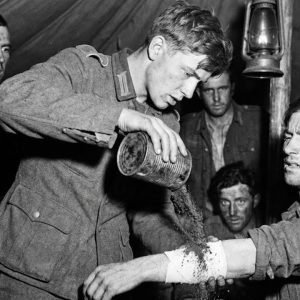
A famous military image can tell us where an operation occurred, which unit participated, or what equipment was used. But the details around the central subject may reveal another story. A soldier’s expression. The condition of a uniform. A hand-written sign. A civilian watching from a doorway.
Sometimes the background becomes the most important part.
This is why historians treat photographic context carefully. A photograph does not automatically explain itself. It needs a caption, provenance, date, location, and, whenever possible, information about the photographer and circumstances in which it was taken. The National Archives itself emphasizes identifiers, captions, photographers, locations, and dates when known because an image without context can easily be misunderstood.

That distinction matters even more in an age of digital images.
Today, an image can travel around the world within seconds. A photograph can be cropped, colorized, sharpened, mirrored, given a new caption, or separated from the information that originally accompanied it.
The result can be powerful.
It can also be misleading.
A photograph from one war may be incorrectly labeled as belonging to another. A photograph of one city may be presented as another. A person may be identified incorrectly. An image may be real while its caption is false.
The photograph itself can be authentic while the story attached to it is not.

That is why historical photography requires more than looking.
It requires verification.
The archives remind us of this through their cataloging systems. A photograph is not simply an attractive picture. It is an archival object with a record, an identifier, a source, and a chain of preservation. The National Archives’ holdings include more than 14 million analog photographs and millions of digital photographs, illustrating just how vast the surviving visual record can be.
And even that enormous collection represents only a fraction of everything that once existed.
That may be the most haunting fact of all.
For every photograph that survived, countless moments were never photographed.
There was no camera nearby.
The photographer arrived too late.

The film was damaged.
The negative was discarded.
The photograph remained in a private box and was forgotten.
Or perhaps the moment was considered too ordinary to preserve.
A mother saying goodbye.
A soldier writing a letter.
Children playing beside a damaged street.
Workers returning home.
People waiting for news.

None of these moments necessarily looked historic when they happened.
But history is not made only of spectacular scenes.
It is made from ordinary days interrupted by extraordinary events.
During the First and Second World Wars, millions of photographs were created, including official military photography and images from private sources. The National Archives notes that these collections encompass everything from combat and military activity to wartime industries and the civilian home front.
That breadth changes how we understand war.
A war is not only a battlefield.
It is also a kitchen with fewer supplies.
A railway station filled with departing soldiers.
A factory operating through the night.

A classroom altered by evacuation.
A newspaper being read by people waiting for news.
A hospital corridor.
A letter being opened.
A family looking at an empty chair.
The camera could capture all of them.
And when those images survive, they complicate the simple version of history.
The photographs of World War II held in archival collections also show something else: the machinery of war. Aircraft, ships, vehicles, uniforms, weapons, military installations, maps, and equipment appear throughout the record. These photographs can help historians understand how armies operated and how technology changed warfare. The National Archives’ World War II holdings include photographs from the Army Signal Corps, Navy, Coast Guard, Marine Corps, Office of War Information, and other agencies.
Yet technology never completely replaces the human story.

A machine can be photographed.
But someone had to maintain it.
A ship can be photographed.
But thousands of people lived and worked aboard it.
An aircraft can be photographed in the sky.
But someone sat inside it, carrying the consequences of decisions made far away.
This is where a photograph becomes strangely intimate.
It collapses distance.
The Second World War was fought across continents and oceans. A person in Europe could be separated from someone in the Pacific by thousands of miles. Governments issued orders from capitals. Armies moved across borders. Ships crossed oceans. Aircraft traveled over cities.
And still, the camera could capture one human face.
One moment.
One place.
The enormous becomes personal.
The personal becomes historical.
There are also photographs that reveal the aftermath rather than the event itself.
A ruined building.
A street covered in debris.
A damaged bridge.
A group of displaced civilians.
A prisoner waiting for release.
Such photographs can feel quieter than combat images, but sometimes that quietness makes them more difficult to forget.
Destruction does not need to be photographed at the instant it happens.
The empty space afterward can say enough.
The National Archives’ collections include photographs documenting destruction and the human toll of World War II, including images taken during the final year of the conflict. Historians have described these photographs as a record of the devastation left behind by the war.
This is an important distinction.
A photograph does not need to show violence directly to document its consequences.
Sometimes the absence of people is the story.
Sometimes the presence of civilians is the story.
Sometimes a photograph of a place before an event becomes meaningful only when compared with a photograph taken afterward.
This is why photographs taken before and after major historical events can be so powerful.
The first image shows a world that seems ordinary.
The second reveals what changed.
Between them may be only hours.
Yet the difference can represent years of history.
One of the most compelling aspects of historical photography is precisely this ability to create a silent comparison between what was and what became.
And that comparison does not always concern war.
Natural disasters, political upheavals, technological changes, social movements, migration, industrialization, and cultural transformation were all photographed. A city street can reveal changes in architecture and transportation. A portrait can show changing clothing and social expectations. A factory photograph can reveal the arrival of machines. A family photograph can preserve customs that disappeared within a generation.
Photography therefore records more than events.
It records change.
The world visible in an old photograph may seem strange at first. Clothing looks different. Streets appear quieter. Vehicles seem unfamiliar. Buildings have disappeared. Faces are arranged differently in front of cameras.
Then something unexpected happens.
The strangeness fades.
The people begin to look familiar.
Someone smiles.
Someone looks impatient.
Someone holds a child.
Someone seems distracted.
Someone is trying to stand still for the camera.
Suddenly, the distance of a century becomes smaller.
That is the quiet power of photography.
It reminds us that people in the past did not experience themselves as “the past.”
They experienced themselves as the present.
They woke up, worked, argued, laughed, worried, waited, loved, and made plans.
Only later did history arrive and give their lives dates.
This is particularly important when examining photographs connected to war.
The people inside those images were not born as symbols.
They became symbols afterward.
A soldier may later represent an entire generation.
A ruined street may become an emblem of a battle.
A photograph of liberation may become part of national memory.
But before the image entered history, it was simply a moment.
That distinction protects us from turning human beings into abstractions.
It is easy to speak about millions of casualties.
It is harder to look at one face.
It is easy to say that a city was destroyed.
It is different to look at the street where people once lived.
Numbers are necessary for understanding scale.
Photographs are powerful for understanding presence.
We need both.
Without numbers, history can lose proportion.
Without faces, history can lose humanity.
That is why the surviving photographic record matters.
It does not replace written history.
It complements it.
A photograph can show us what a written source describes, but it can also raise questions that the written source cannot answer.
Who was standing outside the frame?
Why was the photographer there?
What happened five minutes later?
What happened to the people afterward?
Was the image staged?
Was it censored?
Was the original caption accurate?
What has been lost?
And perhaps most importantly:
What are we assuming simply because the photograph feels convincing?
That last question is essential.
Photography has always carried an aura of truth. A photograph appears to say, “This happened.”
But the camera only records what was inside its frame.
The photographer chose where to stand.
Someone may have chosen what to photograph.
An official agency may have selected which images were distributed.
A newspaper may have cropped the photograph.
A government may have used an image for propaganda.
The National Archives’ collections themselves demonstrate the complexity of wartime photography. They contain both official military photographs and images from private sources, while also preserving photographs connected to propaganda and wartime information campaigns.
One particularly revealing example is the collection of photographs associated with Heinrich Hoffmann, Adolf Hitler’s official photographer. The National Archives notes that Hoffmann’s photography played an important role in Nazi propaganda, while many of his photographs were later seized and used as evidence in the postwar period.
The same medium can therefore serve very different purposes.
A photograph can document.
A photograph can persuade.
A photograph can manipulate.
A photograph can preserve memory.
The image may remain the same, but the context changes its meaning.
This is why looking at historical photographs responsibly means resisting the urge to believe everything a picture appears to say.
The photograph is evidence.
It is not always the entire story.
And perhaps that is what makes the surviving images so compelling.
They do not close history.
They open it.
A photograph of soldiers boarding a ship raises questions about where they were going.
A photograph of troops returning home raises questions about what they had experienced.
A photograph of civilians celebrating raises questions about what they had endured.
A photograph of children after liberation raises questions about where they would go next.
The shutter captures the instant.
History continues outside the frame.
This is also why rediscovered photographs can matter so much. An image forgotten in an attic, stored in a family album, preserved in an archive, or recovered from an old collection may not change the basic facts of history. But it can change how people see those facts.
It can put a human face on an abstract event.
It can provide visual evidence of a place or practice.
It can reveal an overlooked detail.
It can prompt researchers to ask new questions.
And sometimes, it can simply allow a person who has been absent from public memory to be seen again.
There is dignity in that.
Not every photograph needs to reveal a secret.
Sometimes its value is simply that someone existed, and someone remembered to take the picture.
The photographs of the World Wars are particularly important because the conflicts transformed societies on a massive scale. The archival record covers battlefields, military operations, civilian life, industry, transportation, propaganda, refugees, prisoners, liberation, and the aftermath.
Seen individually, these photographs can seem small.
Seen together, they become enormous.
They show the machinery of modern war and the vulnerability of ordinary people living beneath it.
They show uniforms and civilian clothes.
Factories and homes.
Ships and railway stations.
Commanders and children.
Victory celebrations and ruined streets.
The contrast is difficult to ignore.
And perhaps that is exactly what the photographs are asking us to do.
Not to admire war.
Not to romanticize it.
Not to turn suffering into spectacle.
But to look.
To remain with the image long enough to remember that history happened to real people.
A century later, the camera still holds the moment.
The faces may belong to strangers.
The uniforms may be unfamiliar.
The streets may have disappeared.
The political arguments may seem distant.
But the human questions remain.
What did they fear?
What did they hope would happen?
What did they lose?
What survived?
And what did the world become afterward?
There is one final paradox in the story of historical photography.
The more photographs humanity produces, the more difficult it becomes to see them all.
We now live surrounded by images. Millions can be created in a single day. Yet abundance does not necessarily create understanding.
The old photograph had to survive.
The modern photograph has to be noticed.
Both require something from us.
Attention.
That may be the rarest resource of all.
To stop scrolling.
To look again.
To examine the face in the corner.
To read the caption.
To question the context.
To remember that behind every historical image was a real moment that could not be repeated.
The most powerful photograph is not necessarily the clearest, the most famous, or the most technically perfect.
Sometimes it is simply the one that makes us pause.
Because somewhere inside that frozen fraction of a second is a world that no longer exists.
And yet, for as long as the photograph survives, part of that world remains visible.
The archives preserve millions of such fragments. The National Archives alone describes holdings of more than 14 million analog photographs and millions of digital photographs, while its World War I and World War II collections contain images from military, governmental, foreign, and private sources.
But no archive can preserve everything.
No camera was present everywhere.
No photographer saw every farewell.
No lens captured every fear.
No photograph recorded every ordinary morning that became, without warning, the beginning of something extraordinary.
That is why we should be careful with the images that did survive.
They are not merely old pictures.
They are survivors themselves.
Survivors of time.
Of neglect.
Of changing governments.
Of damaged film.
Of forgotten names.
Of wars that attempted to reshape the world.
When we look at them today, we are not simply looking backward.
We are standing at the other end of the photograph’s journey.
The person who pressed the shutter could not know who would eventually see the image.
But we can.
And that gives us a responsibility.
To look carefully.
To verify honestly.
To remember human beings before turning them into symbols.
And to understand that the most important story in a photograph may not be the one written beneath it.
It may be the question that remains after we have finished looking.
Perhaps that is why rare historical photographs continue to hold such power in the modern world. They do not allow the past to remain comfortably distant. They bring it close enough to examine, but leave enough outside the frame to remind us that no photograph can contain an entire human life.
The picture ends.
The history does not.
And when we turn away from the photograph, the question remains:
If one frozen moment can make us feel so close to people who lived generations before us, what responsibility do we have to remember the lives and realities that history never managed to photograph?
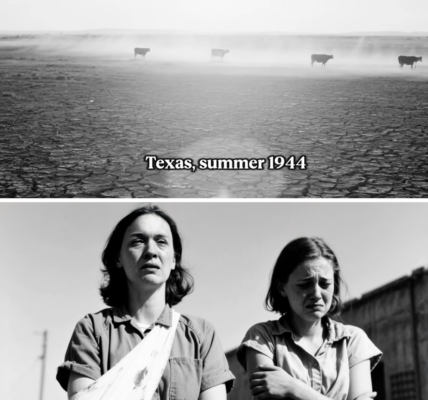
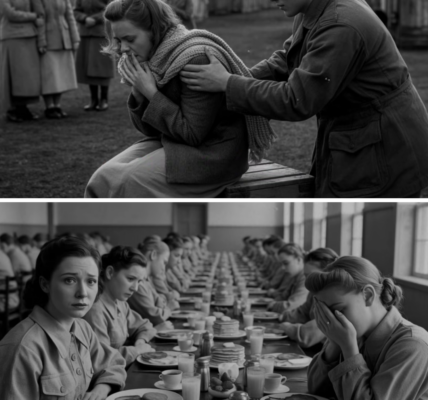
“Some content was generated using AI tools (including ChatGPT) and edited by the author for creativity, storytelling, and historical illustration purposes. Historical facts and key details should be verified against reliable historical sources. Any AI-generated or reconstructed visuals are intended for illustrative purposes and should not be interpreted as original historical photographs or archival evidence.”