Photos They Didn’t Show You in School: Unknown Secrets of History – Ethereal Relics. VD

The Photographs That Outlived the War: What Rare Images Still Reveal About World War II
On December 7, 1941, a camera captured the USS Arizona burning at Pearl Harbor. The photograph did not record every sound, every decision, or every life changed that morning. It recorded something smaller: one moment, frozen before the smoke disappeared. Yet that single frame became part of the visual memory of a war that would soon stretch across continents and oceans. Years later, other photographs would show soldiers eating, civilians navigating bomb-damaged streets, prisoners standing behind fences, and exhausted men still finding brief moments of ordinary life. What can one photograph really tell us about a war? And what might it reveal that the official histories cannot?
Photography had already changed the way people understood history long before the Second World War began. Earlier generations had depended heavily on paintings, written accounts, official documents, and newspaper descriptions. A photograph offered something different. It appeared to place the viewer directly in front of a moment.

But photographs have never been simple windows into the past.
Every image has a photographer behind it. Someone chose where to stand, when to press the shutter, and what would remain outside the frame. Some photographs were carefully arranged. Others were captured quickly, sometimes under dangerous conditions. Some were made for newspapers, some for military records, some for private memories, and some simply because somebody happened to have a camera.
That difference matters enormously when looking at World War II.
The war was too large to be contained by a single narrative. It was fought by armies, navies and air forces, but it was also experienced in kitchens, railway stations, factories, hospitals, schools, streets and homes. It was present in the faces of soldiers leaving for the front and in the expressions of civilians watching the news. It appeared in ruined buildings, improvised meals, military equipment, temporary camps and eventually the landscapes of occupation and remembrance.

The camera could not explain all of this.
But sometimes, it could make us stop.
The photograph of the USS Arizona is one of those moments. On the morning of December 7, 1941, Japanese aircraft attacked the American Pacific Fleet at Pearl Harbor. The Arizona was among the ships struck. The National Archives preserves photographs of the attack, including the famous image of the battleship burning. The attack killed 1,177 people aboard the Arizona and helped propel the United States fully into World War II.
The historical facts can be stated in a few sentences.
The photograph cannot.
It leaves behind smoke.

It leaves behind the shape of a battleship disappearing into fire and darkness.
It leaves the viewer with the uncomfortable knowledge that the people visible in or around the scene were not symbols. They were individuals caught inside an event whose consequences would reach far beyond Hawaii.
That is one of the strange powers of historical photography. A written history naturally moves forward. It tells us what happened before and what happened afterward. A photograph does the opposite. It stops time.
The war continues around the edges of the frame, but the image refuses to move.
That is why photographs from the Second World War can feel so immediate even after more than eighty years.

Consider the difference between a military report and a photograph of soldiers eating.
The report might identify a unit, a location and a date. It might record movements, supplies or operations. Important information, certainly.
But a photograph showing infantrymen sitting down for a meal reveals another layer of the war.
The men still had to eat.
They had to rest.
They had to clean equipment, wait for transportation, read letters, repair clothing and find small pieces of ordinary life wherever circumstances allowed.
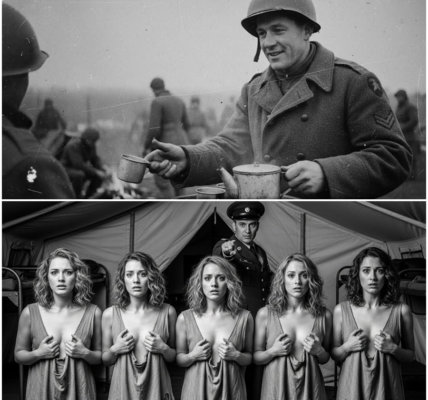
One photograph in the material surrounding this collection is described as showing American infantrymen of the 347th Infantry Regiment receiving a meal in Belgium in 1945. The exact details of such images should always be checked against the original archival caption, but the larger reality is unmistakable: even during a war fought on an enormous scale, military life was made up of thousands of ordinary routines.
That contrast is easy to forget.

When history is reduced to arrows on maps, the human beings disappear.
The photograph brings them back.
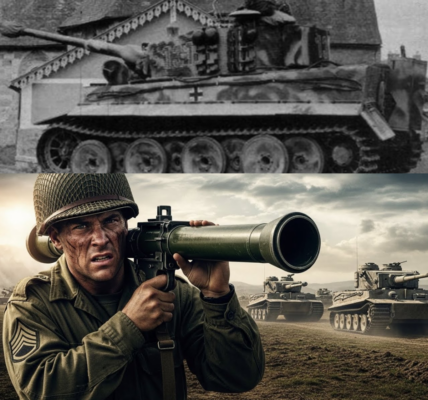
The same is true of images showing military equipment. A photograph of a B-17 waist gunner, for example, can initially appear to be a picture of machinery: aircraft, ammunition, metal and weapons.
Look longer, and the machine begins to frame the person.
The aircraft was a technological achievement. The weapon was designed for combat. The uniform identified the man’s role. But behind all of it was a human being occupying a confined space inside a machine thousands of feet above the ground.
The photograph does not tell us exactly what he was thinking.
We should not invent that.

What it does tell us is enough: the war had transformed industrial technology into an environment in which ordinary men were expected to operate under extraordinary conditions.
That transformation was one of the defining characteristics of World War II.
Photography recorded it from the ground, from ships, from aircraft, from cities and from the edges of battlefields.
And sometimes, the most powerful photographs were not photographs of combat at all.
In London and other British cities, wartime photography documented the damage inflicted by bombing. One photograph described in the source material shows children among the rubble during the Liverpool Blitz in 1941, with a teddy bear associated with the scene.
The image is striking precisely because of the contrast.
The rubble belongs to war.
The teddy bear belongs to childhood.

The two exist in the same frame.
There is no need to exaggerate the scene or invent a conversation between the children. The photograph already contains the contradiction. A war planned by governments and fought by armies had reached the physical spaces where children lived.
That is one of the most important things photographs can do.
They collapse distance.
A strategic decision made hundreds of miles away eventually becomes a broken street, a damaged home, or a child standing beside the remains of an ordinary life.
The photograph does not explain the entire chain of decisions that produced that destruction. But it makes the consequences visible.
And then there are the photographs in which people themselves seem almost incidental to the historical event.

A ticker-tape operator at the New York Stock Exchange in 1915 belonged to another era, far removed from the battlefields of World War II. But by the time war transformed the international order, the machinery of communication had become increasingly important. News travelled through newspapers, radio, telephones, telegraph systems and eventually photographs themselves.
People wanted to know what was happening.
They waited for information.
They watched.
They listened.
They gathered around whatever technology could connect them to events taking place somewhere else.
That relationship between distance and information became especially powerful on June 6, 1944.
In New York City’s Times Square, people gathered around news displays reporting the Allied landings in Normandy. The event itself was happening across the Atlantic, but the news had already become part of American civilian life.

One side of the photograph shows the war.
The other shows people waiting to understand it.
This is an important distinction.
The men landing in Normandy were experiencing the invasion directly. People in Times Square were experiencing it through information.
Both were living through the same historical event, but in radically different ways.
For the soldier, the war was physical and immediate.
For the civilian thousands of miles away, it arrived through words, radio broadcasts, newspaper headlines and photographs.
The camera captured that separation.
And yet it also connected the two.
The same happened repeatedly throughout the war.

Photographs crossed oceans.
They were printed in newspapers and magazines.
They entered homes.
They shaped public understanding.
Some became famous. Others disappeared into boxes, archives and private collections.
That is why the survival of a photograph is partly a matter of chance.
A camera had to be present.
Film had to be exposed correctly.
The negative had to survive.
Someone had to preserve it.
It had to avoid being discarded, damaged, misplaced or forgotten.

In an era before smartphones and instant digital storage, taking a photograph required equipment, film and deliberate effort. Many moments of World War II were therefore never photographed at all.
Others were photographed but never widely seen.
Some survived only as negatives or archival prints.
And some images were rediscovered decades later.
This gives every surviving photograph a strange quality.
It is not merely a picture of what happened.
It is also evidence of what happened to the picture itself.
It survived the war.
It survived the people who made it.

It survived changing governments, changing technology and changing generations.
And eventually, someone opened a box and looked at it again.
That is why rare photographs can feel almost like archaeological objects.
A photograph of a soldier reading a letter in a foxhole on Iwo Jima does not need a dramatic caption to communicate the contrast. The island was the scene of one of the major battles of the Pacific War. Yet within that enormous military struggle, the photograph can show something remarkably ordinary: a person reading mail.
The image does not erase the battle.
It makes the battle more human.
Iwo Jima was fought from February 19 to March 26, 1945, during the American invasion and capture of the heavily fortified island. The National Archives preserves a large body of photographs from the operation, including Joe Rosenthal’s famous flag-raising photograph taken on February 23.
The flag-raising photograph became one of the most recognizable images of the entire war.
But its fame can sometimes make us forget the thousands of other images from Iwo Jima.
There were photographs of landings.
Photographs of equipment.
Photographs of Marines at work.
Photographs of damaged positions.
Photographs of men resting.
Photographs of ordinary moments surrounded by an extraordinary campaign.
History remembers the iconic image.
The archive remembers much more.
That difference matters.
A famous photograph can become a symbol so powerful that it begins to replace the event itself. We recognize the image immediately, but we may no longer ask what happened outside the frame.
That is the danger of treating photographs as complete explanations.
They are not.
They are fragments.
The photograph of the USS Arizona does not show the entire attack on Pearl Harbor.
The photograph of a Marine reading mail does not show the whole battle of Iwo Jima.
The photograph of children among bomb damage does not explain the entire Blitz.
The photograph of people reading D-Day news does not show the fighting on the beaches of Normandy.
Each image is incomplete.
And that incompleteness is precisely why we need context.
Archives preserve photographs together with captions, dates, photographers, records and collections. The National Archives’ World War II holdings include photographs documenting military operations, civilian life, prisoners, liberation, destruction, transportation, camp life and many other aspects of the war.
The photograph gives us the doorway.
Historical research tells us where that doorway leads.
This becomes even more important when we reach photographs from the final phase of the war.
By 1945, the visual language of World War II had changed.
The early images of mobilization and anticipation had given way to photographs of ruined cities, prisoners, displaced people, liberated camps and exhausted soldiers.
The war was approaching its end, but the consequences were only beginning to become fully visible.
One photograph in the source material is described as showing German prisoners helping landscape the first American cemetery near Omaha Beach in France in May 1945.
The image carries a powerful reversal of circumstances.
A year earlier, Allied soldiers had landed on the Normandy coast during D-Day.
Now the battlefield was becoming a cemetery.
The temporary American cemetery at St. Laurent had been established by the U.S. First Army on June 8, 1944, just days after the Normandy landings. Today, the Normandy American Cemetery stands on that site, where thousands of American service members are buried.
The photograph therefore belongs to a moment between war and remembrance.
The fighting had not simply ended and disappeared.
The landscape itself had to be transformed.
The dead had to be identified and buried.
The land had to be cared for.
Memories had to be preserved.
The photographs from this period are sometimes quieter than the images of combat, but that does not make them less important.
In some ways, they are harder to look at.
Because the war is no longer only about what armies were trying to achieve.
It is about what remained afterward.
Another photograph described in the source material shows a British sign associated with Bergen-Belsen in May 1945. Images from the liberation and documentation of concentration camps became part of the historical record of the Nazi persecution and mass murder.
Here, the responsibility of photography changed again.
The camera was no longer simply documenting military activity.
It was documenting evidence.
The National Archives records that World War II photographic collections include images of the liberation of concentration camps, prisoner-of-war camps and other sites, along with photographs of destruction and the aftermath of occupation.
This is where the idea of the photograph as an innocent witness becomes complicated.
A camera does not automatically produce truth.
Images can be staged.
Images can be selected.
Images can be cropped.
Images can be used for propaganda.
Captions can be lost.
Identities can be forgotten.
Locations can be misidentified.
Decades later, photographs circulating online may acquire incorrect dates or dramatic descriptions that were never part of the original record.
That is why historical photographs must be treated with the same care as written documents.
The picture may be genuine while the caption is wrong.
The event may be real while the identity attached to it is uncertain.
The image may be authentic while the story built around it is exaggerated.
This distinction is especially important in the age of social media, where a photograph can travel around the world in seconds.
A mysterious image attracts attention.
A dramatic caption attracts more.
But historical truth does not become stronger because a caption sounds convincing.
Sometimes the most honest phrase is simply: “The exact circumstances are uncertain.”
That is not a weakness.
It is historical discipline.
The photographs of World War II deserve that discipline because they are more than entertainment.
They are fragments of lives.
Look again at the soldier receiving a meal.
Look at the Marine reading his mail.
Look at the aircraft gunner.
Look at civilians surrounded by rubble.
Look at the crowds reading news from Normandy.
Look at the photographs from Pearl Harbor.
Look at the prisoners and the landscapes left behind in 1945.
The images are different.
The circumstances are different.
But together they reveal something that statistics alone cannot.
War does not exist only at the moment of attack.
It exists in anticipation.
In waiting.
In preparation.
In transportation.
In hunger.
In exhaustion.
In uncertainty.
In communication.
In destruction.
In recovery.
And finally, in memory.
That may be the most important lesson hidden inside rare photographs.
The Second World War is often presented through enormous numbers: armies, aircraft, ships, casualties, divisions, battles and territories. Those numbers are essential for understanding the scale of the conflict.
But numbers cannot show the expression on a person’s face.
They cannot show the small act of reading a letter.
They cannot show a child’s toy lying among rubble.
They cannot show the atmosphere of a city waiting for news.
They cannot show how strange it must have been to see familiar streets transformed by war.
A photograph can.
Not completely.
Never completely.
But sometimes enough to make us pause.
And perhaps that pause is valuable.
Because historical memory can become too comfortable when it is reduced to things that happened “long ago.” The people in these photographs did not experience their lives as history.
They experienced them as the present.
For the people at Pearl Harbor, December 7, 1941 was not an anniversary.
It was that morning.
For the soldiers crossing toward Normandy, June 6, 1944 was not a chapter in a textbook.
It was the day in front of them.
For civilians watching news from the invasion, the outcome was not yet guaranteed.
For the soldiers on Iwo Jima, February 1945 was not a famous photograph.
It was an ongoing battle.
For those confronting the remains of Nazi concentration camps in 1945, the meaning of what they saw was not something that could be reduced to a caption.
And for the people standing in ruined European cities after the fighting, the war was not simply “over.”
They still had to live with what it had left behind.
That is why a photograph can become more powerful with age.
When it was taken, it may have been one image among thousands.
Decades later, it becomes a surviving connection.
The people may be gone.
The buildings may have changed.
The uniforms may belong to museums.
The equipment may be rusting behind glass.
The political boundaries may have shifted.
But the image remains.
A rectangle of paper.
A negative.
A digital scan.
A face.
A street.
A ship.
A meal.
A letter.
A ruined building.
A moment that refused to disappear.
The great photographs of World War II therefore do more than preserve famous events. They preserve uncertainty, ordinary life and human scale.
They remind us that history was never experienced as a collection of neat chapters.
It was lived one day at a time.
Sometimes with fear.
Sometimes with routine.
Sometimes with hope.
Sometimes with information that was incomplete.
And sometimes with no idea at all what the next day would bring.
That is what makes the rare photograph so haunting.
Not because it tells us everything.
Because it does not.
It gives us one frame and leaves the rest to history.
The challenge is to resist filling the empty space with invention.
Instead, we look closer.
We ask who took the photograph.
When?
Where?
Why?
What records survive?
What happened before the shutter opened?
What happened afterward?
Who was inside the frame?
And, perhaps most importantly, what remains outside it?
Those questions turn a photograph from an interesting old picture into a historical document.
The Second World War ended in 1945, but its photographs did not.
They continued traveling through archives, books, exhibitions, family collections and eventually digital screens. New generations encounter them without having lived through the world they depict.
That is both a privilege and a responsibility.
We can look back now with knowledge that the people in the photographs did not possess. We know how the war ended. We know which battles became turning points. We know which cities were destroyed and rebuilt. We know which political systems collapsed and which nations emerged transformed.
But when we look at an authentic photograph from the moment itself, we should remember one simple truth:
The people inside it did not know the ending.
Perhaps that is why these images still feel alive.
They have escaped the certainty of hindsight.
They show history before it became history.
And in that frozen second, the past becomes unexpectedly close.
A photograph cannot bring the dead back. It cannot undo destruction. It cannot explain every decision or answer every question. But it can preserve something extraordinarily fragile: the evidence that people were there.
They stood in those streets.
They served aboard those ships.
They worked inside those factories.
They waited for news.
They ate meals.
They read letters.
They watched cities change.
They endured the consequences of decisions made far beyond their control.
And someone, somewhere, pressed a shutter.
That small mechanical act created a bridge across time.
Today, when images can be created, edited and shared almost instantly, it is easy to forget how precious that bridge once was. Millions of photographs may now surround us, but quantity does not guarantee meaning.
Sometimes one imperfect image is enough.
One burning battleship.
One crowded street.
One soldier with a letter.
One child beside the ruins.
One cemetery taking shape after the battle.
One sign marking a place that humanity would never be able to remember innocently again.
The photograph does not ask us to glorify war.
It asks us to look.
And if we look carefully enough, perhaps we begin to understand that history is not made only by famous leaders, generals or governments. It is also made visible through ordinary people caught inside extraordinary circumstances.
That is why rare photographs matter.
They show us not simply what the past looked like, but how much of the past was lived by people whose names we will never know.
The image survives.
The moment survives.
And sometimes, that is all history has left us to hold.
The question is not only what these photographs show us about World War II, but what they ask us to remember when the people who lived through it are no longer here to tell us themselves.
What do you think we can learn from a single photograph that an entire history book might still fail to make us feel?
Some content was generated using AI tools (including ChatGPT) and edited by the author for creativity, storytelling, and historical illustration purposes. Historical facts and key details should be verified against reliable historical sources. Any AI-generated or reconstructed visuals are intended for illustrative purposes and should not be interpreted as original historical photographs or archival evidence.