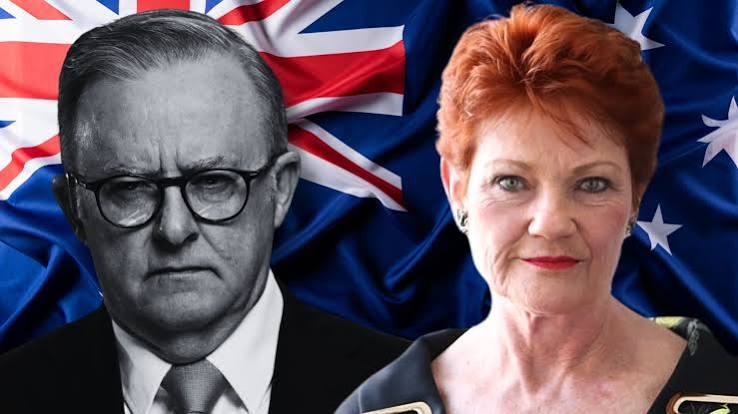

The political tectonic plates of the Australian electorate didn’t just shift; they fractured.
To understand the full gravity of Pauline Hanson confirming that a run for the House of Representatives is now firmly “on the cards,” one must look past the immediate shock of the headline and examine the extraordinary political landscape of mid-2026. For three decades, I have covered the volatile highs and tragic lows of populist movements in this country. I watched the initial 1996 explosion of “Pauline’s Blunder,” her subsequent imprisonment, her long exile, and her eventual resurrection as a tactical kingmaker in the Senate.
But what we are witnessing right now is entirely unprecedented. This is no longer a protest movement designed to throw rocks at the establishment from the comfortable red benches of the Senate. Buoyed by an extraordinary, historic upsurge in the polls, Pauline Hanson is positioning herself to break the century-old duopoly of the major parties and launch a direct, mathematical assault on the Treasury benches.
The catalyst for this strategic pivot is an extraordinary double-blow to the political establishment. Just weeks ago, One Nation completely upended the South Australian state election. Defying all mainstream predictions, the party secured an astonishing 22.9% of the primary vote, effectively pushing the Liberal Party into a humiliating third place and reducing them to their smallest parliamentary presence in state history.

Days later, that momentum went national. In the high-stakes federal by-election for the rural New South Wales seat of Farrer—triggered by the sudden resignation of former Liberal leader Sussan Ley—One Nation’s David Farley secured a crushing victory, claiming a massive 32.8% primary swing to become the first One Nation member ever elected to the House of Representatives.
[The Populist Tsunami: The Mid-2026 Electoral Tectonic Shift]
------------------------------------------------------------------------
Electoral Event    One Nation Primary   Result / Consequence
------------------------------------------------------------------------
South Australia    22.9% (+20.3% swing) Pushed Liberals to 3rd in votes;
State Election                          Won 4 Lower House, 3 Upper House

Farrer Federal     39.8% (32.8% swing)  David Farley wins; First ever
By-Election                             One Nation Lower House MP
------------------------------------------------------------------------
Context: Unprecedented collapse of the traditional Coalition base, triggering
Hanson's transition from Senate safety to a Lower House Prime Ministerial bid.
Hanson’s chief of staff, James Ashby, broke the strategic silence on Sky News, confirming that the party matriarch is actively planning to exit the Senate to contest a lower house seat in Queensland—most likely the regional electorates of Wright or Capricornia, where her personal properties are registered.
The rationale behind the move is anchored in constitutional reality. By long-standing Westminster convention, the Prime Minister of Australia must sit in the House of Representatives, where governments are formed. For thirty years, critics have dismissed Hanson as a structural lightweight, restricted to a minor balance-of-power role in the Senate.
Speaking on Adelaide’s FIVEAA radio, Hanson’s response to her detractors was raw and combative:
“A lot of people criticising me say, ‘Oh well, she can’t get anywhere because she’s in the upper house.’ So don’t underestimate me and what I might do or not do. The country’s in one hell of a mess. Government spending is out of control, agriculture is dying, and we’re not using the resources we have. That’s why we have to keep fighting.”
The reaction from the conservative establishment was swift and panicked. Attempting to stoke fears of internal instability, National Party Senator Matt Canavan immediately went on the offensive, pointing directly to the political history of One Nation’s new member for Farrer, David Farley—who had previously held memberships in both the Nationals and NSW Labor.
“I mean, they do call themselves One Nation,” Canavan remarked sarcastically. “But there’s many, many egos in that party… they just seem to struggle to stay together, to stick together.” Hanson immediately fired back, accusing the major parties of spending three decades using the state apparatus to intentionally terrorize, defund, and destabilize her representatives.
As an investigative journalist who has spent half a lifetime analyzing the inner workings of Canberra, I have learned that a politician’s public explanation for a major move is rarely the real driver. Hanson’s proposed jump to the Lower House is not just about personal ambition; it is a cold, mathematical response to a deep, structural shift in the Australian psyche that many urban commentators are completely failing to grasp.

The Real Story Behind the “Messiah” Numbers
Mainstream political scientists are currently looking at recent Newspoll and Redbridge data—which shows One Nation’s primary vote tracking into the high 20s and low 30s in regional areas—with sheer disbelief. But this isn’t a sudden, inexplicable collective madness. It is the direct consequence of an acute economic betrayal.
              [The Broken Electorate: Primary Driver of Populist Defection]
+------------------------------------+------------------------------------+
|    The Cost-of-Living Squeeze      |     The Sovereignty Mandate        |
+------------------------------------+------------------------------------+
| • 43% of One Nation voters list    | • Deep-seated resentment over net-zero |
|   household inflation and power    |   targets accelerating the closure |
|   prices as their absolute priority. |   of regional industries.          |
| • Widespread anger over affordable | • Intense focus on immigration volumes |
|   housing shortages in regional    |   outpacing local infrastructure   |
|   and outer-suburban hubs.         |   and medical capabilities.        |
+------------------------------------+------------------------------------+
For the past two years, working-class Australians have been subjected to an relentless cost-of-living grinder. Interest rates have remained punishingly high, grocery prices have soared, and a major housing crisis has locked an entire generation out of the Australian dream. When Hanson says “the country is in one hell of a mess,” she is utilizing the exact language spoken across laminate kitchen tables in outer-suburban Adelaide, regional New South Wales, and central Queensland.
By pivoting her platform away from purely cultural grievances and locking it onto economic stability, agricultural survival, and domestic energy security, she has successfully converted her movement from a niche cultural protest into a viable economic life-raft for a desperate populace.
The Minority Government Calculus
Let us address the elephant in the room: Can Pauline Hanson actually become Prime Minister? In a traditional, stable two-party system, the answer would be an absolute no. But the recent data out of the South Australian election has completely rewritten the rulebook.
                     [The Fragmented Parliament Model]
          THE HISTORICAL NORM (Pre-2026)      THE NEW REALITY (Post-SA 2026)
        +-------------------------------+-------------------------------+
        | • Combined major party primary| • Combined major party primary|
        |   vote consistently >75%.     |   vote craters to 56.7%.      |
        |                               |                               |
        | • Predictable, stable two-    | • Massive, cross-bench        |
        |   party preferred outcomes.   |   fragmentation with three and  |
        |                               |   four-way preference counts. |
        +-------------------------------+-------------------------------+
The key statistic from the South Australian result isn’t just One Nation’s 23% vote share; it is the total collapse of the combined major party vote, which plummeted to an historic low of 56.7%. Antony Green’s definitive analysis of the count revealed that out of 47 seats, only 12 finished as traditional Labor-vs-Liberal contests. A staggering 26 seats transformed into direct Labor-vs-One Nation preference battles.
In a highly fragmented, three-cornered federal election, the traditional Coalition is facing structural collapse in regional Australia. If One Nation can replicate its Farrer and South Australian momentum across rural and outer-suburban seats in Queensland, New South Wales, and Western Australia, we are looking directly at a hung parliament where neither Labor nor the Liberals can command a majority.
If Hanson holds a bloc of 10 to 15 Lower House seats, she won’t need an absolute majority to run the country. She will hold the balance of power in the House of Representatives. In that scenario, she can demand the ultimate price for her confidence and supply: a senior cabinet position, a co-premiership, or the Prime Minister’s chair itself. The major parties’ historical strategy of dismissing her as an upper-house anomaly is officially dead.
The Logic of the Exit Strategy
There is a final, deeply personal element to this announcement that highlights Hanson’s maturity as a political survivalist. Her statement, “If you think they’re going to carry me out of that place in a box, it’s not going to happen,” reveals a leader acutely aware of her own mortality and her legacy.
Hanson is 72 years old. She knows that a political party built entirely around a single personality cannot survive the departure of its namesake—a lesson learned through the brutal collapses of previous populist vehicles like the Palmer United Party or Nick Xenophon’s SA Best.

By moving to the Lower House now, she accomplishes two things: she maximizes her party’s seat-earning potential at the absolute peak of her historical popularity, and she establishes a highly visible, institutionalized parliamentary team. She is actively constructing a succession plan, building a permanent, structural apparatus that can carry her populist platform forward long after she chooses to finally step away to her Queensland estate.
The spectacle of Pauline Hanson preparing to abandon the constitutional safety of the Senate for a high-stakes, direct assault on the House of Representatives marks the absolute end of political predictability in Australia. The old world—where two major parties could quietly trade power while ignoring the ambient anxieties of the regional working class—has evaporated.
As I watch Hanson stand alongside her newly minted state and federal members, I am struck by the immense historical irony of this moment. For thirty years, the Canberra press gallery and the major political machines treated her as a temporary disruption, an uncomfortable symptom of regional alienation that would eventually fade away. Instead, through a combination of economic crises, major-party complacency, and raw personal endurance, she has built a movement that now threatens to consume its creators.
Australia is entering completely uncharted waters. The upcoming federal election will not be a standard, orderly campaign about minor tax tweaks or marginal policy adjustments. It will be a fierce, existential struggle for the very architecture of Australian governance.
The political elite once laughed at the idea of a fish-and-chip shop owner from Ipswich taking the reins of national power. As inflation continues to grind down middle Australia and the major parties offer little more than managerial technocracy, the laughter in the corridors of Parliament House has officially turned to silence.
We are left with a fundamental question that will define the next chapter of our Commonwealth: Will the traditional major parties find the political courage to genuinely address the economic and social fractures destroying regional Australia, or will they continue to hide behind elite consensus until Pauline Hanson walks through the front doors of Number 10 Downing Street, not as an outsider, but as the master of their house?