Migration Backlash Grows as British Protesters Target Asylum Accommodation Plans. n111

Epsom, Asylum Protests, and a Nation’s Growing Frustration: The Story Behind the Headlines
Few issues in modern Britain generate stronger emotions than immigration, asylum policy, and public safety.
Those tensions erupted once again in the Surrey town of Epsom, where protests and clashes with police drew national attention after reports circulated online regarding an alleged serious sexual assault.
Videos shared across social media showed angry crowds gathering outside locations believed by some protesters to be connected to asylum accommodation. Demonstrators demanded answers from authorities and voiced frustration over Britain’s immigration system, hotel accommodation policies, and what they perceived as a lack of transparency from officials.
The footage quickly spread across alternative media channels and political commentary platforms, where commentators argued that public anger had reached a breaking point.
However, the story became far more complicated as additional facts emerged.
The Incident That Sparked the Protests
The unrest centered around reports of an alleged sexual assault involving a woman in Epsom.
Initially, speculation spread rapidly online regarding the identity of potential suspects. Much of that speculation focused on claims that asylum seekers or migrants may have been involved.
As public frustration grew, protests were organized in Epsom town center. Demonstrators demanded greater transparency from police and questioned why authorities had not released descriptions of suspects.
Police deployed significant resources to maintain order as tensions escalated.
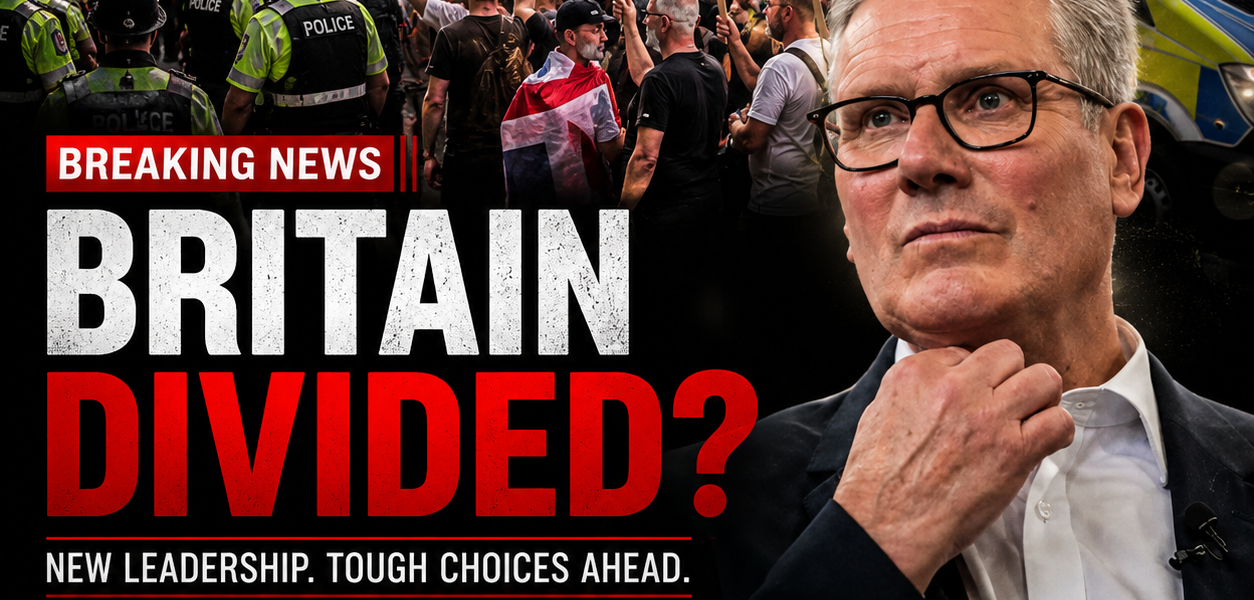
Footage showed confrontations between officers and protesters. Objects were reportedly thrown, roads were blocked, and several arrests were eventually made. Police later stated that some protesters had targeted hotels and residential properties based on inaccurate information that asylum seekers were being housed there.
What Police Later Revealed
A major development occurred when Surrey Police issued an update regarding the investigation.
After reviewing CCTV footage, conducting forensic examinations, interviewing witnesses, and carrying out extensive inquiries, investigators stated they had found no evidence supporting the offense as initially reported. Police also said they had found no evidence that asylum seekers or immigrants were involved.

The force specifically addressed speculation that had spread online regarding migrants and asylum seekers.
According to Surrey Police, there was no evidence linking asylum seekers or immigrants to the alleged incident. Officers emphasized that descriptions of suspects had not been released because investigators lacked sufficient reliable information.
Those findings significantly altered the narrative surrounding the protests.
What had initially been portrayed by some activists and commentators as evidence of a wider immigration-related public safety crisis suddenly became a case in which key assumptions remained unproven.
The Wider Political Context
Despite the developments in the investigation, the protests reflected a broader political reality that extends far beyond Epsom.
Immigration remains one of the most contentious issues in British politics.
Successive governments have promised to reduce illegal migration, reform the asylum system, and reduce the use of hotels for housing asylum seekers. Yet public concern remains high.
Official figures continue to show significant numbers of Channel crossings, while the cost of accommodating asylum seekers has become a major political issue.
Many communities believe local residents are not being properly consulted when accommodation facilities are established nearby.
Others argue that public debate has become increasingly distorted by misinformation and online rumor campaigns.
The Epsom protests occurred against this backdrop of growing national frustration.
The Nigel Farage Factor
The debate has also become intertwined with the rise of political figures such as Nigel Farage.
Farage has repeatedly criticized Britain’s asylum system and called for stronger measures against illegal migration.
Recent comments advocating reviews of asylum claims and stricter enforcement have resonated with many voters who believe the existing system has failed.
Supporters argue that tougher policies are necessary to restore public confidence.
Critics argue that such rhetoric can sometimes inflame tensions and encourage assumptions before investigations are completed.
The Epsom controversy illustrates precisely why this debate remains so politically explosive.
My Professional Perspective
Having covered political unrest, immigration controversies, and public disorder across Britain, Europe, Australia, and North America for decades, I believe the most important aspect of this story has been largely overlooked.
The real story is not simply about asylum seekers.
The real story is about trust.
A Crisis of Trust More Than a Crisis of Immigration
When examining incidents like Epsom, many observers immediately focus on immigration numbers, asylum hotels, or policing.
But beneath all those issues lies something deeper.
Large segments of the public no longer trust institutions to provide information quickly, clearly, and transparently.
When trust declines, a dangerous vacuum emerges.
And vacuums get filled.
Sometimes they are filled by facts.
Sometimes they are filled by rumors.
Sometimes they are filled by anger.
In Epsom, that vacuum was filled by speculation.
Before investigators completed their work, narratives spread online that many people accepted as established fact.
The result was predictable.
People acted based on assumptions rather than confirmed evidence.
The Social Media Acceleration Effect
Twenty years ago, a local incident might have remained a local incident.
Today, a single allegation can become a national controversy within hours.
Videos are clipped.
Posts are shared.
Claims are repeated.
Each repost often strips away nuance and uncertainty.
By the time information reaches millions of viewers, many people believe they are looking at settled facts rather than an evolving investigation.
This phenomenon is not unique to immigration stories.
It happens during elections.
It happens after terrorist attacks.
It happens during major criminal investigations.
The Epsom case demonstrates how rapidly online ecosystems can transform uncertainty into apparent certainty.
Why Public Anger Is Real Even When Facts Are Unclear
Another mistake many commentators make is assuming that because a specific claim turns out to be inaccurate, the underlying frustrations disappear.
They do not.
The anger visible in Epsom did not emerge overnight.
It reflects years of debate about:
- Illegal Channel crossings.
- Asylum accommodation costs.
- Pressure on public services.
- Community consultation.
- National identity.
- Crime and public safety concerns.
Whether one agrees with those concerns or not, they are real political forces.
Dismissing them entirely often drives people further toward alternative media sources and anti-establishment movements.
At the same time, assuming every rumor is true simply because it aligns with existing frustrations is equally dangerous.
Democracies function best when evidence comes before conclusions.
The Danger of Collective Blame
One of the most significant lessons from Epsom is the danger of collective blame.
If individuals commit crimes, those individuals should face justice.
But assigning responsibility to entire communities before evidence exists creates risks for everyone.
This is particularly important in highly emotional cases involving allegations of sexual violence.
History shows that public outrage can sometimes target innocent people who simply happen to belong to a particular group, nationality, religion, or community.
In Epsom, police later stated that properties targeted by protesters were not actually housing asylum seekers.
That fact alone should give pause to anyone tempted to reach conclusions too quickly.
The Political Challenge Facing Keir Starmer
The government of Keir Starmer faces a dilemma that is becoming increasingly difficult to manage.
If authorities appear too restrictive on immigration, they face criticism from human rights groups and progressive voters.
If they appear too permissive, they risk fueling public anger and strengthening populist political movements.
Neither side of the debate appears satisfied.
This creates fertile ground for polarization.
And polarization often produces exactly the kind of confrontational scenes witnessed in Epsom.
The Question Nobody Wants to Answer
There is a question hovering over this entire debate.
Why do so many citizens immediately assume the worst?
The answer is uncomfortable.
For some, it reflects genuine concerns shaped by highly publicized criminal cases from previous years.
For others, it reflects distrust of government and media institutions.
For still others, it reflects political activism that benefits from amplifying outrage.
Understanding that distinction matters.
Because solving the problem requires understanding why public confidence has become so fragile.
Conclusion
The events in Epsom were never simply about one allegation, one protest, or one police operation.
They exposed deeper tensions running through modern Britain.
On one side stand citizens who believe their concerns about immigration and public safety are being ignored.
On the other stand institutions warning that speculation and misinformation can inflame communities before facts are established.
The investigation ultimately produced findings that challenged many of the assumptions circulating online. Police stated they found no evidence supporting the offense as originally reported and no evidence linking asylum seekers or immigrants to the case.
Yet the unrest itself revealed something equally important.
Public trust is becoming one of the most valuable—and fragile—commodities in modern democracy.
When trust weakens, rumors become more powerful.
When rumors become more powerful, tensions rise.
And when tensions rise, communities can find themselves confronting not only the facts of a case, but also the fears, frustrations, and divisions that have been building for years.
The question Britain must now confront is not merely how it manages immigration or asylum policy.
The larger question is this:
How can a society maintain social cohesion when millions of people no longer trust the same sources of information—or even agree on what constitutes the truth?