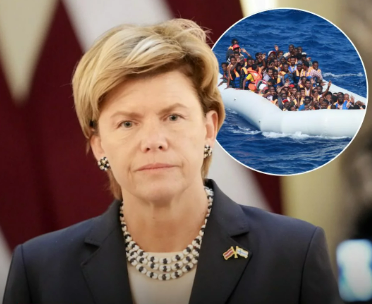

The Fortress in the Pine Woods: Latvia’s Defiant Stand on Europe’s Eastern Edge
Along the easternmost perimeter of the European Union, where dense pine forests melt into peat bogs and cold mist hangs low over the damp moss, a quiet geopolitical standoff has transformed an otherwise tranquil borderland into a high-stakes fortress.
This is the 172.9-kilometer border separating Latvia from Belarus. For decades, it was a quiet demarcation line—marked by boundary posts, logging tracks, and sleepy border settlements. Today, it has become one of the most heavily monitored, politically charged, and physically reinforced frontlines on the European continent.
Latvia, a nation of just 1.9 million citizens, has issued an unequivocal message to European Union headquarters in Brussels: guarding the gateway to the West comes at an immense financial, military, and human cost, and Riga has no intention of being forced to pay for Europe’s border security twice.
================================================================================
                    THE BALTIC FRONTIER: AT A GLANCE
================================================================================
Total Latvia-Belarus Border Length:    172.9 kilometers
Crossing Attempts Blocked (2021–2026): 49,620
Attempts Prevented in 2026 (to Aug):   10,152
Peak Activity:                         Exceeding 100 attempted crossings / day
Key Infrastructure:                    Steel perimeter fence, patrol roads,
                                       bridges, optical towers, sensor networks
================================================================================
The Geopolitical Trigger and the Hybrid Front
The current crisis along Latvia’s eastern frontier did not emerge in a vacuum. In the summer of 2021, the Belarusian administration of Alexander Lukashenko responded to European Union sanctions by systematically organizing migration corridors from the Middle East, South Asia, and Africa directly to the borders of Latvia, Lithuania, and Poland.
Commercial flights were routed into Minsk, travel packages were issued, and thousands of migrants were directed toward the European Union’s external perimeter under the promise of effortless passage into Western Europe. What began as an irregular flow quickly evolved into what European defense analysts and Baltic governments termed a full-scale “hybrid operation”—the weaponization of human migration to destabilize European social cohesion, overwhelm regional infrastructure, and sow political discord across the bloc.
Since that opening salvo in August 2021, the frontier has remained a site of relentless attrition. According to official data from the Latvian Ministry of the Interior, between August 10, 2021, and July 30, 2026, Latvian border authorities successfully intercepted and prevented 49,620 attempted irregular crossings along the 172.9-kilometer demarcation line with Belarus.
Far from abating, the pressure has continued into 2026. The State Border Guard reported that by August 24, 2026, an additional 10,152 illegal crossings had been foiled within the year alone, with single-day spikes regularly exceeding 100 individuals trying to penetrate the frontier line. Because of the persistent operational pressure, the Latvian Cabinet of Ministers extended the state’s enhanced border security regime through the end of 2026.
The Rise of the Steel Wall
In response to sustained irregular incursions, Latvia embarked on an extensive engineering and defense overhaul of its border zone. The government in Riga authorized the complete physical enclosure of the 172.9-kilometer land border with Belarus.
The physical construction comprises far more than a simple wire perimeter:
-
Heavy Steel Fencing: Reinforced metal barriers topped with concertina razor wire designed to prevent rapid breach attempts.
-
Patrol and Tactical Corridors: A dedicated logistics network consisting of all-weather patrol roads, specialized wooden footbridges, and secure boardwalks that allow rapid intervention units to traverse swampy, impassable peat terrain.
-
Hydro-Engineering Infrastructure: Extensive drainage systems designed to stabilize marshland soils and protect surveillance installations from seasonal flooding.
-
Technological Layering: An EU-supported electronic surveillance umbrella featuring high-resolution thermal imaging cameras, seismic ground sensors, automated optical movement trackers, and aerial drone reconnaissance.
The physical fence stands complete, and technological integration across the entire frontier is entering its final operational stages. However, keeping this machine operational requires an around-the-clock commitment: State Border Guard detachments, reinforced by units from the Latvian National Armed Forces (NBS) and the State Police, patrol the woodland trails day and night.
+-----------------------------------------------------------------------------+
|               LATVIA'S INTEGRATED BORDER SECURITY ARCHITECTURE             |
+-----------------------------------------------------------------------------+
|                                                                             |
|   [ SURVEILLANCE LAYER ]                                                    |
|   Thermal Imaging | Ground Sensors | Optical Towers | Drone Reconnaissance  |
|                                                                             |
|   [ PHYSICAL BARRIER ]                                                      |
|   Reinforced Steel Fence | Concertina Razor Wire | Anti-Climb Mesh          |
|                                                                             |
|   [ RAPID-RESPONSE LOGISTICS ]                                              |
|   All-Weather Patrol Roads | Marshland Footbridges | Specialized Drainage   |
|                                                                             |
|   [ TACTICAL PERSONNEL ]                                                    |
|   State Border Guards | National Armed Forces | State Police Battalions     |
|                                                                             |
+-----------------------------------------------------------------------------+
The Key Players and the Clash Over Solidarity
At the center of this diplomatic confrontation are two prominent figures directing Latvia’s foreign and border security policies.
Latvian Foreign Minister Baiba Braže delivered a landmark policy speech to the national parliament (Saeima), setting out an assertive doctrine on immigration and sovereign responsibility. Braže publicly commended the frontline border guards, armed forces, and police units for working tirelessly in extreme weather conditions to neutralize thousands of orchestrated crossings.
Braže’s address drew a line in the sand regarding the European Union’s newly approved Migration and Asylum Pact:
“When it comes to migration, the government’s position is absolutely clear: NO to illegal migration. We have strengthened border protection. The fence is complete, and our services work 24/7 to prevent instrumentalized migration. We are ready to share our expertise within the framework of the Solidarity Mechanism. But Latvia will not accept new migrants and will not pay for them.”
Supporting this strategic posture is General Guntis Pujāts, Chief of the Latvian State Border Guard. Pujāts has consistently stressed that the migrants arriving at the Latvian border have no intention of settling in Riga, Daugavpils, or Rēzekne. Their intended destinations are Berlin, Paris, Brussels, Stockholm, and Amsterdam.
In Pujāts’s assessment, the Latvian units stationed in the freezing mud of the Latgale forests are not merely defending domestic territory; they are acting as the forward shield for the entire European single market and the Schengen Area.
This reality has set up an inevitable collision with the European Commission. The EU’s new migration framework relies on a “mandatory solidarity mechanism,” which requires member states to either accept relocated asylum seekers from overstretched southern and western capitals or pay financial compensation (often set around €20,000 per rejected asylum candidate) into a common European fund.
Latvia’s counter-argument is straightforward: Riga is already paying the price. The Baltic nation contends that building physical walls, deploying active-duty troops, buying advanced surveillance equipment, and repelling nearly 50,000 unauthorized entries over a five-year span is the highest form of European solidarity. Being required to accept quotas or pay penalty levies on top of that operational burden constitutes double taxation for defending Europe’s outer wall.
================================================================================
                         INVESTIGATIVE FIELD LOG
================================================================================
Location:     Latgale Region, Latvia (Latvia-Belarus Border Zone)
Context:      30-Year Investigative Retrospective on European Border Evolution
Key Dynamic:  Frontline Sovereign Defense vs. Supranational Bureaucratic Policy
Core Issue:   Weaponized Demographics and the Geometry of Modern Hybrid Conflict
================================================================================
When you spend three decades covering international conflict zones, border crises, and closed-door diplomatic summits, you learn that geopolitical transitions rarely announce themselves with fanfare. They arrive in the quiet mechanics of a changing landscape: the hum of a diesel generator powering a thermal camera in an ancient forest, the sudden appearance of razor wire across a dirt path where villagers used to pick wild mushrooms, and the language shift inside parliamentary chambers.
Having covered the dismantling of the Berlin Wall in 1989, the chaotic collapse of Yugoslavian borders in the 1990s, and the Mediterranean migrant arrivals of 2015, what is unfolding in Latvia feels fundamentally different. This is not merely an immigration story, nor is it a standard diplomatic disagreement between a small member state and European Union institutions.
It is the emergence of a new doctrine of territorial defense, where human beings are deployed as non-kinetic artillery, and where the old post-Cold War dream of borderless integration is colliding head-on with the harsh reality of modern state confrontation.
1. The Overlooked Reality: The Mechanics of “Instrumentalized” Migration
Many commentators and international observers who view this issue through a traditional humanitarian lens miss how the border dynamic is engineered on the other side of the wire.
This is not a spontaneous movement of desperate people navigating natural migration corridors across land routes. It is a state-sponsored, logistics-heavy operation executed with military precision. In Minsk, tourist agencies, charter flights, and state-monitored transportation networks have been documented funneling individuals directly from Damascus, Baghdad, and various African transit hubs straight into state-owned hotels, before dispatching them to military assembly points along the frontier.
Latvian border officers operating in the Latgale district describe a coordinated tactical pattern:
-
Belarusian border guards in full tactical gear frequently use heavy wire cutters or hydraulic tools to create breaches in the Latvian fence under cover of darkness or dense fog.
-
Migrant groups are guided directly to these breach points, often equipped with ladders, cutting tools, or instructions on how to bypass sensor fields.
-
Armed Belarusian officers remain positioned behind the groups, actively blocking them from retreating back into Belarusian territory once an attempt is made.
To treat this dynamic as an ordinary asylum-seeking scenario is to misunderstand the fundamental mechanism at work. The migrants are caught in an agonizing position: they have paid thousands of dollars to human-smuggling syndicates connected to state actors, only to find themselves used as human battering rams against a reinforced European frontier.
+-----------------------------------------------------------------------------+
|             THE GEOPOLITICAL SMUGGLING PIPELINE (2021-2026)                |
+-----------------------------------------------------------------------------+
|                                                                             |
|  [ Origin Points ]      Middle East / South Asia / Sub-Saharan Africa       |
|                                     │                                       |
|                                     ▼                                       |
|  [ Transit Hubs ]       Commercial flights & Visas via Minsk                |
|                                     │                                       |
|                                     ▼                                       |
|  [ Staging Points ]     State-run hotels & border troop assembly zones      |
|                                     │                                       |
|                                     ▼                                       |
|  [ Border Frontline ]   Coordinated breach attempts at the Latvian fence    |
|                                     │                                       |
|                                     ▼                                       |
|  [ Strategic Goal ]     Overload EU Asylum Systems & Force Political Divide |
|                                                                             |
+-----------------------------------------------------------------------------+
2. The Deeper Meaning: The End of Europe’s Post-Modern Fantasy
For more than thirty years, Western Europe operated under what political scientists termed a “post-modern” view of international relations. The internal Schengen borders were erased; national sovereignty was pooled; soft power, economic interdependence, and legal treaties were assumed to have made hard territorial defense obsolete.
The Baltic states—Latvia, Lithuania, and Estonia—never fully embraced that illusion. Having lived through half a century of Soviet occupation following the secret protocols of the Molotov-Ribbentrop Pact, their collective memory understands that geography is destiny, and that an undefended border is an open invitation to state coercion.
What Latvia is saying to Brussels is profound: The post-modern era is over.
By building a 172.9-kilometer wall, deploying thermal optics, and maintaining an active military guard along its perimeter, Latvia is asserting that the foundational responsibility of a nation-state is the physical integrity of its territory. When Western European capitals demand that Latvia accept bureaucratic redistribution quotas under the guise of “solidarity,” they are applying the logic of a peacetime trading bloc to a country that is operating under a continuous national security emergency.
3. Why This Story Matters to Every Western Citizen
Why should an American citizen, a British taxpayer, or an Australian voter care about a patch of swampy woodland on the Latvian border?
Because the crisis along the Latvia-Belarus line is a template for the future of global conflict. In an era where direct conventional military clashes between nuclear-armed adversaries carry catastrophic risks, hybrid warfare has become the weapon of choice.
Adversaries do not need to launch cruise missiles to disrupt an opponent. Instead, they can:
-
Exploit Western legal systems, constitutional guarantees, and international humanitarian conventions.
-
Channel mass migration to inflame domestic political polarization inside democratic nations.
-
Strain municipal budgets, public housing, and social services in major metropolitan centers thousands of miles away.
-
Tie down national security forces in perpetual border-patrol loops.
What happens along the Latvian fence is a live test case. If an authoritarian regime can successfully destabilize a frontline democratic state by weaponizing desperate people, that tactic will be replicated across other disputed boundaries worldwide.
+-----------------------------------------------------------------------------+
|         THE HYBRID PRESSURE EQUATION: CONVENTIONAL VS. ASYMMETRIC           |
+-----------------------------------------------------------------------------+
|                                                                             |
|  CONVENTIONAL CONFLICT                     ASYMMETRIC HYBRID CONFLICT       |
|  ---------------------                     --------------------------       |
|  * Tanks & Artillery                       * Demographic Pressure           |
|  * Territorial Annexation                  * Political & Social Friction    |
|  * High Risk of Escalation                 * Plausible Deniability          |
|  * Triggers NATO Article 5                 * Operates Below Defense Thresholds|
|                                                                             |
+-----------------------------------------------------------------------------+
4. The Unanswered Questions That Brussels Avoids
As an investigative analyst, you learn to look closely at the questions that official communiqués omit. In this standoff, several critical questions remain unaddressed by policy architects:
-
How does international refugee law function when an adversary state uses asylum mechanisms as an offensive weapon? The 1951 Geneva Convention was designed in the aftermath of World War II to protect individuals fleeing state persecution. It was never written to account for situations where a hostile government systematically flies in foreign nationals to force them across a border as an instrument of asymmetric statecraft.
-
What is the true financial formula for European burden-sharing? Brussels calculates solidarity primarily in financial contributions and the physical processing of asylum claimants. But who values the loss of economic trade, the deployment of armed forces, the construction of physical infrastructure, and the maintenance of security readiness in frontier communities?
-
Where is the operational exit strategy? Fences and thermal cameras can deter and redirect movement, but they do not resolve the underlying geopolitical instability. What happens when the pressure continues not for months, but for decades?
+-----------------------------------------------------------------------------+
|              THE CORE ASYMMETRY: TWO COMPETING CALCULATIONS                 |
+-----------------------------------------------------------------------------+
|                                                                             |
|   BRUSSELS / WESTERN EUROPE               RIGA / BALTIC FRONTLINE           |
|   -------------------------               -----------------------           |
|   Solidarity = Relocating quotas          Solidarity = Holding the external |
|   and contributing to central funds.      frontier against hostile pressure.|
|                                                                             |
|   Focus: Humanitarian frameworks &        Focus: Sovereignty, territorial   |
|   redistributive management.              integrity & hybrid threat defense.|
|                                                                             |
|   Perspective: Peacetime migration        Perspective: Active geopolitical  |
|   processing challenge.                   confrontation on NATO's flank.    |
|                                                                             |
+-----------------------------------------------------------------------------+
5. What Readers Must Understand Beyond the Headline
The mainstream headlines often reduce this conflict to a stark, binary disagreement: “Hardline Baltic Nation Clashes with EU Over Humanitarian Relocation.”
That framing misses the central dilemma. Latvia is not turning its back on Europe. On the contrary, Latvia’s political establishment is arguing that its actions are what allow the rest of Europe to maintain its open internal borders, its economic stability, and its way of life.
When Foreign Minister Baiba Braže declares that Latvia will not take additional migrants or pay financial penalties, she is articulating a conviction shared across the Baltic region: that holding the physical frontier of a 450-million-person trading bloc with the resources of a two-million-person nation is an extraordinary contribution to the collective welfare of Europe.
================================================================================
                              THE FINAL SUMMATION
================================================================================
Core Dynamic:  The transformation of a peaceful woodland into an armed frontier.
The Conflict:  Frontline physical defense vs. central bureaucratic redistribution.
The Human Cost: Individuals caught between statecraft and steel barriers.
================================================================================
The 172.9-kilometer border between Latvia and Belarus is no longer just a geographical boundary; it is a monument to the shifting realities of modern Europe. Along this strip of earth, the idealistic post-Cold War vision of an integrated, borderless continent has met the unyielding realities of geography, state competition, and asymmetric conflict.
Latvia has built its wall. It has cleared tactical corridors through the spruce forests, installed automated sensor arrays, and deployed its soldiers, border guards, and police to keep watch in the winter frost and summer humidity. By preventing nearly 50,000 irregular incursions over five years, Riga has demonstrated its capacity to hold the line.
Yet behind every statistic recorded in the operational logbooks of the State Border Guard lies a human reality that cannot be easily solved by concrete footings or political statements. Men, women, and children from distant nations remain trapped in a geopolitical vice—recruited by human-smuggling networks, guided by foreign intelligence officers, and blocked by razor wire, freezing rivers, and armed border patrols. They are the human cost of a modern hybrid war they scarcely understand.
As winter approaches and the fog rolls across the Latgalian bogs, the armed sentries of the State Border Guard remain at their posts. They are watching the tree line. They are monitoring the monitors. They are guarding the perimeter of the European continent.
Latvia has sent its answer to Brussels: We are already standing watch.
Whether the political leaders in Western European capitals choose to recognize that reality—or whether they will continue to insist that defending the front door is not enough—will shape the future of the European Union for decades to come.
A Final Question for Reflection
When a nation spends its sovereign wealth, deploys its armed forces, and endures continuous geopolitical pressure to secure the outer perimeter of an entire continent, how should the international community define true solidarity—by the number of people a country processes inside its territory, or by its willingness to hold the line for its neighbors?