Ghost Riots in the Rust Belt: How Britain’s Scars Are Being Recycled for Digital Warfare. n1

Ghost Riots in the Rust Belt: How Britain’s Scars Are Being Recycled for Digital Warfare
LONDON — The notifications detonated across social feeds in rapid succession, carrying all the hallmarks of an unfolding national catastrophe. Urgent headers flashed in block capitals: “HAPPENING NOW,” “RIOT HELL,” and “STREETS OVERRUN.” Accompanying posts claimed that a coordinated force of “460 masked rioters” had breached police cordons, shattered barricades, hurled petrol bombs, and stormed hotels housing asylum seekers in both Rotherham, South Yorkshire, and Tamworth, Staffordshire.
For thousands of users scrolling through video clips of flying masonry, police officers holding riot shields against roman candles, and smashed hotel foyers, the threat felt terrifyingly immediate. Digital accounts claimed the chaos had ignited precisely at “5:10 p.m. Friday,” driven by fury over spiraling knife crime and open borders.
Yet inside the command rooms of the regional constabularies, the situation was completely quiet.
South Yorkshire Police moved quickly to douse the digital firestorm, releasing an unequivocal statement confirming that it could “100% confirm” that no such incident had occurred at the Holiday Inn Express in Manvers, Rotherham. Hours later, Staffordshire Police issued an equally definitive rebuttal, labeling the reports of a renewed siege on the Holiday Inn Express in Tamworth as entirely fabricated. No barricades had fallen. No officers were hospitalized. No hotels were ablaze.
Anatomy of a Digital Recycled Crisis
An investigation by independent fact-checking organizations, led by Full Fact, exposed the underlying mechanics of the hoax. The viral posts had not merely invented a story out of thin air; they had systematically stitched together authentic, terrifying archival footage from several unrelated historical crises, cloaking them in the language of breaking news.
Forensic image and metadata analysis revealed that the media assets driving the viral posts were drawn from:
-
The August 2024 UK Asylum Hotel Riots: Authentic footage depicting violent clashes outside the Holiday Inn Express facilities in Rotherham and Tamworth.
-
A 2025 Tommy Robinson Demonstration: Crowd shots and skirmishes from unrelated central London protests.
-
The 2021 UEFA European Championship: Archival video of disorderly England football supporters gathering in Trafalgar Square.
-
The 2011 London Riots: Grainy mobile clips of property destruction dating back fifteen years.
-
U.S. Border Demonstrations: B-roll footage depicting confrontations between protesters and federal immigration authorities in the United States.
By splicing these disparate clips together and stamping them with a hyper-specific figure—“460 masked rioters”—the creators engineered an illusion of forensic authority designed to bypass the critical faculties of casual viewers.
The Real Precedent: August 4, 2024
The reason the phantom claim gained instant traction is that the ground described had already seen real blood. The scenes did not have to be plausibly imagined; they had already occurred more than two years earlier, on Sunday, August 4, 2024, during one of the most severe spasms of civil unrest in modern British history.
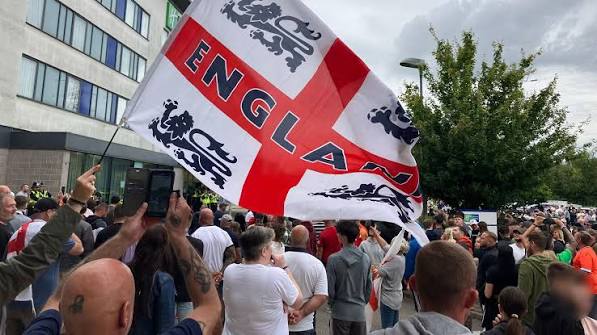
On that day, an initial gathering outside the Holiday Inn Express in Manvers, Rotherham, swelled to approximately 700 people before degenerating into a full-scale riot. Masked agitators weaponized wooden pallets, metal fencing, chairs, and concrete blocks against police lines. Windows were pulverized, a commercial waste bin was set alight against the exterior wall in an attempt to burn down the structure, and rioters breached the interior corridor while roughly 250 asylum seekers and staff were trapped inside. More than 50 police officers sustained injuries, including broken bones and concussions.
Hours later, the violence cascaded south to Tamworth. At another Holiday Inn Express housing approximately 180 asylum seekers, a crowd of roughly 200 launched fireworks, stones, and petrol bombs directly into police defensive lines, setting secondary fires and terrifying occupants who had fled war zones in Sudan, Syria, and Afghanistan.
That real unrest was ignited by digital disinformation following the horrific mass stabbing in Southport on July 29, 2024, where three young girls were murdered at a dance workshop. Malicious online channels had falsely identified the British-born teenage suspect as an undocumented Muslim asylum seeker who had arrived on a small boat.
The judicial aftermath of the genuine 2024 disorder was swift and severe: courts sat through the night, more than 60 men were jailed on riot charges in South Yorkshire alone, and the Home Office subsequently decommissioned the Manvers hotel as asylum accommodation.
Yet two years later, that genuine trauma was exhumed, altered, and weaponized to manufacture a riot that never happened.
2. Professional Analysis & Personal Perspective
My Professional Perspective
For thirty years, I have covered urban insurrection, civil war, and political violence from the backstreets of Belfast and the Balkans to the American Rust Belt and the industrial heartlands of northern England. When an investigative reporter looks at a headline blaring that 460 rioters are currently burning down hotels in Yorkshire, you do not look first at the street corner.
You look at the digital infrastructure driving the outrage.
Here is the deeper side of the story that mainstream news desks and policy analysts consistently fail to grasp: This was not a mistake, an innocent reposting error, or a simple rumor run amok. This was a stress-test of Britain’s civic nervous system—an operational exercise in digital psychological warfare designed to see how easily a scar can be re-opened.
What Details Have People Overlooked?
In the rush to debunk the claim, the press overlooked three critical operational details embedded within the structure of the disinformation itself:
-
The Tactical Specificity of “460”: Anonymous accounts rarely invent random words; they craft cognitive anchors. Stating that “a mob” is rioting triggers general concern, but stating that a “460 masked mob” broke through lines at “5:10 p.m. Friday” mimics official police dispatch cadence. The human brain interprets numerical precision as evidence of direct, verified counting. It was engineered specifically to short-circuit the skepticism of local residents.
-
The Weaponization of the Closed Site: The Manvers hotel in Rotherham had already been evacuated and returned to commercial use long before this post circulated. By claiming that asylum seekers were still inside and under siege, the perpetrators deliberately targeted the residual communal guilt, trauma, and political resentment of a town that had spent two years attempting to heal from the reputational catastrophe of 2024.
-
The Pre-emptive Algorithm Timing: The claim was timed to drop late on a Friday afternoon—the notorious “dead zone” of civil communications. This is precisely when local council press offices are winding down, constabulary media desks are staffed by skeletal weekend shifts, and commercial radio stations run syndicated programming. The perpetrators exploited an institutional communications lag to maximize the unchallenged broadcast window.
What Deeper Meaning Lies Behind This Event?
Why does a ghost riot work? Why are thousands of British citizens willing to believe that their neighbor’s town is being sacked without checking their local evening news?
Because misinformation does not create tension; it harvests pre-existing institutional collapse.
The genuine riots of August 2024 occurred because two systemic pressures collided:
-
An asylum system paralyzed by an enormous administrative backlog, which forced the Home Office to requisition commercial budget hotels in deindustrialized, economically neglected working-class towns without community consultation.
-
A broader public exasperated by collapsing public services, inaccessible housing, and stagnant wages, primed by digital algorithms to perceive those hotels as taxpayer-funded symbols of sovereign neglect.
[ Long-Term Economic Neglect & Collapsing Public Services ]
                           │
                           ▼
  [ Unilateral Placement of Requisitioned Asylum Hotels ]
                           │
                           ▼
  [ Authentic Trauma of August 2024 Street Clashes ]
                           │
                           ▼
 [ Institutional Trust Broken + Digital Memory Preserved ]
                           │
                           ▼
[ 2026: The Ghost Narrative Exploits Unhealed Scars Instantly ]
When an agitator posts a clip of a flaming bin outside a hotel in 2026, the brain of a disillusioned voter in Yorkshire or Staffordshire does not process it as historical data. It processes it as an ongoing, unending baseline reality.
To them, Britain feels permanently fractured, precarious, and on the brink of civil breakdown. The ghost riot feels true because the underlying feelings of betrayal, neglect, and systemic abandonment were never addressed after the real rioters were locked away.
Why Does This Story Matter?
This incident matters because it marks a dangerous evolution in how public disorder is catalyzed.
In 2024, the state believed it had solved the crisis through judicial force. The Starmer administration leaned heavily on the courts, dispensing fast-track prison sentences of two, three, and four years to anyone caught hurling a brick or yelling abuse at a police line. The message was clear: deterrence through the penal system would suppress the unrest.
This episode proves the limits of that strategy. You cannot deter an algorithm with a prison sentence.
The physical participants of the August 2024 riots went to jail, but their digital avatars—the video files, the viral soundbites, the spliced footage of burning barriers—remained floating in the server farms of Telegram, X, and TikTok, awaiting re-activation.
The real-world danger of these ghost riots is not passive; it is operational:
-
The Retaliatory Cascade: If a local community believes an asylum facility has been attacked by far-right mobs, counter-demonstrators, anti-racism coalitions, and minority youth may mobilize to defend it.
-
The Vigilante Convergence: Disillusioned, angry young men, convinced that a national uprising has begun, jump into cars and head toward the site to join the fray.
-
Resource Depletion: Police commanders are forced to divert riot vans and tactical support units to an empty building, stripping outer suburbs of essential emergency response capacity.
A fictitious riot can spawn a completely genuine one within three hours. The line between synthetic theater and actual street violence has effectively dissolved.
What Questions Remain Unanswered?
As this episode fades into the digital archives, the fundamental investigative questions remain studiously avoided by Westminster:
-
Who Built the Spliced Montage? Fact-checkers noted that identical montages emerged simultaneously across dozens of bot-like accounts. Was this amateur trolling, commercial engagement-farming by monetized channels, or an intentional, state-sponsored information operation orchestrated by hostile foreign intelligence services seeking to destabilize British domestic cohesion?
-
The Asylum Estate Reality: What is the actual, unredacted timeline for ending the use of temporary contingency hotels across the United Kingdom? As long as these commercial facilities remain active sites of processing, they will serve as physical targets for real and manufactured outrage.
-
The Information Vacuum: Why do regional police forces still rely on slow, reactive text press releases to combat cinematic, high-definition visual disinformation? In an era where deepfakes and spliced archives dominate the public consciousness, why does the state not deploy verifiable, geo-tagged counter-visuals within minutes rather than hours?
Beyond the panic and the subsequent debunking lies a profound realization: we are now governing a population whose collective memory can be hacked and edited at will.
The phantom sieges of Rotherham and Tamworth were defeated not by riot police, water cannons, or judicial sentencing, but by a basic verification check: an officer standing outside an empty building looking down a peaceful, rainy street.
Yet the relief that greeted the police statements is misplaced. The fact that thousands of citizens instantly accepted the premise that a 460-man masked mob was ransacking an English market town is not a reflection of their gullibility. It is a terrifying diagnostic of their alienation. It demonstrates that the social fabric holding these communities together is so fragile that the specter of civil breakdown is no longer unthinkable; it is anticipated.
The men who threw petrol bombs in August 2024 committed grave criminal acts, and the justice system rightfully held them accountable. But locking up the rioters did not close the fault lines that allowed the violence to erupt in the first place. The anger, the housing shortages, the demographic shifts, and the cynical monetization of tribal fury remain completely intact, simmering just below the surface of daily life.
We survived this ghost riot because the facts were verified before crowds assembled on the pavement. But as technology improves and the appetite for outrage deepens, the next manufactured crisis will be faster, sharper, and harder to disprove.
The question that should keep every policymaker, police commander, and citizen awake tonight is not whether the riot happened on Friday afternoon.
The question is: When our communities are so traumatized that they can no longer distinguish between yesterday’s real tragedy and today’s manufactured lie, how long will it take before an invented fire burns down a real city?