French Navy Footage of Life Jackets for Channel Migrants Fuels British Debate on Migration Policy. n111

Life Jackets, Politics, and the Channel Crisis: Why One French Navy Video Has Reignited Britain’s Migration Debate
A Short Video Sparks a Long-Running Political Battle
PARIS — A brief piece of footage captured in the English Channel has become the latest flashpoint in one of Britain’s most divisive political debates.
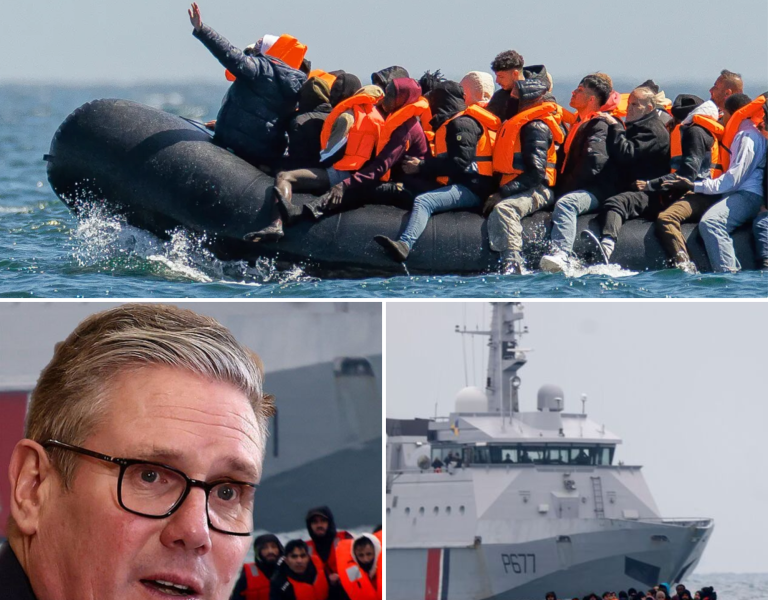
The video, reportedly obtained by GB News and widely circulated across social media and news platforms, shows sailors aboard a French naval vessel approaching a crowded inflatable migrant boat and throwing orange life jackets to those onboard.
To supporters of tougher border enforcement, the images appeared shocking.
To humanitarian organizations and maritime professionals, they showed something entirely different: an effort to prevent a potential tragedy at sea.
The contrasting reactions reveal how migration policy has evolved far beyond a question of border management. It has become a symbolic battle involving national sovereignty, public trust, humanitarian obligations, international cooperation, and political identity.
What might otherwise have been viewed as a routine maritime safety operation quickly became a major political story on both sides of the Channel.
What the Footage Shows
The video depicts a French military vessel maneuvering alongside an inflatable dinghy carrying migrants attempting to cross the English Channel.
As the boats move through the water, French sailors can be seen tossing life jackets toward passengers reaching out from the overcrowded vessel.
The footage spread rapidly online, generating intense discussion and becoming a focal point in Britain’s ongoing argument over how migration should be managed.
Critics immediately questioned whether such actions effectively assist Channel crossings rather than discourage them.
Some argued that providing safety equipment could be interpreted as facilitating journeys that both British and French authorities publicly state they are trying to prevent.
Supporters of the French response strongly disagreed.
French officials described the action as a standard maritime safety procedure designed to reduce the risk of deaths at sea.
Their position is straightforward: regardless of immigration policy, sailors have a duty to protect human life when individuals face danger in open water.
The Context Behind the Crossing Crisis
The controversy comes as Britain and France continue struggling to manage irregular migration across the English Channel.
The route has become one of the most politically sensitive migration corridors in Europe.
Thousands of migrants have attempted the crossing in recent years, often using overcrowded inflatable boats launched from northern France.
The journey is deceptively dangerous.
Although the Channel appears narrow on maps, it remains one of the busiest shipping lanes in the world. Rapid weather changes, strong currents, commercial vessel traffic, and poorly equipped boats create significant risks.
Numerous tragedies have occurred during recent years.

Several crossings have ended in capsizings and fatalities, reinforcing concerns among maritime authorities and humanitarian organizations.
As a result, life-saving measures at sea remain highly sensitive issues.
Britain’s Political Reaction
The footage quickly became political ammunition in Britain.
Critics of current migration policies argued that the images demonstrate the failure of existing enforcement strategies.
Among those raising concerns was Nigel Farage, along with other commentators who questioned whether French authorities are doing enough to prevent departures before migrants enter the water.
For critics, the visual symbolism proved particularly powerful.
They argue that British taxpayers have contributed hundreds of millions of pounds toward joint migration enforcement efforts with France.
Seeing French personnel distribute life jackets rather than stopping departures fueled concerns that British funding is not producing the intended outcomes.
Opposition voices argued that the footage may reinforce perceptions among voters that authorities are managing crossings rather than preventing them.
Those perceptions carry significant political weight, especially as immigration consistently ranks among the top concerns expressed by British voters.
Starmer Government Defends Cooperation
Prime Minister Keir Starmer and his government have defended ongoing cooperation with France.
Officials point to a series of bilateral agreements designed to strengthen border enforcement, intelligence sharing, surveillance capabilities, and anti-smuggling operations.
Under a recent three-year agreement worth hundreds of millions of pounds, France committed to expanding patrols along its northern coastline and increasing efforts to disrupt criminal smuggling networks.
British officials argue that the strategy is producing results.
Government representatives have cited thousands of disrupted crossing attempts and increased operational cooperation between both countries.
From their perspective, isolated images do not reflect the broader scope of enforcement activity occurring behind the scenes.
The government’s argument is that complex migration challenges require sustained cooperation rather than simplistic interpretations of individual incidents.
Why France Says the Life Jackets Matter
French authorities maintain that the life-jacket distribution shown in the footage reflects established maritime responsibilities.
Once migrants are already at sea, officials argue, the immediate priority becomes preserving life.
French maritime personnel operate under international obligations that require assistance when individuals face potential danger on the water.
Maritime experts note that smugglers frequently launch boats carrying insufficient safety equipment.
Overcrowding is common.
Many passengers have little or no maritime experience.
Some boats depart without adequate fuel, navigation systems, or emergency gear.
Under those circumstances, authorities often face difficult choices.
Failing to provide safety equipment may increase the risk of fatalities.
Providing it may attract criticism from those who believe it undermines deterrence efforts.
The French position is that preventing deaths cannot become secondary to political messaging.
The Smuggling Networks Behind the Crisis
One point often overlooked in public debate is the role played by organized criminal networks.
Smuggling groups continue to profit enormously from Channel crossings.
Migrants frequently pay substantial sums for places on overcrowded boats.
Law enforcement agencies in both Britain and France have repeatedly emphasized that dismantling these networks remains a central objective.
Recent bilateral agreements have increasingly focused on intelligence operations rather than simple interception efforts.
Authorities argue that targeting the organizers behind crossings may ultimately prove more effective than concentrating solely on individual boats.
Yet dismantling transnational criminal enterprises remains a difficult and resource-intensive challenge.
As long as demand exists, smugglers continue seeking new methods and routes.
Public Concerns Continue to Grow
Public concern regarding migration remains high throughout Britain.
Polling consistently shows significant anxiety regarding border security, housing availability, public services, social cohesion, and the capacity of existing systems to absorb new arrivals.
Supporters of stronger enforcement argue that repeated crossings undermine confidence in immigration controls.
They contend that voters increasingly view the situation as evidence that governments have lost operational control of national borders.
Others emphasize a different concern.
Humanitarian organizations argue that focusing exclusively on enforcement fails to address why migrants undertake such dangerous journeys in the first place.
Many individuals crossing the Channel originate from regions affected by conflict, political instability, persecution, or severe economic hardship.
Migration experts frequently describe these forces as “push factors” that continue driving movement regardless of enforcement measures.
The Challenge of Finding a Durable Solution
The Channel crisis remains extraordinarily difficult to resolve because every proposed solution carries complications.
Advocates of tougher enforcement call for stronger interdiction measures, expanded returns agreements, offshore processing systems, or additional deterrence strategies.
Critics argue that many of these proposals face legal, diplomatic, and practical obstacles.
Supporters of humanitarian approaches advocate expanding legal migration pathways and asylum processing reforms.
Critics counter that such measures could create additional incentives for migration.
As a result, policymakers find themselves navigating competing priorities:
- Border security.
- Humanitarian obligations.
- International law.
- Public opinion.
- Diplomatic relationships.
- Operational realities.
Few issues illustrate the complexity of modern governance more clearly.

My Professional Perspective
Having covered migration, border policy, international relations, and political movements across Europe for more than three decades, I believe the most revealing aspect of this controversy is not the life jackets themselves.
It is what people think the life jackets represent.
One Image, Two Completely Different Stories
The same footage generated radically different interpretations.
To many critics, the video symbolized surrender.
They saw authorities appearing to assist crossings that governments claim they want to stop.
To humanitarian advocates, the footage symbolized responsibility.
They saw trained sailors preventing a possible disaster.
Neither side was primarily debating the life jackets.
They were debating the meaning attached to them.
This distinction is crucial.
Modern political conflicts increasingly revolve around symbols rather than policies.
And symbols often carry far greater emotional power than statistics or government reports.
The Real Problem Is Not the Boat
The crowded dinghy shown in the footage is not the root cause of the crisis.
It is the visible result of deeper forces.
Migration pressure originates thousands of miles away.
Wars, political instability, demographic growth, economic disparities, and smuggling networks all contribute to movement toward Europe.
Stopping a single boat does not eliminate those pressures.
Providing a life jacket does not create them.
This is why governments continue struggling despite years of policy changes.
They are often addressing symptoms rather than causes.
Why Public Frustration Persists
One reason migration remains politically explosive is that many voters judge success through visible outcomes.
People see boats arriving.
They see headlines about crossings.
They see accommodation costs and asylum backlogs.
As long as those visible indicators continue, many conclude that policy is failing.
Governments may point to disrupted smuggling operations, intelligence successes, and international agreements.
But voters often focus on what they can directly observe.
The life-jacket footage became powerful precisely because it was visual.
It transformed a complex policy debate into a simple image.
And simple images often dominate public opinion.
The Impossible Balancing Act
Perhaps the most important reality is that governments face competing responsibilities that frequently conflict.
They must protect borders.
They must uphold international obligations.
They must prevent deaths.
They must maintain public confidence.
They must cooperate with allies.
They must deter illegal activity.
These objectives do not always align perfectly.
That tension was visible in every frame of the video.
French sailors were confronting an immediate safety issue.
British politicians were confronting a political issue.
The two are related but not identical.
What Comes Next
As summer weather improves, crossing attempts are likely to remain a major political issue.
Every successful crossing will generate scrutiny.
Every enforcement failure will attract criticism.
Every humanitarian incident will produce renewed debate.
The challenge for Britain and France is not simply reducing numbers.
It is rebuilding public confidence that the system itself is functioning effectively.
Without that confidence, even genuine progress may struggle to gain public acceptance.
Conclusion
The footage of French sailors throwing life jackets to migrants in the English Channel lasted only moments.
Yet it has reignited one of Britain’s most heated political debates.
To some, it represents a failure of enforcement.
To others, it represents a duty to save lives.
Both interpretations reflect larger concerns about migration, sovereignty, humanitarian responsibility, and public trust.
The Channel remains a narrow stretch of water separating two close allies.
Politically, however, it has become one of the most contested frontiers in Europe.
The images from the French naval vessel remind us that migration debates are rarely just about numbers.
They are about values.
They are about priorities.
They are about competing visions of responsibility.
And perhaps the most difficult question facing policymakers is this:
When governments are expected to stop dangerous crossings while simultaneously preventing deaths, how do they convince the public that they are successfully doing both?