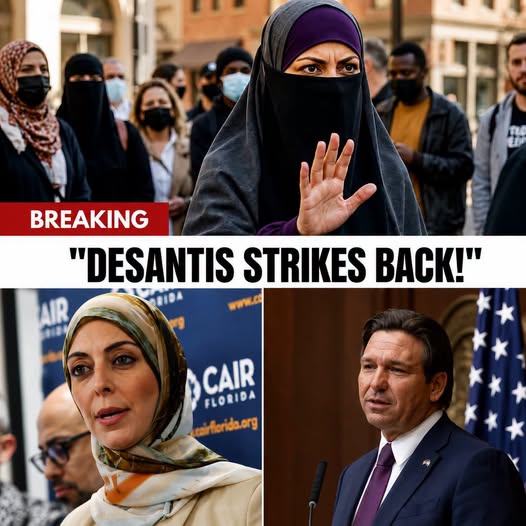
Florida’s HB 1471 Rekindles National Debate Over Foreign Law, Religious Freedom, and State Authority. n1

Florida’s HB 1471 Ignites a National Debate Over Constitutional Authority, Religious Liberty, and the Expanding Power of State Government
When One State Law Becomes a National Conversation
Few states shape America’s political conversation as consistently as Florida. Over the past several years, legislation emerging from Tallahassee has repeatedly become the subject of nationwide debate, often extending far beyond the state’s borders. That pattern continued when Governor Ron DeSantis signed House Bill 1471 into law—a sweeping measure that combines provisions addressing foreign legal systems with expanded state authority over organizations designated as terrorist groups. The law officially took effect on July 1, 2026, following its signing in April. (Flgov)
Supporters quickly hailed the legislation as a decisive effort to reinforce constitutional governance, protect public institutions, and provide Florida with stronger legal tools against extremist organizations. Critics, however, argued that several provisions could face constitutional scrutiny and questioned whether parts of the legislation address genuine legal gaps or instead serve broader political objectives. Civil liberties organizations also warned that the expanded designation powers could have significant implications for freedom of association and religious liberty. (ACLU of Florida)
What began as another state legislative bill rapidly evolved into a national discussion touching on constitutional law, national security, religious freedom, immigration, and the growing influence of state governments in areas traditionally dominated by federal policy.
Unlike many politically charged bills that focus on a single issue, HB 1471 combines several controversial subjects into one comprehensive piece of legislation. That combination has ensured that legal scholars, advocacy organizations, elected officials, and constitutional experts continue examining not only what the law does today but also how it may shape future legal disputes.
What HB 1471 Actually Does
Much of the public discussion surrounding HB 1471 has centered on headlines rather than the bill’s detailed provisions.
The legislation creates a formal state process allowing Florida to designate certain organizations as domestic or foreign terrorist organizations through a framework involving the state’s Chief of Domestic Security, followed by approval from the Governor and Cabinet. Once designated, organizations may face significant legal consequences under Florida law, including restrictions on public funding and expanded criminal penalties relating to material support. (Thượng viện Florida)
The law also contains provisions concerning foreign legal systems. It reinforces that Florida courts may not recognize or enforce foreign or religious legal principles whenever doing so would violate constitutional rights guaranteed under the United States Constitution or Florida law. According to the Governor’s office, this includes preventing enforcement of aspects of foreign legal systems—such as Sharia law—when they conflict with constitutional protections. (Flgov)
Supporters emphasize that the legislation does not prohibit individuals from practicing their religion. Rather, they argue, it ensures that civil disputes remain governed by American constitutional principles.
That distinction has become one of the central points of debate.
Governor DeSantis Presents the Law as a Constitutional Safeguard
Governor Ron DeSantis framed the legislation as part of a broader effort to reinforce Florida’s constitutional framework while strengthening state-level responses to terrorism.
During the bill-signing ceremony, DeSantis argued that every legal dispute within Florida should ultimately be resolved under one governing framework—the United States Constitution—and that the state should possess effective mechanisms for preventing extremist organizations from establishing institutional influence. (Flgov)
Following implementation of the law on July 1, the Governor announced his intention to pursue terrorist designations for several organizations, including Antifa, the Muslim Brotherhood, and the Council on American-Islamic Relations (CAIR), while also reviewing recommendations concerning more than ninety foreign terrorist organizations already recognized in various national security contexts. (Flgov)
Those announcements immediately intensified political debate, shifting public attention from the bill’s statutory language toward how Florida intends to exercise its newly expanded authority.
Why Supporters Believe the Law Was Necessary
For advocates of HB 1471, the legislation represents preventive governance rather than reactive policymaking.
They argue that constitutional protections should never depend upon judicial interpretation after conflicts arise. Instead, legislatures should clearly establish legal boundaries before uncertainty develops.
Supporters further contend that globalization has created increasingly complex legal relationships involving international contracts, foreign judgments, multinational business disputes, religious arbitration, and cross-border family law cases. Although American courts already operate under constitutional principles, they believe explicit statutory language provides greater certainty for judges, attorneys, and litigants.
The terrorism provisions receive equally strong support among advocates.
Supporters argue that violent extremist organizations continue adapting their methods of recruitment, financing, and institutional influence. In their view, states should possess independent legal mechanisms that complement—not replace—federal counterterrorism efforts.
They also argue that state governments should not remain entirely dependent upon federal designation processes when protecting local institutions, schools, charities, or public agencies from organizations believed to present security risks.
To supporters, HB 1471 reflects a broader philosophy: waiting until threats become immediate often means waiting too long.
Critics Question Whether Existing Constitutional Protections Were Already Sufficient
Opponents approach the legislation from an entirely different perspective.
Many constitutional scholars acknowledge that American courts already cannot enforce foreign legal principles whenever those principles violate constitutional rights.
From their perspective, that legal safeguard has long existed through the Supremacy Clause, constitutional jurisprudence, and decades of judicial precedent.
Consequently, critics ask a simple question:
If the Constitution already prevents unconstitutional foreign legal rulings, why is additional legislation necessary?
Civil liberties organizations also argue that some language within HB 1471 may invite litigation over vagueness, implementation standards, and the breadth of the state’s designation authority.
The American Civil Liberties Union of Florida has warned that provisions allowing organizations to be designated as domestic terrorist groups could raise constitutional concerns depending upon how those authorities are exercised in future cases. (ACLU of Florida)
Legal observers expect that practical implementation—not political rhetoric—will ultimately determine whether the law survives future constitutional challenges.