
Burnham Under Fire as Explosive Defence and Welfare Clash Rocks Westminster
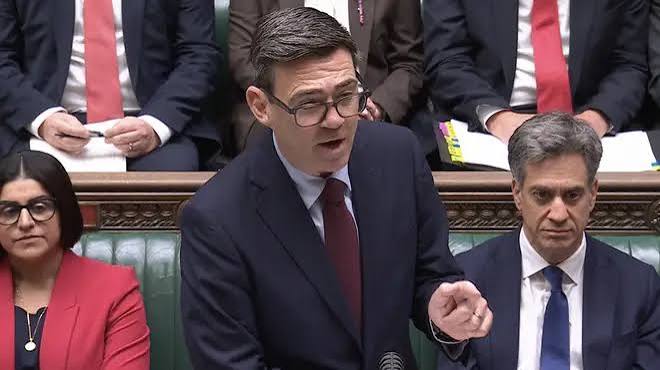
British Prime Minister Andy Burnham is facing intense pressure after refusing to commit to raising defence spending to 3% of GDP by 2030, arguing that national security cannot come at the expense of social security.
The high-stakes confrontation during Prime Minister’s Questions at Westminster exposed a severe policy dilemma facing the British government. As global security threats mount, Whitehall is locked in a fierce debate over how to fund a major military expansion without triggering steep tax hikes, heavy borrowing, or drastic domestic spending cuts.
Conservative leader Kemi Badenoch targeted this friction directly, demanding that the government slash welfare expenditure to inject immediate funds into the Armed Forces. Burnham rejected that path, insisting that his administration remains fully committed to national security while refusing to balance the military budget on the backs of vulnerable families.
What Happened: The PMQs Showdown
The clash erupted when Badenoch pressed the prime minister on whether Britain would meet the 3% defence spending milestone by 2030. Burnham did not answer with a direct affirmative.
Instead, he reaffirmed Britain’s longer-term commitment to hit the broader NATO target of 3.5% of GDP by 2035 and announced that the government would publish its specific timetable for reaching 3% in the spring.
That distinction drew immediate fire from the opposition. Badenoch argued that global threats are too urgent to wait, accusing the government of prioritizing welfare over military preparedness.
The exchange quickly intensified when Burnham stated: “We do everything to support our national security, but it can’t come at the expense of social security.” That single sentence instantly became the defining political battleline of the debate, with Conservatives claiming it proved Labour’s priorities lie elsewhere.
Why It Matters: The Strategic Pressures on Britain
The debate over military expenditure is unfolding against a rapidly deteriorating international security backdrop.
Russia’s ongoing war in Ukraine, increasing hybrid threats targeting European infrastructure, instability in the Middle East, and persistent terrorism have fundamentally altered defense planning. Furthermore, questions regarding the future scope of the United States’ security umbrella in Europe have added urgency to Allied readiness.
NATO Secretary General Mark Rutte recently described the current environment as the most dangerous and complex security landscape the alliance has faced in a generation. During a recent visit to the UK, Rutte urged London to establish a credible, year-by-year trajectory toward higher defense spending rather than delaying major financial decisions until the final years before the 2035 deadline.
For decades, European nations benefited from a post-Cold War peace dividend, diverting resources away from defense and toward domestic priorities like healthcare and welfare. With major continental powers like Germany and Poland aggressively rearming, Britain faces mounting allied pressure to follow suit with verifiable financial commitments.
Badenoch’s Strategy: Cut Welfare to Fund Defence
Badenoch’s core argument is straightforward: Britain is spending more servicing its national debt than on defense, and immediate savings can be found within the welfare budget.
She has argued that welfare expenditure should be trimmed and redirected straight to the military. When pressed on how the government plans to fund its defense commitments, Burnham countered that Labour would reduce welfare dependency through long-term structural reforms—improving education, boosting youth employment, and expanding mental-health support.
Badenoch dismissed that approach as too slow. She argued that long-term employment programs cannot generate the billions of pounds the Armed Forces require immediately.
Furthermore, the political battle expanded when Badenoch attacked the government over foreign policy and sovereignty, raising the issue of the Chagos Islands and accusing ministers of failing to project British strength. Burnham pushed back forcefully, assuring Parliament that Britain’s military base at Diego Garcia remains secure and that the Falkland Islands’ right to self-determination will never change under his watch.
The Brutal Fiscal Reality Behind the Numbers
Stripping away the parliamentary theatre leaves an undeniable fiscal challenge. Moving from the current defense expenditure of roughly 2.7% of GDP toward 3.5% requires tens of billions of pounds in additional annual funding. Rutte has indicated that hitting the 3.5% target would necessitate nearly £30 billion more per year.
A government has limited options when confronted with such massive spending gaps:
-
Increase taxes to generate new public revenue.
-
Borrow significantly more, adding to national debt.
-
Reduce public spending in other vital areas like health, education, or welfare.
-
Rely on accelerated economic growth to naturally expand tax receipts.
While Burnham has staked his strategy on economic growth and job creation, economic expansion is uncertain, whereas military procurement timelines are fixed. Warships, fighter jets, and munitions factories require long-term contracts, predictable demand, and years of lead time.
What Different Sides Are Saying
-
The Government: Insists that national security is absolute, pointing to its commitment to meet NATO’s 3.5% target by 2035 and fully fund its defense investment plan. Ministers argue that indiscriminate welfare cuts would increase homelessness and poverty rather than solve structural budget problems.
-
The Opposition: Argues that the government is moving too slowly, hiding behind long-term reviews while the military faces immediate readiness constraints. Conservatives maintain that welfare savings are the most logical source to fund urgent national defense needs.
-
NATO Leadership: Emphasizes that Britain needs a transparent, annual path of spending increases to give the defense industry and Armed Forces the long-term certainty required for complex procurement.
What Happens Next?
The political battle lines are drawn ahead of the government’s official spring announcement, where the Treasury is expected to reveal its target date for reaching the 3% defense spending threshold.
That announcement will heavily influence NATO’s assessment of Britain’s strategic commitment and dictate procurement schedules for the Armed Forces. Until then, the friction between national security and social welfare will remain at the center of British politics.
How do you think the government should balance the urgent need for increased defense spending against pressures on domestic public services?