History is often remembered through its most dramatic images: soldiers marching toward the front, political leaders standing before enormous crowds, factories rising against smoky skylines, and families watching the world they know disappear into uncertainty. Yet the past was not made up entirely of monumental events. It was also shaped by muddy streets, crowded markets, ordinary arguments, shared meals, tired workers, and children who found reasons to laugh even when life offered them very little. Imagine discovering a photograph taken more than a century ago, showing a group of children playing in the street while a woman hangs laundry from an upstairs window. Nothing about the scene appears extraordinary. And that is precisely what makes it remarkable. For one brief moment, history stops feeling distant and begins to look like life itself. What else might these forgotten photographs reveal about the people who lived before us?
The power of old photographs lies in their ability to preserve details that written records rarely consider important. Official documents record decisions, dates, laws, battles, and political movements. They tell us who governed a country, when a conflict began, and how societies changed. But they often say little about what an ordinary afternoon looked like, how a family arranged itself outside a modest home, or what people did while waiting for a market to open. Photographs can offer a different kind of evidence. A single frame may preserve the shape of a doorway, the condition of a road, the tools used by a worker, or the expressions of people who never expected to become part of the historical record.

Consider the image of children playing in a muddy street in the early twentieth century. Their clothes appear worn, their faces are marked by dirt, and their attention is directed toward something beyond the camera. In the background, a woman hangs laundry from a second-floor window, continuing a household task that would have been familiar to countless generations. The photograph does not need a famous person or an extraordinary event to become meaningful. Its importance comes from the ordinary life it records.
For modern viewers, such a scene can reveal how different the physical environment once was. Streets that are now paved and crowded with vehicles may once have been uneven, muddy, and shared by pedestrians, animals, carts, and children. Domestic work that is now carried out with electric appliances may once have required considerable time and physical effort. Buildings, clothing, and household arrangements provide clues about the resources available to people and the limits imposed by their surroundings.
Yet the most important detail may be the children themselves. They are not merely examples of childhood in another era. They are individuals caught in the middle of an activity, temporarily absorbed in their own small world. Their lives were shaped by conditions that may seem unfamiliar today, but their capacity for play belonged to no particular century. The photograph reminds us that childhood existed long before modern toys, digital entertainment, and the conveniences many people now take for granted.
The image also invites a question about what the camera cannot show. Were these children returning from school, helping their families, or simply spending an afternoon outdoors? What happened after the photograph was taken? Did the woman finish hanging the laundry before the weather changed? Did the children remain in the street until someone called them home? Unless other records survive, the answers may never be known. It is important not to invent a story merely because a photograph encourages us to imagine one. The documented scene is already meaningful enough. Its unknown details are a reminder that every surviving image preserves only a fraction of the life that once surrounded it.

Another photograph described in the collection presents a crowded European market square shortly before a major conflict. Vendors attend their stalls, customers negotiate over vegetables, a dog rests beneath a cart, and a young man reads a newspaper while leaning against a wall. At first glance, nothing seems unusual. The market operates according to familiar routines. People buy food, discuss prices, carry out errands, and make their way through a public space that has served their community for years.
But the historical setting changes how we interpret the scene. When viewers know that a devastating conflict later transformed the region, ordinary activity can become unexpectedly painful to observe. The people in the photograph appear to occupy a world whose future remains invisible to them. The vegetables are still being sold, newspapers are still being read, and the dog has found a comfortable place to sleep. Whatever political tensions may exist beyond the frame, daily life continues.
This contrast between ordinary life and approaching catastrophe is one of the most powerful qualities of historical photography. A photograph taken before a war rarely announces what is coming. It may show a street that will later be damaged, a building that will disappear, or people whose lives will be altered by events they cannot predict. The image acquires a second meaning because the viewer possesses knowledge that the people in the photograph did not necessarily have.
However, the existence of a later tragedy does not mean that every person in the market was unaware of danger. Political conditions vary from place to place, and people often recognize that their societies are entering periods of instability. Some may have followed developments closely, while others concentrated on immediate concerns. Without reliable information about the photograph’s location and date, it would be impossible to determine what these particular individuals knew or feared.
What can be said is that the market represents something larger than commerce. It shows the practical routines through which communities maintain themselves. People still need food, clothing, shelter, and human contact even when political events threaten the stability of their lives. A market can continue to function during uncertain times because daily needs do not disappear when history takes a dramatic turn.
This is why photographs of ordinary public spaces can be as revealing as pictures of political leaders. A speech may explain what a government wanted its citizens to believe. A market photograph may show the environment in which those citizens actually lived. Neither source tells the entire story, but together they can provide a fuller understanding of a historical moment.
The collection’s description of a factory floor from the 1920s offers another view of the past, this time through the people whose labor helped transform modern economies. Workers stand among machinery, their clothes marked by soot and the demands of their jobs. Their faces are tired, their postures practical, and their attention appears directed toward the work before them.
For much of modern history, industrial progress has been represented through images of towering chimneys, expanding railway networks, powerful machines, and impressive production figures. Such images communicate the scale of economic transformation. Yet a factory is not simply a collection of machines. It is also a workplace filled with people whose time, physical strength, and skills make production possible.

Photographs of industrial workers can therefore complicate the familiar story of progress. Mechanization created new opportunities, increased productive capacity, and helped transform transportation, manufacturing, and everyday consumption. At the same time, many industrial workplaces involved long hours, demanding physical conditions, exposure to hazardous materials, and limited control over the pace of work. The precise circumstances varied substantially across countries, industries, and periods.
A single photograph cannot establish the conditions experienced by every worker in a factory. Soot on clothing, for example, may indicate an industrial environment, but it cannot independently prove the full extent of occupational danger or explain the wages and working hours of the people pictured. Those questions require additional evidence, including company records, labor reports, contemporary accounts, and photographs with verified captions.
Nevertheless, the image can restore a human dimension to economic history. Each worker represents someone whose daily routine was shaped by the demands of production. Behind every finished product stood people who operated equipment, moved materials, maintained machinery, and performed tasks that could be exhausting or repetitive. Their contribution was essential even when their names never appeared in public accounts of industrial achievement.
The photograph also encourages viewers to consider how societies measure progress. A new factory may be celebrated as evidence of national growth, but its significance cannot be fully understood without examining the people who worked inside it. What did the work provide for their families? What risks did they face? How much control did they possess over their own lives? These questions do not diminish the importance of industrial development. They make its history more complete.

In many countries, labor movements, workplace reforms, and changes in industrial regulation emerged from conflicts over wages, hours, safety, and workers’ rights. These developments were not inevitable outcomes of technological progress. They resulted from complicated struggles involving workers, employers, governments, and wider social movements. The people visible on a factory floor may not reveal those struggles directly, but their presence reminds us that industrial history was experienced by human beings rather than by machines alone.
A different kind of hardship appears in the described photograph of a family sitting outside a small wooden home on the American frontier during the nineteenth century. A mother holds a baby, a father carries a rifle, and older children stand barefoot on the ground. The setting may evoke familiar images of frontier life, but the photograph offers no guarantee that the family’s circumstances matched the romantic stories often associated with westward expansion.
Popular representations of the American frontier frequently emphasize independence, adventure, courage, and the conquest of difficult landscapes. Such themes have played a powerful role in national mythology. Actual frontier experiences, however, varied widely. Some families found opportunities to establish farms or businesses, while others encountered debt, isolation, disease, severe weather, and uncertain access to markets or medical care.
The wooden house in the photograph may suggest limited material resources, but its appearance alone cannot establish the family’s wealth or social standing. The rifle may have served several purposes in a rural environment, including hunting or protection, but its presence does not prove that the family was under immediate threat. Bare feet may reflect circumstance, climate, or the timing of the photograph rather than a complete picture of the children’s everyday clothing.
This distinction matters because historical photographs are easy to turn into illustrations of stories we already believe. A family outside a wooden house can quickly become a symbol of rugged independence. Yet the people in the frame were more complicated than any single national myth. They may have experienced pride in their home, anxiety about the future, affection for one another, or practical concerns that had nothing to do with the grand narratives later attached to the frontier.
Their photograph can still communicate something important. Establishing a household in a rural environment often required sustained labor. Food had to be obtained, buildings maintained, children cared for, and resources managed carefully. In places where settlements were widely dispersed, distance could complicate access to markets, education, and medical assistance. The daily work of keeping a family alive was itself a substantial undertaking.

The mother holding the baby also directs attention toward the domestic labor that historical narratives sometimes overlook. Caring for children, preparing food, maintaining clothing, and organizing household life were essential activities, even when they were not recognized as economic production in official accounts. The survival of a family depended on this work as much as it depended on the labor performed outside the home.
At the same time, a complete account of frontier history must recognize that westward expansion took place on land with existing Indigenous communities, histories, and claims. The experiences of settlers cannot be separated from the wider consequences of territorial expansion, displacement, conflict, and changing political control. A photograph of one family cannot explain these broader developments, but neither should it be used to present the frontier as an empty landscape waiting to be occupied.
This is one of the challenges of looking at old photographs responsibly. The image may be genuine while the interpretation surrounding it is incomplete. Historical understanding requires both attention to the people pictured and awareness of the larger circumstances in which their lives unfolded.
Some photographs appear remarkable because they preserve moments that seem unusually candid. The collection describes a street scene in London during the 1890s, showing a man stumbling away from a pub, his hat askew and his coat unbuttoned. Unlike formal portraits of respectable citizens, the scene appears to capture a moment of disorder, perhaps even embarrassment.

Yet it is precisely the ordinary imperfection of such a moment that gives it historical interest. People in the past were not permanently composed figures dressed for official portraits. They hurried through streets, made mistakes, became tired, celebrated, argued, and occasionally behaved in ways they might not have wanted preserved for future generations.
Photography in the nineteenth century presented technical obstacles that made candid images more difficult than they are today. Early photographic processes could require lengthy exposures, and subjects often needed to remain still. As cameras, lenses, plates, and photographic methods improved, photographers gained greater freedom to record people and public spaces with less formal staging. The speed and practicality of photography differed across technologies and decades, so the exact circumstances of any particular street image would depend on the equipment used.
Even with these improvements, a photograph showing an apparently spontaneous event does not automatically prove that the subjects were unaware of the camera. A person might have noticed the photographer, reacted to something outside the frame, or been caught in a pose whose meaning is not obvious to a modern observer. The image can look candid without revealing the entire situation that produced it.
The man leaving the pub illustrates why restraint is important. His clothing may appear disordered, but the photograph alone cannot establish how much he had been drinking, what had happened before the moment was recorded, or what kind of person he was. A single frame captures an appearance, not a complete character. Treating the man as a joke would reduce him to a brief and possibly misleading impression.

Instead, the scene can serve as a reminder that history includes people who would never have considered themselves historically important. Most people do not spend their lives preparing to become symbols of their time. They simply move through the world, often unaware that a passing moment may later become an object of curiosity.
Another image described in the collection shows women laughing together at a beach resort in the 1920s. Their swimsuits appear modest by contemporary standards, yet public attitudes toward clothing, leisure, and women’s behavior were changing in many places during the period.
Beach photography can reveal more than fashions. It can document the growth of leisure culture, the development of resorts, changing transport networks, and the expansion of opportunities for some people to spend time away from work and domestic responsibilities. The ability to visit a seaside destination depended on factors such as income, geography, employment, and available transportation. Not everyone enjoyed the same freedom to travel or participate in commercial leisure.
The women in the photograph are not merely examples of changing swimwear. Their laughter suggests a moment of shared enjoyment, although the precise reason for it remains unknown. Perhaps they were responding to a friend, an event nearby, or the photographer. The image cannot tell us. What it does preserve is the fact that these women occupied a public recreational space and were photographed during a moment that appears less formal than the portraits commonly associated with earlier decades.
Clothing also carries historical information, but it should not be treated as a simple measurement of how progressive or restrictive an entire society was. Fashion changed unevenly, and social expectations differed across communities and classes. A swimsuit that appeared daring in one setting might have been ordinary in another. Understanding its significance requires knowledge of local customs, contemporary commentary, and the circumstances in which the photograph was taken.
Still, such images help recover aspects of everyday experience that political histories often leave in the background. They remind us that the twentieth century was not experienced solely through economic crises, social conflict, and war. People also pursued pleasure, built friendships, and created spaces in which they could briefly escape the demands of ordinary life.
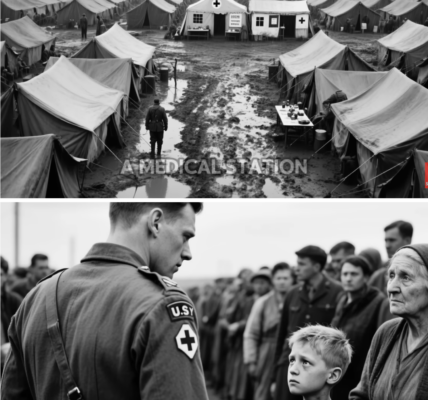
The collection also describes a photograph of a field hospital during an early twentieth-century conflict. Wounded people lie on cots, while a nurse stands in the corner, her face obscured by shadow. There are no dramatic battlefield formations or triumphant public ceremonies. The scene is defined instead by the quiet work that follows violence.

Military photographs are often remembered for their images of movement: troops advancing, aircraft in flight, ships leaving harbor, or soldiers preparing for battle. But the aftermath of conflict reveals another side of war. Injured people require treatment. Medical staff must organize supplies, maintain sanitation, assess patients, and continue working under pressure. The work of caring for the wounded can be physically demanding and emotionally difficult, even when a photograph does not reveal what the people involved are feeling.
The field hospital image is especially powerful because it directs attention away from the spectacle of combat. Its focus is not on the moment when violence occurred, but on the people who must live with its consequences. Bandages and cots indicate medical care, while the nurse’s position suggests the presence of someone involved in that work. Beyond these visible details, however, the image cannot establish the identities of the patients, the nature of their injuries, or the precise conditions under which treatment was provided.
Without a verified date, location, conflict, and original caption, it would be misleading to attach the photograph to a specific war or describe its subjects as members of a particular army. Early twentieth-century conflicts took place across multiple regions and involved different medical systems, technologies, and standards of care. The photograph’s historical meaning depends in part on establishing where and when it was taken.
Yet its broader significance remains clear. War does not end for an individual simply because the immediate fighting stops. Recovery can require prolonged treatment, family support, rehabilitation, and adjustments to daily life. Medical personnel and caregivers also become part of the human history of conflict, even when their work receives less attention than battlefield events.

The photograph’s quiet atmosphere may therefore be more revealing than a staged image of victory. It shows a kind of labor that is easy to overlook precisely because its purpose is to reduce suffering rather than to celebrate achievement. In this setting, courage need not take the form of a dramatic gesture. It may appear in the repeated, practical acts through which one person attempts to care for another.
Another described photograph takes viewers far from the industrial city or wartime hospital. It shows elders gathered beneath a tree in a rural village in Asia, sharing a meal. The scene appears simple, but its historical context could be complex. Across Asia, the nineteenth and twentieth centuries brought a wide range of political, economic, and social changes, including colonial rule, resistance movements, expanding trade, new administrative systems, and transformations in education and transportation.
Those developments did not affect every region in the same way. Asia encompasses numerous societies, languages, religions, political traditions, and local histories. Without a verified location and date, the photograph cannot be assigned to one particular colonial system or interpreted as representative of an entire continent.
What it can preserve is a gathering. The elders are seated together, sharing food in a setting shaped by the surrounding landscape. Their posture and arrangement may invite viewers to think about community, age, and the role of shared meals in social life. But even these interpretations should remain proportionate to the evidence. The image does not reveal the relationships between the people, the occasion for the meal, or the conversations that may have taken place.
This limitation does not make the photograph less valuable. It helps clarify what photographs can and cannot tell us. A picture may provide evidence of clothing, objects, architecture, and physical arrangements. It may suggest how a public or domestic space was used. But it rarely offers a complete explanation of language, belief, personal relationships, or political experience. Those aspects of the past must often be reconstructed from a wider body of evidence.

The elders’ meal also reminds us that major historical changes do not erase everyday routines all at once. Communities continue to prepare food, care for relatives, share knowledge, and maintain social connections while larger forces reshape their surroundings. People living through political change are not simply spectators waiting for history to unfold. They make decisions, adapt to new circumstances, preserve traditions, and sometimes resist changes they consider threatening.
A photograph of a meal cannot document every one of those processes. It can, however, remind us that the people affected by colonialism and modernization had lives extending far beyond the political categories imposed upon them. Their experiences cannot be reduced to a single narrative of victimhood, progress, resistance, or tradition. Understanding them requires attention to local circumstances and, whenever possible, the voices of the people themselves.
Taken together, these described scenes reveal why everyday photographs deserve a place in historical research. They capture details that may be absent from official records, but their value does not depend on treating them as transparent windows into the past. Photographs are products of particular moments, technologies, choices, and circumstances. Someone selected the subject, positioned the camera, and decided when to take the picture. The resulting frame includes some details while excluding others.
The photographer may have intended to document a workplace, preserve a family memory, record a public event, or create an image for commercial use. In other cases, the original purpose may no longer be known. A photograph that survives for decades can eventually become detached from its original context, leaving future viewers with an image but little information about its creation.
This is why provenance matters. Researchers seek to establish where a photograph came from, who created it, when it was taken, and whether its caption can be verified. Original negatives, album notes, institutional records, newspaper references, and related images may help answer these questions. When several independent sources support the same identification, confidence in the historical interpretation can increase.
Archives play a crucial role in this work. Institutions such as the Library of Congress and the United States National Archives preserve extensive photographic collections that document public events, communities, military activity, industry, landscapes, and everyday life. Their holdings also illustrate the importance of catalog records and original captions, which can provide dates, locations, photographer information, and other identifying details when those facts are known.
Digitization has made many historical images easier to discover and compare. A photograph that once required a visit to a physical collection may now be viewed online, sometimes alongside related records. This wider access allows researchers, students, and members of the public to explore material that would otherwise remain difficult to find.

But online circulation introduces its own problems. An image may be shared without its original caption, assigned an incorrect date, or given a dramatic story that cannot be substantiated. Photographs from different countries and decades may be grouped together simply because they look similar. A convincing description can spread widely even when the underlying identification is uncertain.
Modern image editing creates additional challenges. Colorization can make an old photograph appear more immediate, but the colors are often reconstructed rather than recorded in the original image. Cropping can remove important context. Sharpening and restoration may clarify damaged details, yet they can also introduce visual information that was not preserved clearly in the source. AI-generated reconstructions may look plausible while depicting details that no historical evidence confirms.
None of these techniques automatically makes an image useless. Restoration and colorization can help audiences engage with historical material, provided their methods and limitations are disclosed. The essential distinction is between an original photograph, an edited version of that photograph, and an entirely generated illustration. Those are different forms of visual material, and they should not be presented as interchangeable evidence.
The same care should be applied to the stories attached to rare photographs. A striking image can encourage speculation, especially when its subjects are unidentified. Viewers may want to know whether the children survived into adulthood, whether the factory workers later joined a labor movement, or whether the market square was destroyed during a conflict. Such questions are understandable, but an unanswered question is not evidence of a particular outcome.
Responsible historical storytelling does not eliminate mystery. It distinguishes between what can be established, what is plausible, and what remains unknown. Sometimes an image can be connected to census records, local newspapers, military files, or family archives. Sometimes the evidence is incomplete. In those cases, acknowledging uncertainty is not a weakness. It protects the people in the photograph from being turned into characters in an invented story.
There is also a deeper reason to preserve ordinary photographs. Their subjects were rarely aware of the historical significance that later generations might assign to them. The children in the muddy street were not posing as representatives of an era. The market vendors were not consciously demonstrating how society functioned before a conflict. The factory workers were not necessarily trying to make a statement about industrialization. They were carrying out the routines of their lives.
Their photographs become historical documents because those lives are no longer directly accessible to us. Buildings change, streets are rebuilt, clothing falls out of use, and familiar objects disappear from everyday surroundings. Written records may preserve the broad outline of a community’s development, while photographs retain visual traces of its physical world.

Yet these images do more than preserve objects and appearances. They challenge the assumption that historical importance belongs only to the famous. A nurse in a field hospital may never appear in a national monument. A worker on a factory floor may never be named in a textbook. An older person sharing a meal beneath a tree may never become the subject of a political biography. Their absence from celebrated narratives does not mean that their lives lacked meaning.
History is made through the accumulation of individual experiences as well as through major decisions and dramatic events. The relationship between those two scales is complex. A political decision can transform a family’s future, while the actions of ordinary people can influence the development of communities and institutions. Photographs rarely explain these connections by themselves, but they can make the human stakes easier to recognize.
Looking at the past through such images can also change how we understand our own time. Contemporary life produces an enormous number of photographs, many of which are shared immediately and then forgotten. Digital storage allows images to accumulate at a scale that earlier generations could scarcely have imagined. But abundance does not guarantee preservation. Files can be deleted, accounts can disappear, storage systems can fail, and digital images can lose the context that once gave them meaning.
A photograph becomes more useful to future generations when its basic information survives alongside it. Names, dates, locations, descriptions, and explanations of how an image was created can transform an anonymous picture into a valuable historical record. Without such information, even a visually compelling image may become difficult to interpret accurately.
The lesson is not that every photograph must become a museum artifact. It is that ordinary records can acquire significance beyond their original purpose. A family picture may eventually help establish the appearance of a vanished neighborhood. A photograph of a workplace may reveal machinery or safety practices that written reports fail to describe. An image of a public gathering may preserve clothing, signs, architecture, or social arrangements that later disappear.
The photographs described in this collection should therefore be approached with both curiosity and caution. Their scenes offer powerful ways to imagine the everyday texture of earlier lives, but specific historical claims require verified captions and supporting evidence. Where identities, dates, or locations remain uncertain, the honest response is to acknowledge those limits rather than fill the gaps with invented details.
Perhaps the most remarkable quality of these images is how little they need to tell us in order to make the past feel close. A child standing in a muddy street, a worker beside a machine, a family gathered outside a wooden home, or a nurse in a quiet hospital ward may occupy only a small part of the frame. Yet each scene points toward a world of relationships, responsibilities, difficulties, and experiences extending far beyond the camera’s view.

The people in these photographs belonged to different eras and lived under circumstances that may be difficult for modern viewers to imagine. Some enjoyed opportunities unavailable to their ancestors; others faced constraints that continue to shape historical discussions of class, gender, labor, colonialism, and access to resources. Their lives were neither uniformly miserable nor universally simple. They were varied, complicated, and unfinished, just as human lives remain today.
A photograph cannot restore everything that time has taken away. It cannot tell us every thought, recover every conversation, or reveal what happened to every person after the shutter closed. But it can preserve a moment that would otherwise have vanished. In doing so, it offers a reminder that the past was not an abstract collection of dates. It was once the present for people who were busy living it.
Perhaps that is the greatest value of rare historical photographs. They allow us to pause before turning a human life into a historical category. They ask us to look beyond the famous names and dramatic turning points and notice the ordinary people who occupied the world between them. Their stories may be incomplete, but the surviving images still deserve our attention, our questions, and our care.
When we look at these photographs, we are not simply looking backward. We are considering what future generations might learn from the images we leave behind, and whether they will be able to understand the lives those images were meant to preserve.
If a single ordinary photograph from your own life survived for a hundred years, what would you hope future generations could understand about the world you lived in?
Some content was generated using AI tools (including ChatGPT) and edited by the author for creativity, storytelling, and historical illustration purposes. Historical facts and key details should be verified against reliable historical sources. Any AI-generated or reconstructed visuals are intended for illustrative purposes and should not be interpreted as original historical photographs or archival evidence.