These Rare Historical Photos From Forgotten Archive Will Change How You See the Past – Decoding Ancient .V2

The date mattered because September 7 marked a turning point in the air war over Britain. Earlier in the summer, the Luftwaffe had concentrated much of its effort on British airfields, radar installations, and Fighter Command. The struggle for control of the skies was still underway. But that Saturday, German attacks shifted toward London’s docks and surrounding urban areas, beginning the sustained bombing campaign known as the Blitz.
The docks were not chosen at random. London was a major port, a center of commerce, and an important part of Britain’s wartime supply network. Attacking its warehouses, riverside industries, and transport infrastructure offered Germany a way to disrupt the movement of goods and weaken Britain’s capacity to continue the war.
The consequences, however, extended well beyond industrial targets.
Homes stood near workplaces. Families lived close to the river. Streets that had carried workers to and from their jobs became part of a battlefield shaped by aircraft operating thousands of feet above the ground.
The first major raid on September 7 killed hundreds of Londoners and injured many more. Fires spread through the docklands. The bombing continued into the night, and the attacks persisted on successive nights afterward. London had entered a period in which the sound of aircraft and the threat of falling bombs became part of everyday life.
A photograph of a Heinkel He 111 flying over the East End captures the aircraft but cannot show the full city beneath it. The camera records the bomber’s position in the sky. It does not record the families taking shelter, the emergency workers responding to damaged buildings, or the people waiting to discover whether their homes had survived.
That is the limitation—and the power—of historical photography. It isolates a fraction of a second, leaving later generations to reconstruct the larger event from other evidence.
The Blitz also exposes a familiar problem in the history of war: military planners may define a target in terms of docks, factories, or transport routes, but civilians experience the attack through the places where they live.
The German campaign sought to damage Britain’s capacity and willingness to continue fighting. It did not force Britain to surrender. Instead, the raids became one of the defining experiences of British civilian life during the war. The bombing caused enormous loss and destruction, yet it failed to break British resistance.
The familiar phrase Blitz spirit is often used to describe the endurance of Londoners. It can express something real about collective effort and mutual assistance. But it can also make suffering seem simpler than it was. People were frightened. Families were displaced. Buildings were destroyed, and lives were lost. Courage did not mean the absence of fear.
It meant continuing to live and work despite circumstances that offered no guarantee of safety.
The photographs of wartime Britain must be read with that distinction in mind. Resilience and suffering were not opposites. They existed together.
Only a few months before the first great raid on London, Britain had faced another crisis on the European mainland.
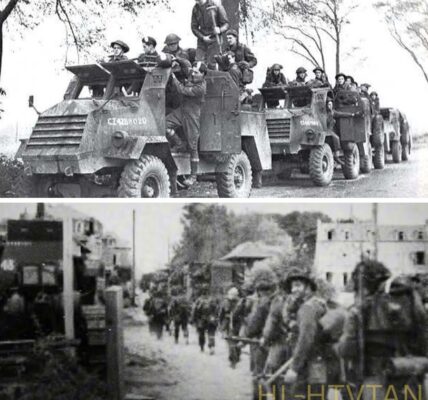
A photograph in the collection describes British troops arriving at Dover after being evacuated from Dunkirk in May 1940. The men returning across the English Channel were not arriving from a victorious campaign. Many had left behind equipment, vehicles, and the ground on which they had fought. They had escaped an encirclement that threatened to destroy much of Britain’s expeditionary force.
The German offensive in western Europe had advanced with extraordinary speed. British, French, and Belgian troops found themselves trapped around Dunkirk in northern France, with German forces closing in. By late May, the prospect of withdrawing a substantial number of Allied troops across the Channel appeared increasingly uncertain.
The British government authorized Operation Dynamo on May 26. Under the direction of Vice Admiral Bertram Ramsay, naval vessels and civilian boats took part in the evacuation. Over the following days, they transported troops from the beaches and harbor to safety in Britain. By June 4, approximately 338,000 British and Allied personnel had been evacuated.
The evacuation was an extraordinary logistical achievement, but it was not a victory in the conventional sense. The Allied armies had suffered a serious defeat in France. Much of their heavy equipment could not be brought back, and France remained under immediate threat.
Yet the evacuation prevented the loss of a vast number of trained personnel. Those soldiers could return to military service, and Britain retained a substantial force at a moment when the possibility of a German invasion was a major concern.
The distinction matters. Dunkirk did not win the war. It preserved an opportunity to continue fighting it.
A photograph of troops crowded aboard a destroyer or disembarking at Dover cannot reveal every individual’s experience. Some may have felt relief; others may have been exhausted, injured, or uncertain about what awaited them. Without personal testimony, it would be wrong to assign a single emotion to the men in the image.

What the photograph can establish, when supported by its archival record, is that soldiers who had been caught in a deteriorating military situation were brought back to Britain.
The retreat also revealed the vulnerability of modern armies. Training, discipline, and equipment could not guarantee success when strategic circumstances turned against them. At Dunkirk, survival depended on the ability to organize a withdrawal under pressure.
There is a tendency to remember military history through advances and victories. Dunkirk reminds us that retreat can also shape the course of a war. The ability to preserve a force, reorganize it, and return it to action can be strategically decisive even when the immediate outcome is defeat.
In May 1940, the soldiers arriving in Dover could not know how long the war would continue. They had escaped one crisis, but another was approaching.
Within months, German aircraft would be attacking British cities. The struggle that had unfolded across France and Belgium was reaching into the homes and streets of Britain itself.
The images of aircraft production and industrial machinery in the collection reveal another side of the conflict. A photograph describes newly built F4U Corsair and F6F Hellcat fighters being prepared for shipment to the Pacific Theater in 1944. Another depicts a B-24 Liberator attacking an oil refinery.
These images belong to different operational settings, but they share a common theme: the growing dependence of modern warfare on industrial production, transportation, fuel, and engineering.
The Corsair and Hellcat were important American naval fighters during the Pacific War. Their production allowed American forces to equip carrier air groups and support operations across a vast theater. The aircraft were not simply machines assembled and sent into battle. They were the products of a system linking factories, supply depots, shipyards, maintenance facilities, and military bases.
A fighter delivered to the Pacific had to be transported over enormous distances, maintained in difficult conditions, supplied with ammunition and fuel, and flown by trained personnel. Each stage depended on other parts of the war economy.
The same principle applied to bombers operating over Europe.

The B-24 Liberator was a long-range heavy bomber used extensively by American forces. Its range and payload made it suitable for attacks on industrial and strategic targets, including oil production facilities.
One particularly significant operation was the August 1, 1943, attack on the oil refineries around Ploiești, Romania, known as Operation Tidal Wave. American B-24 crews attempted a low-level assault on heavily defended facilities supplying oil to Germany and its allies. The mission involved severe losses, and its results were mixed rather than an unqualified success.
The date matters because captions sometimes attach the year of a campaign to a photograph without identifying the precise operation. If an image is labeled simply as a B-24 attacking the Ploiești refinery in 1943, it should not automatically be assumed to depict the August 1 raid unless the original record confirms it.
That distinction does not reduce the importance of the broader campaign. Oil was essential to the German war effort. Aircraft, tanks, trucks, and other military vehicles could not operate without fuel, and attacks on petroleum production were intended to constrain the enemy’s ability to sustain its forces.
But strategic bombing also revealed the limits of military power. A successful strike against a target did not necessarily produce the anticipated strategic result. Industrial systems could be repaired, production could be relocated, and the enemy could adapt. The effects of an operation had to be judged against its costs and its actual contribution to the wider campaign.
The aircraft photographs therefore record both technological capability and the immense resources required to use it.
A finished fighter represented the labor of thousands of people. A bomber on a mission represented a crew, a supply chain, a maintenance organization, and a plan whose outcome remained uncertain.
Behind the machinery stood people who might never see the aircraft they helped produce. Their work was part of the war, even when it took place far from the battlefield.

And while factories produced the equipment needed to fight, governments and military commanders had to decide where that equipment would be sent and how it would be used.
Those decisions shaped not only the course of military operations but also the risks faced by civilians in Europe and Asia.
In January 1943, President Franklin D. Roosevelt traveled aboard a Boeing 314 flying boat on the way to the Casablanca Conference in French Morocco. A photograph described in the collection shows Roosevelt celebrating his birthday aboard the aircraft.
The detail is striking because it places a major political leader in a setting that was both unusual and directly connected to the demands of wartime diplomacy. The aircraft was a large transoceanic flying boat, designed to carry passengers over long distances. In wartime, such transportation offered leaders a way to travel between distant centers of government and military planning.
The Casablanca Conference brought Roosevelt and British Prime Minister Winston Churchill together to discuss the direction of the war. Their deliberations concerned military strategy in Europe and the Mediterranean, the continuation of pressure against Germany and Italy, and the wider coordination of Allied operations.
One of the most consequential public outcomes was the declaration that the Allies would seek the unconditional surrender of Germany, Italy, and Japan. The precise implications of that policy would be debated, but the declaration signaled that the Allied powers did not intend to settle the conflict through a limited compromise with the Axis governments.
This was a different kind of wartime scene from the bombers over London or the soldiers returning from Dunkirk. No battle is visible. No destroyed building marks the immediate cost of a decision.
Yet the conference illustrates how the war was shaped by choices made far from the front lines. Leaders had to consider the allocation of forces, the timing of operations, the risks of opening new fronts, and the resources available to sustain campaigns that might last for years.
The decisions were not made in a vacuum. The Allies had to account for their own military limitations, the capabilities of their opponents, and the need to coordinate operations across enormous distances. A decision to concentrate resources in one theater could affect the timing or scale of operations elsewhere.
The photograph of Roosevelt aboard the flying boat offers a glimpse of the human setting around this work. It does not, by itself, reveal what was discussed during the journey or establish the details of every decision made at Casablanca. Those questions belong to documentary records, conference minutes, correspondence, and historical scholarship.
Still, the image reminds us that the machinery of war extended into government offices, diplomatic meetings, transport networks, and planning rooms. The outcomes of military campaigns were influenced not only by what happened during combat but also by what political and military leaders decided beforehand.
That relationship between leadership and consequences is one of the central problems of military history. Decisions can be made with incomplete information, and their effects may reach people who had no part in making them.
The people living in London’s docklands, the soldiers returning from Dunkirk, and the workers assembling aircraft were all connected to the decisions of governments, even though their individual experiences were very different.

Not every photograph associated with the Second World War shows a battlefield. One of the most unsettling descriptions in the collection concerns Joseph Goebbels with his daughters at a Christmas party on December 23, 1937.
The photograph predates the war in Europe. It depicts a family gathering several years before the Nazi regime collapsed in 1945. That difference in timing is important: it should not be presented as a wartime scene simply because of what later happened to the people involved.
Goebbels was one of Adolf Hitler’s closest political associates and served as Nazi Germany’s minister of propaganda. He helped shape the regime’s public messaging, promoted antisemitism, and supported the political system that led Germany into war and carried out mass persecution.
A family photograph, however, cannot by itself reveal the private dynamics of the household. It shows people gathered at a particular moment. It does not tell us what every person thought, what they knew, or how they understood the world around them.
The historical significance emerges from the contrast between the ordinary appearance of the scene and the political role played by the adults in it.
The Nazi regime relied on images of family life, national unity, tradition, and personal loyalty to present itself as legitimate. Such images were part of a broader political culture in which propaganda sought to make the regime appear natural, stable, and worthy of allegiance.
But the appearance of domestic normality did not erase the regime’s crimes. Nor did the existence of a family gathering make the political actions of its adult participants less consequential.
This is a difficult aspect of studying authoritarianism. People involved in destructive political systems do not necessarily appear extraordinary in every setting. They may be photographed at family gatherings, public ceremonies, or ordinary social occasions. The historical task is to understand those images without allowing their familiarity to obscure the actions for which individuals and institutions were responsible.
The same principle applies to the photograph described as showing Hitler with a Hitler Youth boy on April 20, 1945. By that date, Berlin was under immediate threat, and the Nazi regime was approaching its collapse.
The contrast between public ceremony and military catastrophe was profound. The regime had spent years promoting the image of Hitler as an unshakable leader. Yet the German military position had deteriorated, and the capital was about to fall to Soviet forces.
Hitler died on April 30, 1945. Germany surrendered in May.
A photograph taken during those final days can preserve the outward image of authority. It cannot restore the power that authority once possessed, nor can it explain the full circumstances of the regime’s collapse.

The image’s significance lies in the difference between what a political photograph may have been intended to communicate and what later generations know about the historical setting in which it was taken.
That difference should not lead us to invent hidden meanings or private conversations. It should encourage us to examine the image alongside the documentary record.
The Nazi regime’s defeat ended its control over Germany, but the consequences of its policies extended far beyond that moment. The destruction of European Jewish communities, the persecution of other targeted groups, the devastation of occupied territories, and the loss of millions of lives could not be reversed by military surrender.
The end of the war was a turning point. It was not an erasure of the past.
Among the most important human stories associated with the war is that of Otto Frank, the only member of his immediate family to survive the Holocaust.
A photograph described in the collection shows Otto Frank in 1979, guiding Queen Juliana of the Netherlands through the attic where he and his family had hidden during the German occupation.
The setting was the secret annex in Amsterdam, where Otto Frank, his wife Edith, their daughters Margot and Anne, and four other people lived in hiding for more than two years. Their concealment began in July 1942, as Nazi persecution and deportations intensified in the Netherlands.
The annex offered protection, but it was also a confined and uncertain place. The people hiding there depended on assistance from trusted helpers and had to remain concealed from the outside world. Their circumstances were shaped by the constant danger of discovery.
In August 1944, the people in hiding were arrested. They were deported through the Nazi camp system. Anne and Margot Frank died at Bergen-Belsen in 1945. Edith Frank died at Auschwitz. Otto survived Auschwitz and eventually returned to the Netherlands.
The photograph of Otto Frank in the annex decades later belongs to a different moment from the one in which his family hid there. By 1979, the room had become a place through which visitors could learn about persecution, concealment, and the experiences of those who lived under Nazi occupation.
Otto’s presence connected the physical location to a surviving witness. The walls and rooms could be preserved, but the significance of the site depended on the historical record and the testimony of those who had experienced it.

Anne Frank’s diary became one of the most widely read accounts of life in hiding during the Holocaust. It does not represent the experience of every Jewish family under Nazi rule, and it cannot stand in for the full diversity of Holocaust testimony. Its importance lies in the specific perspective it preserves: the observations and reflections of a young person living under persecution.
The diary also demonstrates how historical evidence can survive in unexpected forms. It is not a military report or a government document. It is a personal record, written under extraordinary circumstances, that later helped generations understand the human experience of the Holocaust.
The annex itself cannot tell the entire story. Nor can one photograph of Otto Frank convey the loss of his family. But the combination of a preserved location, surviving testimony, documentary evidence, and historical research allows the site to serve as a place of remembrance and education.
The photograph’s emotional weight comes from this connection between place and absence. Visitors can stand where people once hid, but they cannot recover the lives that were interrupted or the future that was taken from those who did not survive.
This is one reason historical sites and archives matter. They preserve evidence that can be examined, questioned, and passed to future generations. They also make it more difficult to reduce the past to a collection of abstract dates.
Otto Frank’s story is a reminder that survival did not mean freedom from loss. He returned from the camp system to a world in which his wife and daughters were gone. The family photographs, diary, and preserved rooms became part of the record through which others could learn about their lives.
The purpose of remembering such places is not to turn tragedy into spectacle. It is to understand the people who lived there and the system that persecuted them.
The Second World War ended in Europe in May 1945, but the images associated with its aftermath reveal how much remained unresolved.
A photograph described as showing a man removing a statue of Stalin in Budapest in 1990 belongs to a much later period of European history. It should not be confused with the war itself. Yet it illustrates how the political order that emerged after 1945 would eventually face its own challenges and transformations.
The Soviet Union had become one of the principal victors of the Second World War, but the postwar division of Europe created new tensions. The Cold War brought decades of political rivalry, military competition, and ideological confrontation between the Soviet-led Eastern bloc and the Western powers.
For countries in Eastern Europe, the postwar decades included periods of Soviet influence and intervention. In Hungary, the 1956 uprising was a major challenge to the country’s Soviet-backed political order. Soviet forces intervened militarily, and the uprising was suppressed. The event became an enduring symbol of the struggle over political independence and the limits imposed by Soviet power.
The later removal of monuments associated with Stalin belongs to the history of reassessing that political legacy. But a photograph alone cannot establish the precise circumstances of a particular demolition. The date, location, identity of the statue, and official authorization should be verified before the image is used to support a specific historical claim.

This distinction matters because the decades after 1945 were not simply an extension of the Second World War. They were a new historical period shaped partly by the war’s consequences, including the division of Europe, the emergence of competing military alliances, and the development of nuclear weapons.
The memory of the war influenced political decisions long after the guns fell silent. Governments prepared for the possibility of another major conflict, while citizens and activists increasingly debated the risks of nuclear confrontation.
A photograph of a protest against nuclear weapons, such as the demonstration described in London’s Trafalgar Square on April 3, 1961, belongs to that wider history of postwar anxiety. Its participants were not necessarily responding to the same circumstances, and their individual motivations cannot be determined from the image alone. But the broader context is clear: nuclear disarmament had become a major public issue.
The fear of another war was not abstract. The destruction of Hiroshima and Nagasaki in August 1945 had demonstrated the unprecedented destructive capacity of atomic weapons. In the decades that followed, the accumulation of nuclear arsenals raised questions about deterrence, escalation, and the possibility of catastrophic miscalculation.
The history of the twentieth century therefore cannot be divided neatly into a period of war followed by a period of peace. The end of one conflict created conditions for new rivalries, while the memory of the previous catastrophe shaped how governments and societies understood the dangers ahead.
That does not mean the later decades should be treated as one continuous war. It means the consequences of the Second World War must be understood alongside the distinct events that followed it.
The collection brings together a wide range of images: military aircraft, political leaders, families, workers, cultural figures, protests, and moments of ordinary life. Many belong to periods unrelated to the Second World War. Some concern the First World War; others depict the Cold War, social movements, entertainment, or events decades later.
They should not be forced into a single chronology merely because they appear together.

A photograph of a German bomber over London in 1940 tells us something different from a photograph of a B-24 over an oil refinery in 1943. A picture of troops arriving at Dover after Dunkirk documents a different stage of the conflict from a photograph of Otto Frank revisiting the annex in 1979.
Their value comes from the specific circumstances they preserve.
The most important question is not simply whether a photograph looks dramatic. It is whether its date, location, caption, and historical context can be established.
An image may be authentic while its accompanying caption is inaccurate. A genuine photograph may be assigned the wrong year, misidentify a person, or describe an event more confidently than the evidence allows. In other cases, the original photographer may have recorded only a limited part of a much larger event.
For that reason, photographs should be compared with archival catalogues, contemporary documents, military records, museum collections, and reliable historical research.
The distinction is particularly important when images concern Nazi persecution, military operations, or civilian casualties. These are subjects in which inaccurate captions can distort public understanding, even when the underlying photograph is genuine.

Careful verification does not make a photograph less powerful. It gives its historical meaning a firmer foundation.
Nor should every image be expected to reveal the private thoughts of the people pictured. A frightened expression does not tell us precisely what someone feared. A smiling family does not establish that its members felt secure. A soldier standing beside a damaged aircraft does not reveal everything that happened during the mission.
We can recognize the human significance of an image without pretending to know details that the evidence cannot establish.
This approach also helps distinguish documented events from interpretation. The start of the Blitz on September 7, 1940, is an established historical event. The meaning of a particular photograph within that campaign requires a closer examination of its provenance and context. The wider consequences of the bombing can be studied through records, testimony, and research, but an individual image cannot independently establish every aspect of the campaign.
History becomes more compelling, not less, when those distinctions are respected.
The war was already extraordinary in its scale and consequences. It does not need invented dialogue, exaggerated descriptions, or manufactured mysteries to make its significance clear.
A damaged aircraft, a crowded evacuation vessel, a preserved hiding place, or a ruined city can speak powerfully when the surrounding facts are understood.
The people who appear in these photographs lived in circumstances that were often uncertain. They did not know which events would later be described as turning points or which ordinary moments would survive in archives. Some were soldiers, some were civilians, and some were children whose lives were shaped by decisions made by others.
Their photographs have outlived the immediate circumstances in which they were taken. That survival gives later generations an opportunity—and a responsibility—to examine them carefully.
The purpose of looking back is not to turn every image into a dramatic scene. It is to understand what happened, why it mattered, and what can legitimately be learned from the surviving evidence.
The Second World War was shaped by political decisions, industrial capacity, military strategy, ideological persecution, and the actions of millions of people. Its consequences extended from individual households to entire continents. No single photograph can encompass that history.
But each properly documented image can offer a starting point.

A bomber over London opens a window onto the Blitz. A ship arriving at Dover leads us toward Dunkirk. A photograph of Otto Frank in the annex invites us to examine the Holocaust through the testimony of those who endured it. The ruins of a city lead us to the long work of reconstruction.
Together, such records remind us that history is not only the story of what governments and armies did. It is also the story of the people whose lives were changed by those actions.
The most responsible way to remember them is to preserve the evidence, acknowledge uncertainty where it exists, and resist the temptation to make the past more dramatic by making it less accurate.
War changes the world through decisions made in moments of crisis. History gives later generations the opportunity to examine those decisions after their consequences have become visible.
When you look at these wartime photographs, what do you believe deserves greater attention: the strategic decisions that shaped the conflict, or the experiences of ordinary people who had to live with the consequences?
Some content was generated using AI tools (including ChatGPT) and edited by the author for creativity, storytelling, and historical illustration purposes. Historical facts and key details should be verified against reliable historical sources. Any AI-generated or reconstructed visuals are intended for illustrative purposes and should not be interpreted as original historical photographs or archival evidence.