The photographs of the American West rarely show the whole story. A military camp stretches across the plain at Pine Ridge. Miners disappear beneath mountains of snow. Chinese railroad workers live beside tracks pushing westward. Native families stand silently before the camera while towns, railroads and ranches rise around them. At first, these seem like separate moments. But look longer, and a darker question emerges: what kind of country was being built—and what was being lost while it was built?
On January 19, 1891, the Seventh Cavalry was photographed at Pine Ridge Agency in South Dakota. The Library of Congress identifies the image as a military camp containing tents, horses and wagons, photographed by W. R. Cross. The date places the photograph only weeks after the massacre at Wounded Knee, during a period of intense military presence and political tension on the Pine Ridge reservation.
The photograph itself is remarkably quiet.
Rows of white tents stretch across the landscape. Horses stand among wagons. Nothing in the image moves. Yet the silence is misleading. The camp represented the presence of the United States Army at a moment when relations between federal authorities and Lakota communities had reached one of the most painful points in the history of the American frontier.
The camera does not show what happened at Wounded Knee.

It shows what remained afterward.
That distinction matters.
Photographs can preserve evidence without explaining everything that evidence means. They can show a military camp, but they cannot automatically tell us what every person in that camp believed, feared or intended. The historical record must do that work.
And beyond Pine Ridge, another West was already taking shape.
In an open corral, cowboys wrestled with cattle as branding irons marked animals with the symbols of ownership. The scene was part of a ranching culture that depended upon identification, movement and control of enormous herds across territories where fences were still limited or absent.
The work was practical.
It was also physically demanding.

A calf had to be restrained. The branding iron had to be heated. The mark had to be applied quickly. There was little romance in the process itself.
Yet later generations would transform such scenes into one of the defining images of the American West.
The cowboy became a symbol.
The cattle became an industry.
The open range became a memory.
And somewhere between those three ideas was the ordinary labor that made the system possible.
Mining presented another version of the same reality.
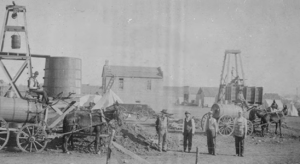
At Warren in Idaho County, miners posed near the entrance of an excavation surrounded by rail carts, barrels and rough wooden supports. The photograph records a world in which extracting valuable material from the earth required enormous physical effort.
There were no modern machines waiting underground.
Timber had to be positioned.
Ore had to be moved.
Supplies had to reach workers.
The deeper the excavation became, the more complicated the work became.
The image therefore reveals something that romantic stories about gold and silver often conceal. Mining was not simply the discovery of wealth. It was a logistical struggle against rock, weather, distance and exhaustion.
Then came winter.
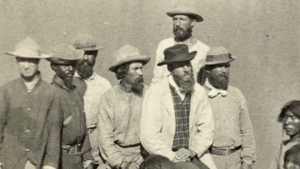
In Colorado’s high country, photographs from the late nineteenth century show settlements buried beneath enormous accumulations of snow. In some mining communities, roofs and chimneys were among the few visible signs that people were still living beneath the frozen landscape.
Imagine what such a photograph actually means.
The snow is beautiful.
The circumstances were not.
For miners and their families, winter could determine whether supplies arrived, whether transportation remained possible and whether work could continue. A mountain settlement might appear almost frozen in time, but underground and inside those wooden structures, people still had to eat, work, repair equipment and survive.
The pursuit of precious metals had brought them there.
The mountains decided how long they could stay.
Farther north, the search for gold became even more extreme.
Around the turn of the century, miners in Alaska worked with sluice boxes, pans and other relatively simple equipment to separate gold from gravel. The methods were physically demanding but understandable: water, gravity and human labor were used to separate heavier gold from surrounding material.
Every pan contained a possibility.
Most contained very little.

That uncertainty was part of the attraction.
Gold rushes were built not only on gold but on hope—the possibility that the next pan, the next claim or the next riverbank might change everything.
That promise drew thousands of people into landscapes that offered few guarantees.
In the Yukon, transportation could become a problem almost as serious as finding gold.
One photograph shows two men repairing a boat after a leak. The overturned craft appears almost vulnerable beside the river, while supplies wait nearby.
It is an unglamorous image.
But it tells the truth about frontier logistics.
A broken boat could mean lost time.
Lost time could mean lost supplies.
And lost supplies could mean real danger in an isolated settlement.
The gold rush was therefore not simply about prospectors standing over shining nuggets. It depended upon boats, animals, tools, food, clothing and people capable of moving all of them through difficult country.
Even gold itself required administration.
Near Nome, Alaska, two miners are shown weighing gold nuggets and dust in a rough cabin around 1900. The scale transformed something found in the ground into something measurable.
Before the scale, gold was a promise.
After the scale, it became a value.
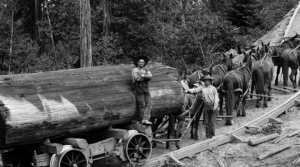
That small object represented an entire economic system developing in remote settlements.
A few particles could mean money.
A larger nugget could mean opportunity.
And a miner who had spent months searching could finally discover whether his labor had produced anything worth carrying home.
But the West was never built by miners alone.
On ranches and farms, workers performed another form of labor that was equally essential.
At Stockdale Ranch in California, workers used a pulley system to move alfalfa hay. Draft animals supplied the power while mechanical devices increased the amount that human workers could handle.
This was a transitional age.
The old West depended upon muscle and animals.
The modern West would increasingly depend upon machines.
The change did not happen overnight.
It appeared first in small mechanisms—pulleys, conveyors, improved agricultural equipment and transportation systems.
Then it became an entire economic transformation.
Coal mines revealed another side of this process.
Workers and draft animals operated in open-pit mining environments in the territories of the late nineteenth century. Behind the photographs was an expanding demand for fuel and industrial materials.
The West was becoming connected to a larger national economy.
Mines fed railroads.

Railroads moved people and goods.
Towns grew around transportation.
Farms supplied expanding populations.
And the frontier that once appeared impossibly distant became increasingly connected to markets thousands of miles away.
But one group was especially important to this transformation, and for decades its contribution was often reduced to a footnote.
Chinese workers.
Photographs from the construction of the Central Pacific Railroad show camps beside the tracks, including the famous Chinese camp at Brown’s Station. The Library of Congress dates Alfred A. Hart’s photograph to between 1865 and 1869.
The camps were not temporary details in some abstract engineering story.
They were communities.
People lived there.
They cooked.
They worked.
They rested.
They endured.
The National Park Service notes that roughly 20,000 Chinese workers made up most of the labor force on the Central Pacific portion of the first transcontinental railroad, which crossed the Sierra Nevada and connected with the Union Pacific at Promontory Summit in 1869.
Another National Park Service account records that by 1868 approximately 11,000 Chinese workers had been employed in construction of the Pacific Railroad, performing jobs including grading, track laying, masonry, blacksmith work and cooking.
Yet the famous celebratory photograph of the golden spike has an absence that is almost as important as what it contains.
Chinese workers were deliberately excluded from that symbolic image.
That detail changes how we look at the railroad photographs.
The tracks did not build themselves.
The spectacular achievement of transcontinental connection depended upon thousands of workers whose presence was essential but whose visibility in national memory was often limited.
The photograph of Brown’s Station therefore becomes more than a picture of tents beside railroad tracks.

It becomes evidence of who was there.
And perhaps more importantly, who was not always remembered afterward.
Railroad construction required another kind of worker too.
At Deadwood Central Railroad, an engineering crew posed with surveying instruments and measuring rods in 1888. The Library of Congress identifies the photograph as a group portrait of railroad engineers equipped with surveying transits and measuring rods.
The image looks almost formal.
Men stand in hats and suits.
A dog is nearby.
Tripods rise from the ground.
But these instruments were helping redraw the physical map of the West.
Every measurement represented a decision about where a railroad could go.
Every grade had consequences.
Every bridge connected one settlement to another.
The railroad was therefore more than transportation.
It was an instrument of transformation.
Once rails arrived, distances changed.
Markets changed.
Towns changed.

And the balance of power across the landscape changed.
The same process can be seen in photographs of locomotives winding through the Black Hills, passenger coaches crossing rough wooden bridges and stagecoaches waiting outside mail and express offices.
Before the railroad, a journey across the West could be slow, dangerous and uncertain.
Afterward, movement became increasingly organized.
Mail could travel farther.
Goods could move faster.
Passengers could cross territories that had once seemed almost unreachable.
But every new connection also accelerated settlement.
And that created another question.
Who was already living on the land?
The answer appears repeatedly in the photographs.
Native families.
Chiefs.
Scouts.
Police.
Women.
Children.

Entire communities photographed during a period of enormous pressure and change.
At Standing Rock Agency, records from the period show Native people gathering for government-distributed food and supplies. A Library of Congress record of an 1883 image describes a large group arriving at the agency to receive food and other supplies from the government.
The photograph does not need dramatic language.
The dependence is visible.
The agency system had become part of the machinery through which federal policy managed Native communities.
The image therefore stands in sharp contrast to photographs of cowboys moving freely across open country.
For one group, the West represented mobility.
For another, it increasingly meant restriction.
That contrast is one of the central realities hidden beneath romantic images of the frontier.
Photographs of Native men and women wearing traditional clothing, medals, blankets and other cultural objects preserve another side of this history.
They show people adapting without simply disappearing.
Some images reveal Western clothing.
Others show traditional dress.
Some show people at military posts.

Others preserve family life and traditional shelters.
Taken together, they demonstrate that cultural change was not a simple story of one society replacing another overnight.
It was a long process of pressure, adaptation, resistance and survival.
The photographs of Cheyenne Indian Police members are particularly revealing.
They wore uniforms and carried out duties within a system shaped by federal authority, while also belonging to Native communities themselves.
That creates an uncomfortable historical complexity.
They were not simply representatives of one side or another.
They lived inside a changing political world and had to navigate it.
History often becomes misleading when it divides everyone into neat categories.
The photographs refuse to do that.

A person could wear a U.S. government uniform and still belong to a Native nation.
A Chinese immigrant could build a railroad that transformed America while facing discrimination.
A cowboy could symbolize freedom while working within a tightly organized economic system.
A miner could arrive seeking independence and become dependent upon distant markets.
The West was full of contradictions.
And those contradictions become even clearer when we return to the towns.
In September 1893, the land run at Perry, Oklahoma Territory, brought settlers, wagons and improvised structures into a rapidly changing landscape. Photographs show temporary camps, wooden buildings, animals and people attempting to establish a new community almost immediately.
The speed is astonishing.
One day, open land.
Soon afterward, streets.
Then stores.
Then water systems.
Then rail connections.
Settlement could happen with extraordinary speed.

But speed came with instability.
People needed food.
They needed water.
They needed transportation.
They needed businesses.
They needed shelter.
They needed law.
And they needed a reason to believe the settlement would survive.
The image of a water wagon at Perry in October 1893 captures one of those less glamorous necessities.
A growing town could not survive on optimism.
It needed infrastructure.
Across the West, the same pattern repeated.
A settlement began.
A store appeared.
A saloon followed.
A stagecoach route connected it to somewhere else.
Then a railroad arrived.

Then the population increased.
What had begun as a camp could become a town.
Dodge City offers a familiar example.
By the mid-1880s, it had become one of the recognizable centers of the cattle frontier. Dirt streets, wooden buildings, horses and wagons created an urban environment that still looked unmistakably rural.
The transformation was already underway.
The frontier was becoming a network of communities.
But the image of the West as a place inhabited almost exclusively by white settlers is contradicted by the photographs themselves.
Chinese merchants operated businesses.
Black workers participated in ranching.
Native communities remained present.
Immigrants built railroads.
Women ran households and performed essential work in isolated settlements.
Workers of many backgrounds participated in agriculture, mining, transportation and commerce.
One photograph of Chinese merchants outside a general store in Arizona Territory in 1894 captures this particularly well. The signs and storefront reflect the presence of Chinese commercial life in the Southwest.
The West was never culturally empty.
It was already crowded with different histories.
The camera sometimes reveals this more clearly than later mythology does.
Another overlooked figure is the woman.

Photographs from frontier settlements frequently place women in domestic settings, but some images reveal something more unexpected.
Women traveled.
They worked.
They managed households.
They participated in the economic survival of isolated communities.
The photograph described in the original material as “ARS” standing beside her canvas tent in Alaska around 1902 should be treated cautiously because the identification is not fully established here. But the broader historical point remains: women were present in mining camps and frontier settlements, performing work essential to food, lodging, communication and community survival.
Similarly, the photograph of Arizona Mary driving a long team of oxen across an arid landscape challenges the assumption that frontier transportation was exclusively a male domain.
Whether every biographical detail attached to such images can be confirmed is another matter.
The image itself still asks an important question.
Who actually kept these settlements moving?
Sometimes the answer is the person history later forgot.

The same can be said of the expeditions that mapped the West.
William Henry Jackson’s photographs are among the most important visual records of nineteenth-century exploration. In 1871 he joined Ferdinand Hayden’s geological survey of Yellowstone, carrying heavy photographic equipment into difficult terrain. The National Park Service notes that Jackson’s images helped convince Congress and the public of Yellowstone’s significance, contributing to the creation of the national park in 1872.
Imagine what that work required.
A modern photographer can carry a small camera.
Jackson carried equipment, glass plates, chemicals and supplies.
The National Park Service describes the practical difficulties: fragile glass plates, water, chemicals, portable darkroom tents and bulky cameras had to be transported across rugged country by pack animals.
The result was more than photography.
It was documentation.
Mountains that many Americans knew only through stories suddenly appeared in photographs.
Landscapes once dismissed by some as exaggerated became visible to people far away.
Photography helped transform remote geography into national imagination.
But there is an irony here.
The same photographic expansion that documented the landscape also documented a society transforming it.
The camera preserved the wilderness.
The railroad crossed it.
The mine cut into it.
The ranch occupied it.
The town expanded across it.
The photograph therefore becomes a witness to two simultaneous processes: exploration and transformation.
One does not exist without the other.
By the 1890s, railroads were pushing deeper into landscapes that earlier generations had considered remote.
A Black Hills and Fort Pierre Railroad locomotive moves through Elk Canyon.
Burlington and Missouri River Railroad trains appear near Hot Springs.
Stagecoaches cross bridges.

Freight wagons carry heavy loads.
The West is no longer isolated.
It is connected.
And once connected, it begins to accelerate.
Gold must move.
Coal must move.
Cattle must move.
Mail must move.
People must move.
Everything becomes part of a larger system.
That system brought opportunity.
It also brought conflict, displacement and environmental change.
The photographs cannot resolve every moral question created by that transformation.

They can, however, prevent us from pretending those questions did not exist.
Perhaps that is why the photograph of a Native family standing before a traditional tipi feels so different from a photograph of a railroad locomotive.
Both represent movement through time.
But only one is usually described as the future.
The other is often described as the past.
That distinction itself reflects the assumptions of later generations.
The people in those Native photographs were not living in an obsolete world.
They were living in their present.
They were making decisions.
They were raising families.
They were adapting.
They were trying to survive a political and economic transformation they had not created.
Some leaders appear on horseback in ceremonial clothing.
Some families stand in front of tipis.
Some individuals wear medals or objects representing status.
Some appear at military posts.

These photographs should not be reduced to symbols of disappearance.
They are records of people who remained visible despite immense pressure.
The same principle applies to the settlers.
A pioneer family standing outside a wooden house may look peaceful.
But the building itself tells another story.
Vertical boards.
A shingle roof.
Limited protection from weather.
A forest or open plain beyond the house.
The family had created a home, but the environment remained powerful.
The frontier demanded adaptation from everyone.
Miners lived in cabins.
Ranchers depended upon horses.
Farmers depended upon animals and increasingly machines.
Railroad workers lived in camps.
Explorers depended upon pack animals.
Native communities adapted to new political realities.
No photograph tells the entire story.

But together they reveal a society learning to live with distance.
And then, slowly, distance began to disappear.
That may be the deepest transformation captured in these images.
A century ago, the West was defined partly by how difficult it was to move through.
The mountains separated communities.
Rivers interrupted journeys.
Snow closed routes.
Animals carried supplies.
Boats were essential.
Stagecoaches followed rough roads.
Railroad engineers surveyed uncertain terrain.
Then the rails arrived.
The tracks became permanent lines through a landscape that had once seemed almost limitless.
And once the railroad connected the West, the old meaning of distance began to collapse.
That transformation came at a cost.
The same infrastructure that created opportunity also intensified settlement and territorial control.

The same government systems that supplied reservations also imposed restrictions.
The same industries that created jobs extracted enormous quantities of natural resources.
The same photographs that celebrated progress sometimes captured the people pushed to its margins.
This is why these images should not be viewed merely as nostalgic windows into a romantic Wild West.
They are fragments of a much more complicated history.
A history of ambition.
Labor.
Migration.
Innovation.
Displacement.
Adaptation.
Conflict.
And survival.
The most revealing photographs are often the quietest.
A miner weighing dust.

A railroad engineer holding a surveying instrument.
A family standing outside a cabin.
A worker beside a hay pulley.
A woman beside a tent.
A Chinese camp beside railroad tracks.
A Native family outside a tipi.
A military camp at Pine Ridge.
None of these photographs contains the entire American West.
But each contains one piece of it.
And when those pieces are placed together, the familiar legend begins to change.
The West was not built by lone heroes riding across empty landscapes.
It was built by thousands of people whose labor, decisions and suffering changed the continent.
Some became famous.
Many did not.
Some had power.
Many had very little.
Some arrived looking for wealth.
Others were already living on the land.

Some built the railroads.
Others watched those railroads cross territories that had once belonged to their communities.
Some photographed the landscape.
Others became subjects inside the landscape.
The camera preserved them all.
That is the strange gift of historical photography.
It freezes people who could not know how history would later interpret them.
The men beside the railroad tracks did not know that generations later someone would study their faces.
The miners could not know that their cabins would become museum images.
The Native families could not know that their photographs would become evidence of a world undergoing irreversible transformation.
The settlers could not know how quickly their temporary camps would become towns.
And the soldiers at Pine Ridge could not know how historians would continue debating the meaning of the events surrounding them.
The photograph stops time.

History does not.
And perhaps that is the reason these images still feel unsettling.
They show a world that looked permanent while it was actually changing beneath everyone’s feet.
The tents would disappear.
The camps would move.
The mines would close.
The stagecoaches would vanish.
The railroads would become ordinary.
The frontier would cease to exist in the way people imagined it.

But the photographs remained.
They became fragments of evidence from a country being built at extraordinary speed.
My personal view is that the most valuable way to look at these photographs is neither to romanticize the Old West nor to reduce it to a single story of conquest. The images show something more difficult and more human: people working, adapting, building families, searching for opportunity and trying to survive enormous changes. They also remind us that progress is never experienced in exactly the same way by everyone living through it.
The real question these photographs leave behind is not simply what the American West looked like.
It is this: when a society changes as rapidly as this one did, whose story gets remembered—and whose story remains just outside the frame?
Some content was generated using AI tools (including ChatGPT) and edited by the author for creativity, storytelling, and historical illustration purposes. Historical facts and key details should be verified against reliable historical sources. Any AI-generated or reconstructed visuals are intended for illustrative purposes and should not be interpreted as original historical photographs or archival evidence.