‘Boo If You Have To’: The Explosive Call to End Welcome to Country — And the Battle Over Identity It Ignited. n1

The Battle for the Spirit of a Continent: Unpacking Australia’s Warfare Over “Welcome to Country”
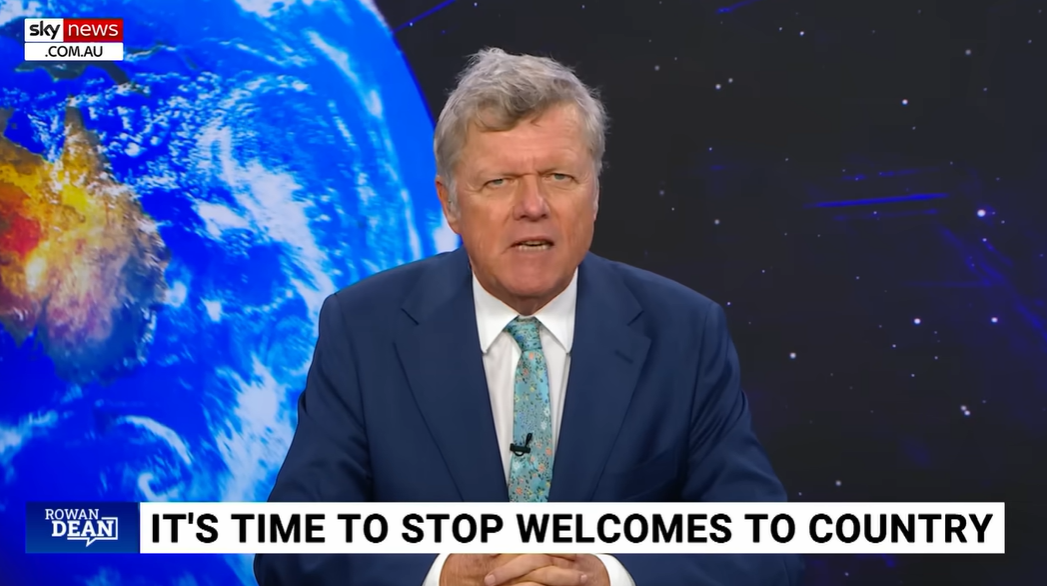
The simmering battle over Australia’s cultural identity and national memory has exploded once again into open political warfare. The latest flashpoint was triggered by a ferocious on-air monologue delivered by Sky News Australia host Rowan Dean, whose blunt demand for an absolute, immediate end to the traditional “Welcome to Country” ceremony has sent shockwaves across the country’s political, media, and social landscapes.
Speaking during his televised commentary segment, Dean launched a scathing assault on the decades-old practice, branding the ceremonial greeting a “shambolic mess” that has outlived its purpose and alienated millions of ordinary citizens. But beyond his harsh critique of the ritual itself, it was Dean’s inflammatory call to public resistance that ignited intense national debate.
“It’s time to stop it. If it takes booing, then boo. If it takes a change of government, then change the government,” Dean declared on air, urging viewers to actively disrupt public events where the ceremony is performed and vote out politicians who sanction its continuation.
The “Welcome to Country” is a formal protocol performed by Indigenous Traditional Custodians—Elders or community representatives authorized by their mobs—to welcome visitors to their ancestral land. Distinct from the shorter “Acknowledgement of Country” (which can be spoken by anyone, Indigenous or non-Indigenous), a Welcome to Country often involves traditional music, dance, smoking ceremonies, or spoken blessings in local Indigenous languages. Over the last quarter-century, the practice has transformed from a niche cultural gesture into a ubiquitous staple of public life in Australia. Today, it is routinely performed at official government assemblies, corporate AGMs, university graduations, public school assemblies, and major sporting fixtures like the AFL and NRL grand finals.
For millions of Australians, the ceremony represents a vital, tangible act of historical truth-telling, reconciliation, and respect toward Aboriginal and Torres Strait Islander peoples, whose continuous living cultures on the continent date back more than 65,000 years.

Dean, however, constructed a starkly opposing argument, asserting that the ritual has strayed radically from its authentic cultural roots. In his view, the ceremony has been weaponized by political elites and corporate boards, converting a once-meaningful gesture into an ideological tool that imposes collective guilt on the general population.
“Welcome to Country must stop and must stop right now. We’ve had enough,” Dean insisted, framing the issue not merely as a matter of event etiquette, but as a direct challenge to Australian sovereignty and personal property rights.
The crux of Dean’s argument hinged on the concept of territorial belonging and democratic equality. “Australia was their land. Australia is our land. It is my land. It is your land,” he argued, contending that no citizen should feel like an outsider in their own country. “It is not somebody else’s land that we have to be invited and welcomed onto”.
These specific words struck a deep raw nerve across the nation, striking directly at the unresolved legacy of European colonization, the doctrine of terra nullius (land belonging to no one), and the contested nature of modern Australian citizenship.
Supporters of Dean’s stance immediately rallied to his defense across conservative media outlets and online forums. They argue that a growing segment of the Australian population suffers from severe “ceremony fatigue,” feeling increasingly alienated by what they perceive as repetitive, performative virtue-signaling. Defenders contend that when banks, airlines, local councils, and private corporations insert formal ceremonial acknowledgments into routine emails and daily commercial interactions, the practice ceases to convey genuine respect and instead devolves into a bureaucratic box-ticking exercise that deepens cultural divisions.
Conversely, critics, Indigenous leaders, and human rights advocates slammed Dean’s commentary as dismissive, historically revisionist, and dangerous. Indigenous Elders emphasized that a Welcome to Country is inherently an invitation of hospitality, inclusion, and shared guardianship—a traditional custom designed to grant safe passage to travelers crossing ancestral tribal boundaries. Far from telling non-Indigenous citizens that they do not belong, advocates argue the ceremony extends an embrace, inviting every Australian to honor the deep, unbroken history of the land they call home.
The political response to the controversy has been calculated and cautious. While prominent conservative figures have acknowledged widespread public debate over “ceremony fatigue,” many have sought to distance themselves from explicit calls for public booing. The federal Labor government, led by Prime Minister Anthony Albanese, has maintained its steadfast support for Indigenous recognition initiatives—having previously championed the 2023 referendum to establish an Indigenous Voice to Parliament—though ministers have largely refrained from engaging directly with Dean’s broadcast theatrics.
Digital platforms have acted as an accelerant for the controversy. Clips of Dean’s segment have racked up millions of views across YouTube, X (formerly Twitter), and Facebook, spawning trending hashtags and fiercely contested comment threads. The debate has drawn in everyday citizens, academic historians, sports stars, and media commentators, revealing a nation fundamentally divided over how to honor its past while maintaining a unified vision for its future.
My Professional Perspective
The Anatomy of Post-Referendum Cultural Warfare
Having covered geopolitics, civil unrest, and constitutional crises across three continents over the past thirty years, I recognize the distinct anatomy of a culture war when it erupts. What we are witnessing in Australia right now is not a spontaneous argument over whether a football match should begin with a smoking ceremony or a speech. It is the raw, unhealed trauma of a nation grappling with the political wreckage of the 2023 Voice to Parliament referendum.
When the Australian electorate decisively rejected the constitutional recognition of First Nations peoples in October 2023, political strategists predicted that the issue of Indigenous affairs would quietly recede into the parliamentary background. That was a profound miscalculation. Instead of settling the debate, the “No” vote uncorked a pent-up wave of conservative grievance and progressive disillusionment.
Rowan Dean’s crusade against the Welcome to Country is the natural continuation of that political friction. In the post-referendum landscape, ceremonial symbols—the Aboriginal flag flying alongside the Southern Cross, the Acknowledgement of Country on corporate websites, and the Welcome to Country at public gatherings—have become proxy battlegrounds. For conservative commentators, attacking these symbols is a high-yield political strategy. It mobilizes a voter base that feels culturally alienated by urban elites, corporate HR departments, and public broadcasters.
To understand why Dean’s rhetoric resonates with a specific segment of the population, one must look at the psychological mechanics of modern populism. By instructing his audience to “boo” or “change the government,” Dean is validating a latent resentment. He is offering his viewers permission to reject a cultural norm that they have felt forced to passively accept for two decades under threat of being labeled insensitive or racist.
                  THE ANATOMY OF SYMBOLIC FRICTION

  [ High-Minded Reconciliation Goals ] ──► Rapid Corporate Adoption
                                                     │
                                                     ▼
  [ Ubiquitous Public Implementation ] ──► Perception of "Performative Mandate"
                                                     │
                                                     ▼
  [ Backlash & "Ceremony Fatigue" ]   ──► Political Exploitation & Friction
The Institutional Infection: How Corporate Bureaucracy Diluted a Sacred Ritual
Where the traditional narrative surrounding this debate fails is in its refusal to examine how the Welcome to Country was transformed from a sacred cultural protocol into a corporate compliance mechanism.
Traditionally, an invitation to a Welcome to Country was an event of genuine solemnity and spiritual gravitas. It was performed when crossing into another mob’s territory—a custom rooted in centuries of diplomacy, trade, and inter-tribal law among First Nations clans across the continent. It was intimate, site-specific, and deeply personal.
However, over the past decade, Australia’s institutional class—spanning multinational mining companies, big-four banks, public universities, and state bureaucracies—enthusiastically co-opted Indigenous symbols as part of their corporate Environmental, Social, and Governance (ESG) portfolios. Suddenly, an Acknowledgement of Country was stapled to the bottom of routine corporate email signatures, recited before internal Zoom meetings about quarterly revenue targets, and broadcast over loudspeakers in suburban shopping centers.
This hyper-institutionalization created two distinct, unintended consequences:
-
The Invalidation of Meaning: When a ritual becomes mandatory, it loses its soul. For many everyday Australians, hearing a script read mechanically by a middle manager before a corporate sales presentation feels disingenuous. It reads as brand preservation rather than a sincere gesture toward Indigenous justice.
-
The Transfer of Frustration: Rather than blaming corporate communications departments for turning sacred customs into corporate jargon, public frustration naturally redirected toward the custom itself—and, by extension, toward Indigenous communities.
This is the vulnerability Rowan Dean exploited. By attacking the “shambolic mess” of public ceremonies, he tapped into a genuine societal frustration with top-down cultural mandates. The tragedy of this dynamic is that Indigenous Elders—who generously give their time, stories, and sacred heritage to perform these ceremonies—have ended up caught in the crossfire between reactionary commentators and risk-averse corporate HR departments.
The Myth of Ownership vs. Custodianship: The Psychological Trigger
The most reveals portion of Rowan Dean’s monologue was not his call to boo, but his explicit declaration regarding land ownership: “Australia was their land. Australia is our land. It is my land. It is your land. It is not somebody else’s land that we have to be invited and welcomed onto”.
This statement exposes the core ideological fault line of settler-colonial societies like Australia, Canada, New Zealand, and the United States. It exposes a profound, unresolved tension between two fundamentally incompatible worldviews: Western legal ownership and Indigenous custodianship.
                      DUELING CONCEPTIONS OF LAND

  ┌─────────────────────────────────┬─────────────────────────────────┐
  │     WESTERN PROPERTY MODEL      │   INDIGENOUS CUSTODIANSHIP      │
  ├─────────────────────────────────┼─────────────────────────────────┤
  │  Land is a commodity to own     │  Land is a living entity        │
  │  Delineated by legal title      │  Bound by spiritual obligation  │
  │  Exclusive individual right     │  Collective inter-generational  │
  │  Transferred via market/deed    │  Guarded through sacred Law     │
  └─────────────────────────────────┴─────────────────────────────────┘
When Dean asserts that “it is my land,” he is speaking from the perspective of Western property law. He is voicing the anxiety of the suburban homeowner who has worked for thirty years to pay off a mortgage, pay property taxes, and secure a legal deed to a parcel of land. To a person operating strictly within that legal paradigm, being repeatedly told at public events that they are on “unceded Aboriginal land” or being “welcomed” onto land they legally own feels like a challenge to their legitimacy and economic security.
What Dean’s rhetoric intentionally ignores, however, is that First Nations custodianship operates on an entirely different plane of reality. When an Elder performs a Welcome to Country, they are not issuing a revocable real estate lease, nor are they challenging a suburban homeowner’s title deed. They are invoking a spiritual obligation to the physical earth—the waterways, the air, the flora, and the fauna—that predates the arrival of the British Crown by tens of millennia.
By framing a spiritual and historical gesture of hospitality as an existential threat to personal property rights, conservative commentators convert a gesture of inclusion into a narrative of dispossession. They convince their audience that by honoring the continent’s First Peoples, non-Indigenous citizens are somehow being degraded into second-class guests in their own birthplace.
The International Comparative: A Global Pattern of Backlash
Australia is not isolated in this struggle. As a journalist who has covered cultural and constitutional shifts across the Commonwealth, I see direct parallels between Australia’s current friction and similar reckonings taking place across other Western democracies.
| Nation | Ceremonial Recognition Practice | Nature of Conservative Backlash | Political Outcome |
| Australia | Welcome to Country & Acknowledgement | Framed as “divisive,” “performative,” and an infringement on national identity. | Growing calls to restrict ceremonies in government bodies and public spaces. |
| Canada | Land Acknowledgments (First Nations, Métis, Inuit) | Criticized as empty “virtue signaling” by corporate and academic institutions while material conditions stay poor. | Increasing skepticism from both conservative critics and Indigenous activists seeking structural reform over words. |
| New Zealand | Māori protocol (Powhiri) & Treaty of Waitangi integration | Debates over the principles of the Treaty of Waitangi and the use of Te Reo Māori in public service. | Legislative efforts by conservative coalition partners to legally redefine treaty principles. |
| United States | Tribal Land Acknowledgments | Targeted by conservative media as part of broader anti-DEI (Diversity, Equity, and Inclusion) political campaigns. | Rollbacks of formal acknowledgments in red-state public universities and government assemblies. |
In Canada, the practice of opening public events with First Nations Land Acknowledgments expanded rapidly following the Truth and Reconciliation Commission’s report. Yet today, those same acknowledgments face scathing criticism from both ends of the political spectrum. Conservatives view them as ideological indoctrination, while Indigenous intellectuals dismiss them as “cheap grace”—a painless substitute for real land back initiatives, clean drinking water, and economic sovereignty.
In New Zealand, the integration of Māori language and protocol into government departments has sparked intense debate within the ruling coalition government, proving that symbolic inclusion inevitably leads to hard political battles over power, resources, and constitutional authority.
What the Australian experience demonstrates is that symbolic gestures cannot indefinitely carry the weight of unresolved political and economic justice. When a government or society relies on rituals like the Welcome to Country to do the heavy lifting of reconciliation—while failing to address systemic gaps in healthcare, housing, incarceration rates, and educational opportunities for First Nations communities—the symbol eventually breaks under the weight of its own hypocrisy.
Conclusion
The explosive debate reignited by Rowan Dean is not merely a transient media outrage cycle; it is a profound existential reckoning over what it means to be Australian in the 21st century.
For generations, the Australian story was told through a single, heroic lens: the story of brave pioneers, bush larrikins, and European settlers who forged a prosperous, egalitarian democracy out of a harsh and untamed continent. The rapid adoption of the Welcome to Country over the last thirty years represented a heroic attempt to rewrite that national story—to expand its borders so that it encompasses both the ancient, continuous custodianship of First Nations peoples and the vibrant modern democracy built since 1788.
To watch that delicate cultural bridge become a weapon in a cable news commentary segment is a depressing indictment of contemporary political discourse. Urging crowds to “boo” an Indigenous Elder executing an ancient ritual of hospitality does not defend Australian heritage; it dishonors it. It replaces a historic opportunity for national maturity with the cheap, incendiary thrills of tribal grievance.
Yet, those who champion Indigenous recognition must also absorb the uncomfortable lessons of this flashpoint. Respect cannot be mandated by corporate decree or enforced through institutional compliance. When sacred customs are converted into bureaucratic routine, they lose their power to heal and instead become targets for political division.
Australia stands at a critical, fragile crossroads. It can choose to descend into an endless, American-style culture war, where every public event becomes a battle line over identity, property, and belonging. Or it can summon the courage to step past the shouting heads on television and rediscover the original, generous spirit of the ceremony itself: an invitation for all people, regardless of their background or heritage, to walk softly on an ancient land, to honor its complex history, and to build a shared future together.
The fundamental question confronting the nation today is stark, urgent, and inescapable:
Will Australia choose to treat its 65,000-year Indigenous inheritance as a source of shared national pride, or will it allow political firebrands to turn that ancient legacy into a permanent battleground of division?
For direct viewing of the original broadcast commentary that sparked this national debate, watch ‘We’ve Had Enough’: TV Host Urges End to ‘Shambolic’ Welcome to Country Ceremonies.
This archival footage offers an unvarnished look at the rhetoric, tone, and arguments driving the ongoing conflict over Australian cultural identity and national symbols.