
Nobody in Dry Hollow remembered the exact day the secret arrived.
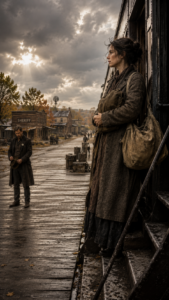
Years later, old men sitting outside the feed store would argue about it while staring toward the red cliffs west of town. Some swore it came on the train from Kansas City. Others claimed it rode in hidden beneath a blanket in the back of a freight wagon. A few insisted it had been buried there all along, waiting beneath the desert soil for someone unfortunate enough to uncover it.
But everyone agreed on one thing.
Three people died because of it.
And before the year was over, nearly every family in Dry Hollow would discover that the truth they had trusted for two decades had been built on a lie.
The strange part was that the story did not begin with a murder.
It began with a woman.
A young immigrant named Elena Petrova stepped off a train on a cold October afternoon in 1884 carrying a canvas suitcase, a sewing kit, and a promise written on two sheets of paper.
By spring, people would whisper her name in saloons.
By summer, gunmen would be searching for her.
And by autumn, she would stand at the center of a secret powerful enough to destroy a sheriff, expose a respected ranching dynasty, and reopen a grave nobody in Dry Hollow wanted remembered.
The desert already knew the truth.
The wind carried pieces of it every night across the mesas.
The question was whether anyone would survive long enough to hear it.
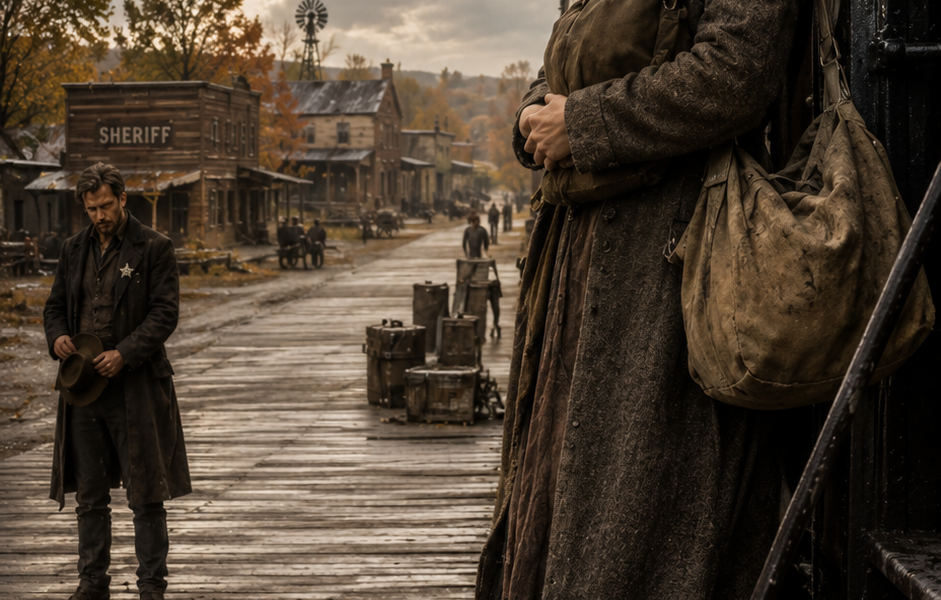
The train hissed and groaned as it rolled into Dry Hollow Station beneath a sky the color of weathered steel. Elena stood near the door before the wheels stopped turning, one hand gripping the rail and the other wrapped around the small leather pouch that contained every dollar she possessed.
The platform appeared smaller than she expected.
Everything in America seemed smaller after the ocean crossing.
The streets.
The towns.
The people.
Only the distances felt larger.
Much larger.
As she stepped down from the train, a cold wind swept across the platform carrying the smell of dust and distant rain. She paused long enough to study the town.
One church.
One hotel.
Two saloons.
A blacksmith shop.
A row of false-front buildings fading beneath years of sunlight.
And standing alone beside a wagon was the man who had written the letters.
Sheriff Nathan Cole.
He looked older than the photograph she had received.
The photograph showed a man perhaps thirty-five.
The man standing before her looked closer to fifty.
Not because of age.
Because grief had spent years carving lines into his face.
He removed his hat.
“Miss Petrova?”
His voice was deep and careful.
She nodded.
“Elena.”
For a moment neither moved.
Around them passengers collected luggage, railroad workers shouted instructions, and steam drifted across the platform like ghosts moving through a battlefield.
Yet something about the sheriff seemed entirely separate from the noise.
As though he had been standing alone for a very long time.
Finally he picked up her larger suitcase.
“Long trip?”
“Very.”
He nodded.
Nothing more.
And strangely, she appreciated that.
Most men filled silence with unnecessary words.
Nathan Cole seemed willing to let silence remain exactly what it was.
As they rode through town, Elena noticed people watching.
Not casually.
Intently.
Women paused in doorways.
Men stopped conversations.
Even children looked up from their games.
She understood immediately.
The town knew why she had come.
In small frontier communities, secrets rarely survived.
The wagon rolled past the church.
Past the general store.
Past a cemetery on a low hill overlooking the valley.
The cemetery caught her attention.
One grave stood apart from the others.
A white stone.
No flowers.
No visitors.
And something strange carved into the weathered surface.
Not a name.
A date.
Only a date.
October 14, 1863.
Nothing else.
The sight lingered in her thoughts long after the cemetery disappeared behind them.
She almost asked about it.
Something stopped her.
Instinct.
The same instinct that had carried her safely across an ocean and halfway across a continent.
The same instinct that whispered there was a story hidden beneath that lonely grave.
A story nobody wanted told.
Nathan’s ranch sat three miles outside town beside a narrow creek lined with cottonwoods turning gold beneath autumn skies.
The house itself was modest.
Clean.
Practical.
Lonely.
The loneliness revealed itself immediately.
A single rocking chair on the porch.
A repaired section of fence.
Tools returned precisely to their places.
Everything carried the unmistakable marks of a man maintaining order because disorder felt too dangerous.
Inside, the house smelled faintly of wood smoke and coffee.
There were two bedrooms.
A kitchen.
A table worn smooth by years of use.
And above the fireplace hung a framed photograph of a woman with dark hair and kind eyes.
Nathan noticed Elena studying it.
“My wife.”
His voice softened.
“Sarah.”
Elena nodded.
“When did she die?”
The question escaped before she could stop it.
Nathan remained silent for several seconds.
“Twenty-one years ago.”
The answer surprised her.
He did not look like a man recently widowed.
He looked like a man who had never stopped being one.
That night a storm moved across the valley.
Rain struck the roof while thunder rolled through distant hills.
Nathan sat at one end of the table reviewing reports from town.
Elena mended a torn shirt beneath the lamp.
Neither spoke much.
Yet the silence felt different now.
Less empty.
More familiar.
At some point lightning illuminated the room.
For an instant Elena saw something tucked between the pages of a ledger lying beside Nathan’s elbow.
A folded newspaper clipping.
Old.
Yellowed.
Carefully preserved.
The photograph attached showed three men standing beside a grave.
The same grave she had noticed in the cemetery.
The one marked only by a date.
Before she could look closer, Nathan closed the ledger.
Too quickly.
The movement seemed almost unconscious.
But she noticed.
And once noticed, it refused to leave her thoughts.
The next morning she walked into town for supplies.
The air carried the sharp scent of approaching winter.
Dry Hollow seemed friendlier in daylight.
Yet beneath the greetings and smiles she sensed something else.
The feeling reminded her of villages back in Russia after tragedy.
Places where everyone knew a story but nobody discussed it.
At the general store she met Clara Bishop, a widow who owned the business.
Clara spoke warmly enough.
Asked about the journey.
Asked whether Elena liked the ranch.
Then asked an odd question.
“Has Nathan talked about Sarah?”
The question arrived too quickly.
Too directly.
Elena hesitated.
“No.”
Clara looked relieved.
Far too relieved.
A moment later she changed the subject entirely.
But Elena had already noticed.
The reaction confirmed what her instincts had suspected.
Sarah Cole’s death was not simply a sad memory.
It was a wound.
One that remained open after twenty-one years.
Outside the store, Elena saw an elderly rancher watching her from across the street.
The man turned away immediately when their eyes met.
Not embarrassed.
Afraid.
That afternoon she returned home carrying supplies and questions.
Nathan was repairing a section of fence near the creek.
She approached slowly.
The wind moved through the cottonwoods above them.
Golden leaves drifted into the water.
“Who is buried beneath the stone with only a date?”
The hammer stopped.
Nathan did not look up.
For several moments there was only wind.
Then he drove another nail into the fence.
“The town should have removed that marker years ago.”
“Why didn’t they?”
Another pause.
Longer this time.
When he finally answered, his voice sounded different.
Tighter.
As though he had stepped unexpectedly onto dangerous ground.
“Because some people are afraid of forgetting.”
Elena waited.
“And others are afraid of remembering.”
Then he picked up his tools and walked toward the barn.
Conversation finished.
Question unanswered.
But now she knew something important.
The grave mattered.
Perhaps more than anything else.
And somewhere behind it waited a truth that still frightened the strongest man in Dry Hollow.
That evening, after Nathan had gone to town, Elena discovered something hidden inside the bookshelf beside the fireplace.
Not intentionally.
A loose board slipped while she was dusting.
Behind it rested a small wooden box.
Inside lay letters.
Dozens of them.
All written by Sarah Cole.
All addressed to Nathan.
And among them was one final letter unlike the others.
A letter that had never been mailed.
A letter written three days before the date on the grave marker.
As Elena unfolded the paper, a single sentence immediately caught her attention.
If anything happens to me, do not trust the men from Black Ridge.
Outside, the wind suddenly rose.
The house creaked softly.
And for the first time since arriving in Dry Hollow, Elena realized she had not come to a lonely ranch in search of a future.
She had stepped directly into the center of a mystery buried for more than twenty years.
A mystery someone had gone to great lengths to keep hidden.
And somewhere beyond the darkening hills, unseen eyes were already beginning to notice that she was asking the wrong questions.
Nathan returned long after dark.
Elena heard the wagon before she saw it, the slow crunch of wheels over frozen ground and the familiar creak of leather harnesses settling after a long ride. She had already placed the wooden box exactly where she found it. The letters were back beneath the loose board. The room looked untouched.
Still, her pulse quickened when the door opened.
Nathan stepped inside carrying cold air with him. Snow threatened somewhere beyond the hills. His coat smelled faintly of horses and cedar smoke.
“You waited up.”
It wasn’t a question.
“I was reading.”
He nodded and removed his hat.
For a brief moment his eyes moved toward the bookshelf.
Not long.
Just long enough.
The movement confirmed something Elena already suspected.
He knew the box was there.
Whether he knew she had found it was another matter entirely.
He hung his coat and moved toward the stove. The fire painted shadows across his face, emphasizing lines that seemed older than the rest of him.
“The weather’s turning.”
“So you said yesterday.”
“It’ll be worse.”
Again silence settled between them.
But tonight it felt different.
There was something hidden inside it.
A question neither of them had spoken aloud.
Elena watched him pour coffee.
He watched the fire.
And somewhere between them sat the ghost of a woman named Sarah.
The next morning brought the season’s first hard frost.
White covered the pasture.
The creek moved sluggishly beneath a skin of ice.
Elena found Nathan already outside splitting wood before sunrise.
The rhythmic strike of his axe echoed across the valley.
Steady.
Controlled.
Almost angry.
She stood on the porch watching him.
There was something strange about the way he worked.
Not like a rancher preparing for winter.
More like a man trying to outrun a memory.
When he finally stopped, he noticed her standing there.
“You should be inside.”
“You should be too.”
The corner of his mouth moved slightly.
Not quite a smile.
Not quite sadness.
Something between.
Then he returned to work.
The mystery might have remained buried longer if not for the funeral.
Three days later the church bell rang just after noon.
A ranch hand named Calvin Reese had died when his horse threw him near the eastern ridge.
At least that was the official story.
The entire town gathered at the cemetery.
Nathan stood near the front with the preacher.
Elena remained toward the back.
The wind cut through coats and shawls alike.
She watched faces.
People revealed more than they realized when death stood nearby.
That was when she saw it.
The elderly rancher from town.
The one who had watched her outside the general store.
His gaze wasn’t fixed on the fresh grave.
It was fixed on the old marker.
The one marked only with a date.
October 14, 1863.
His face had gone pale.
Almost terrified.
Then something even stranger happened.
As the service ended, a small bunch of wildflowers appeared on the anonymous grave.
Nobody had placed them there earlier.
Nobody admitted doing it now.
Yet there they were.
Fresh.
Carefully arranged.
The rancher noticed them too.
And for a split second Elena saw genuine fear enter his eyes.
The kind of fear people carry when they think the dead have returned.
That night she could not stop thinking about it.
The flowers.
The grave.
The letter.
The men from Black Ridge.
Each clue felt connected.
Like pieces of a puzzle assembled by someone who never intended it to be solved.
After Nathan went to sleep, she sat beside the window and read Sarah’s final letter again by lamplight.
The handwriting remained elegant despite obvious haste.
Most of the page discussed ordinary things.
Household matters.
Winter supplies.
Neighbors.
Then the tone changed abruptly.
If they discover what I know, they will not forgive me.
Elena read the sentence three times.
Below it Sarah had written:
Someone must remember the truth about October.
October.
The same month carved onto the grave.
The same month Sarah died.
The same month people refused to discuss.
Outside, wind rattled the windows.
Inside, the mystery deepened.
The following week brought snow.
Heavy snow.
The kind that erased roads and softened entire landscapes.
Dry Hollow seemed cut off from the rest of the world.
Perhaps that was why people began talking.
Isolation has a way of loosening guarded tongues.
Mrs. Bishop at the general store shared small details.
The blacksmith shared others.
A widow from church offered another piece entirely.
Individually, none meant much.
Together, they formed the outline of something enormous.
Twenty-one years earlier, six men from Black Ridge Ranch controlled nearly everything in the valley.
Land.
Water.
Livestock.
Politics.
If they wanted something, they took it.
If someone opposed them, problems followed.
Then one autumn night something happened.
Nobody agreed exactly what.
Only that afterward one man vanished.
One woman died.
And half the town stopped speaking about it.
Elena listened carefully.
Every story contradicted the previous one.
Yet certain details remained constant.
Sarah Cole had known something.
Nathan had tried to protect her.
And someone powerful had ensured the truth disappeared.
One evening she found Nathan repairing tack in the barn.
The lantern hanging overhead cast golden light across rough timber walls.
Outside snow drifted silently through darkness.
Inside, the smell of leather and horses filled the air.
She stood beside the workbench.
“Who was buried under that stone?”
Nathan’s hands stopped moving.
Again.
Always the same reaction.
The same hesitation.
The same shadow crossing his face.
Finally he looked up.
Not angry.
Not defensive.
Tired.
Deeply tired.
“You should leave this alone.”
“Why?”
“Because some truths don’t help anyone.”
She studied him.
“Then why does everyone still fear it?”
The question landed harder than she expected.
Nathan looked away.
Toward the barn doors.
Toward the storm outside.
Toward twenty-one years of regret.
When he finally spoke, his voice was barely above a whisper.
“Because the wrong people survived.”
The words hung between them.
Then he returned to his work.
Conversation over.
Yet that single sentence changed everything.
The wrong people survived.
Not an accident.
Not a misunderstanding.
A choice.
Someone had chosen who lived and who died.
And Nathan knew it.
Days later another clue arrived unexpectedly.
Elena was cleaning the attic when she discovered an old trunk hidden beneath blankets.
Inside lay photographs.
Receipts.
Newspapers.
And one leather-bound journal.
The journal belonged to Sarah.
Her hands trembled slightly as she opened it.
Most entries described ordinary life.
Weather.
Livestock.
Harvests.
Then she reached October 1863.
The writing changed immediately.
Sharper.
More urgent.
October 8.
I heard them arguing again near the creek.
October 9.
Jacob says we should stay out of it.
October 10.
The boy knows more than he should.
Elena froze.
The boy.
Not a name.
Just a reference.
A child somehow connected to everything.
She continued reading.
October 11.
If they discover what Ethan witnessed, none of us will be safe.
Ethan.
For the first time, a name.
The journal continued.
October 12.
I begged Jacob not to confront them.
October 13.
God help us. They know.
The final entry was dated October 14.
Only six words appeared.
They’re coming.
We waited too long.
Nothing followed.
No explanation.
No ending.
Only silence.
The date matched the grave.
Exactly.
Elena closed the journal slowly.
The mystery had shifted.
This wasn’t merely Sarah’s story.
Or Nathan’s.
It was about a child named Ethan.
A child who had seen something terrible.
A child who disappeared from history entirely.
That evening she confronted Nathan again.
This time she brought the journal.
His face drained of color the moment he saw it.
“You found that.”
“I found Ethan.”
The room became still.
Even the stove seemed quieter.
Nathan lowered himself into a chair.
Suddenly he looked much older.
“Ethan wasn’t supposed to be remembered.”
“Who was he?”
Nathan stared at the journal.
For a long time he said nothing.
Then he spoke.
“Ethan Walker was twelve years old.”
The name meant nothing to Elena.
Yet Nathan’s expression suggested otherwise.
“He worked around the ranches. Odd jobs. Deliveries.”
“What did he see?”
Nathan rubbed a hand across his face.
“He saw a murder.”
The words landed like thunder.
Outside, snow drifted against the windows.
Inside, twenty-one years of secrets began cracking apart.
Nathan continued quietly.
“The Black Ridge men killed Jacob Mercer.”
Elena recognized the name immediately.
The anonymous grave.
The date.
Everything connected.
“Why?”
“He found proof they were stealing water rights from half the valley.”
Nathan’s voice hardened.
“Families lost land because of it.”
“And Ethan witnessed this?”
Nathan nodded.
“The boy saw everything.”
“What happened to him?”
Silence.
Long and painful.
Then Nathan looked directly at her.
“No one knows.”
The answer felt wrong.
Incomplete.
Nathan saw her doubt.
“There was a fire the next night.”
His voice softened.
“Sarah died trying to save him.”
Elena stared at him.
A revelation.
Yet somehow not the final one.
Too many pieces still refused to fit.
If Sarah died saving Ethan…
Why was Jacob buried anonymously?
Why did the town fear the grave?
Why did people leave flowers there in secret?
And why had Nathan spent twenty-one years protecting a mystery that should have died long ago?
The answers arrived sooner than either expected.
Because three nights later someone tried to burn the house down.
Elena woke to the smell of smoke.
Nathan was already shouting.
Flames climbed the porch.
Glass shattered.
Horses screamed from the barn.
The attack had been deliberate.
Carefully planned.
Someone wanted more than property destroyed.
Someone wanted evidence erased.
And as Nathan rushed into the night carrying a rifle, Elena noticed something lying on the floor beside the broken window.
A folded piece of paper.
She opened it.
Only four words appeared.
Stop searching for Ethan.
The message changed everything.
Because dead boys do not frighten powerful men.
Only living ones do.
And for the first time, Elena understood the terrible possibility hiding beneath every secret she had uncovered.
Ethan Walker might still be alive.
And somewhere beyond the snowy darkness of Dry Hollow, the final truth was moving toward them at last.