
Pauline Hanson’s “Sharia-Free Australia” Bill: The Political Battle That Is Really About Australia’s Future
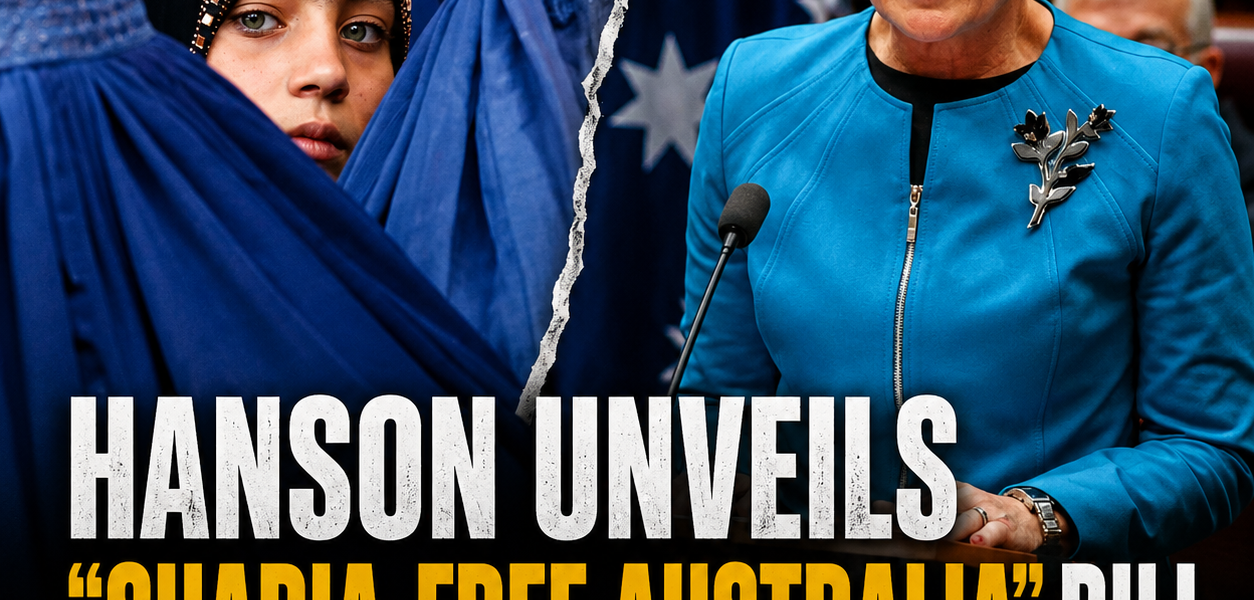
Australia has once again found itself at the center of a fierce national debate after One Nation leader Pauline Hanson unveiled a proposal known as the “Sharia-Free Australia” bill.
On the surface, the proposal appears straightforward. Hanson argues that Australia should maintain one legal system that applies equally to all citizens regardless of ethnicity, religion, or cultural background. According to her position, Australian law must remain the supreme legal authority and no alternative legal framework should be allowed to develop alongside it.
Supporters describe the proposal as a defense of national sovereignty, legal consistency, and social cohesion. Critics, however, see it as a highly controversial and potentially divisive initiative that risks inflaming tensions surrounding Islam, immigration, multiculturalism, and civil liberties.

What began as a legislative proposal has rapidly evolved into one of the most emotionally charged political discussions in Australia.
The debate reaches far beyond legal theory.
It touches fundamental questions about who Australians are, what kind of country they want to become, and how multicultural democracy should function in an era of increasing social and political polarization.
Hanson’s Argument
Hanson has framed the proposal as a simple matter of legal unity.
According to her argument, every person living in Australia should be governed exclusively by Australian law. She maintains that migrants who advocate for the implementation of Sharia law should face greater scrutiny and that government institutions should actively ensure that no competing legal systems gain influence within Australian society.
The proposal is consistent with a broader political platform Hanson has promoted throughout much of her political career.
In recent months, Hanson has intensified criticism of multiculturalism, describing it as a failed policy and arguing that Australia should place greater emphasis on assimilation, shared values, and cultural integration. She has repeatedly linked concerns about immigration, national identity, and social cohesion in public speeches and policy discussions.
Supporters of the bill argue that successful multicultural societies require common rules and shared civic commitments.
From their perspective, Hanson is not targeting a religion but defending the principle that public life must operate under one legal framework.
Many point to similar debates occurring across Europe and North America, where governments have increasingly wrestled with questions surrounding immigration, integration, religious accommodation, and national identity.
For these supporters, the issue is not Islam itself but the preservation of a unified legal system.

Critics Push Back
Opponents reject the premise that Australia faces a genuine legal threat from Sharia law.
Legal scholars and civil liberties advocates note that Australia already operates under a single legal system. Australian courts do not recognize Sharia law as an alternative governing authority capable of overriding national legislation.
Because of that reality, many critics argue the proposal addresses a problem that does not meaningfully exist.
They contend the bill is largely symbolic rather than practical.
More importantly, critics raise serious concerns about enforcement.
One of the central questions involves defining advocacy.
What exactly constitutes advocating for Sharia law?
Would a religious leader discussing Islamic legal traditions be considered an advocate?
Would private conversations about faith become subject to scrutiny?
Could expressions of religious belief be interpreted as political activism?
These questions have become central to the controversy.
Civil liberties groups argue that legislation involving religion, speech, and political expression requires extremely precise definitions. Ambiguous wording, they warn, can create unintended consequences that extend far beyond the original intention of lawmakers.
As a result, the debate has expanded beyond immigration policy and entered broader territory involving freedom of speech, religious liberty, democratic rights, and constitutional principles.
Immigration and Political Context
The timing of the proposal is significant.
Australia is currently experiencing intense political debate surrounding immigration.
Housing affordability remains a major concern for many Australians. Population growth, infrastructure strain, healthcare capacity, and social services are frequently discussed in relation to migration policy.
Both major political parties have faced criticism from voters who believe migration levels have contributed to economic and social pressures.

One Nation has consistently positioned itself as the political force most willing to challenge prevailing immigration policies.
The party advocates lower migration levels, stricter citizenship requirements, and stronger integration expectations for newcomers. These positions have resonated with a segment of voters concerned about rapid demographic change and national identity.
The “Sharia-Free Australia” proposal fits naturally within that broader political strategy.
Rather than focusing exclusively on economics, the bill shifts public attention toward cultural and legal questions.
Supporters view that shift as necessary.
Critics see it as dangerous.
Yet regardless of which side one supports, the proposal has succeeded in accomplishing one undeniable objective: it has placed One Nation at the center of Australia’s political conversation.
A Debate Bigger Than Parliament
Political analysts often point out that many controversial bills never become law.
That does not mean they fail.
In modern politics, legislation frequently serves another purpose: shaping public debate.
Smaller parties often introduce proposals they know are unlikely to pass because the proposal itself becomes a vehicle for influencing national discussion.
The “Sharia-Free Australia” bill appears to be functioning in exactly that way.
It has generated extensive media coverage.
It has sparked intense discussion across social media platforms.
It has forced politicians, academics, advocacy groups, religious leaders, and voters to publicly define their positions.

Whether the legislation ultimately succeeds or fails may prove less important than the conversation it has already created.
The bill has become a symbol of competing visions for Australia’s future.

One vision prioritizes multicultural diversity as a national strength.
The other emphasizes integration, assimilation, and common cultural values as essential foundations of social cohesion.
The collision between those visions is what makes this story so politically explosive.

My Professional Perspective
After covering political movements, cultural conflicts, immigration debates, and identity politics for decades, I believe many observers are focusing on the wrong aspect of this story.
The real story is not the bill.
The real story is the anxiety beneath the bill.
That distinction matters enormously.
This Is Not Primarily About Sharia Law
One of the most overlooked realities in this debate is that Australia does not currently face an imminent challenge from an alternative legal system.
Most legal experts agree on that point.
The practical legal impact of the proposal may therefore be limited.
Yet the public reaction has been enormous.
Why?
Because the bill functions as a symbol.
Supporters are not simply responding to legal theory.
Many are expressing broader concerns about cultural change, immigration levels, social cohesion, and whether traditional Australian identity is evolving too rapidly.
The legislation has become a vessel carrying much larger fears and frustrations.
When citizens feel uncertain about economic pressures, housing costs, demographic shifts, or cultural transformation, those concerns often attach themselves to highly visible political symbols.
This bill has become one of those symbols.
The Global Pattern

Australia is not experiencing this debate in isolation.
Across the Western world, remarkably similar arguments are occurring.
In parts of Europe, debates surrounding immigration and integration have become dominant political issues.
In the United States, disputes involving borders, national identity, and cultural values remain among the most polarizing subjects in public life.
Political movements emphasizing national identity have gained momentum in numerous democracies.
Australia increasingly appears to be following the same trajectory.

The Hanson proposal reflects forces that extend well beyond Canberra.
It is part of a broader international struggle over how liberal democracies balance diversity, integration, individual freedom, and national cohesion.
That context helps explain why emotions surrounding the proposal are so intense.
People are not merely debating a bill.
They are debating the future direction of their country.

The Danger of Symbolic Politics
There is another dimension worth considering.
Symbolic political battles often generate far more heat than light.
When legislation becomes a cultural symbol, practical policy questions can disappear beneath emotional rhetoric.
Supporters may interpret criticism as an attack on national values.
Opponents may interpret support as evidence of prejudice or intolerance.
The result is often deeper polarization.
This creates a risk for all sides.

Complex social challenges become reduced to slogans.
Nuance disappears.
Constructive conversation becomes more difficult.
The danger is not necessarily the legislation itself.
The danger is that symbolic battles can harden divisions and make compromise increasingly impossible.
Questions That Remain Unanswered

Several critical questions deserve more attention.
If the proposal addresses a problem that legal experts argue does not meaningfully exist, what specific outcomes does the legislation seek to achieve?

If advocacy becomes a legal concern, how will lawmakers define the boundary between religious expression and political activism?
Could vague definitions create unintended consequences for freedom of speech?
Would the proposal improve social cohesion—or deepen social divisions?
And perhaps most importantly:
What evidence would demonstrate success?
These questions deserve careful examination regardless of political ideology.
Why This Story Matters
Many political controversies disappear within days.
This one likely will not.
The reason is simple.
The issues beneath the debate are not temporary.
Immigration will remain a major issue.
Housing pressures will remain a major issue.
Questions surrounding national identity will remain a major issue.
Multiculturalism will remain a major issue.
The “Sharia-Free Australia” bill may eventually fade from the headlines.
But the underlying arguments are unlikely to disappear.
They are becoming increasingly central to Australia’s political future.
In that sense, the proposal represents more than legislation.
It represents a political marker showing where some parts of Australian society believe the country should go—and where others believe it absolutely must not.
Conclusion
The controversy surrounding Pauline Hanson’s “Sharia-Free Australia” bill has become one of the most revealing political debates Australia has seen in recent years.
At one level, it is a discussion about law, religion, and immigration.
At a deeper level, it is a conversation about identity, belonging, freedom, integration, and the future character of the nation itself.
Supporters see a defense of common values and legal unity.
Critics see a potentially divisive and unnecessary intervention targeting an already marginalized community.
Both sides believe they are defending fundamental principles.
That is precisely why the debate has become so emotionally charged.
Whether the legislation ultimately succeeds, fails, or never progresses beyond political discussion, its impact has already been felt.
It has exposed anxieties, aspirations, and divisions that exist beneath the surface of Australian politics.
And perhaps that is the most important lesson of all.
Sometimes a political bill is not truly about the text written on its pages.
Sometimes it becomes a mirror reflecting a nation’s hopes, fears, and uncertainties.
The question Australia now faces is not simply whether this bill should become law.
The larger question is this:
As Australia continues to evolve in the twenty-first century, how can it preserve social cohesion, democratic freedoms, and a shared national identity without sacrificing the diversity that has helped shape the modern nation?