
Housing, Immigration, and Political Reality: Why One Nation’s Rapid Clarification Reveals a Much Bigger Australian Debate
Australia’s housing crisis has once again collided with immigration politics, forcing one of the country’s most outspoken political parties into a rapid damage-control operation after confusion erupted over a controversial property ownership proposal.
What began as a discussion about foreign ownership of Australian homes quickly escalated into a national debate about citizenship, migration, property rights, and who should have a stake in Australia’s housing future.
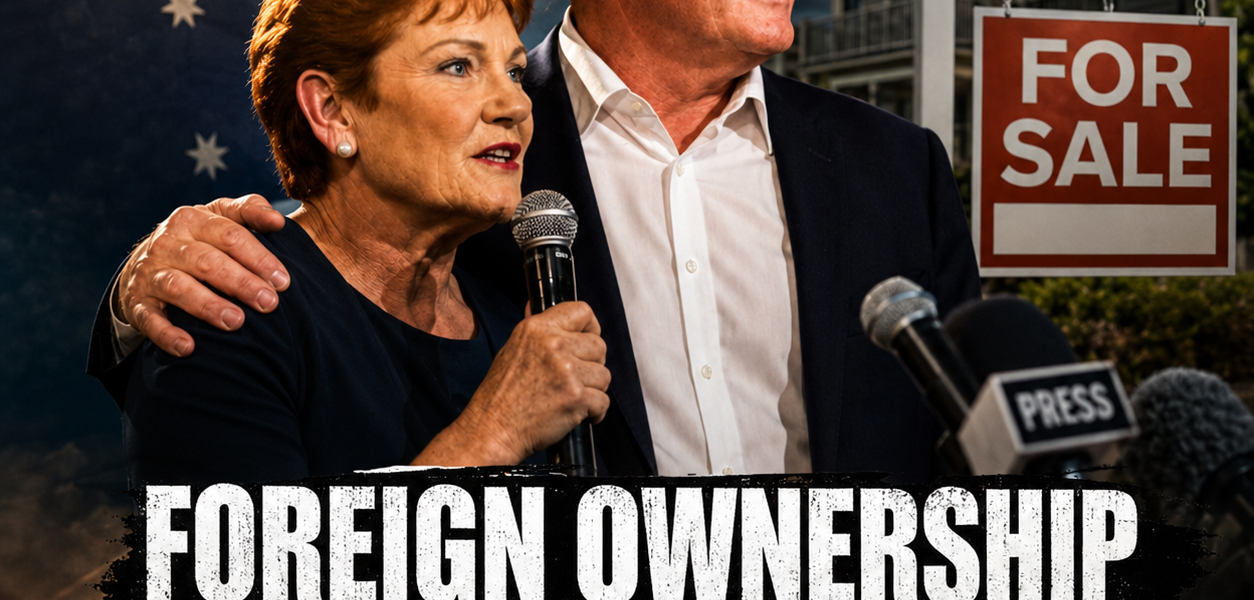
At the center of the controversy are Pauline Hanson and Barnaby Joyce, who found themselves clarifying one of the most sensitive aspects of One Nation’s proposed housing reforms after public concern spread across media and social platforms.
The dispute emerged as housing affordability continues to dominate Australia’s political agenda.
For millions of Australians, the dream of home ownership has become increasingly difficult to achieve.
Property prices remain elevated across many major cities, rental markets are under pressure, and mortgage holders continue to face financial strain following years of economic uncertainty and rising living costs.
Against this backdrop, any proposal involving housing ownership is guaranteed to attract intense public attention.
One Nation’s housing policy is no exception.
The party has proposed ending foreign ownership of Australian residential property indefinitely, arguing that Australian housing should primarily serve Australians rather than overseas investors.
The proposal immediately generated headlines, but the most controversial element emerged during a media interview when Barnaby Joyce discussed how the policy might affect permanent residents.
His comments appeared to suggest that some permanent residents could eventually face pressure to either commit fully to Australia through citizenship or potentially risk losing ownership of their homes.
The remarks triggered immediate concern.
Permanent residents represent a significant portion of Australia’s population. Many have spent years building careers, raising families, paying taxes, and integrating into Australian society while progressing through legal pathways toward citizenship.
Critics questioned whether individuals who had followed all legal requirements and invested their savings into Australian property could suddenly find themselves targeted by new government restrictions.
The uncertainty spread rapidly.

Political commentators, immigration advocates, economists, and community groups began debating how such a policy would operate in practice.
Social media amplified concerns, with many asking whether permanent residency would effectively become a second-class status under the proposed reforms.
As scrutiny intensified, Joyce moved quickly to correct the record.
After further discussions regarding the policy’s intent, he contacted media outlets to clarify that permanent residents would not be required to sell their homes.
The clarification significantly changed public understanding of the proposal.
Soon afterward, Pauline Hanson issued her own statement reinforcing the distinction.
According to Hanson, permanent residents are not the intended targets of the policy because they have already been accepted as long-term members of Australian society.
She emphasized that permanent residents live in Australia, contribute to the workforce, pay taxes, support local communities, and frequently pursue Australian citizenship through established legal processes.
In her view, these individuals should not be treated in the same category as temporary visa holders or foreign investors who have limited or no long-term connection to Australia.
The clarification appeared designed not only to address public concern but also to prevent political damage among migrant communities that may otherwise have viewed the proposal as a direct threat.
Yet despite the adjustment, One Nation remains committed to its broader objective.
Under the party’s proposal, foreign citizens living overseas and temporary visa holders would face stronger restrictions regarding ownership of Australian residential property.
The underlying argument is straightforward: housing should primarily be available to Australian citizens and permanent residents rather than being treated as an international investment asset.
Supporters of the policy believe foreign investment has contributed to housing pressures in certain markets.
They argue that reducing external demand could improve affordability and create more opportunities for Australians attempting to enter the property market.
For many frustrated first-home buyers, this message resonates emotionally.
After years of watching property values rise beyond reach, there is growing public appetite for policies that appear to prioritize local ownership.
However, critics challenge the premise that foreign ownership represents a major driver of Australia’s housing crisis.
Many economists point toward a far more complex picture.
Australia faces long-term supply shortages, restrictive planning regulations, infrastructure constraints, labor shortages in construction, rising material costs, and strong population growth.
In this view, foreign ownership may represent only a relatively small component of a much larger structural problem.
Critics argue that even a complete ban on foreign ownership would not automatically solve affordability challenges if housing supply remains insufficient.
The debate therefore highlights a broader question confronting policymakers:

Are housing prices primarily driven by demand, or are they primarily driven by supply constraints?
The answer has significant implications for future policy.
The controversy also illustrates how politically sensitive housing has become.
Unlike many policy discussions that remain abstract, housing affects people directly.
It determines where families live, how wealth is accumulated, and whether younger generations can achieve financial stability.
As affordability declines, public frustration inevitably grows.
That frustration creates fertile ground for political movements offering decisive solutions.
Whether those solutions are practical, effective, or economically sustainable becomes the next stage of the debate.
For now, One Nation has succeeded in placing housing ownership at the center of national attention.
But the rapid clarification from Hanson and Joyce demonstrates how carefully parties must navigate the issue.
A single misunderstanding can quickly overshadow the broader message they are attempting to deliver.
My Professional Perspective
Having covered housing crises, immigration debates, and election campaigns across Australia, Britain, Europe, and North America, I believe this story is about far more than foreign ownership.
The deeper story is about economic anxiety.
For years, Australians have been told that home ownership remains achievable through hard work and financial discipline.
Yet many younger Australians increasingly feel that the traditional pathway to home ownership is slipping away.
That perception is transforming housing from an economic issue into a political identity issue.
This distinction matters.
When people believe they are being locked out of property ownership, they begin searching for explanations.
Political parties then compete to provide those explanations.
Some point to foreign investors.
Others point to planning restrictions.
Some blame migration levels.
Others blame decades of underinvestment in housing construction.
The reality is usually more complicated than any single explanation.
One of the most overlooked aspects of this controversy is how quickly the debate shifted from housing policy to belonging and citizenship.
That shift reveals a powerful political truth.
Housing is no longer merely about real estate.
It has become intertwined with national identity.
Questions about who can buy homes often evolve into questions about who belongs, who contributes, and who should have access to opportunities within society.
The clarification regarding permanent residents was politically necessary because it acknowledged this reality.
Permanent residents occupy a unique position.
Many have built lives that are virtually indistinguishable from those of citizens.
They work alongside Australians, raise Australian-born children, pay Australian taxes, and participate in Australian communities.
Any suggestion that they might lose property rights was always likely to generate significant backlash.
Another important factor often overlooked is that housing affordability is becoming one of the defining political issues of this generation.
For decades, debates about taxes, healthcare, and national security dominated elections.
Today, housing increasingly occupies that same space.
The reason is simple.
People may disagree about ideology, but almost everyone needs somewhere to live.
When housing becomes unaffordable, political pressure becomes unavoidable.
This is why parties across the political spectrum are proposing increasingly bold solutions.
The danger is that voters may begin expecting quick fixes for problems that developed over decades.
Australia’s housing challenges were not created overnight.

They involve population growth, land use policy, infrastructure planning, construction capacity, financial markets, taxation frameworks, and demographic trends.
No single reform is likely to solve them completely.
Yet political incentives often reward simple messages over complicated realities.
That dynamic helps explain why housing debates have become so emotionally charged.
The most important question remains unanswered:
If foreign ownership restrictions are implemented, how much difference would they actually make?
That question deserves rigorous economic analysis rather than ideological assumptions.
Because ultimately, voters are less interested in political symbolism than practical outcomes.
They want homes they can afford.
They want rents they can manage.
And they want confidence that future generations will have opportunities similar to those enjoyed by previous generations.
Whether One Nation’s proposals can achieve those objectives remains uncertain.
But the political significance of the issue is undeniable.

Housing is no longer a secondary policy debate.
It is rapidly becoming one of the central battlegrounds of Australian politics.

Conclusion
The controversy surrounding One Nation’s housing proposal highlights the extraordinary political sensitivity of Australia’s affordability crisis.
What began as confusion over the status of permanent residents quickly evolved into a broader national conversation about immigration, citizenship, investment, and the future of home ownership.
Pauline Hanson and Barnaby Joyce moved swiftly to clarify that permanent residents would not be forced to sell their homes, easing concerns among many migrants who have established long-term lives in Australia.
Yet the larger debate remains unresolved.
Supporters argue stronger restrictions on foreign ownership could help Australians compete in an increasingly difficult property market.
Critics contend that housing affordability is driven by much deeper structural factors that cannot be solved through ownership restrictions alone.
As Australia’s housing pressures continue to intensify, voters are demanding answers from every political party.
And beneath the arguments about foreign investors, migration, and property rights lies a much bigger question:
If home ownership continues moving further out of reach for ordinary Australians, how dramatically will the country’s political landscape change in response?
The answer may shape Australian politics for years to come.