The Woman on the Platform: The Hidden Story Behind a Promise That Arrived Too Late. t1

The Woman on the Platform: The Hidden Story Behind a Promise That Arrived Too Late
For years, the people of Hartwell remembered a simple story.
They remembered a woman who arrived alone on an afternoon train carrying a single carpet bag. They remembered a rancher who had advertised for help and a stranger who answered. They remembered the quiet meals, the repaired fences, the child who slowly began to smile again, and the ordinary rhythm of a household learning how to breathe.
What they did not remember—or perhaps never fully understood—was how close that story came to never happening at all.
Because before there was a home, there was a platform.
Before there was trust, there was uncertainty.
Before there was love, there was survival.
And before any of them knew it, three lonely lives were already moving toward one another across hundreds of miles of prairie, grief, and unanswered questions.
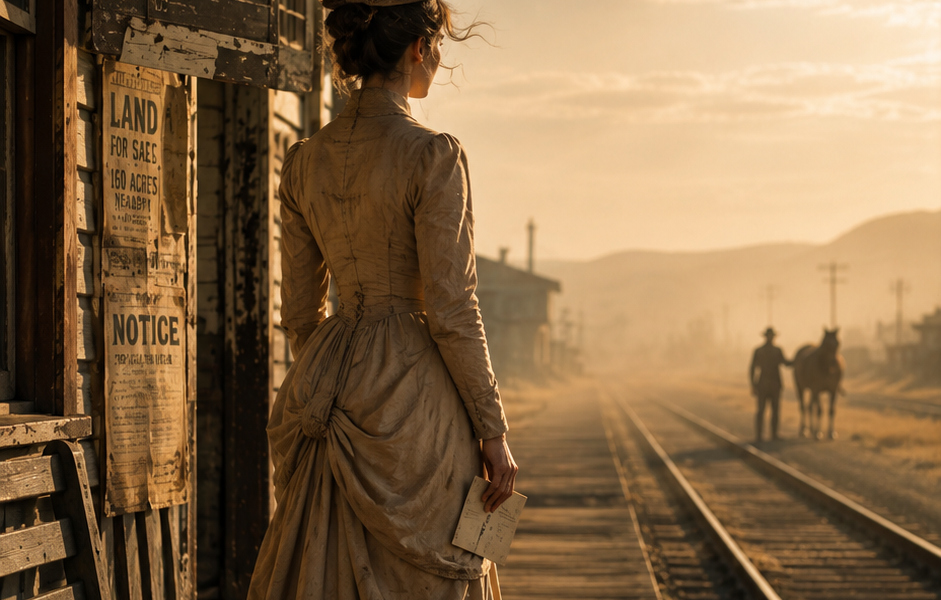
The train had disappeared into the western distance four hours earlier.
Its whistle had faded long before the dust settled.
Yet she remained there.
Standing alone.
Waiting.
The wooden platform beneath her feet held the day’s heat. The wind tugged at her skirt and carried with it the smell of dry grass, creosote, and distant rain.
She had fourteen dollars and sixty cents.
Not enough to start over.
Barely enough to postpone failure.
The territory had a way of exposing the truth quickly. Out here, a person was exactly what they could carry, exactly what they could build, and exactly what they could endure.
And what she carried was very little.
A carpet bag.
A reference letter.
And hope.
Hope, she would later discover, was often the heaviest thing a person could bring west.
The letter that had brought her to Hartwell had arrived at precisely the wrong moment in her life.
The family she worked for in Missouri had fallen apart after fever swept through the household. Employment vanished. Savings disappeared. Future plans dissolved.
Many people in her position would have remained where they were and accepted whatever came next.
She did not.
Perhaps because she had already spent too much of her life watching circumstances decide things for her.
Perhaps because poverty teaches a person that waiting rarely improves anything.
Or perhaps because something in the careful handwriting of the rancher named Calloway suggested reliability.
A promise.
A possibility.
A place where tomorrow might finally look different from yesterday.
She boarded the train before she knew the position no longer existed.
And once she was moving west, there was no practical way to turn back.
By the time she reached Hartwell, she was committed to a future that might not even be waiting for her.
Most people would call that bad luck.
Years later, she would call it destiny.
The man who eventually found her standing on the platform had not intended to change anyone’s life that evening.
He had merely noticed a fact.
A woman alone.
Night approaching.
No family.
No transportation.
No safe place to stay.
There are moments in history that appear insignificant while they are happening.
A door held open.
A horse offered.
A seat at a table.
A spare room.
The world rarely recognizes turning points when they occur.
It only recognizes them later.
He offered shelter because it seemed like the decent thing to do.
Nothing more.
At least that was what he told himself.
Yet as the buggy rolled through the fading light and the town disappeared behind them, both of them carried thoughts they did not speak aloud.
She wondered whether she had made a dangerous mistake.
He wondered why her presence felt so unusual inside a life that had become so predictable.
The house sat at the edge of town like a forgotten sentence.
Small.
Practical.
Built by hands that cared more about function than appearance.
The kind of place that existed because somebody needed shelter, not because somebody dreamed of beauty.
Yet houses absorb the people who live inside them.
Every floorboard remembers.
Every chair remembers.
Every empty room remembers.
And this house remembered loneliness.
Not dramatic loneliness.
Not tragic loneliness.
The quieter kind.
The kind that arrives one ordinary day and never quite leaves.
The kind that settles into routines.
Into silence.
Into meals eaten alone.
Into conversations never spoken because there is nobody there to hear them.
When she entered the house for the first time, she sensed it immediately.
The place was clean.
Orderly.
Maintained.
But it was missing something.
Not furniture.
Not money.
Not comfort.
It was missing another heartbeat.
The next morning revealed more than either of them intended.
Rain tapped softly against the roof while they shared oatmeal and coffee across a narrow table.
The conversation was sparse.
Neither was skilled at explaining themselves.
Neither trusted strangers easily.
Neither knew what the future looked like.
Yet something important happened.
Nothing happened.
No arguments.
No misunderstandings.
No disappointments.
No demands.
Only quiet cooperation.
Sometimes trust does not begin with grand gestures.
Sometimes it begins with the absence of danger.
The absence of pressure.
The absence of reasons to leave.
As days passed, she gradually discovered the shape of his life.
The neglected garden.
The worn fences.
The unfinished repairs.
The countless small tasks that accumulate when one person is responsible for everything.
And slowly she began doing what she had always done.
She made things better.
Not because anyone asked.
Not because she expected gratitude.
Because she could not help herself.
A loose hinge was fixed.
A floor was swept.
Bread appeared on the table.
The yard became more orderly.
The house felt warmer.
Human beings often reveal themselves through what they choose to improve.
And she improved everything she touched.
Meanwhile, he watched.
Not openly.
Not suspiciously.
Simply attentively.
He noticed the biscuits.
The swept floors.
The repaired curtains.
The way the chickens seemed calmer.
The way evenings felt shorter.
The way silence no longer felt empty.
And perhaps most surprisingly, he noticed himself looking forward to returning home.
That realization frightened him more than he cared to admit.
Because anticipation creates vulnerability.
And vulnerable people risk loss.
He understood loss.
He understood it better than most.
The child explained why.
For weeks she had wondered about the traces of another life she occasionally discovered.
A forgotten ribbon.
A small shoe.
A storybook tucked onto a shelf.
Evidence existed everywhere.
But nobody mentioned it.
Then one morning the child appeared at the breakfast table.
Suddenly countless mysteries made sense.
The extra cup.
The worn toys.
The careful routines.
The guarded expressions.
The protective instincts.
The child had already suffered enough loss to become cautious around strangers.
Children are often wiser than adults realize.
They notice grief.
They notice absence.
They notice when someone is pretending to be fine.
And they notice kindness.
The child watched her for days.
Then weeks.
Evaluating.
Deciding.
Trust cannot be demanded from a wounded child.
It must be earned.
One ordinary morning, while she kneaded bread dough, the child asked a question.
It was not important.
Not really.
Something about biscuits.
Something about flour.
Something small.
Yet the room fell completely silent afterward.
Because everyone understood what had happened.
The child had chosen to speak.
A bridge had appeared.
And once that bridge existed, everything changed.
Conversations became easier.
Laughter appeared unexpectedly.
Stories emerged.
The house began sounding different.
People often imagine healing as a dramatic event.
In reality, healing usually arrives disguised as ordinary days.
A shared meal.
A simple question.
A laugh from another room.
A chair pulled out at a table.
By autumn, Hartwell had begun talking.
Small towns always do.
People noticed things.
They noticed she was still there.
They noticed the child followed her around the yard.
They noticed the rancher smiled occasionally now.
Most importantly, they noticed something neither of them had yet admitted.
The house no longer looked temporary.
It looked inhabited.
There is a difference.
One evening, after supper, she found an old photograph tucked inside a drawer.
A woman stood beside him.
Young.
Beautiful.
Confident.
The child’s mother.
The missing piece.
The ghost that still occupied parts of the house.
She stared at the photograph for a long time.
Not because she felt threatened.
Because she finally understood.
Grief had built many of the walls she had been encountering.
Not coldness.
Not indifference.
Not distance.
Grief.
The realization changed everything.
When he returned home that evening, she placed the photograph gently on the table.
Neither spoke immediately.
Neither needed to.
At last he told her the story.
The illness.
The burial.
The months afterward.
The fear of raising a child alone.
The exhaustion.
The guilt.
The loneliness.
And for the first time since arriving in Hartwell, she saw tears in his eyes.
Not many.
Just enough.
Enough to reveal the truth.
Strong people cry differently.
Not because they feel less.
Because they have carried feelings for too long.
That night they talked until the fire collapsed into glowing embers.
Two people sharing histories.
Two survivors comparing scars.
Two strangers becoming something else.
Something neither had expected.
Winter arrived early.
Snow covered the fields.
The fences disappeared beneath white drifts.
Travel became difficult.
The world shrank.
Inside the little house, however, life expanded.
The child learned to read better.
She sewed by lamplight.
He repaired tools near the stove.
Three separate lives slowly intertwined.
No declarations.
No dramatic confessions.
Only accumulation.
The accumulation of trust.
Respect.
Dependability.
Affection.
The strongest relationships often begin this way.
Not with fireworks.
With consistency.
Then came the moment that forced everything into the open.
A letter arrived.
An offer of employment from farther east.
Reliable wages.
Security.
A guaranteed future.
Exactly the opportunity she once would have prayed for.
She read it twice.
Then folded it carefully.
For several days she carried it in her pocket.
And said nothing.
But he noticed.
Because by then he noticed everything.
One evening he finally asked.
She handed him the letter.
He read it silently.
Then folded it.
Then handed it back.
The room felt suddenly smaller.
“Will you go?” he asked.
The question sounded simple.
It wasn’t.
Because both of them understood what he was truly asking.
She looked around the room.
At the stove.
The table.
The child asleep in the next room.
The life that had appeared when she least expected it.
Months earlier she had arrived with fourteen dollars and sixty cents.
Now she possessed something infinitely more valuable.
Belonging.
She looked at him.
The answer had already formed long before the question.
“No,” she said quietly.
His shoulders lowered.
A tiny movement.
Almost invisible.
But she saw it.
And because she saw it, she understood.
The following spring, Hartwell received another piece of news.
The woman who arrived alone on the train was no longer leaving.
The rancher who never expected anyone to answer his letter had finally stopped eating supper by himself.
The child who had once spoken only when necessary now laughed loud enough to be heard across the yard.
And the little house at the edge of town no longer remembered loneliness.
It remembered family.
Years later, people would tell the story differently.
They would call it a love story.
And they would not be wrong.
But love was only part of it.
The deeper truth was about rescue.
Not the dramatic kind found in novels.
The ordinary kind.
The kind created when people choose kindness despite uncertainty.
The kind built from coffee shared at dawn.
From meals cooked after long days.
From patience.
From trust.
From staying.
Because sometimes the most important journeys do not end where we planned.
Sometimes the opportunity disappears.
Sometimes the job vanishes.
Sometimes the original dream fails completely.
And yet, hidden inside that disappointment is the road that leads exactly where we were meant to go.
She thought she had traveled west to become a cook.
He thought he was offering a stranger a place to wait until morning.
Neither understood that fate had already made other arrangements.
Years later, when people asked how it all began, she would smile and tell them the truth.
It began with a missed opportunity.
A delayed arrival.
A platform at sunset.
And a man who stopped his buggy because he noticed a woman standing alone.
Professional Perspective and Analysis
What makes this story endure is not romance alone.
It is the psychology of human connection during periods of uncertainty and loss.
Both central figures enter the story carrying invisible burdens. She arrives burdened by economic insecurity, displacement, and the fear of becoming irrelevant in a world that offered few protections for women alone. He carries grief, responsibility, and the emotional isolation that often follows profound personal loss.
Neither character is searching for love.
This is precisely why the relationship feels authentic.
Human beings often form their strongest bonds when pursuing survival rather than romance. Shared responsibility creates trust. Trust creates safety. Safety creates emotional openness. Emotional openness creates attachment.
The story also illustrates an important historical reality of frontier life. Survival frequently depended on cooperation rather than independence. Popular culture often celebrates rugged individualism, yet communities were built through mutual aid, practical kindness, and everyday acts of generosity.
Perhaps the most misunderstood aspect of stories like this is the belief that life-changing moments announce themselves dramatically.
They rarely do.
Transformational moments often appear ordinary when they happen. A meal shared. A room offered. A chair pulled out at a table.
Only later do people recognize them as turning points.
This story continues to resonate because it reflects a universal human truth: belonging is one of the deepest needs we possess. More powerful than money, more enduring than ambition, and often more difficult to find than either.
In the end, neither character received the future they originally expected.
They received something better.
A future they built together.
And perhaps that is why the story still matters today.
Because every generation understands what it means to feel lost.
And every generation hopes that somewhere beyond uncertainty, there is still a place where they belong.
Some stories begin with a promise.
Others begin with a chance encounter.
But the stories that remain in our hearts are the ones that remind us that a single act of kindness can quietly change the course of an entire life.
Note: Some content was generated using AI tools (ChatGPT) and edited by the author for creativity and suitability for historical illustration purposes.