
The Bride He Never Wanted — And the Frontier Love That Rewrote Two Lives
For years, Jacob Hart believed survival was the same thing as living.
From a distance, his life looked respectable enough. He owned land. He had cattle. His ranch sat beneath endless western skies where sunsets painted the horizon in gold and crimson. Men in town nodded when he passed. His debts were paid. His reputation was clean.
Yet none of those things could silence what waited for him every night.
The quiet.
Not the peaceful quiet people imagine when they dream about the Old West. Not the gentle silence of open land and star-filled skies.
This was a different kind of quiet.
The kind that settles into a house after grief has moved in and decided to stay.
Three years earlier, Jacob had buried his wife.
And though the world continued turning, a part of him never truly left the cemetery.
The frontier was full of widowers who learned how to keep moving. Men didn’t talk about pain. They worked through it. They buried it beneath fences, livestock, and endless days beneath a punishing sun.
Jacob had become an expert at that.
Or so he thought.
Because sometimes loneliness doesn’t arrive like a storm.
Sometimes it arrives like dust.
Slowly.
Quietly.
Until one day you realize it covers everything.
That realization was what led him to write a letter.
A simple letter.
A practical letter.
A letter that would eventually change everything.
The marriage agencies back East had become increasingly popular throughout frontier territories.
The advertisements promised solutions.
Respectable women seeking opportunity.
Hardworking men seeking companionship.
Two strangers connected by necessity.
It wasn’t romance.
At least, that was what everyone claimed.
Jacob certainly believed that.
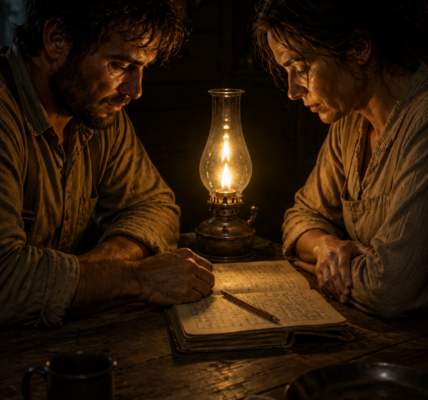
When he sat at his rough wooden table writing the letter, romance was the last thing on his mind.
He chose each word carefully.
He didn’t ask for beauty.
He didn’t ask for charm.
He didn’t ask for passion.
In fact, he actively avoided those things.
Beauty complicated life.
Beauty attracted attention.
Beauty brought expectations.
Jacob wanted none of it.
He requested a woman who understood work.
Someone steady.
Someone practical.
Someone who could help maintain a ranch.
Someone who would fit quietly into the life he had already built.
Someone safe.
Looking back years later, he would realize something important.
The requests we make often reveal the things we’re most afraid of.
And Jacob Hart was terrified.
Not of hardship.
Not of drought.
Not of losing cattle.
He was terrified of feeling again.
Because grief has a strange way of convincing people that love itself is dangerous.
The train arrived just after noon.
The heat shimmered across Cedar Ridge like invisible waves.
Dust swirled through the streets.
Storefront signs creaked lazily in the wind.
Nothing about the day seemed unusual.
Yet decades later, if someone had asked Jacob to identify the exact moment his life changed forever, he would have pointed to that afternoon.
To that train.
To that platform.
To the moment a woman stepped into the sunlight.
At first, he saw only movement.
Passengers descending.
Families gathering luggage.
Travelers stretching weary legs after long journeys.
Then he saw her.
And the world seemed to pause.
She stood at the top of the train steps for only a few seconds.
But some moments refuse to obey time.
Her hair caught the sunlight.
Not perfectly arranged.
Not polished.
Wind-tossed.
Alive.
There was dust on her dress.
Fatigue beneath her eyes.
Evidence of a difficult journey.
Yet none of that diminished her presence.
If anything, it strengthened it.
She didn’t look delicate.
She looked resilient.
Like someone who had already survived things no one could see.
Jacob immediately knew something was wrong.
This wasn’t supposed to happen.
This wasn’t the woman he requested.
This wasn’t the woman he prepared himself for.
And that frightened him more than he cared to admit.
Because before she had even spoken a word, she had already disrupted the carefully controlled future he imagined.
Then their eyes met.
And everything became even more complicated.
Eleanor Walsh had spent most of her life being told who she should become.
She knew what proper young women were expected to do.
She knew what society demanded.
She knew how fathers arranged futures.
How communities enforced expectations.
How women were often treated like passengers in lives they never chose.
What many people never understood was that Eleanor’s journey west wasn’t primarily about marriage.
Marriage was simply the vehicle.
Freedom was the destination.
Back East, her future had already been decided.
A husband selected.
A life planned.
A role assigned.
She was expected to accept it gracefully.
Smile politely.
Remain grateful.
Become someone else’s idea of who she should be.
Instead, she did something that shocked everyone.
She refused.
Not loudly.
Not dramatically.
She simply chose herself.
And in the late nineteenth-century world she inhabited, that decision required extraordinary courage.
Because freedom often sounds romantic until it demands sacrifice.
Eleanor paid for hers with uncertainty.
With fear.
With isolation.
With a one-way train ticket into the unknown.
As she stepped onto that platform, she wasn’t just meeting Jacob Hart.
She was stepping into a future she had chosen herself.
For the first time in her life.
Their first conversation lasted only minutes.
But it revealed more than either intended.
When she mentioned reading his request for a plain bride, Jacob felt an unexpected wave of embarrassment.
Not because the statement was offensive.
Because it exposed him.
It revealed how carefully he had tried to avoid risk.
And Eleanor noticed.
She noticed everything.
That became clear almost immediately.
Some people observe the world.
Others study it.
Eleanor belonged to the second group.
She watched people the way experienced travelers read maps.
Searching for what existed beneath the surface.
By the time they left town, she already understood something important about Jacob.
He wasn’t cold.
He was wounded.
There was a difference.
A significant difference.
One could heal.
The other rarely did.
The problem was that Jacob himself didn’t yet know which one he was.
The wedding took place only hours later.
No church bells.
No elaborate ceremony.
No gathered family.
No flowers.
No celebration.
Just a justice of the peace speaking familiar words before two strangers.
To an outsider, it might have appeared almost transactional.
Two signatures.
Two vows.
Two people fulfilling an arrangement.
But appearances can be misleading.
Because even in that small room, beneath the practical reality of the frontier, deeper forces were already moving.
Fear.
Hope.
Loneliness.
Curiosity.
Possibility.
The invisible emotions that shape lives long before people recognize them.
When Jacob slipped the ring onto Eleanor’s finger, he noticed a slight tremble.
Barely visible.
Gone almost instantly.
Yet it lingered in his thoughts.
Because it reminded him of something.
She wasn’t fearless.
Neither of them were.
They were simply moving forward despite fear.
And there is a profound difference between courage and the absence of fear.
True courage requires fear.
Without fear, courage cannot exist.
The journey to the ranch stretched across miles of open country.
The landscape unfolded beneath the lowering sun.
Golden grass.
Rolling hills.
Distant mountains painted blue by atmosphere and distance.
The American frontier existed in contradictions.
Beautiful and brutal.
Generous and unforgiving.
A place capable of offering opportunity while simultaneously demanding everything in return.
Eleanor seemed to understand that instinctively.
Most newcomers focused on the hardships.
The isolation.
The danger.
The discomfort.
Eleanor noticed something else.
Honesty.
The land asked people to become exactly who they were.
No masks.
No pretenses.
No social performances.
Out here, authenticity wasn’t a virtue.
It was survival.
Jacob found himself listening to her more than expected.
That unsettled him.
Because listening led to understanding.
And understanding led to connection.
The very thing he had spent years avoiding.
Yet despite himself, he wanted to hear what she would say next.
As darkness settled over the ranch that evening, both carried separate fears into the night.
Jacob feared hope.
Eleanor feared disappointment.
Neither voiced it.
Neither needed to.
Sometimes silence speaks more clearly than words.
The ranch house bore visible scars of loneliness.
Not neglect.
Loneliness.
Everything functioned.
Nothing felt alive.
The difference was subtle but unmistakable.
A home reflects its inhabitants.
And this home reflected a man who had stopped expecting joy.
Eleanor noticed that immediately.
She also noticed something else.
Jacob had preserved memories.
Small details remained untouched.
A shelf.
A photograph.
A piece of furniture positioned exactly as someone else once preferred.
The past still lived here.
Not openly.
Not dramatically.
But quietly.
Like a ghost occupying empty rooms.
Most people would have viewed that as a warning.
Eleanor viewed it as evidence.
Evidence that Jacob had once loved deeply.
And anyone capable of loving deeply once could potentially love deeply again.
The question was whether he believed that himself.
Long after midnight, Jacob stared into fading firelight.
Sleep refused to come.
The house felt different.
Not because of what had changed.
Because of what suddenly seemed possible.
And possibility can be terrifying.
Especially for someone who has spent years protecting himself from it.
Outside, the wind whispered across the plains.
Inside, another human being slept beneath his roof.
A woman who had arrived only hours earlier.
A woman who challenged assumptions without trying.
A woman who carried mysteries he could not yet understand.
A woman he was already beginning to think about far too often.
Jacob eventually closed his eyes.
But before sleep finally arrived, a thought surfaced that he immediately tried to push away.
It didn’t work.
Because some truths arrive before we’re ready to accept them.
And this particular truth was becoming harder to ignore.
The woman he had married was not going to fit neatly into the life he built.
She was going to transform it.
And somewhere deep inside, beneath grief, beneath caution, beneath years of emotional self-defense…
a forgotten part of Jacob Hart was beginning to wake up.