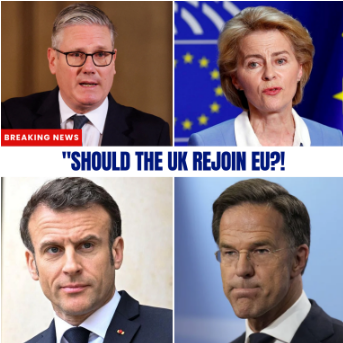

GIBRALTAR LEADER’S CALL FOR BRITAIN TO REJOIN THE EUROPEAN UNION REIGNITES A DEBATE MANY THOUGHT HAD BEEN SETTLED
Nearly a decade after the Brexit referendum transformed Britain’s political landscape, one of the most prominent voices from a British territory has reopened a question that continues to linger beneath the surface of national politics:
Did the United Kingdom make the right decision in leaving the European Union?
That question returned to the spotlight after Gibraltar’s Chief Minister, Fabian Picardo, suggested that Britain should consider reversing course and ultimately rejoining the European Union.
His comments, delivered during a business event in Madrid, immediately attracted attention across Britain and Europe, reopening old arguments about sovereignty, economics, national identity, and Britain’s future role on the world stage.
For many Britons, Brexit may no longer dominate daily headlines. Yet Mr. Picardo’s intervention demonstrates that the consequences of the 2016 referendum remain deeply embedded in British politics, diplomacy, and public debate.
The remarks came against the backdrop of a newly finalized agreement governing Gibraltar’s relationship with the European Union following Britain’s departure from the bloc.
Mr. Picardo argued that the arrangement negotiated for Gibraltar could serve as a useful example of how closer cooperation with Europe can coexist alongside political sovereignty.
“The British public have come to see that they were led down the garden path,” he said, referring to arguments made during the 2016 Leave campaign.
The statement was provocative not simply because of its criticism of Brexit, but because it came from a leader whose territory experienced some of the most immediate and tangible consequences of Britain’s departure from the European Union.
To understand the significance of Picardo’s comments, it is necessary to understand Gibraltar’s unique position.
Located at the southern tip of the Iberian Peninsula, Gibraltar is a British Overseas Territory with a population of roughly 32,000 people.
Although politically British, its geography creates realities unlike those faced by mainland Britain.
The territory sits directly adjacent to Spain, and its economy relies heavily on the daily movement of workers, tourists, goods, and services across that border.
Thousands of workers commute between Spain and Gibraltar every day.
Tourism, financial services, online gaming, shipping, and aviation all depend upon stable and predictable relations with European neighbors.
When Britain voted to leave the European Union in June 2016, Gibraltar delivered one of the most decisive results anywhere connected to the referendum.
More than 95 percent of Gibraltar’s voters chose to remain.
The overwhelming result reflected widespread concern about what Brexit might mean for the territory’s economy and its relationship with Spain.
Those concerns were not theoretical.
Brexit immediately raised questions about border controls, customs arrangements, freedom of movement, and economic access.
Unlike mainland Britain, where many Brexit debates revolved around abstract concepts such as sovereignty or immigration policy, Gibraltar faced the prospect of direct disruption to everyday life.
For years after the referendum, negotiations continued regarding the territory’s future relationship with the European Union.
The recently concluded treaty is viewed by many local officials as a breakthrough.
The agreement is designed to facilitate smoother movement of people and goods while maintaining British sovereignty over Gibraltar.
Supporters describe the deal as a pragmatic compromise that protects economic interests without sacrificing political identity.
Mr. Picardo has repeatedly praised the agreement as evidence that practical cooperation and sovereignty do not have to be mutually exclusive.
His latest remarks go a step further.
Rather than merely defending Gibraltar’s arrangement, he suggested that Britain itself could learn from the model.
The comments quickly sparked reactions throughout the United Kingdom.
Supporters of Brexit were swift to reject the comparison.
Many argued that Gibraltar’s circumstances are fundamentally different from those of Britain.
As a small territory surrounded by European Union territory, Gibraltar faces challenges that do not apply to the United Kingdom as a whole.
Critics accused Picardo of misunderstanding British public sentiment and underestimating the importance many voters continue to place on national sovereignty.
For Brexit supporters, the referendum was not solely about economics.
It was about democratic control.
The ability to make laws independently.
The authority to determine immigration policy.
The freedom to negotiate trade agreements without oversight from Brussels.
These issues remain central to how many Leave voters view Brexit.
Conservative politicians were particularly critical.
Several argued that Gibraltar’s arrangements reflect unique geographic realities rather than a blueprint suitable for a major global economy.
From their perspective, Britain’s departure from the European Union represented a sovereign decision that should be respected regardless of subsequent challenges.
Prime Minister Keir Starmer’s Labour government has adopted a more nuanced position.
While Labour has pursued closer cooperation with European partners in areas such as security, defense, trade facilitation, and youth mobility, the government has repeatedly ruled out rejoining the European Union, the Single Market, or the Customs Union.
Instead, Labour’s strategy focuses on improving Britain’s post-Brexit relationship without reopening the fundamental question of membership.
Officials argue that political energy should be directed toward making existing arrangements work more effectively rather than revisiting the referendum itself.
Yet public opinion remains more complicated than official positions suggest.
Polling over recent years has often shown growing levels of regret among some voters regarding Brexit.
Certain surveys indicate increased support for closer ties with Europe and, in some cases, support for eventual re-entry.
However, public attitudes remain far from unanimous.
Many voters who supported Brexit continue to defend the decision.
Others may express dissatisfaction with aspects of Brexit while remaining opposed to rejoining the European Union.
As a result, there is no overwhelming political consensus capable of driving a major reversal.
The practical challenges involved in rejoining the European Union would also be considerable.
Any future application would likely require Britain to accept conditions that differ from those it previously enjoyed as a member state.
Questions surrounding budget contributions, regulatory alignment, freedom of movement, and the role of European institutions would inevitably reemerge.
Negotiations could take years and would likely provoke intense political divisions.
For this reason, most analysts regard rejoining as politically unlikely in the foreseeable future.
The debate nevertheless continues because Brexit’s consequences remain visible.
Supporters point to new trade agreements negotiated independently by Britain, greater flexibility in domestic policymaking, and enhanced control over immigration and borders.
Critics highlight increased trade friction with European markets, higher administrative burdens for businesses, labor shortages in some sectors, and reduced influence within European decision-making structures.
Economic assessments remain contested.
Some sectors have adapted successfully.
Others continue to face challenges associated with new customs requirements and regulatory barriers.
The result is a complex picture that defies simple conclusions.
For Gibraltar, however, the stakes have always been more immediate.
Its economic survival depends heavily on maintaining fluid cross-border relations.
The territory lacks the geographic insulation enjoyed by Britain.
As a result, practical cooperation often carries greater urgency than ideological debate.
This reality helps explain why Gibraltar’s leadership has consistently emphasized pragmatism over political symbolism.
Mr. Picardo’s comments reflect that perspective.
From Gibraltar’s viewpoint, preserving economic stability and maintaining access to European markets are matters of necessity rather than political preference.
Whether that experience offers lessons for Britain remains a matter of intense disagreement.
What is clear is that the remarks have once again placed Brexit at the center of public discussion.
Nine years after the referendum, the issue remains capable of generating passionate responses from all sides.
My Professional Perspective
Having reported on European politics, British elections, constitutional debates, and international diplomacy for decades, I believe many observers are missing the most important aspect of Fabian Picardo’s intervention.
This is not really a story about Gibraltar.
It is a story about how Brexit has evolved from a political event into a long-term national identity debate.
When Brexit occurred in 2016, both supporters and opponents often framed the issue in dramatic and immediate terms.
Leave campaigners described a future of renewed independence and national control.
Remain supporters warned of severe economic disruption and geopolitical decline.
Nearly ten years later, neither side can honestly claim complete vindication.
Britain did not collapse economically.
Nor did Brexit produce the transformative economic renaissance some supporters anticipated.
Instead, the country entered a far more complicated reality.
This complexity explains why Brexit remains politically unresolved despite being legally completed.
The overlooked detail in Picardo’s comments is not whether Britain should rejoin the European Union.
The more significant question is why this debate continues to resurface.
Most major political events eventually settle into history.
Brexit has not.
The reason is simple.
The referendum addressed multiple issues simultaneously.
Some voters prioritized immigration.
Others focused on sovereignty.
Others were motivated by economic concerns.
Others viewed Brexit as a protest against political elites.
Because different voters wanted different outcomes, evaluating Brexit depends heavily on which objectives are being measured.
This creates an unusual political phenomenon.
Two people can examine the same evidence and reach entirely different conclusions.
One may focus on border control and conclude Brexit succeeded.
Another may focus on trade barriers and conclude Brexit failed.
Both perspectives can contain elements of truth.
That reality makes the debate exceptionally difficult to resolve.
Another overlooked aspect of this story concerns generational change.
When Britain voted in 2016, many younger voters overwhelmingly supported remaining in the European Union.
Nearly a decade later, an entirely new generation of voters has entered the electorate.
Many of them have no direct memory of pre-Brexit Britain as voting adults.
Their political priorities may differ significantly from those of the electorate that participated in the referendum.
This demographic shift matters because political debates often evolve as generations change.
What appears politically impossible today may become more plausible over time.
The reverse can also be true.
The Gibraltar treaty itself deserves closer examination.
Supporters view it as proof that sovereignty and integration can coexist.
Critics see it as evidence that small territories require compromises that larger nations can avoid.
Both interpretations reveal something important.
Modern sovereignty is no longer as straightforward as political slogans often suggest.
In an interconnected world, countries routinely trade degrees of autonomy for access, cooperation, security, and economic opportunity.
The real debate is not whether sovereignty exists.
It is how sovereignty is exercised.

This distinction is frequently lost in public discussion.
One of the most revealing aspects of Picardo’s remarks is the reaction they generated.
The intensity of the response demonstrates that Brexit remains emotionally charged.
That emotional dimension may be even more important than the economic one.
For many supporters, Brexit represented national self-determination.
For many opponents, it represented a strategic mistake.
These are not merely policy disagreements.
They are competing narratives about Britain’s identity and future.
Identity-based political debates rarely disappear quickly because they touch deeper questions about belonging, values, and national purpose.
Another important issue often overlooked is Britain’s changing geopolitical position.
When Brexit debates first dominated politics, discussions focused heavily on trade.
Today, the world looks very different.
Europe faces security challenges associated with Russia’s ongoing confrontation with the West.
Global supply chains face increasing pressure.
Competition between major powers has intensified.
Defense cooperation has become more important than at any point in recent decades.
In this environment, Britain’s relationship with Europe increasingly extends beyond economics.
Questions about defense, intelligence sharing, energy security, migration management, and technological cooperation have become central.
As a result, future debates about Europe may look very different from those of 2016.
The conversation may shift from membership toward strategic partnership.
That appears to be the direction currently favored by both major British parties.
Perhaps the most important lesson from this episode is that Brexit’s final chapter has not yet been written.
Many political observers assumed the argument would fade after withdrawal was completed.
Instead, Brexit has entered a new phase.
The question is no longer whether Britain should leave.
The question is what kind of relationship Britain ultimately wants with Europe.
That debate may continue for years, perhaps decades.
Fabian Picardo’s comments matter not because they will immediately change policy.
They matter because they reveal that uncertainty about Britain’s European future still exists.
And where uncertainty exists, political debate inevitably follows.
Conclusion
Fabian Picardo’s call for Britain to consider rejoining the European Union has reopened one of the most consequential political debates of the modern era.
On the surface, the comments reflect Gibraltar’s unique circumstances and its desire for close cooperation with Europe.
But beneath that lies a much larger conversation about sovereignty, economic prosperity, national identity, and Britain’s place in an increasingly complex world.
Nearly a decade after the referendum, Brexit remains more than a policy decision.
It remains a symbol.
For some, it symbolizes independence and democratic control.
For others, it symbolizes lost opportunities and diminished influence.
The reality, as is often the case in history, is likely more complicated than either narrative suggests.
What Gibraltar’s chief minister has done is remind Britain that the debate never truly disappeared.
It simply evolved.
The legal process may be complete.
The political process is not.
And as Britain continues to navigate economic pressures, geopolitical uncertainty, and shifting public attitudes, one question remains impossible to ignore:
Was Brexit the final destination of Britain’s European journey—or merely the beginning of a new chapter whose ultimate ending has yet to be written?