Why Germans Were Puzzled That US Big Red One Knew To Blow Through Walls Before Entering Aachen. nu

Why Germans Were Puzzled That US Big Red One Knew To Blow Through Walls Before Entering Aachen
October 13, 1944, 0930 hours. A narrow street in the eastern quarter of Aachen, Germany. Oberst Gerhard Wilck, the newly installed garrison commander of the 246th Volksgrenadier Division, is standing in a cellar beneath a bombed-out apartment block reviewing the defensive positions his men have prepared.
He has been in command for less than 24 hours. He arrived in the city the night before slipping through a gap in the American encirclement that is closing around the city like a fist. His orders from the highest authority in the Reich are simple. Hold this city to the last man and the last bullet. Do not surrender. Do not withdraw.
If necessary, allow yourself to be buried beneath the ruins. Wilck has studied the ground. His men have turned the streets of Aachen into kill zones. Machine guns are sighted at intersections to sweep the roads in interlocking arcs of fire. Anti-tank guns are positioned to catch any Sherman that tries to push down a boulevard.
Barricades of rubble and overturned streetcars block the main avenues. The cellars are connected through the city’s sewer system allowing his troops to move underground, surface behind an advancing enemy, fire, and disappear again. Every doctrine the German army has written about urban defense, every lesson extracted at terrible cost from the rubble of Stalingrad, has been poured into these positions.
The defense is oriented to do one thing. It is built to destroy an enemy that comes down the streets. The Americans do not come down the streets. When the assault begins, what Wilck’s garrison encounters is something no German urban defense manual has prepared them for. The Americans do not pour infantry into the boulevards where the machine guns are waiting.
They do not send tanks around corners into the teeth of anti-tank fire. Instead, a sound begins that the German defenders in the forward buildings hear before they see anything. It is the sound of walls exploding. Not the exterior walls facing the street, the interior walls, the shared walls between apartments, the basement partitions that separate one building from the next.
The Americans are inside the buildings and they are moving through the city without ever stepping outside. They are blowing holes through the walls, climbing through the dust and rubble into the next room, clearing it with grenades and bayonets, and blowing through the next wall after that. They are entering from directions that have no doors.
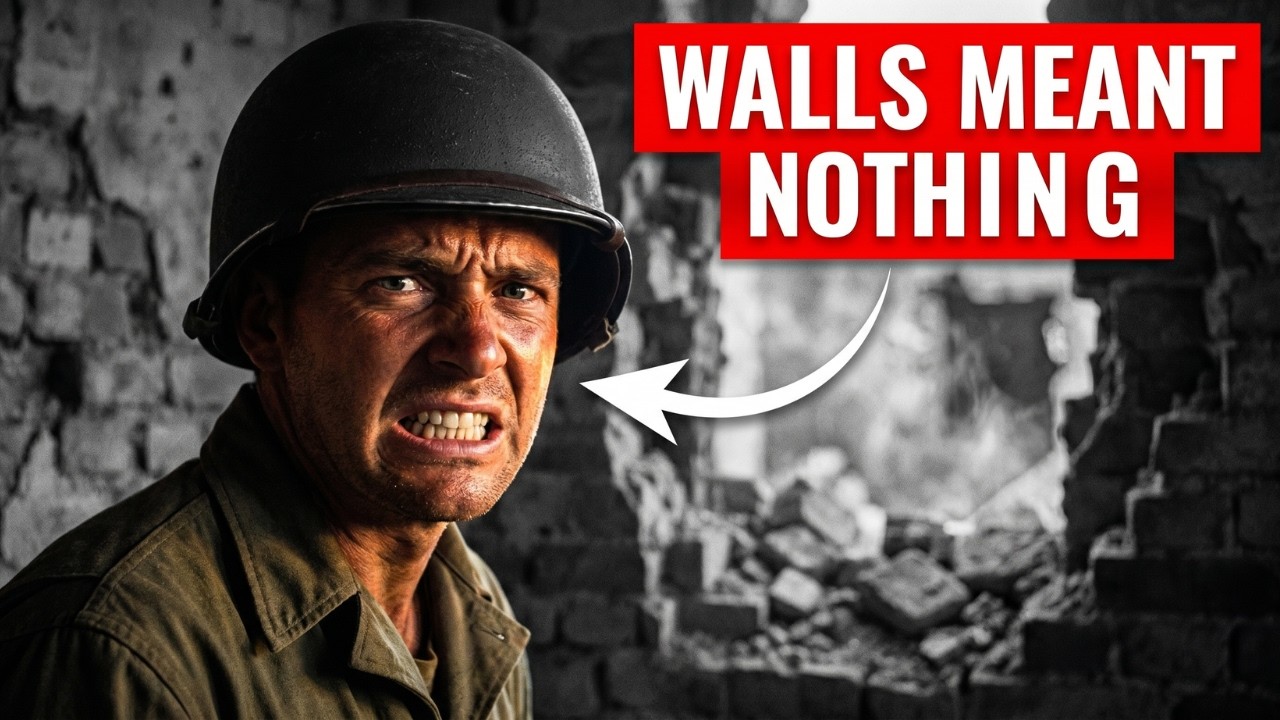
They are arriving on floors that have no stairs leading to the street. They are, in the most literal sense, coming through the walls. For a German sergeant crouched behind a machine gun at the end of a street he has been told to defend, this changes everything. His field of fire covers the road.
His position is designed to stop men who are advancing toward him in the open. But the men who appear behind him have not used the road at all. They have come through three apartments, two basements, and a shared attic. And they are now inside his building firing down at his position from above. The question this script sets out to answer is not simply how the Americans learned to fight this way.
The question is why the Germans, who had survived Stalingrad, who had written the book on urban defense, who understood better than any army on earth what a city does to an attacking force, were unable to counter a method that was, at its core, not complicated. The Americans were blowing holes in walls. It was not a secret.
It was not sophisticated. Yet it systematically dismantled the most carefully prepared urban defense on the Western Front. To understand why, we need to go back, not to Aachen, not to D-Day, but to the reason every army in the world feared cities in the first place. And to the small number of soldiers in several different armies who, between 1941 and 1943, had quietly figured out how to turn that fear inside out.
There is a reason generals have avoided fighting in cities for as long as there have been cities to fight in. Urban terrain negates almost every advantage a modern army possesses. Artillery, the great killer of the open battlefield, cannot be aimed precisely enough to hit a single room in a single building without destroying the structure entirely and potentially burying both the enemy and your own troops.
Armor, the decisive arm of maneuver warfare, becomes a steel coffin in a narrow street where a single man on a rooftop with a shaped charge weapon can destroy a 40-ton tank. Air power, the weapon that had reshaped every major campaign since 1939, cannot distinguish a defended building from an empty one. Radios, the nervous system of modern command, are blocked and distorted by concrete and steel.
Lines of sight collapse from kilometers to meters. A single sniper in a fourth-floor window can pin down an entire platoon for hours. The open field calculus of modern war, in which superior firepower plus superior mobility equals victory, ceases to function. The city makes the attacker stupid, slow, and vulnerable.
The city makes the defender, even a weak one, dangerous. The example that hung over every military planner in 1944 was Stalingrad. Between August 1942 and February 1943, the German Sixth Army, under General Oberst Friedrich Paulus, reinforced by elements of the Fourth Panzer Army, had driven into the city on the Volga expecting to take it in a matter of weeks.
The Luftwaffe had already reduced much of the city to rubble before the ground troops entered. Ironically, the rubble made the defense easier. Tanks could not navigate collapsed streets. Infantry lost all sense of direction in the featureless wasteland of broken concrete. Soviet defenders under General Vasily Chuikov’s 62nd Army fought from sewers, from basements, from the upper floors of shattered factories like the Barrikady and the Red October works.
They invented what Chuikov called storm groups, small teams of 10 or 15 soldiers loaded with grenades and submachine guns, who would infiltrate at night, seize a floor of a building, and hold it against counterattack by day. They turned every stairwell into an ambush, and every pile of rubble into a fighting position.
The Germans called it Rattenkrieg, rat war. A German officer wrote that the distance between the enemy and us was measured not in meters, but in floors, sometimes in ceilings. The battle consumed over 700,000 German and Axis casualties. It consumed over a million Soviet casualties. The Sixth Army, one of the finest field formations Germany had ever produced, ceased to exist when Paulus surrendered on January 31, 1943, the day after his promotion to field marshal, making him the first German field marshal in history to be taken alive by an enemy.
The remaining northern pocket of German resistance capitulated two days later. Every officer who had studied Stalingrad drew the same conclusion. Cities devour armies. Avoid them when you can. When you cannot, prepare to pay a price in blood that no general wants to calculate. But Stalingrad also produced something else.
It produced, in the rubble and the sewers and the blasted factory halls, the first widespread use of a technique that had no official name yet, but that soldiers on both sides were already practicing out of sheer necessity. When a Soviet squad needed to move from one building to the next, and the street between them was a kill zone covered by German machine guns, the squad did not cross the street.
The squad went through the wall. They used explosives, pickaxes, sledgehammers, anything that could breach the masonry. They blew or smashed a hole large enough for a man to climb through, moved into the next building, and continued the fight from inside. It was not elegant. It was not planned. It was survival, but it worked. And the lesson, like most battlefield lessons, began to travel.
It traveled first to the British Army. By the early 1940s, British military doctrine had formalized a concept called the vertical technique for fighting in built-up areas. British training materials showed infantry entering a building from the top floor, clearing downward through each level, and breaching through shared walls to move laterally between structures without using the street. The idea was simple.
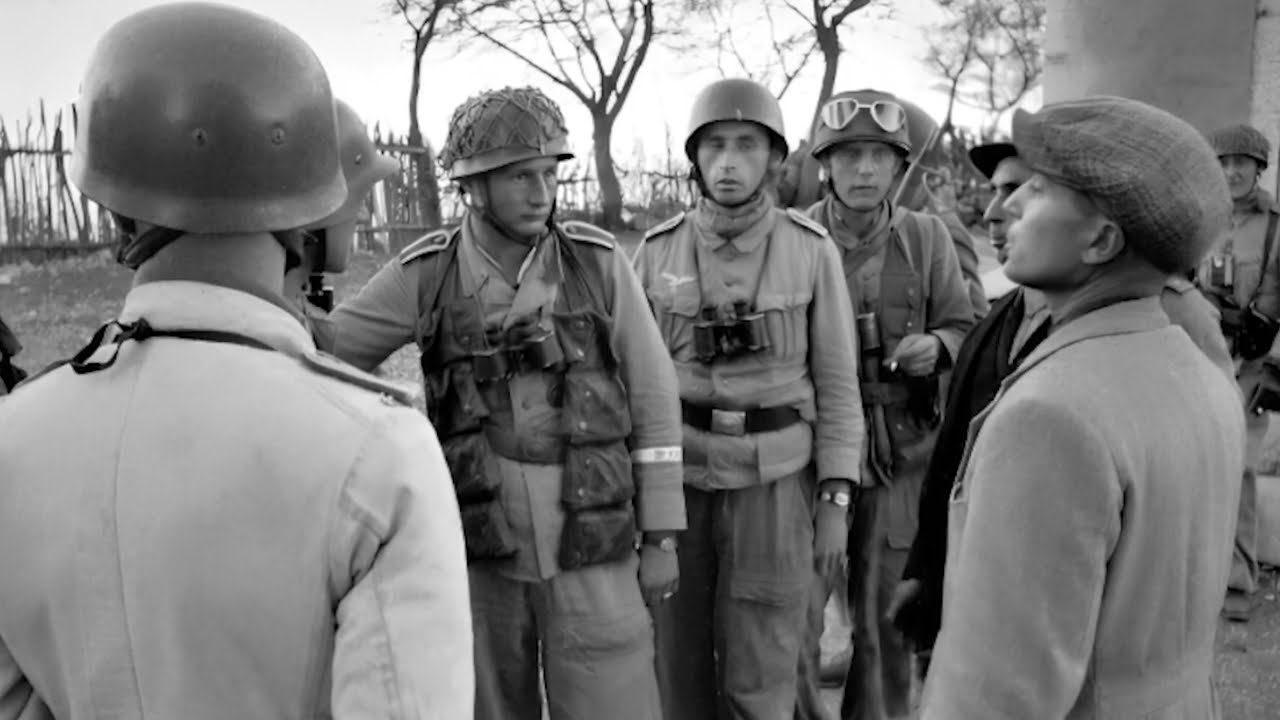
The street was where the defender expected you. The walls were where he did not. It traveled next to the Canadians, and it was the Canadians who gave the technique the name that would stick. In December 1943, at a small Italian port town called Ortona, on the Adriatic coast, the Loyal Edmonton Regiment and the Seaforth Highlanders of Canada, supported by tanks of the Three Rivers Regiment, fought one of the most intense small unit urban battles of the entire war.
The German 1st Parachute Division had fortified the town, turning every stone building into a strongpoint, and every narrow medieval street into a death trap. The paratroopers were among the best soldiers in the Wehrmacht. They had mined the buildings, rigged entire blocks to collapse with demolition charges, and created interlocking fields of fire that covered every approach.
The Canadians attacked and were immediately channeled into the killing ground the Germans had prepared. The fighting lasted eight days, from December 20th to December 28th. Casualties mounted. Progress, measured in single buildings, cost entire platoons. Then the Canadians began to adapt. They stopped using the streets.
They entered buildings from the rooftops, clearing downward. They blasted holes through the connecting walls of the tightly packed row houses with explosive charges and anti-tank rounds, moving from one structure to the next without ever exposing themselves to the fire in the streets below, the soldiers called it mouse holing.
You became the mouse, the wall became the hole. You went through it because the door was death. They used shaped demolition charges called beehives to punch man-sized holes through brick and stone walls in a single detonation. By the end of the battle, Ortona had become a laboratory for urban combat innovation, a place where existing tools and doctrines were refined under fire into a coherent method of fighting through a city without using its streets.
At Ortona, mouse holing was not a doctrinal innovation handed down from a staff college. It was a field adaptation created by sergeants and corporals who were watching their friends die in the streets and who decided to stop going into the streets. After the battle, the technique was documented, studied, and circulated.
But the crucial point, the point that matters for what happened at Aachen 10 months later, is that the technique was available to anyone who was paying attention. The British had it. The Canadians had it. The Soviets had been doing it since Stalingrad. The Americans had published field manual 31-50 titled Attack on a fortified position and combat in towns on January 31, 1944, which described the fundamentals of fighting in built-up areas.
The technique was not a secret. It was common knowledge among Allied armies by the time the invasion of France began. And yet, when the 1st Infantry Division applied it at Aachen in October 1944, the result was not a repetition of Ortona. It was something different. Something that went beyond the survival trick the Canadians had improvised in a medieval Italian port town and became, in the hands of American infantry, engineers, tankers, and artillerymen, an industrial-scale method for taking apart a city one room at a time.
To understand why, you have to understand what the 1st Infantry Division was by the autumn of 1944 and what the men inside it had already been through. The Big Red One, named for the large red numeral one on its shoulder patch, was one of the most experienced divisions in the entire United States Army.
It had landed in North Africa in November 1942. It had fought through Tunisia, where the American Army had taken its worst beating of the European war at Kasserine Pass in February 1943. At Kasserine, the Big Red One had not been the primary victim. That dubious honor belonged to other units in the Second Corps, but the division had been close enough to the disaster to absorb its lessons.
The lesson was simple and brutal. German combined arms coordination, the ability to mass tanks, infantry, and artillery at the decisive point and hit before the defender could react, was something the American Army did not yet know how to match. The men who survived Kasserine never forgot the feeling of being outfought by a better organized enemy.
It became a source of anger that would fuel everything that followed. The division invaded Sicily in July 1943, fighting through the rugged interior of the island in summer heat. It had been in the first wave on Omaha Beach on June 6th, 1944, where two of its regiments, the 16th Infantry and the 18th Infantry, had suffered some of the highest casualties of the entire invasion.
On Omaha, the Big Red One had learned what happens when plans fail completely and men have to act without guidance. The officers who led the recovery on the beach, men like Captain Joe Dawson, who would later hold his ridge outside Aachen, had improvised their way off a beach that was supposed to kill them. They brought that habit with them to every fight afterward.
It had fought through the hedgerows of Normandy, where every field was a separate battle and every hedgerow was a fortress. In the bocage, the division had refined the small unit combined arms tactics that would become its signature. Tanks working with infantry at the squad level, engineers blowing gaps in obstacles, artillery called in close, sometimes dangerously close, because the distances were measured in yards.
It had pushed through France. By October 1944, the division had been in continuous or near continuous combat for nearly 2 years. This matters because the men who walked into Aachen were not the same men who had been shattered at Kasserine. The survivors of those early disasters had become something no training camp in the United States could produce.
They had become soldiers who had learned, through repetition and loss, that the official way of doing things would get them killed, and that the way to stay alive was to figure it out themselves. In the hedgerows, they had learned to fight in tiny groups without waiting for orders. On Omaha Beach, they had learned that when the officers were dead, the sergeants led, and when the sergeants were dead, a private with a rifle and an idea was good enough.
At Kasserine, they had learned what it felt like to lose, and they had decided, in a way that does not appear in any official report, but that every veteran of the division understood, that they were never going to feel that way again. The Big Red One that arrived at Aachen was not an army of doctrine.
It was an army of experience, and experience in urban warfare turned out to be worth more than any manual ever written. The plan for Aachen was built around a simple recognition. The German defenses were oriented to face an attack from the west and the southwest. The Siegfried Line, which the Germans called the Westwall, was one of the most extensive fortification systems in Europe.
In the sector around Aachen, it was in places more than 10 miles deep. It consisted of thousands of reinforced concrete pillboxes, anti-tank obstacles known as dragon’s teeth, minefields, barbed wire, and pre-registered artillery positions, all designed to channel and destroy an invading army coming from the direction of France and Belgium.
The pillboxes were built with walls up to 5 ft thick with interlocking fields of fire that covered every road and every avenue of approach. Behind the pillboxes, the terrain itself favored defense. Aachen lay in a saucer-shaped depression ringed by hills including the Lousberg, which rose to 862 ft and which the Americans would call Observatory Hill.
Any attacker coming from the west would be fighting uphill into fortifications that had been improved and expanded since 1936. The First Army plan, developed under Lieutenant General Courtney Hodges and executed through the Seventh Corps under Major General J. Lawton Collins, was to encircle the city with the First Infantry Division from the south and the 30th Infantry Division from the north, link up east of the city to cut it off, and then assault from the east, the direction the Germans were least prepared to defend. The official
army history notes that in striking from the east against defenses that until recently had been sighted against assault from the west and south, the regiment held a distinct advantage. It was a plan that exploited the one flaw in the German defensive design. The Siegfried Line faced the wrong way. Colonel John F.R.
Seitz, commanding the 26th Infantry Regiment of the First Infantry Division, was given the job of clearing the city itself. He had two battalions available. The Second Battalion under Lieutenant Colonel Daryl M. Daniel would attack through the southern and central residential districts. The Third Battalion under Lieutenant Colonel John T.
Corley would attack through the northeastern factory district, Farwick Park, and up to the Lousberg heights, a hill the Americans called Observatory Hill that dominated the city. The First Battalion under Major Francis W. Adams had been detached to the 3rd Armored Division for the encirclement and was not available for the street fighting.
2,000 American soldiers were going to clear a city defended by somewhere between 4,600 and 6,000 German troops. Before the infantry went in, the Americans sent the city a message. On October 10, Major General Clarence R. Huebner, commanding the 1st Infantry Division, ordered a surrender ultimatum delivered to the garrison under a white flag.
The ultimatum warned that if the city did not surrender within 24 hours, it would face destruction from air and artillery bombardment. The demand was carried forward by 1st Lieutenant Cedric Laffly, 1st Lieutenant William Boehm, and Private First Class Ken Kading, who walked through the German lines under a flag of truce along the Trierer Strasse.
The German command rejected the ultimatum. They had no choice. Adolf Hitler had declared Aachen a fortress city. His orders were categorical. There would be no surrender. The reason for Hitler’s insistence was not military. It was symbolic. Aachen was not a critical rail junction. It was not a supply hub. It was not even a particularly defensible position once the Siegfried Line had been breached.
What Aachen was to the Nazi regime was something far more dangerous. It was the city of Charlemagne. It was Charlemagne’s capital and the traditional coronation city of the Holy Roman Empire. It was the place where German kings had been crowned for nearly 600 years, from Otto the 1st in 936 to Ferdinand the 1st in 1531. The Nazi regime had explicitly claimed the legacy of what it called the First Reich, Charlemagne’s empire, as the predecessor of Hitler’s Third Reich.
To surrender Aachen without a fight would be to concede that the first stone in the foundation of the Thousand-Year Reich had been pulled out. Hitler was prepared to destroy the city rather than let it be taken. And the civilians who remained, somewhere between 5,000 and 20,000 of a pre-war population of 165,000, were caught between an army that would not stop and a regime that would not yield.
So, the Americans delivered the other message. Over the next 2 days, roughly 300 P-38 and P-47 fighter bombers from the 9th Tactical Air Command struck the city. 12 battalions of American artillery fired thousands of rounds into the urban area. By the time the infantry crossed the line of departure, 75 Allied bombing raids had already destroyed 43% of Aachen’s buildings and damaged another 40%.
The city the infantry entered was already a ruin, but a ruin with defenders in the cellars is still a fortress. Then Daniel’s 2nd Battalion went in. What Lieutenant Colonel Daryl Daniel built for the assault on the city center was not a plan from any textbook. It was something closer to what an engineer would design if you told him his job was to disassemble a city one building at a time without losing his workforce.
Daniel organized each rifle company as a self-contained combined arms task force. Each company received three tanks or tank destroyers, two 57-mm anti-tank guns, additional bazooka teams, a flamethrower, two heavy machine guns, and attached to each battalion, on loan from Battery C of the 991st Field Artillery Battalion, was a weapon that would become the signature tool of the battle.
It was a self-propelled 155-mm gun mounted on an M12 chassis. A core-level artillery piece designed to fire at targets miles away, brought forward to fire point-blank into buildings at ranges measured in yards. Daniel’s method was methodical, violent, and effective. A platoon would approach a block of buildings. The tanks and tank destroyers would open fire with high explosive rounds set on delayed fuse, punching through the exterior walls and detonating inside the rooms.
The purpose was not to destroy the building. The purpose was to drive the defenders into the cellars, where they would be pinned down and unable to fire back. While the armor kept the building under continuous fire, the infantry would move in. They did not enter through the front door. They entered through holes blown in the side walls or through windows on upper floors reached by ladders or through basement walls breached with explosive charges.
Once inside, the clearing was intimate and brutal. Grenades into every room before entering. Bayonets fixed. Any cellar entrance covered by a man with a submachine gun or a flamethrower, while another man dropped a grenade down the stairs. When the building was clear, the squad did not go back outside.
They blew a hole through the wall into the next building and started the process again. Daniel coined a slogan for the method. He called it “Knock ’em all down.” The soldiers understood what it meant. It meant that no building was to be treated as an obstacle. Every building was to be treated as a problem, and the solution to the problem was concentrated firepower followed by men with grenades moving through the walls.
Daniel later wrote in his official monograph that the soldiers were quick to realize that the defenders could hardly deliver accurate fire with buildings falling about their ears. The rubble that the bombardment created was not a hindrance. It was the method. The more the buildings came down, the fewer places the Germans had to hide.
On the first day, October 13, the second battalion crossed the railway embankment that marked the eastern edge of the city center. Every man in the assault wave threw a grenade over the embankment before going over it. On the far side, the building-by-building fight began. Progress was measured in city blocks, sometimes in individual rooms.
Each block cost hours, but the losses were remarkably low for the scale of the fighting, and Daniel knew why. He wrote that he credited the slow, thorough methods employed and the constant stress laid upon the use of all available firepower. Firepower was doing the dying, his men were doing the clearing.
The ammunition consumption figures tell the story better than any description. During the battle for the city center, the 2nd Battalion alone fired approximately 5,000 mortar rounds. The men threw roughly 4,300 grenades, more grenades per man than any normal infantry operation would require because in urban clearing every room received a grenade before a soldier entered it.
They burned through 50 gallons of flamethrower fuel. They expended 40,000 rounds of 30 caliber ammunition and 27,000 rounds of other small arms ammunition. These numbers represent an almost unimaginable concentration of fire poured into a few dozen city blocks over the course of 9 days. The philosophy behind it was simple.
Steel was cheaper than men. A hundred rounds fired into a room before a soldier entered it was a better trade than one soldier killed because the room had not been cleared. The numbers bear Daniel out. Across the entire battle for the city center, the 2nd Battalion and its attached units suffered fewer than 100 casualties.
In the northeastern sector, Lieutenant Colonel John Corley’s 3rd Battalion was fighting a different kind of terrain but using the same philosophy. Corley’s area included the factory district, a maze of industrial buildings with thick concrete walls and heavy steel doors, and the parklands around Farwick Park and the Kuhrhaus, a large public building the Germans had fortified as a strong point.
Corley’s men discovered on the first day that some of the apartment buildings and air raid shelters in his sector could withstand the fire of tanks and tank destroyers. The walls were too thick. The standard 75-mm and 76-mm guns could not penetrate them, so Corley called for the self-propelled 155.
The weapon arrived the following morning, and in its first test it justified every risk involved in bringing a core-level artillery piece into a street fight. With a single round, the 155 practically leveled a reinforced apartment building that had resisted everything else the battalion had thrown at it. From that point forward, the 155 became the key to Corley’s advance.
When a strong point held up the attack, the gun was brought forward, positioned at close range, and fired directly into the structure. The results were devastating. At one point, Daniel’s 2nd Battalion also faced a disguised strong point that turned out to be a buried German tank. A tank destroyer knocked a hole in the wall of an adjacent building.
The hole was widened so the self-propelled 155 could be aimed down the street through it. And multiple rounds were fired into the concealed position until the buried tank was destroyed. The 1,106th Engineer Combat Group, holding the line south of the city and maintaining contact with the assault force, found their own ways to contribute.
At one stage of the battle, they captured several German streetcars. They loaded the streetcars with explosives, aimed them down the tracks toward the German positions, and let them roll. The official Army history noted that the results did little real damage, but added, almost with a smile, that this was somewhat offset by the impish delight the engineers derived from it.
The detail matters not because of the damage the streetcars caused, but because of what the act reveals. The engineers were not waiting for instructions. They were not consulting a manual. They saw streetcars. They saw explosives. They saw a direction that led toward the enemy. They put the three together because that is what the men of the Big Red One had been trained by two years of war to do.
They solved problems with whatever was lying around. On October 15, the battle escalated sharply. A German counterattack combining remnants of the 404th Regiment with Hauptsturmführer Herbert Rink’s 1st SS Panzer Battalion, reinforced with tanks and assault guns, struck Corley’s positions at Farwick Park. The counterattacking force retook the Kurhaus temporarily.
The fighting in and around the park was among the most violent of the entire battle, but Corley’s men held, then pushed the counterattack back and resumed the advance. On October 18, 2nd Lieutenant William D. Ratchford’s platoon received the assignment of clearing the Hotel Quellenhof, a large, solidly built hotel that the Germans had turned into a defended position.
Ratchford’s men cleared it floor by floor, room by room, using the same technique that had been applied across the entire city. Grenades first, then men through the door. Check every closet, every bathroom, and every space large enough to hide a soldier with a weapon, then move to the next room. The Quellenhof fight was building clearing in miniature, and it demonstrated that the method worked at every scale, from an apartment block to a hotel to a factory.
While the infantry fought through the city, the ring around it was closing. On October 16, elements of the 1st Infantry Division and the 30th Infantry Division linked up near Würselen, north of Aachen, completing the encirclement. Wilck’s garrison was now cut off. Reinforcements could not get in. Ammunition could not get through.
Food and water were running out. By the final days, Wilck could account for roughly 1,100 soldiers and 100 police still capable of fighting. That same day, Field Marshal Gerd von Rundstedt, commanding all German forces in the west, sent Wilck a message through the chain of command. The message said that Wilck would hold this venerable German city to the last man, and would, if necessary, allow himself to be buried under its ruins.
It was not a suggestion. It was an order from the highest operational authority on the Western Front, relaying the will of the Führer himself. Wilck issued his own order of the day on October 19. He told his troops that the final struggle was at hand. He told them to fight to the last round. He told them that the honor of the German soldier, and the honor of the city of Charlemagne, demanded nothing less.
The Americans had a different plan for the honor of the city of Charlemagne. On October 19 and 20, Task Force Hogan, built around two battalions of the 3rd Armored Division, under Lieutenant Colonel Samuel M. Hogan, attacked and captured the Lousberg, the high ground that overlooked the entire city. With observers on the Lousberg, every German position in Aachen was now visible to American artillery.
Corley’s self-propelled 155, firing at a large air-raid bunker that appeared to be a German strongpoint, delivered round after round into the structure. What Corley did not know was that the bunker he was battering was near Wilck’s own command post, and the sustained bombardment was shattering the garrison commander’s resolve, along with the concrete around him.
On October 21, 1944, at 12:05 in the afternoon, Oberst Gerhard Wilck surrendered. He gave a final address to his remaining troops in the center of the city. Then he was taken prisoner. He had held the city for 9 days against a force that had dismantled his defenses by refusing to fight where those defenses were aimed.
He would spend the rest of the war as a prisoner, held at Trent Park, the converted English country house north of London where British intelligence was secretly recording every word German officers said to each other. The fall of Aachen was the first time in the war that a city on internationally recognized German soil had been captured by the Western Allies.
For nearly 6 months, it would remain the only large German city in Allied hands. Approximately 85% of the city was destroyed, though Aachen Cathedral, the medieval church where Charlemagne was buried and German kings had been crowned, survived largely intact despite the bombardment. American casualties across the broader battle, including the encirclement and the Siegfried Line fighting, exceeded 6,000.
The 26th Infantry Regiment sustained 498 casualties in the city fighting itself, 75 killed and nine missing. German losses were roughly 5,000 casualties, plus approximately 5,600 prisoners taken, of whom over 3,400 surrendered in the final capitulation. The numbers tell a story, but they do not tell the whole story. The real story is in the method, and the method demands an explanation.
How did two battalions of American infantry clear a defended city at a casualty ratio that seemed to defy every lesson of Stalingrad? The answer is not mouse holing. Mouse holing was the technique. The answer is what the Americans did with the technique that no one else had done. At Ortona, the Canadians had used mouse holing to survive.
They blew through walls because the streets were death and the walls were the only alternative. The technique at Ortona was reactive. It was born from desperation. The Canadians were adapting to a situation that was killing them. At Aachen, the Americans did not use mouse holing to survive. They used it to attack.
They married the wall breaching technique to a system of combined arms that turned every rifle squad into a miniature siege engine. The Canadian at Ortona had a demolition charge and his rifle. The American at Aachen had a demolition charge, his rifle, three tanks, two anti-tank guns, a bazooka team, a flamethrower, two heavy machine guns, and a 155-mm artillery piece on call at the end of the block.
The Canadian broke through walls to escape the killing ground. The American broke through walls to create a killing ground of his own. One in which the combined arms he brought with him could be applied at point-blank range to each individual room before his riflemen ever crossed the threshold. This distinction matters because it explains why the German defenders, many of whom had fought in the east and understood urban warfare as well as any soldiers alive, were unable to adapt quickly enough.
The German defensive plan for Aachen was built on Stalingrad logic. It assumed the attacker would enter the streets. It assumed the battle would become a grinding room-to-room attrition fight in which the defenders’ knowledge of the terrain would give him the advantage. It assumed that the attacker would bleed faster than the defender because the attacker always bleeds faster in a city.
The Americans broke every one of those assumptions. They did not enter the streets. They did not engage in a grinding attrition fight. They used firepower to make the defenders’ knowledge of the terrain irrelevant because the terrain kept changing. A building that had been a strong point in the morning was a pile of rubble by the afternoon.
A defensive position cited to cover a street was useless when the enemy came through the back wall of the building next door. The sewer system that the Germans used to move troops behind the American advance was countered by Daniel’s order to locate, block, and weight down every manhole cover in the zone of advance. The documented German reaction to the American method was not puzzlement at the technique itself.
It was something closer to helplessness in the face of the firepower that accompanied it. General Major Walter Deckert of the 3rd Panzergrenadier Division, whose unit attempted to reinforce the Aachen garrison, described what his troops faced in language that appears in the official American history sourced from captured German manuscripts.
Deckert said that it was obvious that an advance through this fire was impossible and that it was equally impossible to feed the attack from the rear, to move up reserves or ammunition. The American advantage was not just in the walls, it was in the weight of fire that preceded the men who came through the walls.
German after-action records from the 81st Corps, offered by way of explaining their failure, estimated that American artillery in the Aachen sector outnumbered German guns by a ratio of roughly 86 batteries to 69. And that daily American ammunition expenditure ran to approximately 9,300 rounds against roughly 4,500 for the German side.
Even allowing for exaggeration in those self-serving estimates, the disparity was real. The Americans were not simply outfighting the Germans in the buildings. They were burying them under a volume of firepower that made coherent defense impossible. The German garrison at Aachen was not incompetent. The 246th Volksgrenadier Division and its attached units fought hard.
The SS counterattack at Farwick Park showed that the defenders were capable of offensive action. But Wilck’s garrison was a mirror of everything that had gone wrong with the German military by the autumn of 1944. The 246th Volksgrenadier Division was a product of the desperate reorganization program that the Wehrmacht had launched after the catastrophic losses of the summer.
Volksgrenadier divisions were smaller, less well equipped, and more hastily trained than the infantry divisions they replaced. Their officer corps was a patchwork. Their non-commissioned officers were frequently men who had been promoted out of necessity rather than merit. Their riflemen included middle-aged men regraded from rear area duties and teenagers too young to have been called up in any earlier year of the war.
Supplementing the division were two Luftwaffe fortress battalions, men trained as anti-aircraft crews or airfield guards, who had been reassigned to ground combat roles with little infantry preparation. Wilck also had anti-aircraft group Aachen deployed primarily in a field artillery role and roughly 100 police.
These were the men ordered to hold a city to the last bullet against a division that had been fighting and winning since North Africa. They were fighting a battle plan that had been designed for a different kind of attacker and they could not redesign it fast enough. Their defensive doctrine told them to channel the enemy into killing zones on the streets.
The enemy refused to be channeled. Their experience from the Eastern Front told them that urban fighting was a slow attritional grind that favored the defender. The Americans turned it into a fast systematic demolition that favored the side with more firepower. The Germans had prepared for a siege. The Americans brought a wrecking crew.
There is a question that every account of Aachen eventually arrives at and it is the same question that the research into this battle keeps circling back to. Why were the Americans, who had less urban combat experience than either the Germans or the Soviets, able to adapt so effectively? The doctrine was thin. Field Manual 31-50 existed, but it was a general document that said little about the specific integration of heavy armor and artillery into building level clearance.
The technique of mouse holing was borrowed, not invented. The combined arms concept was not written down as a city fighting method in any American manual of the period. The answer is not in the manuals. The answer is in the men. The American soldier of 1944 came from a country that built things. He came from a country of carpenters and electricians and plumbers and auto mechanics and farmers who fixed their own equipment because the nearest repair shop was 40 miles away.
He came from a country where a 16-year-old boy might know how to operate a bulldozer because his father’s construction company needed an extra driver. He came from a country where dynamite was a tool, not a weapon, where blasting stumps out of a field was a weekend chore, and where the idea of knocking a hole through a wall to get to the other side was not a military innovation, but a basic principle of demolition that any man who had ever remodeled a house understood in his bones.
These were men from a country where a barn raising, a collective construction project involving dozens of men coordinating complex work without formal leadership, was not a historical curiosity. It was something their grandfathers had done and some of them had done themselves. They understood, without having to be taught, that a large problem could be broken into smaller problems, that each man could take responsibility for his piece, and that the result would come together if everyone knew what the finished product was supposed to look
like. When Lieutenant Colonel Daniel told his men to blow through the walls, he was not introducing them to a foreign concept. He was giving them permission to do something that, for many of them, was closer to their civilian experience than anything else the army had asked them to do. The charges were bigger.
The stakes were higher. But the principle was the same. You have a wall. You need to be on the other side. You make a hole. You go through it. When a tank destroyer crew figured out on their own that they could punch a hole in a side wall and use it as a firing port for the 155, they were not executing a brilliant tactical innovation.
They were doing what any competent demolition crew would do on a job site. Find the angle. Make the opening. Do the work. The German private in Aachen came from a different world. He came from a country where authority was centralized, where the state built things and the citizen used them, and where the idea of an individual soldier redesigning the battlefield on his own initiative was not, regardless of what the doctrine manual said, something the culture encouraged.
The German army’s Auftragstaktik tradition, its doctrine of mission type tactics that empowered junior officers to make independent decisions, was one of the great achievements of military thought. But by 1944, that tradition had been hollowed out. Three years of catastrophic losses on the Eastern Front had killed the experienced officers who embodied it.
The men who had been trained for a decade in the art of independent decision-making were buried in unmarked graves from Kursk to Kiev. Hitler’s obsessive micromanagement had punished initiative at every level. The no retreat orders, the summary executions of officers who withdrew without permission, the relief of every general who showed a spark of independent judgment, all of it had sent the same message downward through the ranks. Do not think. Do not adapt.
Follow orders, because the man who follows orders may survive, but the man who acts on his own will be punished whether he succeeds or fails. The men defending Aachen were not the superbly trained professionals of 1940. They were Volksgrenadiers, hastily raised, inadequately trained, and led by officers who had been promoted faster than their experience warranted, because the men above them were dead.
The contrast with the American side could not have been sharper. The Big Red One’s junior officers and non-commissioned officers had been forged by two years of continuous combat. They did not need to be told to improvise. They had been improvising since North Africa. They did not need permission to adapt.
They had learned in the hedgerows that waiting for permission got you killed. When Daniel organized his company-level task forces, he was not imposing a structure on reluctant men. He was formalizing something his soldiers were already doing instinctively, which was figuring out the problem in front of them and assembling whatever tools were available to solve it.
There is a moment in the record that captures this perfectly. It is not a moment of heroism. It is a moment of engineering. When Daniel’s battalion discovered that a concealed German position, later identified as a buried tank, was blocking the advance, nobody waited for a solution to come from the regiment. Nobody filed a request for a specialized demolition team.
A tank destroyer knocked a hole in the wall of an adjacent house. The hole was widened. The self-propelled 155 was aimed through it. Round after round was fired until the buried tank was destroyed. The advance resumed. The entire sequence, from problem identification to solution, was improvised on the spot by men who treated a German fortification the way a construction foreman treats an unexpected rock in a foundation.
You do not stand there and stare at it. You get a bigger tool and you remove it. This was the quality that German doctrine had aspired to produce for over a hundred years and that, by 1944, the German army could no longer reliably deliver. The cruel irony of Aachen is that the German defenders were fighting under a system that had once been the most flexible command structure on earth, but that had been crushed into rigidity by the very regime that depended on it.
General Leutnant Gerhard von Schwerin, commanding the 116th Panzer Division, had actually attempted to spare the city before the battle began. In September, recognizing that Aachen had no significant military value and that defending it would only result in its destruction, von Schwerin left a letter at the city post office for the advancing Americans offering to surrender the city peacefully.
The letter fell into the wrong hands. German hands. Von Schwerin was arrested and relieved of command. He was not shot, but only because Field Marshals von Rundstedt and Model intervened on his behalf. The message to every other German commander on the Western Front was unambiguous. Initiative, the very quality that Auftragstaktik was supposed to protect, was now punishable.
Von Schwerin had looked at the situation, made a judgment, and acted. It was exactly what the doctrine demanded and it nearly cost him his life. Wilck, who replaced the sequence of commanders that followed von Schwerin’s removal, understood the lesson. He did not attempt to make tactical judgments about the value of holding the city.
He followed orders. He held until he could hold no longer, and then he surrendered, knowing that the act of surrender itself might condemn him in the eyes of the regime that had sent him there. The paradox of Aachen is that the Americans did not win because they had a better doctrine for fighting in cities.
They won because they had something that functioned better than doctrine. They had a force of men who had been shaped by two years of combat and a lifetime of cultural habit into the kind of soldiers who, when confronted with a wall between them and their objective, did not consult the manual. They made a hole. They went through it.
Every like on this video is a small act that keeps stories like this one visible. Not the stories of the generals who drew the arrows on the maps, but the stories of the sergeants and the privates and the engineers who turned those arrows into reality one room at a time. And that matters. In the weeks and months after Aachen fell, the lessons were studied and circulated.
The combined arms method that Daniel and Colley had developed was documented in after-action reports and distributed across the American army in Europe. When other cities had to be taken at Cologne in March 1945, at other urban strongholds along the Rhine, commanders had the Aachen model to draw on. The self-propelled 155 as a direct fire building breacher, the company-level combined arms task force, the systematic use of mouse-holing to bypass street-level defenses, all of these became part of the American approach to urban warfare.
After the war, they informed the revision of Field Manual 31-50, which was reissued in 1952 and again in 1964, incorporating many of the lessons paid for in the rubble of Aachen. But the aftermath of the city’s fall carried a darker thread as well. The Americans appointed a civilian mayor to govern the shattered city.
His name was Franz Oppenhoff, a lawyer who was sworn in on October 31, 1944. For 5 months, he administered the city under Allied occupation, trying to restore basic services to the surviving civilian population in a city that was 85% destroyed. On March 25, 1945, an SS commando team crossed into Allied lines on a mission personally authorized by Heinrich Himmler.
The operation was called Carnival. The team found Oppenhoff at his home and shot him dead on his doorstep. He was 42 years old. He was murdered for the crime of cooperating with the occupiers of a city that his own government had ordered destroyed. Oppenhoff’s assassination is not a footnote. It is the final proof of the system that the Americans had defeated at Aachen.
The German war machine by 1944 was not a system capable of learning. It was a system capable only of punishing. It punished von Schwerin for trying to save the city. It punished Wilck by ordering him to die in it. It punished Oppenhoff for trying to rebuild it. Every act of independent judgment, every attempt to respond to the reality on the ground rather than the fantasy in Berlin, was met with the same answer.
Obey or be destroyed. The Americans in the same period were doing the opposite. They were rewarding adaptation. Daniels’ knock ’em all down method was not punished as a deviation from doctrine. It was studied, praised, and replicated. Corley’s decision to bring a core-level artillery piece into a street fight was not questioned as a breach of protocol.
It was recognized as an innovation. The engineers of the 1106th who loaded explosives onto captured street cars were not disciplined for wasting munitions. They were, if the official history’s tone is any guide, regarded with something close to pride. The real answer to the question of why the Americans succeeded at Aachen is not found in any single tactic.
Mouse-holing was a tool. The combined arms task force was a tool. The self-propelled 155 was a tool. The real answer is that the American army in 1944 had produced a force of men who, from the squad level to the battalion level, were constantly looking for better tools and were authorized by their culture, their training, and their hard-won experience to use whatever they found.
The Germans at Aachen had built a defense designed to punish an enemy who fought the way doctrine said an enemy should fight. The Americans refused to be that enemy. They did not come down the streets. They came through the walls. They did not attack the strongpoints head-on. They brought a 155-mm gun to point-blank range and erased them.
They did not fight a battle of attrition. They fought a battle of demolition. And the defenders, who had been told to hold to the last man under ruins, found that the ruins were being created not by the slow grinding of a Stalingrad, but by the systematic, room-by-room, wall-by-wall advance of men who treated a European city the way they would have treated any other construction project back home. Measure it.
Plan the approach. Apply the tools. Move to the next section. Oberst Wilck spent the rest of the war at Trent Park, where British microphones captured whatever he said to his fellow prisoners. Whether he ever described in those private conversations what it felt like to have his defense dismantled from the inside, to watch his garrison destroyed by an enemy that never appeared where it was supposed to appear, we do not know with certainty.
What we do know is what the record shows. He prepared for an attacker that would come down the streets. The attacker came through the walls. He prepared for a Stalingrad. He got something worse. He got an enemy that had learned every lesson Stalingrad had to teach and then added something Stalingrad never had.
American firepower, American engineering, and American soldiers who had been raised in a country where when a wall was in your way, you did not go around it, you went through it. Captain Bobby E. Brown of Company C, 18th Infantry Regiment, earned the Medal of Honor east of Aachen on October 8th, 1944 at a place the Americans called Crucifix Hill.
He destroyed three pillboxes with pole charges, was wounded three times during the action, and continued to fight. He was one of the bravest soldiers the Big Red One ever produced. After the war, he worked as a custodial foreman at the United States Military Academy at West Point. He is buried at Arlington National Cemetery. Staff Sergeant Joseph E.
Shaffer of Company I, 18th Infantry, earned the Medal of Honor near Stolberg, southeast of Aachen, on September 24, 1944. Captain James M. Burt of Company B, 66th Armored Regiment, 2nd Armored Division, earned the Medal of Honor at Würselen on October 13. Captain Joe Dawson of Company G, 16th Infantry, who had won the Distinguished Service Cross at Omaha Beach, held a position the division called Dawson’s Ridge on the eastern approaches to Aachen for 39 days.
His company lost 117 of its 139 men and received a Presidential Unit Citation. Dawson did not fight inside the city. He fought on the ridge that kept the Germans from relieving it. None of these men invented mouse holing. None of them wrote a doctrine that changed the history of urban warfare. What they did was something more fundamental and harder to teach.
They solved the problem in front of them with whatever they had, and they did it without waiting for someone to tell them how. The city of Aachen had been the seat of Charlemagne, the capital of the first great European empire, the place where German kings were crowned for nearly 600 years.
Hitler ordered it held because of what it symbolized. The Americans took it because of what stood in front of them. They did not fight for a symbol. They fought through walls, through cellars, through rubble and dust and smoke, one room at a time, because the room in front of them needed clearing, and the man who was going to clear it was the man who was standing there.
That is the story of Aachen, not a tale of generals or doctrines or grand strategies. A tale of sergeants with demolition charges, privates with grenades, engineers with a creative streak and a box of captured munitions, and a 155-mm gun that somebody decided to aim at a building instead of a horizon. They turned a siege into a demolition project, and they did it so thoroughly that the men who had survived Stalingrad could not keep up.
If this investigation gave you something to think about, that like button does more than you might expect. It pushes the story into the feeds of the viewers who care about getting the history right. Not the version that makes anyone look good, not the version that simplifies the ugly parts, the version that actually happened with the names and the details and the rubble still on the ground.
Subscribe if you want the next chapter. There are many more of these stories, and most of them are about men whose names never made it into the textbooks, who went home after the war and went back to building houses and fixing engines and raising families, and who never told anyone what they had done in a ruined city in western Germany in the autumn of 1944.
They deserve to be remembered, not as legends, as what they were, ordinary men who were very, very good at solving problems.
Note: Some content was generated using AI tools (ChatGPT) and edited by the author for creativity and suitability for historical illustration purposes.